

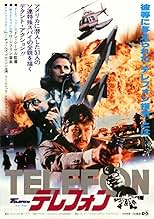
Un officier russe est envoyé aux États-Unis pour essayer d'arrêter des agents dormants qui attaqueront automatiquement des entités gouvernementales lorsqu'ils entendront certains mots codés.Un officier russe est envoyé aux États-Unis pour essayer d'arrêter des agents dormants qui attaqueront automatiquement des entités gouvernementales lorsqu'ils entendront certains mots codés.Un officier russe est envoyé aux États-Unis pour essayer d'arrêter des agents dormants qui attaqueront automatiquement des entités gouvernementales lorsqu'ils entendront certains mots codés.
- Réalisation
- Scénaristes
- Vedettes
- Prix
- 1 nomination au total


- Doctor
- (as Regis J. Cordic)
Avis en vedette
A fine action thriller, despite its incredible storyline
No question, there's a whole lot of good acting in Don Siegel's "Telefon" (from Tyne Daly, for instance), but the story, from Walter Wager's novel, is, at least partly, ridiculous. Criticism of international secret policy comes off o.k., claiming that what intelligence agencies have always lacked most is intelligence. But it's more about suspense and action; especially the blowing up of a whole valley is staged with Siegel's dynamic perfection routine.
The film has got Charles Bronson in its center and he does his usual fine job as an ultra-cool Soviet major smuggled into the U.S. in order to exterminate a fellow KGB agent (Donald Pleasence) who has gone crazy there and is now endangering the whole Cold War balance system.
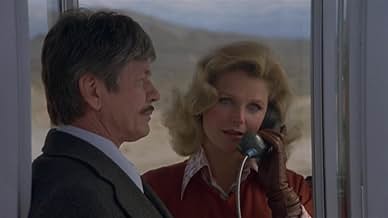
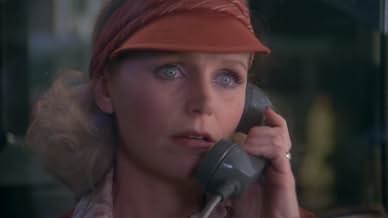
Please note the important rôle telephones play throughout the whole film, not just for Pleasence's ambitions. And watch out for Roy Jenson as his last victim, a man who has played lots of minor parts in major movies. - And don't forget listen to the film, as Lalo Schifrin's score is very fascinating once again.
Above Average Bronson
The plot, though not hard to follow, is a bit intricate and involves the solution of several puzzles and a good deal of travel around the country, from Denver to Akron to Los Angeles to Cambridge (NM), to some dumpy bar in rural Texas with a rattlesnake in a cage. The series is designed to spell out the name of the villain, Dalchimsky, across a map of the USA. It's not worth going into enough detail to explain exactly what that means. But I must add that I thought it was pretty rotten of the director to actually blow that rattlesnake's head off for real, Crotalus atrox, a beautiful specimen. Where is PETA when you need them? And what do they have against snakes? Oh, sure, nobody would argue that rattlesnakes are as cuddly as French poodles or sea otters -- but, still.
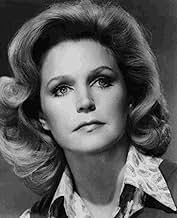
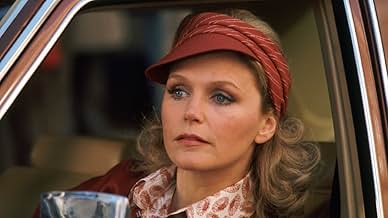
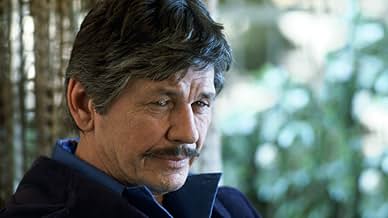
Bronson is his usual self with his built-in swagger and mustache. He's a Russian major and his hair looks styled by Mister Kenneth or something. And he's completely incapable of projecting anxiety, let alone fear. Lee Remick was no longer a teenage baton twirler but she has the strangest, most appealing pair of pale blue eyes, surrounded by black circles, like Meg Ryan's. And she too has a curious rolling gait, like a sailor's. Neither Bronson nor Remich was ever a major star by Hollywood standards but they're both engaging and it's sad to think that they are now both history. I could never get with Donald Pleasance as an actor. He's probably a fine man and loves his dog, but his shining dome and pop eyes become banal in a hurry. Sheree North in her small part gives a good impression of being an exuberantly sexy no-nonsense woman.
The plot has its implausibilities. We kind of expect Bronson and Remick to wind up together somehow, and they do, but it comes out of nowhere. Bronson has heretofore done no more than smile at Remick, and that only once, when suddenly they get in the car and take off for a motel ten miles away.
A couple of fireballs for the young at mind, but no car chases, no slow motion deaths (except for that disenfranchised rattler), and only one shooting.
This is one of about two Bronson vehicles I look forward to seeing again. I'm not sure why. Schifrin's music is no more than adequate. The photography is interesting, all of its colors drawn from the red end of the spectrum, all beige, gray, orange, and scarlet. Anyone in blue looks like a tramp at a Kandinsky exhibit. Maybe I like the irony of a Russian major trying to save the USA from being blown up.
Underrated Thriller
The movie has two elements from earlier Cold War films: The Manchurian Candidate (1962) and Dr. Strangelove (1964). Like Laurence Harvey in the former, agents here are programmed by trigger words to carry out their mission in robotic fashion. At the same time, there's the overhang of a possible doomsday as in Strangelove. Here those elements are skillfully blended to build suspense.
What really distinguishes the film, however, is an overall absence of Cold War good guys and bad guys. There's really only one villain, the unreformed Stalinist. Unlike 50's Cold War films, this one treats operatives of both sides strictly as professionals doing their duty without noticeable favorites. One possible exception is Remick. Despite her coy girlish manner, she's also been assigned to eliminate partner Bronson once he succeeds in killing Pleasance. That way, no one will be left to spill the beans about the aborted plan and embarrass the new Soviet regime. So Bronson is to be rewarded by his superiors with death. Maybe that's a good enough reason, but not unarguably so.
Meanwhile, Bronson's his usual steely self, while Remick plays up the girlish appearance, leaving us to guess how much of a façade it is. But stealing the show is Tyne Daly as the plain-looking brain behind the American side. Her superiors appear rather addled much of the time, while she deftly maneuvers clues behind her bank of computers. Good touch. Most of the action comes from explosions that blow up real good. I don't know how they did them in 1977, but they're impressive as heck.
Anyway, the movie suggests a possible waning of Cold War passions on our side, perhaps because of growing recognition of what a nuclear exchange would entail. Be that as it may, the movie remains a taut and under-rated political thriller, helmed by the masterful Don Siegel.
The Ultimate Détente Film
Does Anyone Else Get The "Naked Gun" References?
I have rather fond memories of watching this film when it was broadcast at odd hours on a local independent television station. The ideas this movie adapted from Walter Wager's original novel were quite creative, but I recall the acting of everyone here to be pretty bad (especially leads Bronson and Remick). The old-fashioned '70s computers, rotary phones, and Cold War ultra-seriousness further diminish its effectiveness. This isn't the kind of movie MGM is probably anxious to reissue on a deluxe DVD - probably because its two stars and director are all deceased, but it is a reasonably entertaining film to catch on television.


Le saviez-vous
- AnecdotesDirector Don Siegel asked Charles Bronson to shave his trademark mustache off for this movie. Bronson replied, "No mustache, no Bronson." Siegel said in his book 'A Siegel Film: An Autobiography', "I felt that as much as Bronson wore a heavy mustache in Russia, it would help his disguise if he had no mustache when he arrives in Canada. However he didn't want to shave it off."
- GaffesAll of the KGB characters shown in uniform at the beginning of the film are "out of uniform." Although Borzov, Bronson's character, and the others are clearly meant to be in the KGB, the uniforms they wear are trimmed in red, the color of the regular Soviet Army, not the KGB. During the era of the film KGB uniforms were trimmed in Royal Blue. Also, the uniforms in the film lack the distinctive "Sword and Shield" patch worn by KGB officers on their jacket and coat sleeves.
- Citations
Nicolai Dalchimsky: The woods are lovely, dark, and deep, but I have promises to keep. And miles to go before I sleep, and miles to go before I sleep. Remember. Miles to go before I sleep.
- ConnexionsFeatured in 42nd Street Forever, Volume 3: Exploitation Explosion (2008)
- Bandes originalesThe Yellow Rose of Texas
(uncredited)
Traditional American folk melody
Meilleurs choix
- How long is Telefon?Propulsé par Alexa
Détails
- Date de sortie
- Pays d’origine
- Langue
- Aussi connu sous le nom de
- Telèfon
- Lieux de tournage
- Helsinki, Finlande(Moscow, Leningrad, Russia, ten days)
- société de production
- Consultez plus de crédits d'entreprise sur IMDbPro
Box-office
- Budget
- 7 000 000 $ US (estimation)
- Durée
- 1h 42m(102 min)
- Mixage
- Rapport de forme
- 1.85 : 1