

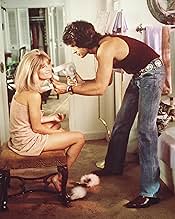
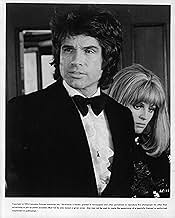
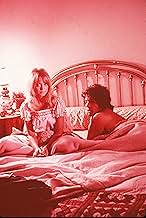
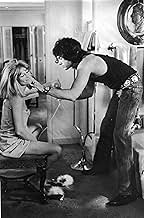
Le jour du scrutin de 1968, un coiffeur est trop occupé à couper les cheveux et à s'occuper de ses différentes copines et de sa maîtresse, dont il rencontre et découvre le mari qui a une lia... Tout lireLe jour du scrutin de 1968, un coiffeur est trop occupé à couper les cheveux et à s'occuper de ses différentes copines et de sa maîtresse, dont il rencontre et découvre le mari qui a une liaison avec son ex-blonde.Le jour du scrutin de 1968, un coiffeur est trop occupé à couper les cheveux et à s'occuper de ses différentes copines et de sa maîtresse, dont il rencontre et découvre le mari qui a une liaison avec son ex-blonde.
- Réalisation
- Scénaristes
- Vedettes
- A remporté 1 oscar
- 3 victoires et 11 nominations au total






Avis en vedette
Fun 60s lifestyles with social criticism thrown in
Beatty has never been more charming - or revealing as emptily vain as anyone so "successful" with women can become, and the film switches between surprisingly adult material even for now with a concern for mid-life crises, cultural politics, and ultimately, a cynical view of how the free-wheeling 60s counterculture didn't take themselves seriously enough. Robert Towne's influence in the script is clearly evident.
Already "dated" when it came out, it's a great snapshot of the times, its concerns and issues, and is relevant today.
why don't more people love shampoo?
It's strange that more people haven't written about this movie. In many ways, Shampoo seems to have been forgotten, floating somewhere in film history heaven. I live in Los Angeles and have never heard about it being screened anywhere. Dave Kehr and the critical establishment in general have all written it off as a film that hasn't aged well. And I've never seen a book written about either Shampoo or Ashby. Am I living in a vault or is this really the legacy of Shampoo? If you don't like this movie, I urge you to write or contact me. My e-mail address is listed above. I simply don't understand why more people don't
best script ever
Structurally, "Shampoo" is brilliantly devised. Each character has an opposite. George, the satyr, has Lester, the cuckhold, as his opposite. George exudes natural sexual appeal, whereas Lester is loved merely for his wealth. Tony Bill's character, an ad executive, is the younger version of Lester. Tony Bill dangles a job offer to Goldie Hawn in order to bed her. Despite his hip outward appearance, this character is as staid as Lester. In fact, the two characters are linked by separate scenes in which each one stares out of a skyscraper window, gazing at a panoramic view of L.A., and makes a world-weary comment about the craziness below (in Bill's case, he says, "Jesus, this town"). There is also a contrast between George and Jackie. George, in his own words, "doesn't f*** for money, I do it for fun," whereas Jackie ends up as a kept girl (by Lester). Goldie Hawn's character also prostitutes herself, in a very subtle way. In the moral universe of Beverly Hills in 1968, Beatty's promiscuity seems more pure than the money-driven machinations of everyone else.
The Country Wife
Here in the updated "Shampoo", Beatty and Towne make the hero an assumed-to-be-gay hairdresser (instead of impotent)and the results are inspired bedroom farce mixed with social satire.
Younger viewers may find the film a little dated but it was a "period" film when it was made (set in 68 when it was shot in 74) so Ashby consciously gave it that dated look. For me this and Heaven Can Wait are Beatty's best work. Walks a fine comic/tragic line. And this really feels like the closest character to Beatty's heart. It was after this that I went back and saw Splendor in the Grass and began to appreciate Beatty as an actor rather than just a gigolo celebrity.
Great dialogue by Towne, Jack Warden's hilarious and Julie Christie is stunning.
Again, what I do in the bedroom is all of your business
One thing George has consistently wanted to do is open his own hair salon; one day, he turns to Lester and Felicia (Jack Warden and Lee Grant), a wealthy, local-area couple. However, another problem emerges for George and that is the fact that Lester's current mistress (Julie Christie) is one of George's former girlfriends. Lester just outright assumes George, because of his appearance and choice of occupation, is gay, and doesn't see him as any legitimate sexual threat. It isn't until George becomes closer to Lester, meeting his wife, rekindling things with Lester's mistress, and even becoming entranced with select other women that George succumbs to furthering his pedigree as a sexual deviant.
Shampoo subtly evokes the breakdown of the limiting and often sexually regressive sexual politics and standards of the 1960's; it plays similar instruments as Paul Mazursky's brilliant and underrated Bob & Carol & Ted & Alice where the very nature of its plot is subversive because it takes a sensitive, introspective camera into characters' bedrooms rather than simply closing the door on it. It's a period of time in American cinema that I cheekily bill "what I do in the bedroom is all of your business," due to the liberal mindset and furtherance of sexual freedom, orientation, and behavior in public. In the contemporary, sex is still a social taboo in America, but with each year, be it what is accepted by the MPAA, or what is casually discussed by young people in a serious, social setting, the stigma of sex is continuing to be broken in many ways.
Shampoo looks at the social mores by picking a character who is contemptible not because he loves his sex but because of how dishonest he chooses to be. There's nothing wrong with having multiple sexual partners, nor is there nothing inherently wrong with practicing polygamy or sleeping around. There is something wrong, however, with being dishonest or deceptive about it, which is what George consistently is. With that, screenwriters Robert Towne and Beatty seem to recognize this, and Beatty himself seems to recognize it as he's playing the character. Nonetheless, he challenges you to like him largely by the quick-witted and zippy way he moves and conducts himself, as well as the way he works and entertains his clients. He may not be an easy character to like, but he's not an easy character to write off.
With that, Beatty gives an entertaining performance and effective turns an ensemble film into what could easily be mistaken as a one-man show, if it wasn't for the significant presences of Goldie Hawn and Lee Grant, specifically Grant who winds up having some strong scenes with Beatty during more pivotal moments of the film. These inclusions make Shampoo more likable throughout all the contemptible attributes of the film, and the film winds up addressing sexual politics in a way that doesn't tell the audience, but show them. It sort of walks in circles, not always coming to a clear point, but Beatty's performance and its more subtler approach to the material is enough to make it, if nothing else, a thematically and fundamentally interesting piece for the time.
Starring: Warren Beatty, Goldie Hawn, Julie Christie, Jack Warden, and Lee Grant. Directed by: Hal Ashby.


Le saviez-vous
- AnecdotesLovers off and on since 1967, Warren Beatty and Julie Christie broke up for good during the making of this movie. They remained friends and later worked together in Le ciel peut attendre (1978).
- GaffesThe Coca-Cola can George drinks from while chatting with Lorna is a post-1968 design.
- Citations
George Roundy: Can't we just, eh, be friends?
Lorna: Okay.
[teen-aged Lorna makes George an offer he can't refuse]
Lorna: You wanna fuck?
- Générique farfeluIn the opening credits, horror film producer/actor William Castle is billed as "Bill Castle," but in the end credits he is back to "William Castle."
- ConnexionsFeatured in Precious Images (1986)
- Bandes originalesWouldn't It Be Nice
(1966) (uncredited)
Music by Brian Wilson
Lyrics by Tony Asher, Mike Love and Brian Wilson
Performed by The Beach Boys
Meilleurs choix
- How long is Shampoo?Propulsé par Alexa
Détails
- Date de sortie
- Pays d’origine
- Langue
- Aussi connu sous le nom de
- Sosyete kuaförü
- Lieux de tournage
- 2270 Bowmont Drive, Beverly Hills, Californie, États-Unis(Jackie's House at Bowmont & Hazen)
- sociétés de production
- Consultez plus de crédits d'entreprise sur IMDbPro
Box-office
- Budget
- 4 000 000 $ US (estimation)
- Brut – États-Unis et Canada
- 49 407 734 $ US
- Brut – à l'échelle mondiale
- 49 407 734 $ US