ÉVALUATION IMDb
7,0/10
18 k
MA NOTE


Ajouter une intrigue dans votre langueA broken-hearted hit man moves to the desert where he finds skilled swordsmen to carry out his contract killings.A broken-hearted hit man moves to the desert where he finds skilled swordsmen to carry out his contract killings.A broken-hearted hit man moves to the desert where he finds skilled swordsmen to carry out his contract killings.
- Réalisation
- Scénaristes
- Vedettes
- Prix
- 9 victoires et 13 nominations au total


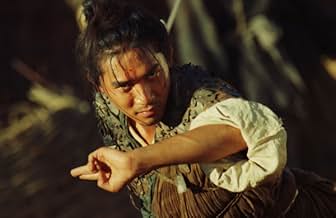
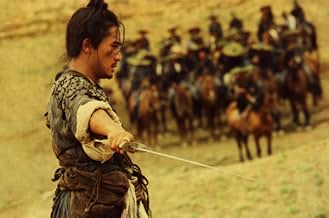




Tony Leung Chiu-wai
- Blind Swordsman
- (as Tony Chiu Wai Leung)


Collin Chou
- Swordsman
- (uncredited)

Li Yin
- Rebel swordsman
- (uncredited)
7,018K
1
2
3
4
5
6
7
8
9
10
Avis en vedette
Ashes of Time Redux
Near the end, the proprietor of an inn perched on the windy edge of a sandy desert that stretches to the horizon has an epiphany; he has never before actually stopped to observe the desert, not as a transition, but as destination, as something that you don't calculate how to cross, but observe as a place you have crossed to reach. I have written the almost exact same idea (different setting) in one of my screenplays. This is the personal connection with a favourite film I value so much. Film becomes more than film, I see film as dream, a consciousness briefly shared then forgotten. It's that feeling of dreaming the same dream with a great artist that makes me tingle.
This is a film like the best of novels, a web woven of fragmented image and word, drives and desires, rendered cinematically alive when the two coalesce to reveal yawning chasms of human experience, the one common shared human experience we all know. The film's opening serves as present tense and WKW builds fascinating removes from it to the point where the final story of the film climaxes in the past with shocking reverberations that make me rush through the entire film, clawing my way back to the present and previous past occurrences, to change my perspective.
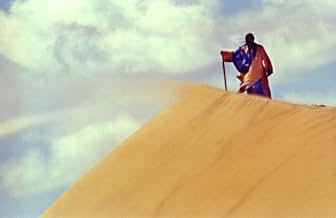
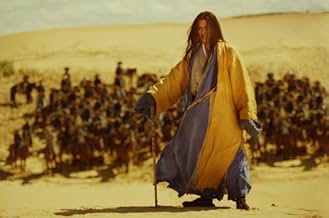
At the beginning of the film, a master swordsman arrives at an inn to offer the inn keeper a gulp from a wine that makes you forget the past. The inn keeper refuses. Throughout the film we happen upon characters, or characters happen upon the film as it passes time in that wind-torn inn by the desert, fixed in position by memory, by their inability or willinglessness to let go a human passion or folly, revenge or love however distant and impossible. We all need something to live for the inn keeper muses, and we know sometime we'll cling to the uglier most obsessive aspects of our nature to get us through the night. But this is all we have, not something to separate us from animals because even a dog will come to know the hand that strikes it, but all we have as humans to distinguish us from creation, being able to cling to that sad bitter memory of unfulfillment for years and make our unvanquished madness dear to us.
This is all a bit of a game, life is through the remove of storytelling, it becomes myth and fabrication, but what wouldn't we give to go back and play it again. In the end we discover that the wine that makes you forget the past is regular wine and a character is only set free when he finds out his love, love he had and denied until he realized how precious it was to him and came back to find it gone, has died. But that was already two years ago and he's stood in place for those two years, allowing himself to be released from his selfimposed exile when a piece of paper reaches his hands, as though even absolution from guilt or shame or obligation can only properly come to pass in an official manner.
WKW gives us swordplaying spectacle to go with this but he doesn't focus on it. Swords strike and fighters leap into the air in blurry shapes of color and motion yet the eye doesn't rest on the details of the fight but rather centers on facial expressions and the maddening ferocity of it all, like it's all a dance and we're dancing right in the middle of it. To say this is a wuxia is to set different expectations for it. Here poetry is not a poetry of appearances. As with his previous films, WKW tells us marvellous things about obsession and release, the yearning to remember and forget, and about letting ourselves go into new beginnings.
This is a film like the best of novels, a web woven of fragmented image and word, drives and desires, rendered cinematically alive when the two coalesce to reveal yawning chasms of human experience, the one common shared human experience we all know. The film's opening serves as present tense and WKW builds fascinating removes from it to the point where the final story of the film climaxes in the past with shocking reverberations that make me rush through the entire film, clawing my way back to the present and previous past occurrences, to change my perspective.
At the beginning of the film, a master swordsman arrives at an inn to offer the inn keeper a gulp from a wine that makes you forget the past. The inn keeper refuses. Throughout the film we happen upon characters, or characters happen upon the film as it passes time in that wind-torn inn by the desert, fixed in position by memory, by their inability or willinglessness to let go a human passion or folly, revenge or love however distant and impossible. We all need something to live for the inn keeper muses, and we know sometime we'll cling to the uglier most obsessive aspects of our nature to get us through the night. But this is all we have, not something to separate us from animals because even a dog will come to know the hand that strikes it, but all we have as humans to distinguish us from creation, being able to cling to that sad bitter memory of unfulfillment for years and make our unvanquished madness dear to us.
This is all a bit of a game, life is through the remove of storytelling, it becomes myth and fabrication, but what wouldn't we give to go back and play it again. In the end we discover that the wine that makes you forget the past is regular wine and a character is only set free when he finds out his love, love he had and denied until he realized how precious it was to him and came back to find it gone, has died. But that was already two years ago and he's stood in place for those two years, allowing himself to be released from his selfimposed exile when a piece of paper reaches his hands, as though even absolution from guilt or shame or obligation can only properly come to pass in an official manner.
WKW gives us swordplaying spectacle to go with this but he doesn't focus on it. Swords strike and fighters leap into the air in blurry shapes of color and motion yet the eye doesn't rest on the details of the fight but rather centers on facial expressions and the maddening ferocity of it all, like it's all a dance and we're dancing right in the middle of it. To say this is a wuxia is to set different expectations for it. Here poetry is not a poetry of appearances. As with his previous films, WKW tells us marvellous things about obsession and release, the yearning to remember and forget, and about letting ourselves go into new beginnings.
A slow dance of color and regret
Without a doubt, Ashes of Time is a beautiful, deeply felt movie. The acting and cinematography are outstanding. The color and camera angles are poetic. But the DVD quality is barely acceptable and the plot, what there is of it, is very confusing. The movie is less a journey from point A to point B than it is a dream-like dance around a central theme: regret for the way we treat those we love.
For those who would watch the movie for the martial arts-- the main characters are mostly swordsmen and martial artists-- the movie is less than satisfying. The fight scenes are highly stylized, employing fast cuts, blurs of motion, and disorienting lighting and camera angles. The fight scenes are more about camera technique than martial arts technique.
Ashes of Time is not a movie that can be absorbed in one viewing. For many viewers, though, it will be worth a second or even third.
For those who would watch the movie for the martial arts-- the main characters are mostly swordsmen and martial artists-- the movie is less than satisfying. The fight scenes are highly stylized, employing fast cuts, blurs of motion, and disorienting lighting and camera angles. The fight scenes are more about camera technique than martial arts technique.
Ashes of Time is not a movie that can be absorbed in one viewing. For many viewers, though, it will be worth a second or even third.
Moody
I had the same issues with Wang Kar Wai's other movie "2046". Whats this all about? Mortality, love, existence. It's somehow about all of this. In other movies these themes are dealt with in the background of a plausible or implausible story. Here they are dealt with head-on, in what feels like a long hypnotic "dream poem" that is more symbol than story. There is the deep Camus-like narrator voice in the background saying stuff like "She waited frozen under deep unrelenting waves and the smell of eucalyptus" (not a line from the movie, but it could be). Maybe there is a lot that isn't easily translated. So it's confusing both intentionally and unintentionally. At the same time there is some kind of majestic beauty to it. It is mostly quiet and moody but erupts occasionally with little bouts of violence. To be honest I hardly understood any of this movie (full credit to whoever wrote the IMDb synopsis) but I was left with an impression - a feeling, a mood, an emotional state - which may have been the whole point.
The Ballads Within The Ballad Of Ou-yang Feng
'Dung Che Sai Duk' (aka 'Ashes of Time') is a beautiful visual tapestry. It is another fine example of poetry on canvas. The story does not follow a linear structure but at the same time the dazzling visuals grip the viewer and involve us in the characters' life. The first time I watched 'Dung Che Sai Duk' I was engaged throughout the entire duration but by the end I was left a little confused. This is because I overlooked the layers and some of the important details. It also didn't help that the subtitles were poor. After second viewing, this time with better subtitles, it became a lot more clearer and my appreciation has increased much more.
Almost the entire film is set in the desert. There are plenty of swordfights to enjoy but this is secondary to the story which is mainly about unrequited love and how the fights are a projection of their anger and way of dealing with rejection. The fight scenes are well choreographed. However, I felt slow motion was overused. The editing is good but I was disappointed that so many sequences were cut from the Redux version. The dialogues are marvelously poetic. The tricky cinematography is conducted through various angles and so astonishingly effective. The soundtrack is superb and atmospheric. The cast boasts of top talented names like, Leslie Cheung, Maggie Cheung, Brigitte Lin, Tony Leung Chiu Wai, Jacky Cheung and Carina Lau all of whom do full justice to their roles with subtle performances.
Kar Wai Wong is known for experimenting with different themes and here he does that with unrequited love. Although the treatment of the story is slightly different when compared to his other works, the same essence remains within the characters. It is a movie that stays with you and invites you to revisit.
Almost the entire film is set in the desert. There are plenty of swordfights to enjoy but this is secondary to the story which is mainly about unrequited love and how the fights are a projection of their anger and way of dealing with rejection. The fight scenes are well choreographed. However, I felt slow motion was overused. The editing is good but I was disappointed that so many sequences were cut from the Redux version. The dialogues are marvelously poetic. The tricky cinematography is conducted through various angles and so astonishingly effective. The soundtrack is superb and atmospheric. The cast boasts of top talented names like, Leslie Cheung, Maggie Cheung, Brigitte Lin, Tony Leung Chiu Wai, Jacky Cheung and Carina Lau all of whom do full justice to their roles with subtle performances.
Kar Wai Wong is known for experimenting with different themes and here he does that with unrequited love. Although the treatment of the story is slightly different when compared to his other works, the same essence remains within the characters. It is a movie that stays with you and invites you to revisit.
All Along the Watchtower
Kar-Wai is one of the three best directors working today. Many feel this is his best work. Surely it is the greatest leap since his previous, but I find the Mood-2046 pair more important, even lifealtering.
If you come into this expecting a story that unfolds in good order and makes sense, you will be disappointed. The overlapping of layers, the folding of narrative, the merging of images is what we're in for.
There are two famous stories about this. The first is that at some point he quit work, then quickly went off to make "Chunking Express," during which he "found himself" ...
The other story has to do with "Pulp Fiction." Tarantino is a huge borrower of ideas. Having already written a couple "raw" movies that people admire, he stumbled upon Kar-Wai in the midst of making this a long affair. All the clever bits in the structure of "Pulp" are from this, just as surely as all the clever bits in "Star Wars" are from Kurosawa.
What are those bits? Multiple persons in one body. Multiple bodies for one person. Circular storytelling where any part is the beginning. Nested narrative where one story tells another. Characters that imagine and forget each other, bringing them into our world and out.
Death, love, yearning, accident, encounter.
All of this at the beginning of a luscious partnership between Kar-Wai and Christopher Doyle. They are today what Greenaway and Sacha Vierny were: dangerous adventures in cinematic imagination coupled with mastery of cinematic expression.
This takes a few too many chances and you can see precisely where Kar-Wai abandoned it to search for sense. (He always shoots in order of what you see.) But if you are ready for the transcendental thrills of his later work, you might want to start here.
Ted's Evaluation -- 3 of 3: Worth watching.
If you come into this expecting a story that unfolds in good order and makes sense, you will be disappointed. The overlapping of layers, the folding of narrative, the merging of images is what we're in for.
There are two famous stories about this. The first is that at some point he quit work, then quickly went off to make "Chunking Express," during which he "found himself" ...
The other story has to do with "Pulp Fiction." Tarantino is a huge borrower of ideas. Having already written a couple "raw" movies that people admire, he stumbled upon Kar-Wai in the midst of making this a long affair. All the clever bits in the structure of "Pulp" are from this, just as surely as all the clever bits in "Star Wars" are from Kurosawa.
What are those bits? Multiple persons in one body. Multiple bodies for one person. Circular storytelling where any part is the beginning. Nested narrative where one story tells another. Characters that imagine and forget each other, bringing them into our world and out.
Death, love, yearning, accident, encounter.
All of this at the beginning of a luscious partnership between Kar-Wai and Christopher Doyle. They are today what Greenaway and Sacha Vierny were: dangerous adventures in cinematic imagination coupled with mastery of cinematic expression.
This takes a few too many chances and you can see precisely where Kar-Wai abandoned it to search for sense. (He always shoots in order of what you see.) But if you are ready for the transcendental thrills of his later work, you might want to start here.
Ted's Evaluation -- 3 of 3: Worth watching.


Le saviez-vous
- AnecdotesThis film had an exhausting effect on Wong Kar-Wai. While on hiatus during the editing process he wrote and shot Chung Hing sam lam (1994) to "clear his head".
- Citations
Ou-yang Feng: People say, when you can't have what you want, the best you can do is not to forget.
- Autres versionsWong Kar-wai revisited the film and created the Redux version which premiered at the Cannes Film Festival 2008. This version has alternative footage and changes in the order of scenes. The Redux version has new opening titles, and the season's fade-ins introducing each chapter are new. It also has a new color-scheme and a new soundtrack. Some scenes from the original version have been deleted, for example the two main character's introduction in the beginning. The overall run time of the Redux version is slightly shorter than the original theatrical version.
- ConnexionsFeatured in Century of Cinema: Naamsaang-neuiseung (1996)
Meilleurs choix
Connectez-vous pour évaluer et surveiller les recommandations personnalisées
Détails
Box-office
- Budget
- 40 000 000 $ HK (estimation)
- Brut – États-Unis et Canada
- 174 273 $ US
- Fin de semaine d'ouverture – États-Unis et Canada
- 21 372 $ US
- 12 oct. 2008
- Brut – à l'échelle mondiale
- 2 009 694 $ US
Contribuer à cette page
Suggérer une modification ou ajouter du contenu manquant