
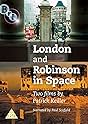
Ajouter une intrigue dans votre langueAn inspiring tale through London by pictures narrated by Paul Scofield.An inspiring tale through London by pictures narrated by Paul Scofield.An inspiring tale through London by pictures narrated by Paul Scofield.
- Réalisation
- Scénariste
- Vedettes
- Prix
- 1 victoire au total

Paul Scofield
- Self - Narrator
- (voice)

John Major
- Self
- (uncredited)
Norma Major
- Self
- (uncredited)
Dennis Skinner
- Self
- (uncredited)

Alastair Stewart
- Self
- (uncredited)
7,4818
1
2
3
4
5
6
7
8
9
10
Avis en vedette
Atmospheric, painful, and occasionally loathsome
I'm sorry, I know I am in the minority, but I really didn't get this doc-montage-essay, for all its wit and cleverness, and lush photography, and even lusher soundtrack, I felt I was being soundly manipulated by the filmmaker into seeing London as a political and spiritual wasteland. Yes, this film is, I suppose, artistically good, I felt some of the narration was poignant, and resonant of an underlying angst that many people experience in London, which can be isolating. Still, the haughty, droning voice of the narrator, really put me off. The simplistic dichotomy of labour versus conservatives, one good, the other doom laden, an insult to my intelligence, and the lack of voice within the film, apart from the writer's insistent polemic, was by far the most meaningful element. The film approves itself, and obliterates all dissent.
A Uniquely British Exploration with Universal Appeal
This documentary offers an unconventional perspective on a major British city, focusing specifically on events from a particular year. While its poetic, essayistic style and intellectual rigor offer a compelling view of urban life, some might find the film's distinctively British references and nuances challenging to fully appreciate if they're not native to the UK. For instance, the voiceover provides a nuanced interpretation of the city's complexities and political landscape, but it might lean too heavily on British historical and literary contexts for an international audience to grasp fully. Despite its strengths, this could be viewed as a weak point for viewers unfamiliar with British culture and history. Overall, the film invites deeper engagement, serving not merely as a factual account but as a contemplative portrayal that captures the essence and contradictions of city life.
Woke
Woke before its time. Reeks of politics and identity politics. Lovey-leftism at its best - pure Fabianism. Of course the BFI love it. Interesting how the IRA issue has evaporated - largely due to terrorism becoming associated with other groups, I expect. A star for the images of London and a star for the idea.
Big words and loads of references do not equal an intelligent, well-argued point.
This is simply awful.
It's very pretentious. Constant references to artists and philosophers, even though they are irrelevant to prove the point the narrator is trying to make. Use of the french language for no other reason than trying to sound "fancy".
Some pretty shots, like the recurring theme of water, that was good.
Extreme manipulation of the events that happened in 1992. Conservatives win the election and right after the IRA bombing is shown, almost suggesting that the bombing was a response to the result.
Constantly criticizing the monarchy and conservative supporters. Making it hard to classify this as an excursion film. If it was up to me, I would put this in the "*Author complains for 1 hour and a half straight through its characters about the world he lives in and blames SOCIETY" genre. Yep, its one of those wE LIvE in A sOCieTY BS movies.
It's very pretentious. Constant references to artists and philosophers, even though they are irrelevant to prove the point the narrator is trying to make. Use of the french language for no other reason than trying to sound "fancy".
Some pretty shots, like the recurring theme of water, that was good.
Extreme manipulation of the events that happened in 1992. Conservatives win the election and right after the IRA bombing is shown, almost suggesting that the bombing was a response to the result.
Constantly criticizing the monarchy and conservative supporters. Making it hard to classify this as an excursion film. If it was up to me, I would put this in the "*Author complains for 1 hour and a half straight through its characters about the world he lives in and blames SOCIETY" genre. Yep, its one of those wE LIvE in A sOCieTY BS movies.
A great way to see out the London Century
Well, I don't have anything to say about this film that's as intelligent as Margarita Nikolaevna's comments, which you should read.
A whole interconnected body of work appeared at the end of the twentieth century which seemed to want to deal with 'the problem of London'--with the fact that, while London had been the most modern city on the planet for a terrible length of time, it had never arrived at any conscousness of the nature of its own modernity. I'll name some of these works---Iain Sinclair's _Lights out for the Territory_, Allan Moore's masterpiece, _From Hell_ (which this film understands, I think, much more deeply than the Hughes Brothers'), the pics of Mark Atkins, Peter Ackroyd's _Hawksmoor_, Michael Moorcock's _King of the City_, the job Bill Drummond did on the M25---but Patrick Keiller's film is the most magnificently negative and observant of all of these. Of course it enters into a dialogue with Benjamin's marvelous theorising about how Paris was the Capital of the 19th Century, but if you haven't seen it you should be warned that there's a real humour and humanity here which we're accustomed not to find in serious documentary: eg. the great joke of the mysterious guy in the shopping-centre reading Benjamin.... Oh, yeah, now I wait in the Ikea caff, piling meatball upon meatball, and waiting for the fullfilment and suppression of flat-pack...
A whole interconnected body of work appeared at the end of the twentieth century which seemed to want to deal with 'the problem of London'--with the fact that, while London had been the most modern city on the planet for a terrible length of time, it had never arrived at any conscousness of the nature of its own modernity. I'll name some of these works---Iain Sinclair's _Lights out for the Territory_, Allan Moore's masterpiece, _From Hell_ (which this film understands, I think, much more deeply than the Hughes Brothers'), the pics of Mark Atkins, Peter Ackroyd's _Hawksmoor_, Michael Moorcock's _King of the City_, the job Bill Drummond did on the M25---but Patrick Keiller's film is the most magnificently negative and observant of all of these. Of course it enters into a dialogue with Benjamin's marvelous theorising about how Paris was the Capital of the 19th Century, but if you haven't seen it you should be warned that there's a real humour and humanity here which we're accustomed not to find in serious documentary: eg. the great joke of the mysterious guy in the shopping-centre reading Benjamin.... Oh, yeah, now I wait in the Ikea caff, piling meatball upon meatball, and waiting for the fullfilment and suppression of flat-pack...


Le saviez-vous
- AnecdotesShot over a period of 11 months in 1992.
- GaffesIn the end-credits, the film mentions music by the "Columbian" (rather than Colombian) Carnival Association.
- Citations
Narrator: 'London,' he says, 'is a city under siege from a sub-urban government, which uses homelessness, pollution, crime, and the most expensive and run-down public transport system of any metropolitan city in Europe, as weapons against Londoners' lingering desire for the freedoms of city life.'
- ConnexionsFollowed by Robinson in Space (1997)
Meilleurs choix
Connectez-vous pour évaluer et surveiller les recommandations personnalisées
Détails
Contribuer à cette page
Suggérer une modification ou ajouter du contenu manquant