ÉVALUATION IMDb
7,0/10
8,5 k
MA NOTE


Ajouter une intrigue dans votre langueA woman risks losing her chance of happiness with the only man she has ever loved.A woman risks losing her chance of happiness with the only man she has ever loved.A woman risks losing her chance of happiness with the only man she has ever loved.
- Réalisation
- Scénaristes
- Vedettes
- Nominé pour le prix 2 BAFTA Awards
- 6 victoires et 29 nominations au total





Anthony LaPaglia
- Sim Rosedale
- (as Anthony Lapaglia)


Mary MacLeod
- Mrs. Haffen
- (as Mary Macleod)


7,08.5K
1
2
3
4
5
6
7
8
9
10
Avis en vedette
Rich movie demands a lot of viewers
Reviews of this movie seem to fall into few categories, loved it because of Gillian Anderson, loved it because of the book, loved it because it was dreamy, hated it because I just didn't get it, hated it because of Gillian Anderson, hated it because it wasn't the book, hated it because it had no Arnie and wasn't Armageddon.
If you can't follow Edwardian English, if you can't follow a movie with scene shifts without a subtitle that says "you are now in London", "You are now in New York", if you can't read emotions off of actor's faces even when their words contradict their feelings, well, you're going to hate this movie. If you need a driving soundtrack to tell you exactly what mood you're supposed to be feeling for each scene, you're going to hate this movie. If you can't accept the fact that flawed characters develop but don't always overcome in the end, you're going to hate this movie.
OK, now that the summer action flic viewers have stopped reading this review in disgust (just as they left this movie early), we can get on with the review. I think Gillian Anderson was a good pick for the part, and did a very good, if not quite excellent performance. Part of Guilded Age/Edwardian upper-crust behaviour was the semblance of civility under the most trying of circumstances, such as saying "Thank You" when you've just been fired or otherwise dissed. Add that to the stylized English and you end up having to PAY ATTENTION to understand what is going on to get it.
One of the brilliant aspects of casting is the Gillian Anderson pick. Instead of a brilliant blonde or smouldering brunette, you have a non-conventional look (short, voluptuos and red-headed) that jolts (and excites) the modern eye, but actually better fit in to the pre-Chanel standard of beauty of that time.
At its heart the novel is a morality tale, describing the pitfalls of being beautiful, manipulative and shallow while failing to be cunning and wise. Lily Bart is callous to her suitors at first, only to fall into multiple social traps. In the end she relies solely on her integrity and dignity, which is insufficient to extricate her from her circumstances. This may offend many who expect the heroine to prevail in the end due to a simple basic morality (which is there in Lily), perseverance (which is also there), a clever plot twist and a 40mm grenade launcher (both missing).
Lavish sets, beautiful backdrops, gorgeous costumes, good acting (with the possible exception of Akroyd), all make this a surreal, if sad, journey for the cognitively aware and patient. I say "possible exception" because of one subtext of the novel & movie is the interplay of the American Nuveau Riche and the old nobility of England and Europe. Thus the wealthy American Entrepeneurs are depicted as brutish and obvious, though this is tolerated in society because their path was already blazed in the 1890's by the first wave of gold miners, oil drillers and electric company tycoons that swept through Europe and married into storied, if not monies, bloodlines. Thus, Akroyd's blatant and crude manipulations and language are somewhat justified.
But, if you don't like period pieces, costume dramas, and identifying with wealthy people who have never worked a day in their lives, all this will be lost on you.
If you can't follow Edwardian English, if you can't follow a movie with scene shifts without a subtitle that says "you are now in London", "You are now in New York", if you can't read emotions off of actor's faces even when their words contradict their feelings, well, you're going to hate this movie. If you need a driving soundtrack to tell you exactly what mood you're supposed to be feeling for each scene, you're going to hate this movie. If you can't accept the fact that flawed characters develop but don't always overcome in the end, you're going to hate this movie.
OK, now that the summer action flic viewers have stopped reading this review in disgust (just as they left this movie early), we can get on with the review. I think Gillian Anderson was a good pick for the part, and did a very good, if not quite excellent performance. Part of Guilded Age/Edwardian upper-crust behaviour was the semblance of civility under the most trying of circumstances, such as saying "Thank You" when you've just been fired or otherwise dissed. Add that to the stylized English and you end up having to PAY ATTENTION to understand what is going on to get it.
One of the brilliant aspects of casting is the Gillian Anderson pick. Instead of a brilliant blonde or smouldering brunette, you have a non-conventional look (short, voluptuos and red-headed) that jolts (and excites) the modern eye, but actually better fit in to the pre-Chanel standard of beauty of that time.
At its heart the novel is a morality tale, describing the pitfalls of being beautiful, manipulative and shallow while failing to be cunning and wise. Lily Bart is callous to her suitors at first, only to fall into multiple social traps. In the end she relies solely on her integrity and dignity, which is insufficient to extricate her from her circumstances. This may offend many who expect the heroine to prevail in the end due to a simple basic morality (which is there in Lily), perseverance (which is also there), a clever plot twist and a 40mm grenade launcher (both missing).
Lavish sets, beautiful backdrops, gorgeous costumes, good acting (with the possible exception of Akroyd), all make this a surreal, if sad, journey for the cognitively aware and patient. I say "possible exception" because of one subtext of the novel & movie is the interplay of the American Nuveau Riche and the old nobility of England and Europe. Thus the wealthy American Entrepeneurs are depicted as brutish and obvious, though this is tolerated in society because their path was already blazed in the 1890's by the first wave of gold miners, oil drillers and electric company tycoons that swept through Europe and married into storied, if not monies, bloodlines. Thus, Akroyd's blatant and crude manipulations and language are somewhat justified.
But, if you don't like period pieces, costume dramas, and identifying with wealthy people who have never worked a day in their lives, all this will be lost on you.
A Period Drama For A Modern Audience
Along with Scorsese's, The Age of Innocence and Iain Softley's, The Wings of the Dove, Terence Davies' The House of Mirth forms a triumvirate of modern period drama for a discerning audience. Davies is not interested chiefly in either scenery or costume - that is, in history as a heritage theme-park - but in the story, its themes and characters, and in teasing out good performances from his cast. The modest budget of this film works in its favour. Most of the best scenes and shots are framed in intimacy, not lost amidst panoramas of superficial grandeur or the shallow aesthetics of Merchant-Ivory-style film making.
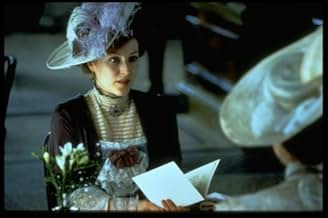
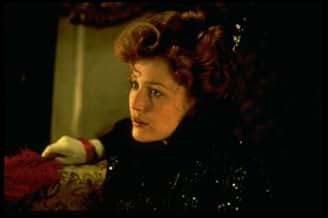
At the heart of Davies' film is Gillian Anderson's brilliant performance as Lilly Bart. Since she is on screen almost all of the time the film really stands or falls by her performance. She sheds her "X-Files" persona in moments and conveys an enormous range of subtle emotions as her character vacillates between an almost involuntary avarice and moral scruples, foolishness, charm, fortune and tragedy. The affect of Anderson's performance is lasting and deep. Indeed, this film lives on long in the memory and continued to trouble me for weeks after I had seen it.
At the heart of Davies' film is Gillian Anderson's brilliant performance as Lilly Bart. Since she is on screen almost all of the time the film really stands or falls by her performance. She sheds her "X-Files" persona in moments and conveys an enormous range of subtle emotions as her character vacillates between an almost involuntary avarice and moral scruples, foolishness, charm, fortune and tragedy. The affect of Anderson's performance is lasting and deep. Indeed, this film lives on long in the memory and continued to trouble me for weeks after I had seen it.
Absolutely Riveting
I'm not sure how this movie could get a bad review. Of course, there are those people who find its pace too slow. However, one must realize that this is a period drama; it's not meant to be an action-packed suspense thriller. Everything is subtle, but it is so beautifully prepared, thought out, and executed by all.
1. Were it for nothing else, the technical aspects of this film would have kept me watching until the very end. The music was perfectly placed to rise and fall with the internal emotions of the characters - especially Lily and Lawrence - and to express the turmoil of the social downfall of Lily. On top of that, you have phenomenal costumes and set with the most lavish colors. Lastly, and possibly what I found most fascinating about the film, was the lighting. it always seemed just bright enough or just dark enough to reflect the romance or dreariness. In addition, there is just not denying that the way the light fell upon Gillian Anderson in every, single scene is something I have never seen before.
2. The all-star cast! Gillian Anderson. Eric Stolz. Laura Linney. Anthony LaPaglia. Dan Akroyd. Do I have to go on? I can almost guarantee that you'll find yourself, at one point or another, yelling at the screen. These characters are so manipulative and deceitful and malicious. And Lily is so naive and just won't accept love when it's given!! I think the best thing about the cast and performances in this film is that watching the film and listening to it are 2 completely opposite experiences. The actors convey one thing with their faces and another with their voices; it's pure talent. I was amazed.
3. If nothing else, this film should watched purely for Gillian Anderson. This project was so different than her 'X Files' persona - and such a success, at that. The way she uses her eyes to express 5 different emotions in a matter of seconds blew me away. Her acting and utter vulnerability was awe-inspiring.
1. Were it for nothing else, the technical aspects of this film would have kept me watching until the very end. The music was perfectly placed to rise and fall with the internal emotions of the characters - especially Lily and Lawrence - and to express the turmoil of the social downfall of Lily. On top of that, you have phenomenal costumes and set with the most lavish colors. Lastly, and possibly what I found most fascinating about the film, was the lighting. it always seemed just bright enough or just dark enough to reflect the romance or dreariness. In addition, there is just not denying that the way the light fell upon Gillian Anderson in every, single scene is something I have never seen before.
2. The all-star cast! Gillian Anderson. Eric Stolz. Laura Linney. Anthony LaPaglia. Dan Akroyd. Do I have to go on? I can almost guarantee that you'll find yourself, at one point or another, yelling at the screen. These characters are so manipulative and deceitful and malicious. And Lily is so naive and just won't accept love when it's given!! I think the best thing about the cast and performances in this film is that watching the film and listening to it are 2 completely opposite experiences. The actors convey one thing with their faces and another with their voices; it's pure talent. I was amazed.
3. If nothing else, this film should watched purely for Gillian Anderson. This project was so different than her 'X Files' persona - and such a success, at that. The way she uses her eyes to express 5 different emotions in a matter of seconds blew me away. Her acting and utter vulnerability was awe-inspiring.
Mesmerising film
This is a slow paced mesmerising film. If your only knowledge of Gillian Anderson is as Dana Scully in the X-Files then you are in for a big surprise. Firstly the lady can act, and secondly with great subtlety. If you have read the book then clearly the writer/director Terence Davies has taken a few liberties. But so much script has been lifted word for word from the novel that I think he can be forgiven any eccentricities. This is a story of manners in early twentieth century New York and environs. Everyone seems so decent and 'proper', but each plays their own manipulative game. No-one (with the exception of Sim Rosedale) tells the truth. As a morality tale it seems as relevant today as when Edith Wharton wrote it. Davies has succeeded in losing none of its mood or punch by transferring it to screen. Unfortunately I think this is a film that requires watching more than once as some explanatory scenes appear to have ended up on the cutting room floor. Generally the acting is excellent throughout though I felt that at times Davies's enthusiasm for detail hamstrung some actors where others appeared to have relished the close direction. This is a film to add to your personal collection.
Truly beautiful
The book is a masterpiece and this adaptation is almost up to that level, just as richly told and emotional. It is not the kind of adaptation that will suck people in straightaway but the slow pace and how subtle a lot of aspects are actually add to the storytelling rather than distract and shouldn't be reasons to dismiss it. While I can understand completely why not everybody will like The House of Mirth some of how the detractors express their opinion reek of ignorance, like with the I'm-right-you're-wrong attitude. The House of Mirth does have a slow start and Eric Stoltz's performance can seem rather lightweight for such a complex character, though he is not without his affecting moments. The casting does have the "is this going to work" thought initially but the performances come across really well. Laura Linney sinks her teeth into her role and is suitably bitter, Eleanor Bron is formidable, Dan Aykroyd also comes across surprisingly well in a menacing and cunning turn and Jodhi May is charming and sympathetic. Terry Kinney, Anthony LaPaglia, Penny Downie and Elizabeth McGovern are also very good. The best of the lot is Gillian Anderson, whose performance is magnetic and truly heartfelt, her last scene with Stoltz is just heart-wrenching. The House of Mirth is shot very elegantly and the whole adaptation's period detail looks gorgeous. The lack of music is a good choice, allowing the intimate, understated atmosphere of the storytelling speak for itself. The dialogue is distinctively Edwardian and very literate without being stilted, how it's adapted is very thoughtfully done and any observations of the attitudes and classes of the time are sharply done. The story takes its time to unfold which is not a bad thing, period dramas often benefit from this especially when it's adapted from complex source material, and thankfully this deliberate pacing is not done in a self-indulgent way. Narratively The House of Mirth is incredibly touching and rich in theme and character, allowing you to identify with the characters(written and characterised believably) and with the interactions and the emotion it always maintained my interest. The direction is very intelligent and subtle. All in all, a truly beautiful adaptation. 9/10 Bethany Cox


Le saviez-vous
- AnecdotesEdith Wharton named the source novel after a passage from Ecclesiastes 7:4, "The heart of the wise is in the house of mourning; but the heart of fools is in the house of mirth."
- GaffesThe film, which takes place during 1905-07, depicts several characters attending a performance of the opera "Cosi fan tutte" -- but that opera was first performed in New York in 1922.
- Générique farfeluThanks to the staff of Kelvingrove Museum, the Lord Provost and staff at Glasgow City Chambers, residents of Kersland Street, all the staff at the Arthouse Hotel, Glasgow, and the Earls of Wemyss and March and Lady Wemyss.
- Bandes originalesOboe Concerto in D Minor: Slow Movement
Composed by Alessandro Marcello
Performed by Ferenc Erkel Chamber Orchestra
Courtesy of Naxos Recordings
Meilleurs choix
Connectez-vous pour évaluer et surveiller les recommandations personnalisées
- How long is The House of Mirth?Propulsé par Alexa
Détails
Box-office
- Budget
- 10 000 000 $ US (estimation)
- Brut – États-Unis et Canada
- 3 043 284 $ US
- Fin de semaine d'ouverture – États-Unis et Canada
- 48 770 $ US
- 25 déc. 2000
- Brut – à l'échelle mondiale
- 5 186 458 $ US
- Durée
- 2h 15m(135 min)
- Couleur
- Mixage
- Rapport de forme
- 2.35 : 1
Contribuer à cette page
Suggérer une modification ou ajouter du contenu manquant