

Le fils d'un homme de main de la mafia est témoin d'un meurtre, le forçant, lui et son père, à prendre la route, et son père sur la voie de la rédemption et de la vengeance.Le fils d'un homme de main de la mafia est témoin d'un meurtre, le forçant, lui et son père, à prendre la route, et son père sur la voie de la rédemption et de la vengeance.Le fils d'un homme de main de la mafia est témoin d'un meurtre, le forçant, lui et son père, à prendre la route, et son père sur la voie de la rédemption et de la vengeance.
- Réalisation
- Scénaristes
- Vedettes
- A remporté 1 oscar
- 23 victoires et 82 nominations au total


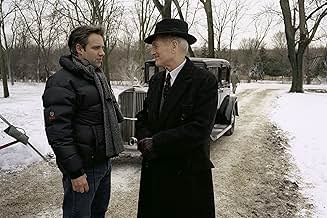
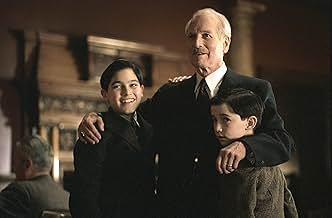
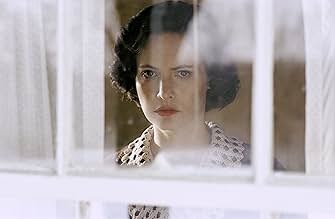


- Finn McGovern's Henchman
- (as Stephen Dunn)

Avis en vedette
A Rolls-Royce Movie
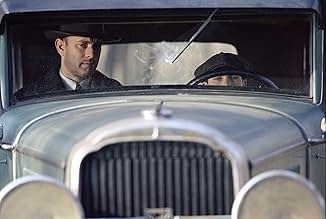
This story of a hit man (Tom Hanks) and his relationship to a surrogate father - figure who is also his boss, an elderly Irish mob leader (Paul Newman) , seems to have been culled from innumerable gangster movies of years past. The father /son motif that hangs over this picture is so heavy handed in its treatment that there is not much room for spontaneity ; the entire enterprise has been very carefully wrought , and nearly all the dialog is delivered with an air of great portent : this is obviously a gangster film , hence the requisite amount of violence and bloodshed , but the film is nearly devoid of any humor to speak of ; only in scenes involving a young boy driving a getaway car in a cunningly edited montage is there any sense of lightheartedness to leaven the pervasive sense of doom.
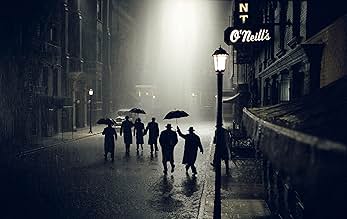
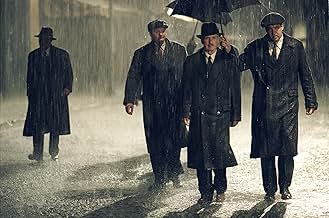
That being said , I have nothing but the highest praise for the stunning look of this film ; indeed , it is not an overstatement to say that this is one of the most beautifully photographed and designed movies I have ever seen. Veteran cameraman Conrad Hall will very likely win another Oscar for his work here . The production 's sets and costumes are just as exemplary ; in fact , the entire film is a technical marvel. Mr. Mendes continues to astonish with his vivid use of color, and he and Mr. Hall again make very dramatic use of red blood splattered against pale colored walls , all the more effective and disconcerting due to the preponderance of blacks, blues and grays that dominate the movie's color scheme.
If I have failed to duly note the acting , it is not because the actors do not purport themselves ably ; everyone in the film is top notch, with special mention going to the two malevolent bad guys : Daniel Craig is the classic "man you love to hate", the spoiled, impulsive son of Newman's gangster father ; and an almost unrecognizable Jude Law as an especially slimy miscreant who goes on pursuit of Hanks and his son and figures very importantly in the film's riveting second half. But acting in a movie this dazzling is bound to take a back seat to the photographic fireworks on display here. If a Rolls-Royce was a movie , I've no doubt it would look like ROAD TO PERDITION.
Despite what you may have heard, it's an awesome movie
Road to No Where
On paper, the plot is an average set up. Relationships in a crime family are tested, but none are ever stretched too far. In this sense it feels somewhat familiar and not very original.
But what does keep this movie from being average-blah, is the care put into EVERY shot. I give a huge amount of credit to the cinematographer. A good amount of noticeable techniques were used. I particularly liked one symmetrical pillar shot that used a zoom in dolly in trick. A slight variation of the Vertigo introduced, zoom in dolly out.
But with all of these wonderful shots I noticed something. There was so much technically stunning camera work, I found myself completely drawn out of the story. Was this done intentionally? To some degree I think so. This nicely compliments the dark and rainy 1930's settings.
Noticing this I tried to put more thought into the plot. There basically was none. The characters were cold and lacked development. Any dialog is important and used sparingly. I couldn't stop myself from drawing comparison to The Godfather. What Road to Perdition lacks is any underlying intensity between the characters. I never feel like they were a tight-knit family and do feel as if I'm simply watching characters play their parts. The story has no poetry and feels more like a collection of parts that aren't worth its sum.
I appreciate it in its stunning visuals, but once the credit rolled I felt nothing. And I find no reason to return back to it.
A subtle masterwork of a great forthcoming director!
This film is based on a bold graphic novel by Max Allan Collins and Richard Piers Rayner. This is a father/son story which basically employs the two candidates solely unfit for the roles. Mike Sullivan had no father as a child, so John Rooney took him in. Although a generous man, Mr. Rooney involved himself in organized crime. Therefore, the debt of Sullivan was only to be paid off in involving himself in the business. Now, Sullivan has a wife and two children and is trying to keep his children safe, but at the same time pay back his boss. The events to follow, will test Sullivan's loyalty and embrace his family's fate.
With a great adaptation by David Self, the dialogue comes out seldomly, but yet very virtuous. The story unfolds in a beautiful 1930's setting (Brilliant Art Direction by Richard L. Johnson & Nancy Haigh) covered with a dark rainy (snow on the ground) exterior. Driving the story, is Thomas Newman's wonderful Irish score, settling in only when necessary.
But the most important technical element in the film is Conrad L. Hall's beautiful photography. This is some of the best cinematography I've seen; and I watch a lot of films. The scene when Mike and Michael are in the car, entering Chicago is quite impressive. The shot starts at the front of the car, revealing Mike(Hanks) through the windshield. It subsequently dollys around to the side of the car, to see Michael(Hoechlin) awakening and peering out his side window. As it continues, it trucks sideways and dollys back, completely around the car and reveals a gorgeous scenic 1930's Chicago.
With a great cast and crew, the principle man creates a brazenly amazing film. I'm talking about Sam Mendes, who made his feature film debut in 1999 with American Beauty. (won him various awards) Before American Beauty, Mendes worked as a play director for the British Theater, but decided that he wanted to move on saying that there was nothing new for him in theater. With only two films, Sam Mendes has marked himself in my book as one of the great directors (In a list of about twenty-five).
The film illuminates a brazen genre that has its hits and misses and expresses the true theme brilliantly. The photography, acting and story is phenominal. I'm still waiting for Scorcesee's Gangs of New York, but for now, I'm fully confident in saying that this is the "Best Film of the Year". Considering it's competition (Signs, Insomnia, Minority Report) thats a strong statement.
Simply Beautiful
It has a combined intensity and lightness of touch that won't work for anyone who wants the typical fast-paced action flick. If we lived in Elizabethan days, I'd say this movie's a bit like a Shakespearean tragedy. But since we don't, let's say it's more like a Drama-Suspense movie.
The plot is simple, but the story is complex. The movie is intelligent in the way relationships and issues are explored. Much of the story is shown rather than told, which I find makes it more subtle and moving - and which also works well for a story based on a comic book (or graphic novel). At times I felt I was actually there in the 1930s, part of this story - there was such a realistic yet dream-like quality in the style of its telling.
I don't often prefer movies to the books they were based upon, but in this case I do. (Though I did enjoy the book too.) I've bought the DVD, which is great because it has some wonderful deleted scenes and insightful commentary.
(I also took my little cousin, who's a little younger than the boy in the movie, to see it after I saw it for the first time, because he has issues at home and I wanted to use this as a way of starting a discussion on father-son issues with him. He loved it - and the discussion.)
Blocage sonore


Le saviez-vous
- AnecdotesFor the bank robberies sequence, Tyler Hoechlin (Michael Sullivan, Jr.) had to learn to drive, something he was only too happy to do. Hoechlin mastered it all easily, but, just to be on the safe side, a stunt driver was sitting in the back, with his own set of driving controls.
- GaffesIn that era, gentlemen removed their hats indoors, particularly in places like diners. Even not-so gentlemen. To not do so would have attracted attention.
- Citations
Michael Sullivan, Jr.: So when do I get my share of the money?
Michael Sullivan: Well... how much do you want?
Michael Sullivan, Jr.: Two hundred dollars.
Michael Sullivan: Okay. Deal.
[Michael Jr. stops eating and thinks for awhile]
Michael Sullivan, Jr.: Could I have had more?
Michael Sullivan: You'll never know.
- Générique farfeluThanks to all at the Donmar Warehouse Theatre, London
- ConnexionsFeatured in The Making of 'Road to Perdition' (2002)
- Bandes originalesWhose Honey Are You?
Music by J. Fred Coots (as Fred J. Coots)
Lyrics by Haven Gillespie
Performed by Ruth Etting
Courtesy of Take Two Records
Meilleurs choix
Détails
- Date de sortie
- Pays d’origine
- Site officiel
- Langue
- Aussi connu sous le nom de
- Road to Perdition
- Lieux de tournage
- sociétés de production
- Consultez plus de crédits d'entreprise sur IMDbPro
Box-office
- Budget
- 80 000 000 $ US (estimation)
- Brut – États-Unis et Canada
- 104 454 762 $ US
- Fin de semaine d'ouverture – États-Unis et Canada
- 22 079 481 $ US
- 14 juill. 2002
- Brut – à l'échelle mondiale
- 181 001 478 $ US
- Durée
- 1h 57m(117 min)
- Couleur
- Mixage
- Rapport de forme
- 2.35 : 1