ÉVALUATION IMDb
6,8/10
2,8 k
MA NOTE

Ajouter une intrigue dans votre langueTwo unemployed Chinese teenagers have trouble resisting the temptations of the Western world.Two unemployed Chinese teenagers have trouble resisting the temptations of the Western world.Two unemployed Chinese teenagers have trouble resisting the temptations of the Western world.
- Réalisation
- Scénariste
- Vedettes
- Prix
- 2 victoires et 5 nominations au total




Limin Wang
- The Karaoke Customer
- (as Wang Li Min)
Juan Antonio Samaranch
- Self
- (archive footage)
- (uncredited)

Jia Zhang-ke
- Man singing in street
- (uncredited)
6,82.7K
1
2
3
4
5
6
7
8
9
10
Avis en vedette
Gritty but boring
I saw this film at the IFP LA Film Festival on June 16, 2003. It started out pretty well, but became aimless and sort of meandered. I couldn't root for any of the characters. The background of economically depressed mainland China is interesting, but only for a while. After half an hour, I wanted characters I cared about, but this movie didn't have any. It's not that the young actors weren't talented, it's just that the script was anti-climatic and didn't leave me wanting more, I just wanted the movie to end.
Powerful and affecting
Unknown Pleasures, directed by Jia Zhangke, powerfully brings home the spiritual malaise affecting Chinese youth as a result of global capitalism. Although the film is set in a small, impoverished Chinese city in remote Shanxi province close to the Mongolian border, there is almost nothing traditionally Chinese in this film other than the location.
Two 19-year olds, Bin Bin (Zhao Wei Wei) and Xiao Ji (Wy Qiong) are heavily influenced by American culture and seem to exist only for their own immediate pleasure. They live on the margins in a city where, according to the director, two-thirds of the population were unemployed in 2001. They drink coke, chain smoke cigarettes, covet U.S. dollars, talk excitedly about Hollywood movies such as Pulp Fiction, and dance to Western-style music at the local club. In the words of Kent Jones (Film Comment Sept/Oct 2002), the protagonists are "media-addicted, resigned to momentous change, and powerless to understand or affect it".
Bin Bin lives with his mother (Bai Ru), who works at a local textile factory and sympathizes with the Falun Gong (an extreme Buddhist religious sect that has been persecuted by the Chinese Communist government). Apathetic and disengaged with no job and nothing to do, the two friends hang around the local community center playing pool and chatting with the regulars. After trying out for an acting job, Xiao Ji becomes attracted to Qiao Qiao (Zhao Tao) whose protective lover is gangster Quiao San. Xiao follows her around but seems unable or unwilling to make a move. When they finally go dancing, Xiao has to confront the threats of Quiao San's goons who finally catch up with him and slap him around.
Bin Bin also has a girlfriend, Yuan Yuan (Zhou Qing Feng), but their romance seems to consist only in watching movies in a hotel room and singing popular songs (whose words suggest their own lives). Yuan Yuan has more purpose in life than Bin Bin and wants to study International Trade in Beijing. In a scene depicting Jia's wry humor, Xiao Ji puts Yuan's studies in perspective by saying, "WTO is nothing. Just a trick to make some cash" and Bin Bin declares to Yuan Yuan, " It is said that international trade is about buying rabbits to resell in the Ukraine." With little interest in common, they slowly drift apart. In a very telling scene, as Bin Bin sits in a booth in the inside of a train station staring blankly, Yuan Yuan rides her bicycle around and around, waiting for him to throw off his lethargy and join her.
Though the boys hear about events in the outside world on television, for example, the winning of the Olympic Games by Beijing and the arrest of the leaders of the Falun Gong in Japan, they don't seem affected. Seemingly inured to unexplained violence, they are just mildly perplexed when a bomb explodes nearby with tragic results. Bin Bin asks whether the United States is attacking China.
Shot in digital video that enhances its authenticity, Jia avoids pathos and sentimentality for a documentary-style realism that is deeply affecting. Although he focuses on the boys as victims of social and economic dislocation in China, the theme is more about feelings of abandonment, loneliness, and emotional numbness. Jia, one of the best of China's new generation underground "indie" directors, has captured this sense of ennui more palpably than any movie I've seen in a long, long time. When Xiao finally abandons his sputtering motor bike in the middle of a new superhighway, Jia seems to be suggesting that both he and China itself are at a precarious crossroads in their existence and must discard what isn't working if they are to move on.
Two 19-year olds, Bin Bin (Zhao Wei Wei) and Xiao Ji (Wy Qiong) are heavily influenced by American culture and seem to exist only for their own immediate pleasure. They live on the margins in a city where, according to the director, two-thirds of the population were unemployed in 2001. They drink coke, chain smoke cigarettes, covet U.S. dollars, talk excitedly about Hollywood movies such as Pulp Fiction, and dance to Western-style music at the local club. In the words of Kent Jones (Film Comment Sept/Oct 2002), the protagonists are "media-addicted, resigned to momentous change, and powerless to understand or affect it".
Bin Bin lives with his mother (Bai Ru), who works at a local textile factory and sympathizes with the Falun Gong (an extreme Buddhist religious sect that has been persecuted by the Chinese Communist government). Apathetic and disengaged with no job and nothing to do, the two friends hang around the local community center playing pool and chatting with the regulars. After trying out for an acting job, Xiao Ji becomes attracted to Qiao Qiao (Zhao Tao) whose protective lover is gangster Quiao San. Xiao follows her around but seems unable or unwilling to make a move. When they finally go dancing, Xiao has to confront the threats of Quiao San's goons who finally catch up with him and slap him around.
Bin Bin also has a girlfriend, Yuan Yuan (Zhou Qing Feng), but their romance seems to consist only in watching movies in a hotel room and singing popular songs (whose words suggest their own lives). Yuan Yuan has more purpose in life than Bin Bin and wants to study International Trade in Beijing. In a scene depicting Jia's wry humor, Xiao Ji puts Yuan's studies in perspective by saying, "WTO is nothing. Just a trick to make some cash" and Bin Bin declares to Yuan Yuan, " It is said that international trade is about buying rabbits to resell in the Ukraine." With little interest in common, they slowly drift apart. In a very telling scene, as Bin Bin sits in a booth in the inside of a train station staring blankly, Yuan Yuan rides her bicycle around and around, waiting for him to throw off his lethargy and join her.
Though the boys hear about events in the outside world on television, for example, the winning of the Olympic Games by Beijing and the arrest of the leaders of the Falun Gong in Japan, they don't seem affected. Seemingly inured to unexplained violence, they are just mildly perplexed when a bomb explodes nearby with tragic results. Bin Bin asks whether the United States is attacking China.
Shot in digital video that enhances its authenticity, Jia avoids pathos and sentimentality for a documentary-style realism that is deeply affecting. Although he focuses on the boys as victims of social and economic dislocation in China, the theme is more about feelings of abandonment, loneliness, and emotional numbness. Jia, one of the best of China's new generation underground "indie" directors, has captured this sense of ennui more palpably than any movie I've seen in a long, long time. When Xiao finally abandons his sputtering motor bike in the middle of a new superhighway, Jia seems to be suggesting that both he and China itself are at a precarious crossroads in their existence and must discard what isn't working if they are to move on.
A dark film of disaffected youth
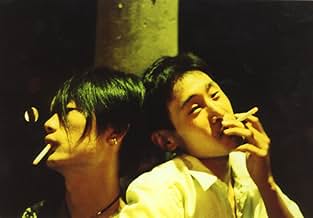
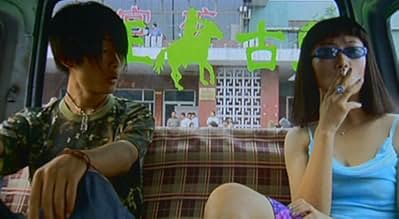
There isn't an ounce of joy or spark in these characters, who I'm pretty sure don't crack a single smile throughout the film. They manage to smoke a million cigarettes though. Not that there's anything to smile about, and that's the point. There is no beauty anywhere, nor is there hope. The landscape is a wasteland, the buildings are ugly or in ruins, and jobs are few. One says there is no future, and the other says that 30 years is plenty for a lifetime. Even when they're alone with women, they look forlornly off to the side or curl up in the fetal position.
This is a heavy neorealist type of film, reflecting poor parts of China that were still attempting to modernize in this time period. Who knows, as China's economic strength has continued to rise, maybe this film is already looked upon as quaint, or will be soon. American cultural references (e.g. Pulp Fiction) are known by the characters in the film, but it's from a distance, and things like the modern dance moves that have been picked up seem pretty tepid. Meanwhile, a single American dollar is viewed as quite a find, and a can of Coke is a treat. It certainly reminded me of the blessings in my life.
The scene that was most powerful for me was when the young woman who sings and dances (Zhao Tao) is trying to leave her boyfriend's company. Again and again she gets up and tries to exit, and again and again he pushes her back into her seat, and it seems such a perfect metaphor for the cycle of abuse in these kinds of relationships. Later we see he's also given her a black eye.
Given the dreary view the film shows of China, and the nihilistic attitude it takes towards the future, it was a little surprising to me that it wasn't censored more by the government. We see the power of the State on small television sets cracking down on the Falun Gong, what seems like a forced confession, and in real life when a policeman tells one of the guys that the punishment for robbing a bank is death. There is a lottery in place that may be a way of instilling a larger hope in people's minds than the infinitesimal chance of winning would justify, perhaps not unlike American lotteries. There is also a new highway project being built and great fanfare when Beijing is announced as the home of the 2008 Olympics. I guess all of these things can be viewed as in keeping with the government's interests, but in light of all the shabby surroundings and the dismal future these two guys have, they seem pretty sorrowful.
The film is meaningful and I admire director Jia Zhangke for having worked in an underground, indie type manner to produce a view of honesty and truth. I didn't rate the film higher because it's so depressing that I wouldn't want to look for it again anytime soon.
This is a heavy neorealist type of film, reflecting poor parts of China that were still attempting to modernize in this time period. Who knows, as China's economic strength has continued to rise, maybe this film is already looked upon as quaint, or will be soon. American cultural references (e.g. Pulp Fiction) are known by the characters in the film, but it's from a distance, and things like the modern dance moves that have been picked up seem pretty tepid. Meanwhile, a single American dollar is viewed as quite a find, and a can of Coke is a treat. It certainly reminded me of the blessings in my life.
The scene that was most powerful for me was when the young woman who sings and dances (Zhao Tao) is trying to leave her boyfriend's company. Again and again she gets up and tries to exit, and again and again he pushes her back into her seat, and it seems such a perfect metaphor for the cycle of abuse in these kinds of relationships. Later we see he's also given her a black eye.
Given the dreary view the film shows of China, and the nihilistic attitude it takes towards the future, it was a little surprising to me that it wasn't censored more by the government. We see the power of the State on small television sets cracking down on the Falun Gong, what seems like a forced confession, and in real life when a policeman tells one of the guys that the punishment for robbing a bank is death. There is a lottery in place that may be a way of instilling a larger hope in people's minds than the infinitesimal chance of winning would justify, perhaps not unlike American lotteries. There is also a new highway project being built and great fanfare when Beijing is announced as the home of the 2008 Olympics. I guess all of these things can be viewed as in keeping with the government's interests, but in light of all the shabby surroundings and the dismal future these two guys have, they seem pretty sorrowful.
The film is meaningful and I admire director Jia Zhangke for having worked in an underground, indie type manner to produce a view of honesty and truth. I didn't rate the film higher because it's so depressing that I wouldn't want to look for it again anytime soon.
Expecting much more
I don't recall where I read a favorable review of this art film, but if I did I would make sure I don't rent anything else they recommend. This film went nowhere. Two Chinese boys with no motivation. They don't take any risks really, and neither do the filmmakers. I was not left with any particular emotion or thought. Photographically it was OK. Perhaps the filmmaker was going for Bergman type effect of portraying emotional emptiness. And maybe its a cultural translation I'm not getting.
Saw parts of China not seen before - the more urban dirty landscape.. So that was a plus. I liked the girl. Her character had the most um, character.
Saw parts of China not seen before - the more urban dirty landscape.. So that was a plus. I liked the girl. Her character had the most um, character.
Best film yet this year
I'm confused as to why people would still give the pleasant peasant fables of Zhang Yimou house-room now we're offered a view of intense, complex, and contemporary Chinese cinema like this. I adored the extreme negativity of this film's most repetitive moments: Xiao Ji getting slapped about the face ("having a good time?" "yes" "having a good time?" "yes" "having a good time?" "yes" "having a good time?" "yes"...) or trying repeatedly to drive up a slight slope on his motorbike. The very repeatability of film seems to highlight the way that only this silly, essentially boring medium gets at what's going on when stuff happens, in capitalist China as well as at home...


Le saviez-vous
- AnecdotesMandarin title refers to a song by Richie Jen
- Citations
Mr. Ren: Welcome to auditions for the Mongolian King Liquor Troupe! Please applaud our city's famous singer and dancer, Miss Zhao Qiao Qiao, in her modern dance number titled "Unknown Pleasures". The performance reminds us the Mongolian King spirits! Drink Mongolian King! Drink Mongolian King!
- ConnexionsFeatures Da nao tian gong (1961)
Meilleurs choix
Connectez-vous pour évaluer et surveiller les recommandations personnalisées
Détails
Box-office
- Brut – États-Unis et Canada
- 11 254 $ US
- Fin de semaine d'ouverture – États-Unis et Canada
- 3 628 $ US
- 30 mars 2003
- Brut – à l'échelle mondiale
- 55 901 $ US
Contribuer à cette page
Suggérer une modification ou ajouter du contenu manquant