ÉVALUATION IMDb
6,8/10
36 k
MA NOTE


En 1967, Ernesto « Che » Guevara dirige une petite armée partisane pour mener une guérilla révolutionnaire au destin malheureux en Bolivie, en Amérique du Sud.En 1967, Ernesto « Che » Guevara dirige une petite armée partisane pour mener une guérilla révolutionnaire au destin malheureux en Bolivie, en Amérique du Sud.En 1967, Ernesto « Che » Guevara dirige une petite armée partisane pour mener une guérilla révolutionnaire au destin malheureux en Bolivie, en Amérique du Sud.
- Réalisation
- Scénaristes
- Vedettes
- Prix
- 2 victoires et 7 nominations au total



Demián Bichir
- Fidel Castro
- (as Demian Bichir)


6,836.1K
1
2
3
4
5
6
7
8
9
10
Avis en vedette
Radio Rebelde / Radical Writings on Guerilla Warfare
It helps to know that this was originally brought to life as a Terrence Malick screenplay about Che's disastrous forray in Bolivia. Financing fell through and Soderbergh stepped in to direct. He conceived a first part and shot both back to back as one film trailing Che's rise and fall.
He retained however what I believe would be Malick's approach: no politics and a just visual poem about the man behind the image, exhaustive as the horrible slog through Cuban jungles and windswept Andean plateaus must have been. Malick applied this to his New World that he abandoned Che for, lyrical many times over.
But Soderbergh being an ambitious filmmaker, he puzzled over this a little more. Here was a man of action at the center of many narratives about him, some fashioned by himself, conflictingly reported as iconic revolutionary or terrorist, charismatic leader or ruthless thug, erudite Marxist thinker or brutal soldier.
So how to visually exemplify this contradicting ethos as our film about him? And how to arrange a world around this person in such a way as to absorb him whole, unfettered from narrative - but writing it as he goes along - off camera - but ironically on - and as part of that world where narratives are devised to explain him. As flesh and bones, opposed to a cutout from a history book.
One way to do this, would be via Brecht and artifice. The Korda photograph would reveal lots, how we know people from images, how we build narratives from them. Eisenstein sought the same in a deeper way, coming up with what he termed the 'dialectical montage': a world assembled by the eye, and in such ways as the eye aspires to create it.
So what Soderbergh does, is everything by halves: a dialectic between two films trailing opposite sides of struggle, glory and failure, optimism and despair. Two visual palettes, two points of view in the first film, one in the presence of cameras hoping to capture the real person, the other were that image was being forged in action.
The problem, is of course that Brecht and Eisenstein made art in the hope to change the world, to awaken consciousness, Marxist art with its trappings. By now we have grown disillusioned with the idea, and Soderbergh makes no case and addresses no present struggles.
But we still have the cinematic essay about all this.
The first part: a narrative broadcast from real life, meant to reveal purpose, ends, revolution. The second part: we get to note in passing a life that is infinitely more expansive than any story would explain, more complex, beautiful, frustrating, and devoid of any apparent purpose other than what we choose as our struggle, truly a guerilla life.
I imagine a tremendous film from these notions. Just notice the remarkable way Part 2 opens. Che arrives at Bolivia in disguise, having shed self and popular image. No longer minister, spokesman, diplomat, guerilla, he is an ordinary man lying on a hotel bed, one among many tourists. Life could be anything once more, holds endless possibility. Cessation.
What does he do? He begins to fashion the same narrative as before, revolution again. Chimera this time. Transient life foils him in Bolivia. Instead of changing the world once more, he leaves behind a story of dying for it. We have a story about it as our film, adding to the rest.
He retained however what I believe would be Malick's approach: no politics and a just visual poem about the man behind the image, exhaustive as the horrible slog through Cuban jungles and windswept Andean plateaus must have been. Malick applied this to his New World that he abandoned Che for, lyrical many times over.
But Soderbergh being an ambitious filmmaker, he puzzled over this a little more. Here was a man of action at the center of many narratives about him, some fashioned by himself, conflictingly reported as iconic revolutionary or terrorist, charismatic leader or ruthless thug, erudite Marxist thinker or brutal soldier.
So how to visually exemplify this contradicting ethos as our film about him? And how to arrange a world around this person in such a way as to absorb him whole, unfettered from narrative - but writing it as he goes along - off camera - but ironically on - and as part of that world where narratives are devised to explain him. As flesh and bones, opposed to a cutout from a history book.
One way to do this, would be via Brecht and artifice. The Korda photograph would reveal lots, how we know people from images, how we build narratives from them. Eisenstein sought the same in a deeper way, coming up with what he termed the 'dialectical montage': a world assembled by the eye, and in such ways as the eye aspires to create it.
So what Soderbergh does, is everything by halves: a dialectic between two films trailing opposite sides of struggle, glory and failure, optimism and despair. Two visual palettes, two points of view in the first film, one in the presence of cameras hoping to capture the real person, the other were that image was being forged in action.
The problem, is of course that Brecht and Eisenstein made art in the hope to change the world, to awaken consciousness, Marxist art with its trappings. By now we have grown disillusioned with the idea, and Soderbergh makes no case and addresses no present struggles.
But we still have the cinematic essay about all this.
The first part: a narrative broadcast from real life, meant to reveal purpose, ends, revolution. The second part: we get to note in passing a life that is infinitely more expansive than any story would explain, more complex, beautiful, frustrating, and devoid of any apparent purpose other than what we choose as our struggle, truly a guerilla life.
I imagine a tremendous film from these notions. Just notice the remarkable way Part 2 opens. Che arrives at Bolivia in disguise, having shed self and popular image. No longer minister, spokesman, diplomat, guerilla, he is an ordinary man lying on a hotel bed, one among many tourists. Life could be anything once more, holds endless possibility. Cessation.
What does he do? He begins to fashion the same narrative as before, revolution again. Chimera this time. Transient life foils him in Bolivia. Instead of changing the world once more, he leaves behind a story of dying for it. We have a story about it as our film, adding to the rest.
Soderbergh resurrected
Neatly skipping over everything from the coup in Cuba to his undercover entry into Bolivia, part two of Soderbergh's portrayal of Che Guevara is that of the tragic hero. As with Che Part One, this rather rambling guerrilla warfare escapade through the colourful mountains of Bolivia is probably destined to disappoint more people than it will satisfy, so why was the film (and particularly Benicio Del Toro's performance) so loudly praised at Cannes?
James Rocchi, for instance, called it, a work of art that's, "not just the story of a revolutionary," but, "a revolution in and of itself." The Guardian's Peter Bradshaw called it a "flawed masterpiece." I return to my original contention for Part One that the value lies particularly in depiction of a hero figure. And in an age when there is a surfeit of poor hero role-models, could it not be salutary to see a strongly honourable one, even if stripped of some of the less endearing episodes of his life? This is the psychological hero enshrined by the great Scottish essayist, Thomas Carlyle, in his seminal book, Heroes and Hero Worship. Heroes can be real or imaginary (or somewhere in-between). But should genuinely inspire us to higher goals, a higher purpose. Compare this with the unrealistic 'heroes' of standard Western storytelling: where a person undergoes trials and tribulations before obtaining a barely-believable reward usually everlasting love or material wealth as if by divine studio intervention. Real heroes have an excess of moral courage not Lost Ark dare-devilishness or James Bond super-toys. They rise, and empower others to rise, to be the best that they can be. In Part One, Che succeeds. In Part Two, he fails. It is not for want of moral courage but since a) not all good plans can succeed and b) being human, mistakes are inevitable.
Guevara's intellectual clarity is flawed when he equates conditions that justify armed struggle with conditions that make that armed struggle able to succeed. It is a serious miscalculation.
High in the mountains from La Paz, the colours are breathtaking. There is an air of mise-en-scene authenticity that was occasionally lacking in Che - Part One (The U.S. would not allow Soderbergh to film in Cuba.) Visual treats are heightened by maximising natural light and the extreme flexibility and realism offered with groundbreaking RED cameras. This is a high performance digital cine camera with the quality of 35mm film and the convenience of pure digital. Designed for flexibility and functionality, the package weighs a mere 9 lbs. "Shooting with RED is like hearing the Beatles for the first time," says Soderbergh. "RED sees the way I see . . . so organic, so beautifully attuned to that most natural of phenomena light." If Che had stopped with the successful Cuban revolution it would have enshrouded him with an almost mystical invincibility. That he fails in Bolivia shows not only that he has human limitations but that it is his moral virtues that are remembered, not the political triumph. Critics will say and with some justification - that his armed struggle inspired much less noble characters to achieve tin-pot dictatorships. His development of guerrilla fighting tactics are not good or bad in themselves (and have since been used for both).
But for all its praiseworthiness, the film often seems to lack dramatic and narrative tension. We stumble from one escapade to another, knowing that he will eventually meet his death. I found myself glancing at my watch and thinking it could have been shorter. But the work that has gone into this interviews with people from all sides and even getting one of Guevara's ex-comrades to coach actors on the minutiae of the Bolivian operations make the film a commendable achievement. It might not be top-flight entertainment, but it demonstrates integrity in documenting a significant slice of history.
There is also another very important point in the Che 'hero' figure here. It's about failure. That if you try your utmost, even if you fail, your effort will not have been in vain because it may give others hope and moral courage. One could cynically call it a 'martyr' complex, and it is found, of course, in many religious figures as well. But Che does not 'sacrifice' himself. He does what he does best, to the best of his not inconsiderate ability, and so provides an example. Success or failure in any particular instance become mere details.
With the U.S.'s longstanding and illegal blockade of Cuba (all in the name of 'freedom'), I am tempted to write that Che Parts 1 & 2 are too good to be wasted on the U.S. But that would be to invite a contention that the film has sought so earnestly to avoid. One must hope that many viewers will have the skill to view Che without politics and the bias that inevitably engenders. Whatever its faults, it rehabilitates Soderbergh from the populist nonsense of Oceans 11.
But if you haven't heard of Che Guevara or seen Part One, or if you can't get past the phrase 'murderous Marxist' without frothing at the mouth, I might struggle to imagine what you would get from this film. The same can be said for many who have, and can.
James Rocchi, for instance, called it, a work of art that's, "not just the story of a revolutionary," but, "a revolution in and of itself." The Guardian's Peter Bradshaw called it a "flawed masterpiece." I return to my original contention for Part One that the value lies particularly in depiction of a hero figure. And in an age when there is a surfeit of poor hero role-models, could it not be salutary to see a strongly honourable one, even if stripped of some of the less endearing episodes of his life? This is the psychological hero enshrined by the great Scottish essayist, Thomas Carlyle, in his seminal book, Heroes and Hero Worship. Heroes can be real or imaginary (or somewhere in-between). But should genuinely inspire us to higher goals, a higher purpose. Compare this with the unrealistic 'heroes' of standard Western storytelling: where a person undergoes trials and tribulations before obtaining a barely-believable reward usually everlasting love or material wealth as if by divine studio intervention. Real heroes have an excess of moral courage not Lost Ark dare-devilishness or James Bond super-toys. They rise, and empower others to rise, to be the best that they can be. In Part One, Che succeeds. In Part Two, he fails. It is not for want of moral courage but since a) not all good plans can succeed and b) being human, mistakes are inevitable.
Guevara's intellectual clarity is flawed when he equates conditions that justify armed struggle with conditions that make that armed struggle able to succeed. It is a serious miscalculation.
High in the mountains from La Paz, the colours are breathtaking. There is an air of mise-en-scene authenticity that was occasionally lacking in Che - Part One (The U.S. would not allow Soderbergh to film in Cuba.) Visual treats are heightened by maximising natural light and the extreme flexibility and realism offered with groundbreaking RED cameras. This is a high performance digital cine camera with the quality of 35mm film and the convenience of pure digital. Designed for flexibility and functionality, the package weighs a mere 9 lbs. "Shooting with RED is like hearing the Beatles for the first time," says Soderbergh. "RED sees the way I see . . . so organic, so beautifully attuned to that most natural of phenomena light." If Che had stopped with the successful Cuban revolution it would have enshrouded him with an almost mystical invincibility. That he fails in Bolivia shows not only that he has human limitations but that it is his moral virtues that are remembered, not the political triumph. Critics will say and with some justification - that his armed struggle inspired much less noble characters to achieve tin-pot dictatorships. His development of guerrilla fighting tactics are not good or bad in themselves (and have since been used for both).
But for all its praiseworthiness, the film often seems to lack dramatic and narrative tension. We stumble from one escapade to another, knowing that he will eventually meet his death. I found myself glancing at my watch and thinking it could have been shorter. But the work that has gone into this interviews with people from all sides and even getting one of Guevara's ex-comrades to coach actors on the minutiae of the Bolivian operations make the film a commendable achievement. It might not be top-flight entertainment, but it demonstrates integrity in documenting a significant slice of history.
There is also another very important point in the Che 'hero' figure here. It's about failure. That if you try your utmost, even if you fail, your effort will not have been in vain because it may give others hope and moral courage. One could cynically call it a 'martyr' complex, and it is found, of course, in many religious figures as well. But Che does not 'sacrifice' himself. He does what he does best, to the best of his not inconsiderate ability, and so provides an example. Success or failure in any particular instance become mere details.
With the U.S.'s longstanding and illegal blockade of Cuba (all in the name of 'freedom'), I am tempted to write that Che Parts 1 & 2 are too good to be wasted on the U.S. But that would be to invite a contention that the film has sought so earnestly to avoid. One must hope that many viewers will have the skill to view Che without politics and the bias that inevitably engenders. Whatever its faults, it rehabilitates Soderbergh from the populist nonsense of Oceans 11.
But if you haven't heard of Che Guevara or seen Part One, or if you can't get past the phrase 'murderous Marxist' without frothing at the mouth, I might struggle to imagine what you would get from this film. The same can be said for many who have, and can.
A Refined, Seminally Important Biopic With An Unprecedentedly Discriminate and Disciplined Approach
Possibly the most brilliant thing about Che: Part Two, as we begin to integrate it with Part One in our minds, is that there is no clarification of why Che chose to confidentially abscond from Cuba after the revolution, no allusion to his experience in the Congo, no clarification of why he chose Bolivia as his subsequent setting for a coup d'etat, no allusion to the political decisions he made as a young man motorcycling across South America, which Walter Salles has given prominent familiarity. Extraordinary focus is given to Che meeting the volunteers who accompany his guerrilla factions. Yet hardly any endeavor is made to single them out as individuals, to establish involved relationships. He is reasonably unreasonable. Che drives an unbreakable doctrine to leave no wounded man behind. But there is no feeling that he is deeply directly concerned with his men. It is the concept.
In Part 1, in Cuba, the rebels are welcomed by the people of the villages, given food and cover, supported in what grows to be a victorious revolution. Here, in Bolivia, not much understanding is apparent. Villagers expose him. They protect government troops, not his own. When he expounds on the onesidedness of the government medical system, his audience appears uninterested. You cannot lead a people into revolution if they do not want to comply. Soderbergh shows U.S. military advisers working with the Bolivians, but doesn't fault the United States for Che's collapse. Che seems to have just misfigured his fight and the place where he wanted to have it.
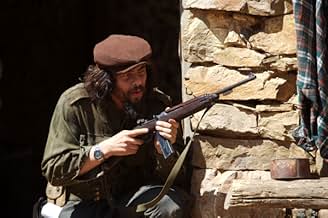
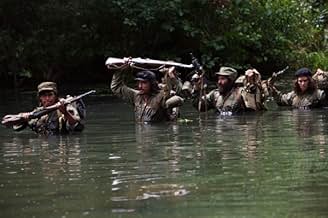
In showcasing both wars, Soderbergh doesn't build his battle scenes as actions with specific results. Che's men attack and are attacked. They exchange fire with faraway assailants. There is generally a cut to the group in the aftershock of combat, its death toll not paused for. This is not a war movie. It is about one man's reasonably unreasonable drive to endure. There is no elaborate cinematography. Soderbergh looks firmly at Che's inflexible dedication. There are remarkable sporadic visceral shots, but being few they are all the more powerful, such as Che's POV shot during his final beats. There is an abundance of the terrain, where these men live for weeks at a time, and the all-consuming effect is of languor, Guevara himself having malaria part of the time.
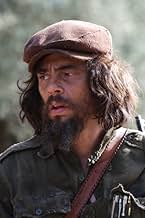
Benicio Del Toro, one of the film's producers, gives a champion's performance, not least because it's modest. He isn't portrayed as the cutting edge like most epic heroes. In Cuba, he arises in conquest, in Bolivia, he falls to the reverse, and occasionally is actually difficult to distinguish behind a tangle of beard and hair. Del Toro illustrates not so much an identity as an attitude. You may think the film is too long. I think there's a genuine cause for its breadth. Guevara's affairs in Cuba and particularly Bolivia was not a sequence of episodes and sketches, but an undertaking of staying power that might virtually be called insane. In the end, Che as a whole or in parts is a commercially ballsy movie, one where its director begins by understanding the limits innate in cinematic biography and working progressively within those means.
In Part 1, in Cuba, the rebels are welcomed by the people of the villages, given food and cover, supported in what grows to be a victorious revolution. Here, in Bolivia, not much understanding is apparent. Villagers expose him. They protect government troops, not his own. When he expounds on the onesidedness of the government medical system, his audience appears uninterested. You cannot lead a people into revolution if they do not want to comply. Soderbergh shows U.S. military advisers working with the Bolivians, but doesn't fault the United States for Che's collapse. Che seems to have just misfigured his fight and the place where he wanted to have it.
In showcasing both wars, Soderbergh doesn't build his battle scenes as actions with specific results. Che's men attack and are attacked. They exchange fire with faraway assailants. There is generally a cut to the group in the aftershock of combat, its death toll not paused for. This is not a war movie. It is about one man's reasonably unreasonable drive to endure. There is no elaborate cinematography. Soderbergh looks firmly at Che's inflexible dedication. There are remarkable sporadic visceral shots, but being few they are all the more powerful, such as Che's POV shot during his final beats. There is an abundance of the terrain, where these men live for weeks at a time, and the all-consuming effect is of languor, Guevara himself having malaria part of the time.
Benicio Del Toro, one of the film's producers, gives a champion's performance, not least because it's modest. He isn't portrayed as the cutting edge like most epic heroes. In Cuba, he arises in conquest, in Bolivia, he falls to the reverse, and occasionally is actually difficult to distinguish behind a tangle of beard and hair. Del Toro illustrates not so much an identity as an attitude. You may think the film is too long. I think there's a genuine cause for its breadth. Guevara's affairs in Cuba and particularly Bolivia was not a sequence of episodes and sketches, but an undertaking of staying power that might virtually be called insane. In the end, Che as a whole or in parts is a commercially ballsy movie, one where its director begins by understanding the limits innate in cinematic biography and working progressively within those means.
decline of a revolutionary
Part Two picks up... not where the last film left off. As part of the quasi-conventionality of Steven Soderbergh's epic 4+ hour event, Che's two stories are told as classic "Rise" and "Fall" scenarios. In Part Two, Che Guevara, leaving his post as a bureaucrat in Cuba and after a failed attempt in the Congo (only in passing mentioned in the film), goes down to Bolivia to try and start up another through-the-jungle style revolution. Things don't go quite as well planned, at all, probably because of Che's then notorious stature as a Communist and revolutionary, and in part because of America's involvement on the side of the Bolivian Government, and, of course, that Castro wasn't really around as a back-up for Che.
As it goes, the second part of Che is sadder, but in some ways wiser than the first part. Which makes sense, as Guevara has to endure low morale from his men, betrayals from those around him, constant mistakes by grunts and nearby peasants, and by ultimately the enclosing, larger military force. But what's sadder still is that Guevara, no matter what, won't give in. One may see this as an incredible strength or a fatal flaw- maybe both- but it's also clear how one starts to see Che, if not totally more fully rounded, then as something of a more sympathetic character. True, he did kill, and executed, and felt justified all the way. And yet it starts to work on the viewer in the sense of a primal level of pity; the sequence where Guevara's health worsens without medicine, leading up to the shocking stabbing of a horse, marks as one of the most memorable and satisfying of any film this year.
Again, Soderbergh's command of narrative is strong, if, on occasion, slightly sluggish (understandable due to the big running time), and one or two scenes just feel totally odd (Matt Damon?), but these are minor liabilities. Going this time for the straight color camera approach, this is almost like a pure militia-style war picture, told with a great deal of care for the men in the group, as well as Guevara as the Lord-over this group, and how things dwindle down the final scene. And as always, Del-Toro is at the top of his game, in every scene, every beat knowing this guy so well- for better and for worse- that he comes about as close to embodiment as possible. Overall, the two parts of Che make up an impressive package: history as drama in compelling style, good for an audience even if they don't know Che or, better, if they don't think highly of him. It's that special. 8.5/10
As it goes, the second part of Che is sadder, but in some ways wiser than the first part. Which makes sense, as Guevara has to endure low morale from his men, betrayals from those around him, constant mistakes by grunts and nearby peasants, and by ultimately the enclosing, larger military force. But what's sadder still is that Guevara, no matter what, won't give in. One may see this as an incredible strength or a fatal flaw- maybe both- but it's also clear how one starts to see Che, if not totally more fully rounded, then as something of a more sympathetic character. True, he did kill, and executed, and felt justified all the way. And yet it starts to work on the viewer in the sense of a primal level of pity; the sequence where Guevara's health worsens without medicine, leading up to the shocking stabbing of a horse, marks as one of the most memorable and satisfying of any film this year.
Again, Soderbergh's command of narrative is strong, if, on occasion, slightly sluggish (understandable due to the big running time), and one or two scenes just feel totally odd (Matt Damon?), but these are minor liabilities. Going this time for the straight color camera approach, this is almost like a pure militia-style war picture, told with a great deal of care for the men in the group, as well as Guevara as the Lord-over this group, and how things dwindle down the final scene. And as always, Del-Toro is at the top of his game, in every scene, every beat knowing this guy so well- for better and for worse- that he comes about as close to embodiment as possible. Overall, the two parts of Che make up an impressive package: history as drama in compelling style, good for an audience even if they don't know Che or, better, if they don't think highly of him. It's that special. 8.5/10
Every bit as compelling and rewarding as its predecessor.
Following directly from where the story left off in part one, the second half which sets about telling the inevitable downfall and much more grim side of the man's legacy is exactly as such. In direct contrast to the first feature, part two represents a shift from Che the pride and glory of a revolutionised country, to Chestruggling liberator of a country to which he has no previous ties. The change of setting isn't just aesthetic; from the autumn and spring greys of the woodlands comes a change of tone and heart to the feature, replacing the optimism of the predecessor with a cynical, battered and bruised reality aligned to an all new struggle. Yet, as Che would go on to say himselfsuch a struggle is best told exactly as thata struggle. While Part One certainly helped document that initial surge to power that the revolutionary guerrilla acquired through just that, Part Two takes a much more refined, callous and bleak segment of Che's life and ambition, and gives it an assertive portrayal that is both poignant and tragic in a tangible, easy to grasp manner.
While the movie's tone in some regards does stray off and differ quite drastically from Part One however, there still remains that same documented approach taken a month ago that avoids melodrama and fabrication as much as possible. This somewhat distant, cold approach to telling Che's story and struggle will no doubt turn some viewers off; indeed, I still remain reserved about whether or not the feature itself should have been named after one manif anything, the entirety of Che, taken as a whole, delivers a tale that goes beyond mere biography and instead documents a man's struggle alongside those who helped carry him along the way. By no means does Soderbergh try to paint a humanistic portrait here akin to what Hirschbiegel did with Der Untergang half a decade ago (excuse the ironic contrast); Che is a slow moving, reserved and meditative approach to telling a history lesson that just happens to be narrated by the one man who arguably- conducted the whole thing.
Yet by moving from the lush green landscapes of Cuba and retreating to the bleak, decaying backdrop of Bolivia for Part Two, the story does inevitably take on a distinctly contrasting tone that doesn't feel too disjointed from its predecessor, but does enough to give it its own reference points. Here, the basic structure of Part One is echoed backthere's the initial struggle, the battles, the fallen comrades and the recruiting of those to replace them, all the while we see some glimpses of the man behind the movement. Yet, as anyone with the vaguest idea of the actual history behind the feature will know, Part Two is destined to end on a much more underwhelming, and disquieting note. This difference, in combination with the similarities to Part One, make a compelling and memorable whole; by all means, both could be digested one their own (and kudos to Soderbergh for achieving as such) and enjoyed as they are, but taken as one statement, Che delivers exactly what it sets out to achieve.
Indeed, everything that made Part One the treat that it was one month prior is still evident here from the subtle yet engrossing performances from the central cast to the slow building, realistically structured combat scenesthe drama inherent to the characters on screen is just as vague and indiscernible, but with a feature such as this, Part Two once again proves that avoiding such elements don't necessarily hurt a film when there is enough plot and reflection on other elements to keep the viewer engaged. In fact, upon writing this review I was at odds as to whether or not to simply add a paragraph or two to my initial review for Part One, and title the review as a whole, yet I felt that to do so would only serve to disillusion those who may sit down to watch the entirety of both films consecutively.
With that said, I cannot rightfully decree whether or not Che holds up to the task of engaging an audience for its sprawling four hour plus runtime, but upon viewing both segments I can at least attest to each part's ability to do just that. With a reflective, intricate screenplay combined with endlessly mesmerising photography and nuanced performances that do justice to the movie's characters without drawing attention to themselves, Che Part Two is every bit as compelling and rewarding as its predecessor, but this time with a tragic but uplifting, reaffirming conclusion fit for the history pages of film.
While the movie's tone in some regards does stray off and differ quite drastically from Part One however, there still remains that same documented approach taken a month ago that avoids melodrama and fabrication as much as possible. This somewhat distant, cold approach to telling Che's story and struggle will no doubt turn some viewers off; indeed, I still remain reserved about whether or not the feature itself should have been named after one manif anything, the entirety of Che, taken as a whole, delivers a tale that goes beyond mere biography and instead documents a man's struggle alongside those who helped carry him along the way. By no means does Soderbergh try to paint a humanistic portrait here akin to what Hirschbiegel did with Der Untergang half a decade ago (excuse the ironic contrast); Che is a slow moving, reserved and meditative approach to telling a history lesson that just happens to be narrated by the one man who arguably- conducted the whole thing.
Yet by moving from the lush green landscapes of Cuba and retreating to the bleak, decaying backdrop of Bolivia for Part Two, the story does inevitably take on a distinctly contrasting tone that doesn't feel too disjointed from its predecessor, but does enough to give it its own reference points. Here, the basic structure of Part One is echoed backthere's the initial struggle, the battles, the fallen comrades and the recruiting of those to replace them, all the while we see some glimpses of the man behind the movement. Yet, as anyone with the vaguest idea of the actual history behind the feature will know, Part Two is destined to end on a much more underwhelming, and disquieting note. This difference, in combination with the similarities to Part One, make a compelling and memorable whole; by all means, both could be digested one their own (and kudos to Soderbergh for achieving as such) and enjoyed as they are, but taken as one statement, Che delivers exactly what it sets out to achieve.
Indeed, everything that made Part One the treat that it was one month prior is still evident here from the subtle yet engrossing performances from the central cast to the slow building, realistically structured combat scenesthe drama inherent to the characters on screen is just as vague and indiscernible, but with a feature such as this, Part Two once again proves that avoiding such elements don't necessarily hurt a film when there is enough plot and reflection on other elements to keep the viewer engaged. In fact, upon writing this review I was at odds as to whether or not to simply add a paragraph or two to my initial review for Part One, and title the review as a whole, yet I felt that to do so would only serve to disillusion those who may sit down to watch the entirety of both films consecutively.
With that said, I cannot rightfully decree whether or not Che holds up to the task of engaging an audience for its sprawling four hour plus runtime, but upon viewing both segments I can at least attest to each part's ability to do just that. With a reflective, intricate screenplay combined with endlessly mesmerising photography and nuanced performances that do justice to the movie's characters without drawing attention to themselves, Che Part Two is every bit as compelling and rewarding as its predecessor, but this time with a tragic but uplifting, reaffirming conclusion fit for the history pages of film.
- A review by Jamie Robert Ward (http://www.invocus.net)


Le saviez-vous
- AnecdotesWas the first feature-length movie to be shot with the Red One Digital Camera, as well as the first mainstream film to be shot in the 4K resolution. (Part One was also shot with this camera, but Part Two was shot first so Benicio Del Toro could gradually regain the weight he lost for this film)
- GaffesAt his execution, Che was shot a total of nine times, not three as shown in the movie.
- Citations
Ernesto Che Guevara: To survive here, to win... you have to live as if you've already died.
- Bandes originalesBalderrama
Lyrics by Manuel José Castilla
Music by Gustavo Leguizamon
Performed by Mercedes Sosa
Courtesy of Universal Music
Copyright (c) by Lagos Editorial (Warner/Chappell Music Argentina)
Meilleurs choix
Connectez-vous pour évaluer et surveiller les recommandations personnalisées
Détails
- Date de sortie
- Pays d’origine
- Langues
- Aussi connu sous le nom de
- Che: Part Two
- Lieux de tournage
- sociétés de production
- Consultez plus de crédits d'entreprise sur IMDbPro
Box-office
- Budget
- 40 000 000 $ US (estimation)
- Brut – États-Unis et Canada
- 748 555 $ US
- Fin de semaine d'ouverture – États-Unis et Canada
- 61 070 $ US
- 14 déc. 2008
- Brut – à l'échelle mondiale
- 8 638 163 $ US
- Durée
- 2h 15m(135 min)
- Couleur
- Mixage
- Rapport de forme
- 1.85 : 1
Contribuer à cette page
Suggérer une modification ou ajouter du contenu manquant