Deadwood
- L'épisode a été diffusé 21 mars 2004
- TV-MA
- 1h 2m

Ajouter une intrigue dans votre langueAfter executing his last act of justice as a Montana marshal, Seth Bullock relocates to a gold-mining camp known as Deadwood in Dakota Territory, where he and partner Sol Star look to start ... Tout lireAfter executing his last act of justice as a Montana marshal, Seth Bullock relocates to a gold-mining camp known as Deadwood in Dakota Territory, where he and partner Sol Star look to start a hardware business. Bullock soon crosses paths with another new arrival.After executing his last act of justice as a Montana marshal, Seth Bullock relocates to a gold-mining camp known as Deadwood in Dakota Territory, where he and partner Sol Star look to start a hardware business. Bullock soon crosses paths with another new arrival.
- Réalisation
- Scénaristes
- Vedettes
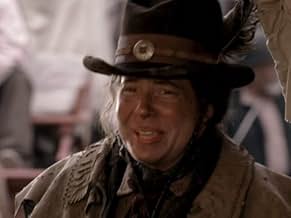


- Reverend H.W. Smith
- (as Raymond McKinnon)

Avis en vedette
not your grandpa-John-Wayne western - not even spaghetti style - the grit pours off the screen
This is an ensemble though, so while one might expect Bill Hickock to be the star, he's only a part of what goes on in this 'town' of Deadwood: there's the guy nicknamed 'Montana' who used to be a lawman (the show opens with him having to decide what to do with a criminal in front of a posse) and his partner (Timothy Olyphant and John Hawks respectively) who want to open up a hardware shop; Jane, who we don't really know until another episode or so if she is a she (she first comes off so boyish it's androgynous); the town Doctor (Brad Dourif, my favorite actor of the bunch) clinging to doing right much as he can; and Mr. Al Swearengen, who runs the local saloon/gambling joint/whore-house, and gets Ian McShane as the actor. And boy how does he!
In a lot of ways Deadwood is set up in the pilot like a Western- noir, or really about the low-down criminal activities and Machiavellian power-plays that Al is up to, and while crimes do get committed - a big one, involving a slaughter of a foreign family traveling eastbound, will be driving the rest of the narrative for the season - and it's this that makes the show so compelling. It's not just about having men pull their guns to settle things; it's about money, about how much a place costs or what kind of deal you can get on a gold claim and the pitfalls with that; how, if you want to stay ahead of the game, you got to watch what goes on in town from on high (as Al seems to do whenever he can). There's a constant tension that things can go down/bad quickly in this place, and it comes from the mood of the characters and the dirt and muck of the setting. It may not be THE west as it really was, but there's an authenticity that's seen and felt to dress, look of the faces, the primitive qualities of a place that is technically off the 'grid' as far as a territory goes in 1876.
It's tempting to also draw a correlation as this being an HBO show from this period with The Sopranos; it's hard to see this show existing without the success of that, allowing for hardcore crime shows such as this (it is really a crime show, perhaps, in the guise of a Western, or the other way around). And Al is the key thing - he's the Boss and brings fear and respect to those around him (sometimes both), and yet has a charismatic air that makes him how he is: how can he run roughshod over these women under him, or that they stay under his rule after he, say, beats one and strangles one (Trixie) into submission? Why do people defy him if they know he can squash them like a bug? The stakes get set in a way without direct contact between Al and Bill and Seth Bullock meeting (though Bill and Bullock do go out to the scene of the massacre/gun-fight it in the last part). We know this guy is the villain, but the power of him, and in McShane's performance, is that we understand him, everything he's after - money, power, control, keeping things in their place without things going TOO off the rails - and has a little more brain than most.
Also, the bark is as bad as his bite, or worse. One last thing to comment on is the language, how much profanity is used (especially a certain C-sucker line that is thrown about almost as much as the F- word). Why so much of this? Is there a poetry to all of this? I think so, otherwise it would be gratuitous. In a way I was torn in this regard (more-so in the subsequent episodes of season 1 than in the pilot); is the cursing a substitute for action? These characters are more than capable - they do - in kicking a** and taking names and so on. And yet these people do have individual voices, and I never got the sense that Milch had everyone talking exactly the same, which is an important distinction.
So, Deadwood gets off to a bloody, filthy start, with only little bits of humor (gallows type, no pun intended). If you think that sounds like your kind of thing, dig in. If not... give it a chance anyway, and the performances may win you over.
A brilliant introduction
A stylish beginning for this series.
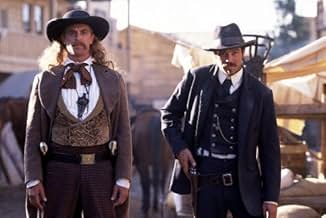
Timothy Olyphant takes center stage as Seth Bullock, a former Montana lawman who moves to Deadwood, South Dakota, to open a hardware store with his business partner Sol Star (John Hawkes). Soon after, a legendary name arrives in town: the gunfighter Wild Bill Hickok (Keith Carradine), along with an entourage that includes Calamity Jane (Robin Weigert). Among the people to whom we're introduced is local mover & shaker Al Swearengen (Ian McShane), a tough, potty-mouthed saloon owner.
This rich cast also includes Molly Parker, Jim Beaver, Brad Dourif, Paula Malcomson, Leon Rippy, William Sanderson, W. Earl Brown, Jeffrey Jones, Garret Dillahunt, Ray McKinnon, and Peter Jason, and the script allows many of them time to make a vivid impression. Olyphant does some effective underplaying, allowing for veteran talents like McShane and Carradine to dominate the screen in showy roles.
Directed by longtime feature film action specialist Walter Hill ("48 Hrs.", "The Warriors", "Extreme Prejudice", etc.), this is complex, intelligent, absorbing material that was well-researched and definitely feels authentic, through and through. If you pay enough attention, you see interesting things happening in the background (like a graphic, 19th century incarnation of dentistry). Solid entertainment overall.
Eight out of 10.
I enjoy the way you lie
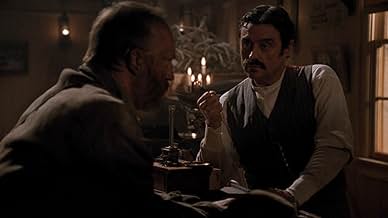
The town is run by Al Swearengen (played by Ian McShane), a ruthless saloon owner who controls everything in Deadwood. Swearengen is a fascinating character, and McShane's performance is outstanding. He is a complex character who can be charming and violent at the same time.
The episode also introduces us to other important characters, such as Wild Bill Hickok (played by Keith Carradine), a famous gunslinger who has come to Deadwood to gamble, and Calamity Jane (played by Robin Weigert), a tough and outspoken woman who becomes Hickok's friend.
Overall, "Deadwood" is a great start to the series. The writing is sharp, the acting is superb, and the setting is stunning. The show captures the lawlessness and brutality of the old west while also exploring the complex relationships between the characters. If you're a fan of westerns or just great television, "Deadwood" is a must-watch.


Le saviez-vous
- AnecdotesThe set of Deadwood's Main Street was reused with very little alterations for Django déchaîné (2012) and Westworld (2016).
- GaffesWhen Bullock and Star are unloading their wagon, and the guy keeps yelling at them to hurry up, Bullock grabs the last bag off of the wagon. When the camera cuts back to the wagon, there are now several bags still unloaded.
- Citations
Ellsworth: I may have fucked up my life flatter'n hammered shit, but I stand here before you today beholden to no human cocksucker, and holdin' a workin' fuckin' gold claim, and not the U.S. government tellin' me I'm trespassin', or the savage fuckin' red man or any of these other limber-dick cocksuckers passin' themselves off as prospectors had better try and stop me.
- ConnexionsFeatured in The 56th Annual Primetime Emmy Awards (2004)
- Bandes originalesTheme From Deadwood
(uncredited)
Written by David Schwartz
Performed by James Parks
Meilleurs choix
Détails
- Durée
- 1h 2m(62 min)
- Couleur
- Mixage
- Rapport de forme
- 1.78 : 1