NOTE IMDb
7,4/10
14 k
MA NOTE

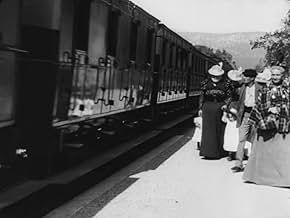
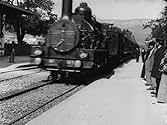
Ajouter une intrigue dans votre langueA train arrives at La Ciotat station.A train arrives at La Ciotat station.A train arrives at La Ciotat station.



7,413.7K
1
2
3
4
5
6
7
8
9
10
Avis à la une
One of the Most Enduring Images Of Cinema's Earliest Years
This footage of the "Arrival of a Train" is one of the most enduring images of the earliest years of cinema. The often-repeated accounts of the startled reactions to this movie from early audiences, along with the ways that such reactions were commemorated in other early movies such as "The Countryman and the Cinematograph", have made it one of the best-known of the earliest movies, and beyond that, the film in itself accomplishes its own aim very well.
The Lumières discovered very quickly how effective motion towards the camera could be, and that idea is certainly used to good effect here. The diagonal direction of the motion, necessitated by the material being filmed, gives it a distinctive character. Compared with the train, the crowd reactions here are a bit less interesting than they are in some of the other Lumière features that include crowds who know they are being filmed. A couple of them do acknowledge the camera as they go about their business.
Yet even today, the train grabs the viewer's notice, so that the crowd and other details get much less attention. That in itself shows how effectively this enduring classic was able to carry out an interesting idea.
The Lumières discovered very quickly how effective motion towards the camera could be, and that idea is certainly used to good effect here. The diagonal direction of the motion, necessitated by the material being filmed, gives it a distinctive character. Compared with the train, the crowd reactions here are a bit less interesting than they are in some of the other Lumière features that include crowds who know they are being filmed. A couple of them do acknowledge the camera as they go about their business.
Yet even today, the train grabs the viewer's notice, so that the crowd and other details get much less attention. That in itself shows how effectively this enduring classic was able to carry out an interesting idea.
10jhaugh
A moving train - voila
Having invented a hand-cranked, motion-picture camera during the year 1894 - and making films that could be exhibited to scientific groups during the early months of 1895; Louis Lumiere was a driven man. During one exhibition of the Cinematograph at the Societe d'Encouragement pour l'Industrie Nationale, he met an engineer (Jules Carpentier) who wished to manufacture the invention for selling in Paris. Louis accepted the proposal. Initial production would be 25 units. They would be professionally manufactured as opposed to the inventors experimental camera. Louis continued to use this camera to gather enough views for a public presentation at the end of the year.
There were a number of problems in producing the first prototype of the twenty-five units. Even when Louis, exhausted, took some rest-and-relaxation at the Lumiere's vacation house in the town of le Ciotat (pronounced see-oh-tah), he could not relax; and remained in constant communication with Jules in Paris. Louis was able to communicate on a daily basis with Jules because the mail trains of "le P.L.M. (Paris-Lyon-Mediterranee)" railway provided him with a means of staying in touch as well as providing his transportation between Lyon and la Ciotat.
Still driven by his work, he decided to go to the station and use the arriving train as one of his subjects. Perhaps wanting to assure that there would be plenty of action to record on the station platform, he took along his mother, his wife, and his two children along with their nanny. They all ventured forth, on a bright sunshiny Mediteranean day - la Ciotat is on the southern coast of France, between Marseille and Toulon, where people came to sunbathe and fish - the group ventured forth to the train station on the northern edge of the town with the verdant foothills of the Alpes de Provence providing a backdrop to the railroad.
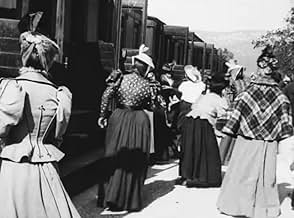
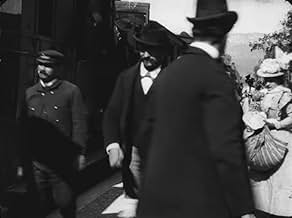
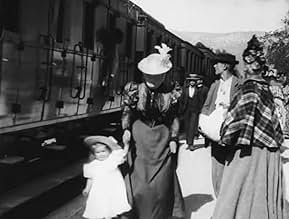
Louis' wife, in a neck-to-foot elegant dress with a pristine white bonnet, and the nanny were instructed to run around the platform and appear as if they were trying to locate an expected-arriver as the train ground to a halt. The mother, in a shawl, would quietly observe - as a good matriarch should. Louis could not position his camera and let the train chug from right to left across the view because he would just capture a blur. He positioned it very near the track so the train would be seen in its entire length; and then rattle by very close to the viewer. The station personnel, in uniform, would hold back the crowd of departing people on the platform until the train had halted.
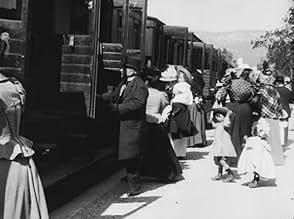
So the train arrives; locomotive and tender pass to the left of the camera followed by a mail car and a string of passenger cars. Louis has been cranking since the train was in good view. The crowd on platform can be restrained no more. They break ranks and move to the platform edge, ready to board, as the train stops. The two women with children in hand bustle about looking for someone. The matriarch stands still - observing. A young, and unscripted, peasant lad wanders about seemingly unsure as to where he should go to find his car. Dazed by the adventure of his first train ride? Then the doors open (on the French railway equipment the compartments are entered/exited directly to the platform.) Passengers begin to detrain. Louis has run out of film and stops cranking.
The first railroad train to star in a movie prepares to move on to Toulon (on schedule no doubt.)
There were a number of problems in producing the first prototype of the twenty-five units. Even when Louis, exhausted, took some rest-and-relaxation at the Lumiere's vacation house in the town of le Ciotat (pronounced see-oh-tah), he could not relax; and remained in constant communication with Jules in Paris. Louis was able to communicate on a daily basis with Jules because the mail trains of "le P.L.M. (Paris-Lyon-Mediterranee)" railway provided him with a means of staying in touch as well as providing his transportation between Lyon and la Ciotat.
Still driven by his work, he decided to go to the station and use the arriving train as one of his subjects. Perhaps wanting to assure that there would be plenty of action to record on the station platform, he took along his mother, his wife, and his two children along with their nanny. They all ventured forth, on a bright sunshiny Mediteranean day - la Ciotat is on the southern coast of France, between Marseille and Toulon, where people came to sunbathe and fish - the group ventured forth to the train station on the northern edge of the town with the verdant foothills of the Alpes de Provence providing a backdrop to the railroad.
Louis' wife, in a neck-to-foot elegant dress with a pristine white bonnet, and the nanny were instructed to run around the platform and appear as if they were trying to locate an expected-arriver as the train ground to a halt. The mother, in a shawl, would quietly observe - as a good matriarch should. Louis could not position his camera and let the train chug from right to left across the view because he would just capture a blur. He positioned it very near the track so the train would be seen in its entire length; and then rattle by very close to the viewer. The station personnel, in uniform, would hold back the crowd of departing people on the platform until the train had halted.
So the train arrives; locomotive and tender pass to the left of the camera followed by a mail car and a string of passenger cars. Louis has been cranking since the train was in good view. The crowd on platform can be restrained no more. They break ranks and move to the platform edge, ready to board, as the train stops. The two women with children in hand bustle about looking for someone. The matriarch stands still - observing. A young, and unscripted, peasant lad wanders about seemingly unsure as to where he should go to find his car. Dazed by the adventure of his first train ride? Then the doors open (on the French railway equipment the compartments are entered/exited directly to the platform.) Passengers begin to detrain. Louis has run out of film and stops cranking.
The first railroad train to star in a movie prepares to move on to Toulon (on schedule no doubt.)
Truly Historical, But Not The First Film
The other reviewers are correct that this is a remarkable piece of history, but it is not the first movie. What film earns that honor depends partly on how you define movies. If you consider Edison's Kinetoscope shorts to be movies, the first movies were from 1893. And even before Edison, there had been some experimentation with projected motion pictures. Even if you give the Lumiere brothers credit for inventing the form (which is a very reasonable decision, but not an inevitable one), I believe their first film was "Workers Leaving The Factory" (aka " Sortie des usines Lumière, La (1895) ") Also, according to the "Oxford History of World Cinema", reports that terrified audience members hid under their seats when the film was first shown are probably apocryphal. Still, this (and the Lumiere brothers other early shorts) are well worth seeing for anyone who loves movies.
Interesting to note change of angle
I watched this film on a DVD that was rammed with short films from the period. I didn't watch all of them as the main problem with these type of things that their value is more in their historical novelty value rather than entertainment. So to watch them you do need to be put in the correct context so that you can keep this in mind and not watch it with modern eyes. With the Primitives & Pioneers DVD collection though you get nothing to help you out, literally the films are played one after the other (the main menu option is "play all") for several hours. With this it is hard to understand their relevance and as an educational tool it falls down as it leaves the viewer to fend for themselves, which I'm sure is fine for some viewers but certainly not the majority. What it means is that the DVD saves you searching the web for the films individually by putting them all in one place but that's about it.
Anyway onto this film which is the continuation of the understandable Lumière standard of standing a camera pointing at an event and then recording it happen. In this case a train pulls into a station and people get out. In terms of action it is not that interesting but in regards history of cinema it does offer something at least. It struck me that the other films from Lumiere I had seen to this point had point head on at the action whereas this one was set so that we had a wider view and that things played out across the screen towards the viewer. Also amusing is that some people become awkward when they notice the camera whereas other just bluster in front of it unaware.
The usual fare then that produces little of interest in terms of actual content but has more of interest when viewed in its historical and cultural context.
Anyway onto this film which is the continuation of the understandable Lumière standard of standing a camera pointing at an event and then recording it happen. In this case a train pulls into a station and people get out. In terms of action it is not that interesting but in regards history of cinema it does offer something at least. It struck me that the other films from Lumiere I had seen to this point had point head on at the action whereas this one was set so that we had a wider view and that things played out across the screen towards the viewer. Also amusing is that some people become awkward when they notice the camera whereas other just bluster in front of it unaware.
The usual fare then that produces little of interest in terms of actual content but has more of interest when viewed in its historical and cultural context.
Not the Last Stop, but the First
At just under a minute, L'Arrivée d'un train à La Ciotat (1895) is one of Louis Lumiere's earliest excursions into film-making. As was formulaic with what he called "actualités," or non-narrative shorts, Louis Lumiere set up his cinematographe (a portable crank-handled camera that triples as a film projector and developer) at such an accomplished angle as to catch the arrival of a train at La Ciotat, where it captures the bustling comers-and-goers of the station who happen to stray in front of the lens, looking altogether curious, or else wary of the unfamiliar contraption. The crowd seems lively enough, but just for good measure, Lumiere's refined wife and mother-in-law can be seen actively searching for an imaginary, but eagerly expected passenger.
As uninteresting as it is (and it IS, even for the most pretentious film buff), L'Arrivée d'un train à La Ciotat's historical appeal is undeniable, if not legendary. The film's effect upon its first public viewing is a well-worn myth told to enthusiastic film students by their professors. Apparently, initial audiences, unaware of film's capacity to fully imitate reality, fled in fear of the image of a train barreling down upon the screen. The French newspaper, Le courrier du centre, (July 14, 1896) alleged the advancing locomotive made "spectators draw back instinctively fearing they'd be run over by the steel monster." Nevertheless, such a widespread and instantaneous physical response seems foolish or naïve even then, especially when the projector would have been visible and the sound audible to all seated in what at that time passed as a "theater." In reality, it is far more likely that this incident was limited to a few isolated cases, and was later exaggerated to enhance its appeal and boost the film's reputation. Consequently, the commerciality of the venture succeeded with tremendous results. Over a hundred years later, not only is L'Arrivée d'un train à La Ciotat a cinematic icon, but proof of how powerful and impressionable moving pictures could (and would) become.
Recommended for those with an interest in film as an art form, or for those looking for early examples of film in history.
As uninteresting as it is (and it IS, even for the most pretentious film buff), L'Arrivée d'un train à La Ciotat's historical appeal is undeniable, if not legendary. The film's effect upon its first public viewing is a well-worn myth told to enthusiastic film students by their professors. Apparently, initial audiences, unaware of film's capacity to fully imitate reality, fled in fear of the image of a train barreling down upon the screen. The French newspaper, Le courrier du centre, (July 14, 1896) alleged the advancing locomotive made "spectators draw back instinctively fearing they'd be run over by the steel monster." Nevertheless, such a widespread and instantaneous physical response seems foolish or naïve even then, especially when the projector would have been visible and the sound audible to all seated in what at that time passed as a "theater." In reality, it is far more likely that this incident was limited to a few isolated cases, and was later exaggerated to enhance its appeal and boost the film's reputation. Consequently, the commerciality of the venture succeeded with tremendous results. Over a hundred years later, not only is L'Arrivée d'un train à La Ciotat a cinematic icon, but proof of how powerful and impressionable moving pictures could (and would) become.
Recommended for those with an interest in film as an art form, or for those looking for early examples of film in history.


Le saviez-vous
- AnecdotesPopular legend has it that, when this film was shown, the audience fled in terror, fearing being run over by the "approaching" train. This legend has since been identified as promotional embellishment, though there is evidence to suggest that people were astounded at the capabilities of the Lumières' cinématographe.
- ConnexionsEdited into Louis Lumière (1968)
Meilleurs choix
Connectez-vous pour évaluer et suivre la liste de favoris afin de recevoir des recommandations personnalisées
Détails
- Date de sortie
- Pays d’origine
- Langue
- Aussi connu sous le nom de
- L'arrivée d'un train en gare de La Ciotat
- Lieux de tournage
- Société de production
- Voir plus de crédits d'entreprise sur IMDbPro
- Durée
- 1min
- Couleur
- Mixage
- Rapport de forme
- 1.31 : 1
Contribuer à cette page
Suggérer une modification ou ajouter du contenu manquant