Le jour se lève
- 1939
- Tous publics
- 1h 33min
NOTE IMDb
7,6/10
8,8 k
MA NOTE

Après avoir commis un meurtre, un homme s'enferme dans son appartement et se souvient des événements qui l'ont conduit au meurtre.Après avoir commis un meurtre, un homme s'enferme dans son appartement et se souvient des événements qui l'ont conduit au meurtre.Après avoir commis un meurtre, un homme s'enferme dans son appartement et se souvient des événements qui l'ont conduit au meurtre.
- Réalisation
- Scénaristes
- Stars
- Récompenses
- 1 nomination au total


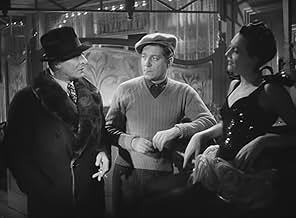



René Génin
- Le concierge
- (as Genin)

Arthur Devère
- Mr. Gerbois
- (as Arthur Devere)

René Bergeron
- Le patron du café
- (as Bergeron)


Marcel Pérès
- Paulo
- (as Peres)
Annie Cariel
- Une locataire
- (non crédité)


Georges Douking
- L'aveugle
- (non crédité)
Georges Gosset
- Un agent
- (non crédité)
7,68.7K
1
2
3
4
5
6
7
8
9
10
Avis à la une
Before the flood.
That was one of the last French masterpieces of the thirties just before the war.Marcel Carné was accused of pessimism and the movie was quickly forbidden by the military censorship that used to say in 1940:"if we've lost the war,blame it on "Quai des Brumes""(Carné's precedent movie.The director answered:"you do not blame a barometer for the storm"). "Le jour se lève " is,if it's possible,darker than its predecessor. From the very beginning,the hero,a good guy (Gabin) is doomed,his fate is already sealed,because the tragedy has already happened .That's why the movie is a long flashback.The memories are brought back on the screen with an astounding virtuosity by some elements of the set (the teddy bear for instance).Only three main characters outside that of Gabin,the evil one (Berry who was to play the devil in "les visiteurs du soir "1942),the lucid one (Arletty) and the ambiguous one (Jacqueline Laurent).The latter provides
the only flaw of the movie:Laurent acts Françoise as the innocent pure girl,however Carné leaves no doubt about her relations with Berry. A remake was made by Anatole Litvak with Henry Fonda ,Barbara Bel Geddes and Ann Dvorak (who must have been studying Arletty's acting for a long while),called "the long night" with an absurd happy end. Needless to say,it's the French Carné movie that you've got to see!
the only flaw of the movie:Laurent acts Françoise as the innocent pure girl,however Carné leaves no doubt about her relations with Berry. A remake was made by Anatole Litvak with Henry Fonda ,Barbara Bel Geddes and Ann Dvorak (who must have been studying Arletty's acting for a long while),called "the long night" with an absurd happy end. Needless to say,it's the French Carné movie that you've got to see!
What is it about French films that makes them so special?
There is something so lyrical about the tale of the doomed François portrayed by the great Jean Gabin that even in its hardest luck moments you feel you are watching poetry in motion.
In addition, Le Jour se Leve is a character study with all the contradictions that tend to go with pained souls like François' - except that there is a further depth that renders the film quite universal, a depth made of little moments in human relationships and the flaws that gently emerge but only renders the humans involved more endearing.
Still, all that glitters is not gold: the apparently pure Françoise has actually been bedded by M. Valentin (Berry); and the police are more interested in getting their man than in saving him.
The direction is precise and inspired, resorting to the then much used flashback technique but never allowing it to dominate the film.
The photography - well, it is gorgeous and it gives the film its expressionistic ambiance. Finally, Gabin - one of the greatest actors ever in one of his greatest roles. Need one say more?
The ending can be predicted from the moment François kills a visitor in his apartment but that aside it is a film full of cinematographic treasures, acting to gape at, and a quality of direction that is seldom seen these days. A must see for anyone who cares about movies.
In addition, Le Jour se Leve is a character study with all the contradictions that tend to go with pained souls like François' - except that there is a further depth that renders the film quite universal, a depth made of little moments in human relationships and the flaws that gently emerge but only renders the humans involved more endearing.
Still, all that glitters is not gold: the apparently pure Françoise has actually been bedded by M. Valentin (Berry); and the police are more interested in getting their man than in saving him.
The direction is precise and inspired, resorting to the then much used flashback technique but never allowing it to dominate the film.
The photography - well, it is gorgeous and it gives the film its expressionistic ambiance. Finally, Gabin - one of the greatest actors ever in one of his greatest roles. Need one say more?
The ending can be predicted from the moment François kills a visitor in his apartment but that aside it is a film full of cinematographic treasures, acting to gape at, and a quality of direction that is seldom seen these days. A must see for anyone who cares about movies.
simple story
sentimental, far to be great, almost common. but seductive under the science of Carne to give delicate nuances to flash backs, to transform scenes in little gems. and, in same measure, the art of Prevert to transform each detail in a precise piece of puzzle. a film about love and innocence. about a kind of Mephisto - remarkable performance of Berry - and delicate lights of role in Jacqueline Laurent performance. but, in many aspects, a film of Arletty and Jean Gabin. not a surprise. the names of director and scriptwriter are basic guarantees for a remarkable work. but, after so many years, like many other films," Le jour se leve" has more seductive sparkles and great profound value.
A tragedy of everyday proportions
We see a man shot; who he is and why we don't know. The murderer has locked himself inside his room. Police are forced to shoot in, trying to get him to surrender. The story then proceeds in flashback.
Marcel Carné directs this famous French film starring Jean Gabin. The two had worked together the previous year on "Le quai des brumes", a film well known then and now. If you are unfamiliar with Gabin, he was to the late 1930's in France what Bogey would be shortly in America, only Bogey with a soupçon of Cagney. More animated than Bogart, but less than Cagney with his agile song-and-dance-man side. A tough guy who's actually a good guy.
Now, a soft-hearted tough guy who's surrounded by police -- that could also describe Bogart's breakthrough film, "High Sierra", from 1941, and perhaps there is some superficial similarity.
However, this story is mostly a tale of love affairs and working class life -- that's really where its interest lies. There's a real sympathy here for the common man, when even a modest house on a rutted street would seem beyond his reach.
This film's original reputation may have been based at least in part on its Gallic openness about sexual matters. It's quite outré by the Anglo-Saxon standards of 1939. Regardless, the justly celebrated "Le jour se lève" has a poetic quality overall, and a memorably ironic final shot of the kind we don't seem to see quite often enough anymore.
Marcel Carné directs this famous French film starring Jean Gabin. The two had worked together the previous year on "Le quai des brumes", a film well known then and now. If you are unfamiliar with Gabin, he was to the late 1930's in France what Bogey would be shortly in America, only Bogey with a soupçon of Cagney. More animated than Bogart, but less than Cagney with his agile song-and-dance-man side. A tough guy who's actually a good guy.
Now, a soft-hearted tough guy who's surrounded by police -- that could also describe Bogart's breakthrough film, "High Sierra", from 1941, and perhaps there is some superficial similarity.
However, this story is mostly a tale of love affairs and working class life -- that's really where its interest lies. There's a real sympathy here for the common man, when even a modest house on a rutted street would seem beyond his reach.
This film's original reputation may have been based at least in part on its Gallic openness about sexual matters. It's quite outré by the Anglo-Saxon standards of 1939. Regardless, the justly celebrated "Le jour se lève" has a poetic quality overall, and a memorably ironic final shot of the kind we don't seem to see quite often enough anymore.
Great and unique storytelling makes great and unique movie.
Thing that this movie is best known and appreciated for is its unique way of storytelling. It's one of the very first movies that features a story that gets mostly told with flashbacks and it keeps switching back between past and present. This storytelling technique was later made more famous and popular by Orson Welles with his masterpiece "Citizen Kane".
But of course a movie requires a bit more than just some good storytelling, though it still remains a very important aspect. But this movie also has a great, quite simplistic movie, with still a lot happening in it, like only the French could make. It's a bit of a sweet love-story, that shows the events leading up to a fatal shooting. Some people will call this movie slow but hey, that was just the way movies were back in its days. But it's not like it's slow pace ever makes the movie a boring or dragging one, or at least not to me. It might had been the case if the movie had been a bit longer but with its running time around 90 minutes, it's simply a short movie to watch.
It's also one beautiful looking movie, that features some great cinematography and especially lighting. Shadows play in important part in the movie its visual look. Amazing thing about its cinematography is that the movie actually had 4 different cinematographers attached to it. No idea what the story is behind this but I guess that each used their own specialty for this movie, or some of them simply got fired or stepped up during production. Anyway, whatever was the case, it really didn't hurt the movie its visual look. Marcel Carné movies often were visually a real pleasure to watch and this movie forms no exception on this.
It's also a movie that quite heavily relies on its actors to tell its story and to deliver its great dialog, that got specially written by poet scenarist and songwriter Jacques Prévert. And this movie luckily had some great actors to work with. At the time Jean Gabin really was one of the best French actors. He really did his best work in the '30's and starred in some other classics such as "Pépé le Moko" and "La grande illusion" during the same decade.
Some great and unique storytelling equals a great and unique movie.
9/10
http://bobafett1138.blogspot.com/
But of course a movie requires a bit more than just some good storytelling, though it still remains a very important aspect. But this movie also has a great, quite simplistic movie, with still a lot happening in it, like only the French could make. It's a bit of a sweet love-story, that shows the events leading up to a fatal shooting. Some people will call this movie slow but hey, that was just the way movies were back in its days. But it's not like it's slow pace ever makes the movie a boring or dragging one, or at least not to me. It might had been the case if the movie had been a bit longer but with its running time around 90 minutes, it's simply a short movie to watch.
It's also one beautiful looking movie, that features some great cinematography and especially lighting. Shadows play in important part in the movie its visual look. Amazing thing about its cinematography is that the movie actually had 4 different cinematographers attached to it. No idea what the story is behind this but I guess that each used their own specialty for this movie, or some of them simply got fired or stepped up during production. Anyway, whatever was the case, it really didn't hurt the movie its visual look. Marcel Carné movies often were visually a real pleasure to watch and this movie forms no exception on this.
It's also a movie that quite heavily relies on its actors to tell its story and to deliver its great dialog, that got specially written by poet scenarist and songwriter Jacques Prévert. And this movie luckily had some great actors to work with. At the time Jean Gabin really was one of the best French actors. He really did his best work in the '30's and starred in some other classics such as "Pépé le Moko" and "La grande illusion" during the same decade.
Some great and unique storytelling equals a great and unique movie.
9/10
http://bobafett1138.blogspot.com/


Le saviez-vous
- AnecdotesWhile not the first film to use dissolves to represent flashbacks, it was considered too new a method in the language of cinema that its producers' insisted on pre-title cards to avoid any confusion.
- Citations
M. Valentin: You're the type women fall in love with . . . I'm the type that interests them.
- ConnexionsFeatured in Un compositeur pour le cinéma: Maurice Jaubert (1985)
Meilleurs choix
Connectez-vous pour évaluer et suivre la liste de favoris afin de recevoir des recommandations personnalisées
- How long is Daybreak?Alimenté par Alexa
Détails
Box-office
- Montant brut aux États-Unis et au Canada
- 35 321 $US
- Week-end de sortie aux États-Unis et au Canada
- 11 864 $US
- 16 nov. 2014
- Montant brut mondial
- 35 321 $US
- Durée
- 1h 33min(93 min)
- Couleur
- Rapport de forme
- 1.37 : 1
Contribuer à cette page
Suggérer une modification ou ajouter du contenu manquant