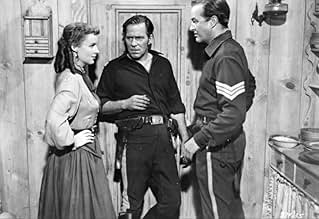
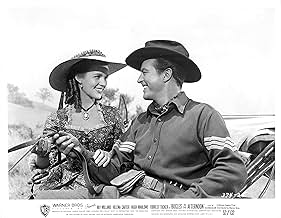
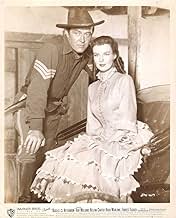
Ajouter une intrigue dans votre langueAfter violently attacking a fellow officer Lt. Edward Garnett, cavalry Captain Kern Shafter is court martialled. Later, he rejoins the army with Custer's regiment at Fort Lincoln, Dakota, be... Tout lireAfter violently attacking a fellow officer Lt. Edward Garnett, cavalry Captain Kern Shafter is court martialled. Later, he rejoins the army with Custer's regiment at Fort Lincoln, Dakota, becoming a sergeant, where he runs into his old foe.After violently attacking a fellow officer Lt. Edward Garnett, cavalry Captain Kern Shafter is court martialled. Later, he rejoins the army with Custer's regiment at Fort Lincoln, Dakota, becoming a sergeant, where he runs into his old foe.
- Réalisation
- Scénaristes
- Stars
- Woman
- (non crédité)
- Trooper
- (non crédité)
- Telegrapher
- (non crédité)
- Lt. Cooke
- (non crédité)
- Man
- (non crédité)
- Trooper
- (non crédité)
- Mrs. Carson
- (non crédité)
- Man
- (non crédité)
Avis à la une
Awkward love triangle dominates Cavalry-vs.-Indians western
There is lots of action, great location photography and numerous enjoyable western scenes of men on horseback fighting Indians and rescuing townsmen and such. Unfortunately the film is badly miscast. Ray Milland is too laidback for a role that required someone a bit younger, tougher and more embittered, like John Payne (who excelled in this kind of role in films like CAPTAIN CHINA, CROSSWINDS and PASSAGE WEST) or a bit more ramrod straight like Randolph Scott, who was making plenty of westerns for the same studio (Warner Bros.) at the time. While she's absolutely gorgeous, Helena Carter has such polished diction and precise finishing school manners that she never appears believable as a settler in this hardscrabble western territory. She never shows emotion and scolds her two would-be lovers with carefully measured words rather than letting loose a little honest fury at them for their ridiculous behavior. Hugh Marlowe excelled at playing smarmy, officious types, but he wasn't much of a tough guy and never poses a sufficiently convincing threat to the hero. Worse, there are three great actors in the supporting cast who excelled at playing heavies-Forrest Tucker, Barton MacLane, and James Millican-yet they all play nice guys here. What a waste! Tucker, in particular, seems to be auditioning for a part in a John Ford western by imitating both Ward Bond and Victor McLaglen.
Luckily, the Sioux and Cheyenne are on hand to menace the cavalry. In one of the best scenes, early in the film, Milland rides alone into a band of armed, hostile Sioux to identify and apprehend two braves wanted for murdering a trio of prospectors. Marlowe hopes the Sioux will kill him, but Milland gets his suspects and rides out unharmed. The Sioux are led by Chief Red Owl, played by Indian actor John War Eagle. The other Sioux are all played by real Indians as well. Later in the film, Sheb Wooley is seen briefly as Custer. George (Superman) Reeves has a small part as one of the cavalry officers. The film was produced by William Cagney (James's brother), directed by Roy Rowland, and written by veteran screenwriters Geoffrey Homes and Harry Brown from a novel by famed western author Ernest Haycox.
Enjoyable, Underrated 'B' Western
The cinematography and location filming are very impressive and evocative. The action scenes are exciting and well staged. The scene compositions are particularly well done. For example, in the confrontations and battles between cavalry and Indians, we often see both sides at once, in one shot, making it a lot more realistic and engrossing than cross-cutting between one side and the other.
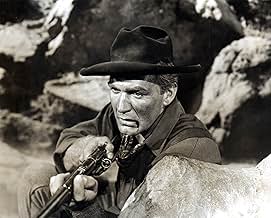
Sometimes there are moments that are gripping and even spine-tingling, such as the remorseless advance of the Indians up the cliff towards Forrest Tucker as he makes his heroic last stand.
Some of the other reviewers complained about character actor heavies such as Tucker, Barton MacLane and James Millican playing good guys, but actually it is a pleasant change seeing them in sympathetic roles.
There are many effective moments, even in brief shots, such as the ironic one when General Custer, on his way to the Little Big Horn, gives a sweeping, nonchalant bow to the woman who asks him to bring all the men home alive.
I've seen this film about five times over the last few decades, and it is still just as good!
Reasonable film adaptation of respected Little Big Horn novel
I blinked a little at Kern Shafter's appearance on arriving to enlist at Fort Abraham Lincoln; he looked extremely smart, even for the gambler he had become. I assume his motivation in rejoining the colours was nostalgia for army life,though this wasn't completely evident.
The well-known participants in the battle - Custer, Reno, Benteen - don't get much screen time, and the General himself has only a few lines. At least he looks the part, with the short hair he favoured for a hot campaign rather than his trademark long locks. Purists may raise their eyebrows at the cavalry using repeating rifles, when in fact they carried single-shot carbines, and pack-animals rather than the wagons shown supplied the troops in the general battlefield area.
But all in all, it's a reasonable cavalry Western, but not in the same league as those of John Wayne and John Ford.
"OF all the cavalry posts in the world..........."
But Milland's come back as an enlisted man in the 7th cavalry where Captain Marlowe is now assigned and there's Helena Carter to get the boys hormones a going'.
Fortunately this triangle story with the replacement apex is against the background of the fight at Little Big Horn. Lots of nice slam bang action make up for some of the sillier aspects of the romance.
Good Saturday afternoon western for those like me who like them.
A good Western, but it sure doesn't look like Montana !
Le saviez-vous
- AnecdotesWhen Ray Milland's character views the aftermath of Custer's battle at the Little Big Horn through binoculars, footage from La Charge fantastique (1941)--also a Warner Bros. film--is used.
- GaffesThe big tree is seen being felled but the shots of the wood being loaded in he wagons is obviously not from the tree as it's no where near thick enough.
- Citations
Stage Passenger: I don't for the life of me see how he does it.
Josephine Russell: He sat up all night.
Stage Passenger: Well, so did i... with a sick deck of cards. But i still can't sleep. Only wish i could. Then i wouldn't have to look at this miserable country. If i have my way about it, i'd give it back to the Indians.
Man: If we don't start looking sharp, we won't have to give it back... They'll take it.
- ConnexionsEdited from La Charge fantastique (1941)
Meilleurs choix
- How long is Bugles in the Afternoon?Alimenté par Alexa
Détails
- Durée
- 1h 25min(85 min)
- Rapport de forme
- 1.37 : 1