

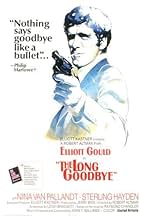
Philip Marlowe, détective privé, aide un ami à se sortir d'affaire. Mais ce faisant, il se retrouve impliqué dans le meurtre de sa femme.Philip Marlowe, détective privé, aide un ami à se sortir d'affaire. Mais ce faisant, il se retrouve impliqué dans le meurtre de sa femme.Philip Marlowe, détective privé, aide un ami à se sortir d'affaire. Mais ce faisant, il se retrouve impliqué dans le meurtre de sa femme.
- Réalisation
- Scénaristes
- Stars
- Récompenses
- 2 victoires et 1 nomination au total





Stephen Coit
- Detective Farmer
- (as Steve Coit)

Vincent Palmieri
- Vince
- (as Vince Palmieri)

Pancho Córdova
- Doctor
- (as Pancho Cordoba)


7,542.5K
1
2
3
4
5
6
7
8
9
10
Avis à la une
Marlowe, The Marlboro Man
Usually smoking, and sometimes smirking, Elliott Gould mumbles and stumbles his way through Altman's re-invention of this gumshoe novel by Raymond Chandler. The film's unexpectedly interesting ending suggests a good story, but you'd never know it from the film's plot, which rambles and meanders, seemingly without purpose, a pointless talk-fest wherein Marlowe interacts with the cops, a femme fatale, a buddy who wants to disappear, and assorted hoods and mobsters. It's all rather sordid and seedy as you would expect, except that it's brought up to date, for 1973, and in its "hipness" and sophistication becomes something of a parody of 1940's private-eye flicks. Gould's Marlowe is annoyingly smug, with a too casual manner. And I found none of the other characters to be sympathetic or likable.
The dialogue and the acting are stilted and self-conscious. In one party sequence that takes place on the beach, Dr. Verringer (Henry Gibson) insists that he get his money. The guests stand around, as if they are movie extras brought in for this one day of shooting. The viewer can easily imagine microphones just over the heads of the principal actors, and personnel just off-screen, waiting for Altman to yell: "Cut". Along with other scenes, it looks forced and staged.
The film's best attribute is its cinematography. I especially like the sequence showing human figures retreating into the surf at night. Combined with the sound of ocean waves, it makes for an interesting segment.
Some viewers love this film because of Altman's direction and Gould's performance. Others hate it because it so deviates from Chandler's original story. I personally did not like the film, mostly because of Marlowe, himself, and because of the tangled and convoluted plot, populated by loquacious characters who I found totally not interesting.
The dialogue and the acting are stilted and self-conscious. In one party sequence that takes place on the beach, Dr. Verringer (Henry Gibson) insists that he get his money. The guests stand around, as if they are movie extras brought in for this one day of shooting. The viewer can easily imagine microphones just over the heads of the principal actors, and personnel just off-screen, waiting for Altman to yell: "Cut". Along with other scenes, it looks forced and staged.
The film's best attribute is its cinematography. I especially like the sequence showing human figures retreating into the surf at night. Combined with the sound of ocean waves, it makes for an interesting segment.
Some viewers love this film because of Altman's direction and Gould's performance. Others hate it because it so deviates from Chandler's original story. I personally did not like the film, mostly because of Marlowe, himself, and because of the tangled and convoluted plot, populated by loquacious characters who I found totally not interesting.
Not one for those looking for a gripping detective story, but still interesting
Phillip Marlowe is out getting food for his cat at 3am when friend Terry Lennox pops over and asks for a lift to Mexico. Marlowe obliges but returns to his home to find the police waiting for him with stories of Terry murdering his wife and Marlowe being an accessory. Three days later he is released from a holding cell whereupon he learns the news of his friend's suicide and all charges are dropped. Determined to get to the bottom of this open and shut case, Marlowe finds himself involved in the stormy marriage of Roger and Eileen Wade and the criminal activities of Marty Augustine.
Hailed as a classic, this film is actually a bit of hard work crossed with cool style in a plot that gets somewhere but seems to take a long time and a million back roads to get there. It won't be to everyone's tastes as a result because, even though I quite liked it, I must confess that the narrative is hard to follow and hard to particularly care much about. The wit of it is watching Marlowe updated a device that will annoy as many as it pleases. In Gould's laidback and shabby detective we have the opposite of the tough and snappy detectives of the genre, but it sits well within the modern setting of the modern generation (as was) with its hedonism and fads. This is interesting but not the same as a good detective story, which sadly this isn't. If you're not won over by the overall approach then it is unlikely that you will find a lot more to fill the time.
Altman's direction is focused on the style and, although he is fairly respectful to the material in regards what happens, he doesn't go out of his way to make it engaging. Gould fits the role well and enjoys his character. I would have liked more of the complexity underneath to come through to contrast with this surface. He is the film but he is well supported by a hammy show from Sterling and solid turns from Rydell, Pallandt, Gibson and Bouton.
Overall then a difficult film to really like. It has enough of its own style to be interesting but not enough of a hook in the narrative to please a mass audience. Altman's hands are all over the film and I understand why some viewers don't like it for that reason. Not one for those looking for a gripping detective story, but still interesting.
Hailed as a classic, this film is actually a bit of hard work crossed with cool style in a plot that gets somewhere but seems to take a long time and a million back roads to get there. It won't be to everyone's tastes as a result because, even though I quite liked it, I must confess that the narrative is hard to follow and hard to particularly care much about. The wit of it is watching Marlowe updated a device that will annoy as many as it pleases. In Gould's laidback and shabby detective we have the opposite of the tough and snappy detectives of the genre, but it sits well within the modern setting of the modern generation (as was) with its hedonism and fads. This is interesting but not the same as a good detective story, which sadly this isn't. If you're not won over by the overall approach then it is unlikely that you will find a lot more to fill the time.
Altman's direction is focused on the style and, although he is fairly respectful to the material in regards what happens, he doesn't go out of his way to make it engaging. Gould fits the role well and enjoys his character. I would have liked more of the complexity underneath to come through to contrast with this surface. He is the film but he is well supported by a hammy show from Sterling and solid turns from Rydell, Pallandt, Gibson and Bouton.
Overall then a difficult film to really like. It has enough of its own style to be interesting but not enough of a hook in the narrative to please a mass audience. Altman's hands are all over the film and I understand why some viewers don't like it for that reason. Not one for those looking for a gripping detective story, but still interesting.
Altman's mischievous take on a cinema archetype
The very embodiment of '70s Hollywood genre revisionism, Robert Altman's film of The Long Goodbye stands as one of his most accessible, wittily misanthropic films, and probably the finest performance of Elliot Gould's career to date.
A warning for Raymond Chandler purists: you probably won't like this film. Altman and screenwriter Leigh Brackett had quite a task in adapting Chandler's second-last novel to the screen, for in it the 'knight errant' Phillip Marlowe comes over more like a prudish sap. Altman and Brackett have streamlined the narrative, removed peripheral characters, and crucially transformed Marlowe into a murkier, more comically ambiguous protagonist.
In Altman's and Gould's hands, Marlowe is laconically relaxed, murmuring, alternately amused and annoyed at the world. Like Chandler's hero, he is an outsider, a spectator, everywhere he goes. Unlike the literary Marlowe, Gould's character seems washed up on the shores of an unfamiliar land, his nobility as crumpled and stale as his suit.
Along for the ride are the archetypal Chandler villains and victims: self-hating celebrities, young wives trapped in loveless marriages, crooked doctors, low-rent psychopathic gangsters, bored cops, flunkies lost out of time. Typically, the milieux Marlowe moves in range from the affluence of the Malibu Colony to the cells of the County Jail. Altman, however, wishes to make a film in and about 1973; the film is shot through with the psychic reverberations of the end of hippiedom and the remoteness of the 'Me Generation'.
Another Altman touch is his openly expressed contempt for Hollywood and its conventions. As if to acknowledge the artificiality of a private detective story in the midst of 1970s Los Angeles, the film is suffused with jokey references to cinema. Bookended with 'Hooray for Hollywood', the film shows gatekeepers impersonating movie stars, characters changing their names for added class, hoods enacting movie clichés simply because that's where they learnt to behave. Even Marlowe himself refers to the artifice when talking to the cops: 'Is this where I'm supposed to say 'What's all this about?' and he says 'Shut up, I ask the questions' ?'
As for the supporting cast, Sterling Hayden shines out as the beleaguered novelist Roger Wade. There is more than a touch of Hemingway in Hayden's bluff, blustering, vulnerable old hack. Baseball champ and sportscaster Jim Bouton is casually mysterious as Marlowe's friend Terry Lennox, Laugh-In alumnus Henry Gibson is suitably greasy as Dr Verringer, actor/director Mark Rydell (best known for 'On Golden Pond') is convincingly chilling as gangster Marty Augustine, and Nina van Pallandt lends a dignified, defiant pathos to her role as Eileen Wade.
Special note must be made of Vilmos Zsigmond's tremendous photography, employing his early 'flashing' style of exposure to lend Los Angeles a suitably sultry, bleached-out aura. Also deserving attention is John Williams' ingeniously minimalist score. Comprised solely of pseudo-source music, the score is a myriad of variations on a single song, appearing here as supermarket muzak, there as a party singalong, elsewhere as a late night radio tune.
The film's controversial ending is utterly antithetical to Chandler's vision. The message from Altman, however, is loud and clear: Chandler's world no longer exists if indeed it ever did.
A warning for Raymond Chandler purists: you probably won't like this film. Altman and screenwriter Leigh Brackett had quite a task in adapting Chandler's second-last novel to the screen, for in it the 'knight errant' Phillip Marlowe comes over more like a prudish sap. Altman and Brackett have streamlined the narrative, removed peripheral characters, and crucially transformed Marlowe into a murkier, more comically ambiguous protagonist.
In Altman's and Gould's hands, Marlowe is laconically relaxed, murmuring, alternately amused and annoyed at the world. Like Chandler's hero, he is an outsider, a spectator, everywhere he goes. Unlike the literary Marlowe, Gould's character seems washed up on the shores of an unfamiliar land, his nobility as crumpled and stale as his suit.
Along for the ride are the archetypal Chandler villains and victims: self-hating celebrities, young wives trapped in loveless marriages, crooked doctors, low-rent psychopathic gangsters, bored cops, flunkies lost out of time. Typically, the milieux Marlowe moves in range from the affluence of the Malibu Colony to the cells of the County Jail. Altman, however, wishes to make a film in and about 1973; the film is shot through with the psychic reverberations of the end of hippiedom and the remoteness of the 'Me Generation'.
Another Altman touch is his openly expressed contempt for Hollywood and its conventions. As if to acknowledge the artificiality of a private detective story in the midst of 1970s Los Angeles, the film is suffused with jokey references to cinema. Bookended with 'Hooray for Hollywood', the film shows gatekeepers impersonating movie stars, characters changing their names for added class, hoods enacting movie clichés simply because that's where they learnt to behave. Even Marlowe himself refers to the artifice when talking to the cops: 'Is this where I'm supposed to say 'What's all this about?' and he says 'Shut up, I ask the questions' ?'
As for the supporting cast, Sterling Hayden shines out as the beleaguered novelist Roger Wade. There is more than a touch of Hemingway in Hayden's bluff, blustering, vulnerable old hack. Baseball champ and sportscaster Jim Bouton is casually mysterious as Marlowe's friend Terry Lennox, Laugh-In alumnus Henry Gibson is suitably greasy as Dr Verringer, actor/director Mark Rydell (best known for 'On Golden Pond') is convincingly chilling as gangster Marty Augustine, and Nina van Pallandt lends a dignified, defiant pathos to her role as Eileen Wade.
Special note must be made of Vilmos Zsigmond's tremendous photography, employing his early 'flashing' style of exposure to lend Los Angeles a suitably sultry, bleached-out aura. Also deserving attention is John Williams' ingeniously minimalist score. Comprised solely of pseudo-source music, the score is a myriad of variations on a single song, appearing here as supermarket muzak, there as a party singalong, elsewhere as a late night radio tune.
The film's controversial ending is utterly antithetical to Chandler's vision. The message from Altman, however, is loud and clear: Chandler's world no longer exists if indeed it ever did.
Fairly engrossing, with a pretty hard-edged cat
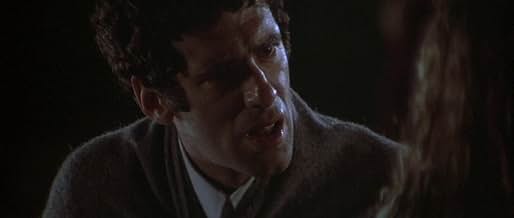
I like the hard-to-solve mystery we get here. Actually, they don't even come close to giving us enough clues to solve it, hence the difficulty. But in that we feel we're up against it like the protagonist, detective Phil Marlowe, played by Elliot Gould.
Times have really changed for Marlowe since 1946, when he was played by Humphrey Bogart. Then he was cool, implacable, wore a fedora a lot, and wound up with babe Lauren Bacall. That was the only strain of the plot viewers could follow. There were some dead bodies, smoking guns, and tough questions from cops along the way.
In this movie it's 1973, and Marlowe still think he's cool but that opinion is not so widespread this time - he's being played for a sucker by at least half the cast, including a longtime friend, and his own cat. He unravels the mystery mostly out of a lack of having anything better to do, which he clearly stood in need of.
Director Robert Altman follows his own ideas about how to communicate visually. Like when he changes scene to a hospital, he doesn't do any kind of establishing long shot, he shows a closeup of a light over a patient's bed. His montages create a kind of equivalent of our human experience, where we use our minds to focus on detail. He usually winds up with scenes that feel like we're watching something actually happen. But he does know how to use visuals for dramatic power when he wants, as the ending makes clear.
Some of the performances he gets from actors are amazing, like Mark Rydell as psychotically dangerous gangster Marty Augustine. The way he works himself into a rage with his rants changes gears from funny to frightening at high speed, and I can't believe it didn't influence Joe Pesci's performance in "Goodfellas."
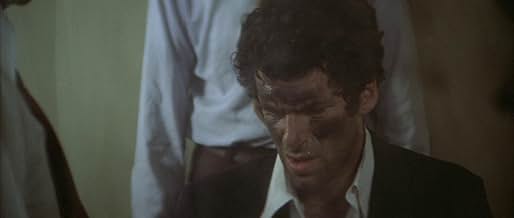
Not everything works here, like Gould smearing fingerprint ink on his face then breaking into Al Jolson at police headquarters, but on the whole a fairly engrossing take on detective mysteries.
Times have really changed for Marlowe since 1946, when he was played by Humphrey Bogart. Then he was cool, implacable, wore a fedora a lot, and wound up with babe Lauren Bacall. That was the only strain of the plot viewers could follow. There were some dead bodies, smoking guns, and tough questions from cops along the way.
In this movie it's 1973, and Marlowe still think he's cool but that opinion is not so widespread this time - he's being played for a sucker by at least half the cast, including a longtime friend, and his own cat. He unravels the mystery mostly out of a lack of having anything better to do, which he clearly stood in need of.
Director Robert Altman follows his own ideas about how to communicate visually. Like when he changes scene to a hospital, he doesn't do any kind of establishing long shot, he shows a closeup of a light over a patient's bed. His montages create a kind of equivalent of our human experience, where we use our minds to focus on detail. He usually winds up with scenes that feel like we're watching something actually happen. But he does know how to use visuals for dramatic power when he wants, as the ending makes clear.
Some of the performances he gets from actors are amazing, like Mark Rydell as psychotically dangerous gangster Marty Augustine. The way he works himself into a rage with his rants changes gears from funny to frightening at high speed, and I can't believe it didn't influence Joe Pesci's performance in "Goodfellas."
Not everything works here, like Gould smearing fingerprint ink on his face then breaking into Al Jolson at police headquarters, but on the whole a fairly engrossing take on detective mysteries.
Unfocussed but ultimately quite interesting and entertaining.
Private investigator Philip Marlowe is approached by a friend, Terry Lennox, who is in a bit of a jam. Marlowe helps him get to Mexico but the next day his friend's wife turns up dead. The police hold Marlowe but then release him once Terry Lennox is found dead in Mexico - suicide. To the cops it is an open-and-shut case of murder-suicide but Marlowe doesn't believe that to be the case. Marlowe then is hired by the wife of wealthy author Roger Wade to find her husband. The Wades were neighbours of the Lennoxes. A powerful mob boss also leans on him to find the large sum of money Terry Lennox was transporting for him. Could all these events be connected?
Robert Altman directs a movie based on a Raymond Chandler novel, and it's a mixed bag.
Starts off very well with some humorous scenes and dialogue and a fair amount of intrigue. The middle-to-end sections lack focus, however, and, while it is never dull, the movie feels like it is drifting to a lacklustre conclusion. The intrigue just seems to get sucked out of the movie in that segment. In addition, the theme song gets played in just about every situation and in various forms - it gets very irritating, very quickly.
Ends well though, with a good twist and a powerful conclusion.
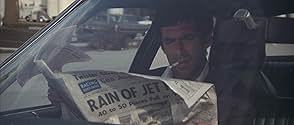
A new take on Philip Marlowe from Elliott Gould - he is hardly Humphrey Bogart and he's not trying to be. Altman's Philip Marlowe is the dishevelled, anti-social chain-smoking anti-hero rather than the suave, confident hero that Bogart portrayed. For the most part, it works, though at times I wished for the coolness and wise-cracks of Bogie.
Supporting cast are fine. Sterling Hayden is great as the larger-than-life, Ernest Hemingway/John Huston-esque Roger Wade.
Not the Philip Marlowe of the Bogart movies, but it'll do.
Robert Altman directs a movie based on a Raymond Chandler novel, and it's a mixed bag.
Starts off very well with some humorous scenes and dialogue and a fair amount of intrigue. The middle-to-end sections lack focus, however, and, while it is never dull, the movie feels like it is drifting to a lacklustre conclusion. The intrigue just seems to get sucked out of the movie in that segment. In addition, the theme song gets played in just about every situation and in various forms - it gets very irritating, very quickly.
Ends well though, with a good twist and a powerful conclusion.
A new take on Philip Marlowe from Elliott Gould - he is hardly Humphrey Bogart and he's not trying to be. Altman's Philip Marlowe is the dishevelled, anti-social chain-smoking anti-hero rather than the suave, confident hero that Bogart portrayed. For the most part, it works, though at times I wished for the coolness and wise-cracks of Bogie.
Supporting cast are fine. Sterling Hayden is great as the larger-than-life, Ernest Hemingway/John Huston-esque Roger Wade.
Not the Philip Marlowe of the Bogart movies, but it'll do.


Le saviez-vous
- AnecdotesThe location for Roger Wade - Sterling Hayden's home was actually Robert Altman's home at the time.
- GaffesWhen Marty Augustine and his henchmen are forcing Marlowe to get naked, Arnold Schwarzenegger looks straight into the camera for a full second when he is about to take his pants off.
- Citations
Philip Marlowe: Nobody cares but me.
Terry Lennox: Well that's you, Marlowe. You'll never learn, you're a born loser.
Philip Marlowe: Yeah, I even lost my cat.
- ConnexionsEdited into El adios largos (2013)
- Bandes originalesThe Long Goodbye
by John Williams and Johnny Mercer
Performed by The Dave Grusin Trio, Jack Sheldon, Clydie King, Jack Riley, Morgan Ames, Aluminum Band, The Tepoztlan Municipal Band
Meilleurs choix
Connectez-vous pour évaluer et suivre la liste de favoris afin de recevoir des recommandations personnalisées
Détails
- Date de sortie
- Pays d’origine
- Langues
- Aussi connu sous le nom de
- Un largo adiós
- Lieux de tournage
- 2178 High Tower Drive, Hollywood, Los Angeles, Californie, États-Unis(Marlowe's residence)
- Sociétés de production
- Voir plus de crédits d'entreprise sur IMDbPro
Box-office
- Budget
- 1 700 000 $US (estimé)
- Montant brut mondial
- 27 504 $US
Contribuer à cette page
Suggérer une modification ou ajouter du contenu manquant