Bust-Out
- Épisode diffusé le 19 mars 2000
- TV-MA
- 59min

Ajouter une intrigue dans votre langueWith the Feds closing in, Tony and Richie bust out a debtor's sporting-goods store as pressure at home and within the crew mounts.With the Feds closing in, Tony and Richie bust out a debtor's sporting-goods store as pressure at home and within the crew mounts.With the Feds closing in, Tony and Richie bust out a debtor's sporting-goods store as pressure at home and within the crew mounts.
- Réalisation
- Scénaristes
- Stars

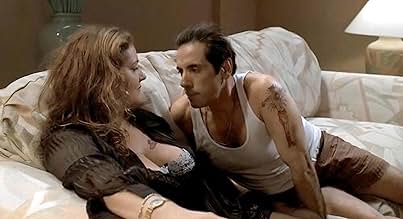
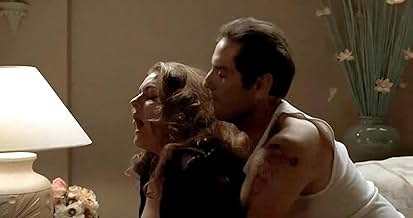


- Christopher Moltisanti
- (générique uniquement)


- Silvio Dante
- (générique uniquement)


- Adriana La Cerva
- (générique uniquement)


- Matt Bevilaqua
- (images d'archives)
- (as Lillo Brancato Jr.)

Avis à la une
The episode centers on the tragic downfall of Davey Scatino, an old friend of Tony Soprano's whose compulsive gambling spirals out of control
The narrative unfolds around Davey's increasing debt accrued through his compulsive gambling in the Executive Game-a high-stakes poker game run by Tony's crew. Tony and Richie Aprile orchestrate a scheme to exploit Davey's credit line, forcing the collapse of his business and pushing him toward despair and potential suicide. Parallel to the mafia's predatory financial maneuvering is the intricate depiction of family dynamics: Carmela's interactions with Davey's widow and her attraction to house painter Victor Musto add emotional complexity and illuminate the social ties that bind the criminal world to everyday life. Tony's struggle to connect with his son A. J., especially after observing the boy under threatening circumstances, underscores the episode's recurring focus on paternal responsibility and the hereditary nature of trauma.
John Patterson's direction captures the episode's tension and emotional weight with deliberate pacing and a keen emphasis on atmosphere. The juxtaposition of the cold, calculating world of organized crime with the intimate domestic scenes is articulated through contrasting shot compositions-tight, claustrophobic framing during mafia confrontations and broader, more fluid shots in family moments. Patterson utilizes lighting to evoke mood shifts; the oppressive, shadow-filled interiors of Davey's store contrast with the warmer, more emotionally charged settings of the Soprano household. The climactic scenes, including Richie's violent outburst and Davey's desperate withdrawal, are executed with intensity and precision, amplifying the psychological stakes.
Cinematography further reinforces the narrative's dualities through a muted color palette and controlled visual structure. The editing rhythm supports the rising tension and emotional frustration, balancing scenes of psychological anguish with moments of threatening violence. Sound design integrates ambient urban noise with a haunting score that underscores the growing sense of doom enveloping Davey's world. These technical components contribute to an immersive experience, rooting the story's high emotional stakes in a realistic and palpable environment.
Performances in "Bust-Out" are standout elements, with Robert Patrick delivering a heartrending portrayal of Davey's descent from affable acquaintance to broken man. James Gandolfini embodies Tony's calculated but conflicted leadership, alternating between pragmatic ruthlessness and emerging parental concern for A. J. Edie Falco's Carmela further humanizes the narrative with her portrayal of complex emotions, while Dominic Chianese and David Proval contribute to the volatile mood prevailing in the mafia scenes. The ensemble's performances collectively drive the episode's intense emotional and thematic impact.
Thematically, the episode delves into the destructive consequences of addiction, both personal and systemic. Davey's story illustrates the fatal intersection of individual vulnerability with organized crime's predatory mechanisms. The "bust out" scheme symbolizes how the mafia's grip extends beyond physical violence, consuming victims economically and psychologically. The episode also touches on the cyclical nature of power and loyalty within mafia families and explores the emotional costs of maintaining appearances and survival in brutal social systems.
Moreover, the episode acts as a critique of American capitalism and the myth of the self-made man, exposing the fragility of success and respectability among working-class individuals entangled in criminal economies. Carmela's subplot concerning Victor Musto introduces a nuanced examination of desire, fidelity, and class mobility, enriching the episode's broader sociocultural tapestry. The tension between aspiration and harsh reality is palpable throughout, contributing to the series' sophisticated cultural critique.
Some viewers note that the episode's heavy thematic content and psychological focus may challenge those expecting more conventional crime drama pacing.
However, this narrative depth and character focus are precisely what elevate The Sopranos as a masterwork of modern television, offering profound insights into human nature and systemic corruption.
"Bust-Out" is a powerful and emotionally charged episode that exemplifies The Sopranos' ability to intertwine complex character development with incisive social commentary. John Patterson's skillful direction, combined with compelling writing and strong performances, crafts a narrative that is both gripping and thought-provoking. The episode's exploration of addiction, betrayal, and the fragile nature of control reinforces the series' status as a landmark in televised storytelling, inviting audiences to reflect on the hidden costs of power and survival inside and outside the mafia world.
Absolutely fantastic acting for Gandolfini in this one
Watching sopranos after the second golden age of television is an interesting experience. On the one hand it's been a slower burn than the shows it inspired. But in another way, there's so much that happens in a single episode, either literally in the plot or figuratively in the character development. It's definitely a fascinating show; one that has earned its stripes tenfold.
Bust-out is underrated
The honest guys and the crooks
The predictable element of Bust-Out is introduced in the opening sequence: apparently, someone saw Tony kill Matt Bevilaqua, and since this guy doesn't know who he is framing, his patriotism demands that he inform the authorities. Upon learning the startling news, Tony makes all kinds of arrangements so that he can disappear as soon as possible, although he keeps pressuring his old friend David Scatino (Robert Patrick) while he still has time, even if that means leading Dave towards bankruptcy. In the meantime, Richie asks Uncle Junior for help, as he isn't satisfied with his current earnings, while Pussy is told by Agent Lipari that if he had anything to do with the Bevilaqua hit (the witness couldn't identify the second shooter with certainty) he will go to jail automatically.
This episode's main charm consists of its retrieval of the Scatino character from The Happy Wanderer: whereas the previous episode was a metaphysical study of life and death, Bust-Out has a more down-to-earth approach in its analysis of radically opposed lives - David, who has always been an honest guy, is so desperate to get out of debt he eventually blows his own son's college fund and contemplates suicide right after doing so, while Tony, thanks to his attitude with people like Dave, is able to take AJ out on a fishing trip and spend some quality time with the kid without really deserving it. The juxtaposition of the two situations makes for one of the show's more tragic moments, perfectly rendered by an almost unrecognizable Patrick: watch the episode back-to-back with either Terminator 2 or the Law & Order: SVU ep where he played a child molester, and you'll hardly know it's the same actor.
So who's the witness?
This is a strong episode with great character moments for Tony and Carmela.
A big Sword of Damocles hangs over Tony, driving the plot, whilst numerous scenes depict his selfish nature and it's impact on others. All Tony's scenes are very well written and James Gandolfini is on top form.
Carmela has a lot of focus, particularly in her exchanges with Tony and a guest character who embodies many of the qualities Tony does not have. This is also well written and Edie Falco gives another fantastically realistic performance.
Robert Patrick is brilliant yet again as Dave Scatino and this character shows how weakness is punished by the predatory instincts of people like Tony, plus the impact it has on innocent family members.
Other great scenes are scattered throughout the episode with characters like AJ, Janice, Richie, Big Puss, Dr Melfi, Uncle Junior, and Meadow all giving strong contributions. One line by Uncle Junior is a great foreshadowing to what comes later in the season.
For all it's dark cynicism, there is plenty of the usual dark humour and entertainment value with so many of the characters and dialogue. I think without this aspect the show would be a seriously depressing commentary on life.


Le saviez-vous
- AnecdotesThe fable "The Scorpion and the Frog" is mentioned by Tony to David Scatino because of its dark morality. It goes, "A scorpion asks a frog to carry it across a river. The frog hesitates, afraid of being stung, but the scorpion argues that if it did so, they would both drown. Considering this, the frog agrees, but midway across the river the scorpion does indeed sting the frog, dooming them both. When the frog asks the scorpion why, the scorpion replies that it was in its nature to do so."
- GaffesThe poulet galantine Carmela promises to the decorator could not be prepared by the following lunchtime. The preparation of the dish has several steps that must be performed over several days.
- Citations
David Scatino: [after woken up by Tony unzipping the camping tent David was sleeping in inside his sports goods store] Tony, what're you doing here?
Tony Soprano: I was going to ask you the same fuckin question
David Scatino: It's my store
Tony Soprano: [after looking at the mess, sarcastically] congratulations, it's a fuckin disaster
David Scatino: Hey, some of those airline tickets came in, you want me to split them with Richie?
Tony Soprano: They're mine, it's my idea. This is where you sleep?
David Scatino: Yeah, sometimes. It's easier than going home
Tony Soprano: [while sitting down on a wooden bench near David's tent] I know what you mean. I remember when you transferred in the tenth grade from Baden-Baden, fuckin army brat
David Scatino: Hey, you remember when those Guidos from Paterson caught you at Garret Mountain and had you barricaded in your old man's car? I whipped that rocket and hit that guy in the eye?
Tony Soprano: Don't reminisce on me
David Scatino: You told me not to get into the game, why'd you let me do it?
Tony Soprano: Well, I knew you had this business here Davey, it's my nature "frog on a scorpion" you know? Besides if you would've won I'd be the one crying the blues right?
David Scatino: What's the end?
Tony Soprano: The end? Declaring bankruptcy
Tony Soprano: [after David begins crying] hey, your not the first guy to get "busted out."This is how a guy like me makes a living: this is my bread and butter. When this is over your free to go. You can go wherever you want
- ConnexionsEdited from Les Soprano: From Where to Eternity (2000)
Meilleurs choix
Détails
- Date de sortie
- Pays d’origine
- Site officiel
- Langue
- Lieux de tournage
- Sociétés de production
- Voir plus de crédits d'entreprise sur IMDbPro
- Durée
- 59min
- Couleur
- Mixage
- Rapport de forme
- 1.78 : 1