NOTE IMDb
7,4/10
59 k
MA NOTE


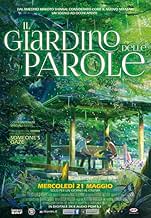
Un garçon de 15 ans et une femme de 27 ans se retrouvent un jour de pluie dans le jardin national de Shinjuku Gyoen.Un garçon de 15 ans et une femme de 27 ans se retrouvent un jour de pluie dans le jardin national de Shinjuku Gyoen.Un garçon de 15 ans et une femme de 27 ans se retrouvent un jour de pluie dans le jardin national de Shinjuku Gyoen.
- Réalisation
- Scénariste
- Stars
- Récompenses
- 2 victoires et 2 nominations au total

Miyu Irino
- Takao Akizuki
- (voix)


Gou Maeda
- Takao no ani
- (voix)
Suguru Inoue
- Matsumoto
- (voix)

Megumi Han
- Satou
- (voix)
Mikako Komatsu
- Aizawa
- (voix)
Yûki Hayashi
- Moriyama
- (voix)
- (as Yuki Hayashi)
Wataru Sekine
- Young Takao
- (voix)
Taishi Murata
- Student B
- (voix)
- …

Crash Buist
- Takao's Brother
- (voice: English version)
7,458.8K
1
2
3
4
5
6
7
8
9
10
Avis à la une
(Rwo) Review : GARDEN OF WORDS Is Cheesy, But Has Heart
Promoted as a feature-length film, Shinkai Makoto's Garden of Words surprisingly only lasts 46 minutes. However, it was enough for the director to portray human emotions as well as understand the purpose of relationships.
The word "love" in modern Japanese is "ai", but in the ancient language, it was actually written as "koi", which is a compound of two other Kanji means "solitude" and "sad". Though Garden of Words is set in modern times, "love" in this film will be portrayed in its original meaning, which leads to a story about longing and loneliness, as well as suggesting an unhappy ending for love.
At the center, there is Takao, a 15-year-old student who wants to become a shoe-maker. On rainy days, he often plays truant in a Japanese-style garden and learns to make shoes there. By chance he meets Yukino, a mysterious woman much older than him, and whenever it rains, the two of them meet each other in the garden. Over time, their relationship deepens and the mystery surrounding Yukino finally reveals itself on a dry day.
Similar to Shnkai's previous films The Place Promised in Our Early Days, 5 Centimeters Per Second, Children Who Chase Lost Voices, the most impressive thing about Garden of Words are the vibrant & unique visual elements. In this latest film, he continues to develop his own unique style. Clean and cute, a little bit cheesy even, Shinkai uses excessive glare and light pink tones, and the result is a bombastic impressive 46- minute picture.
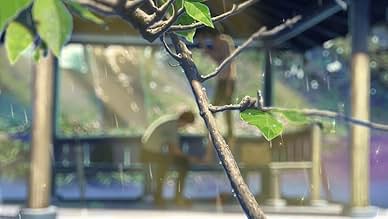
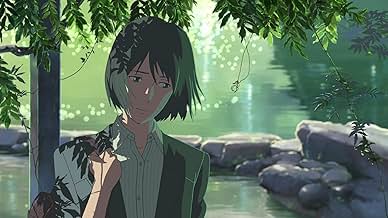
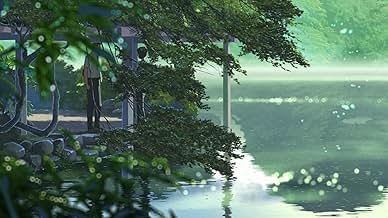
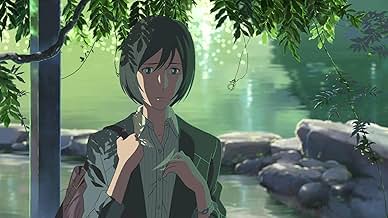
The park's natural setting, with green trees drooping into the water, the wind stirring the small rocks, creates a space ripe with romance and poetry, which helps ease anxiety. Although the scenes in the school, Yukino's house, train station etc were beautifully drawn, the brightest points in the painting of Garden of Words are the natural moments when two people sit in the park together and enjoy the stillness of emotion.
Garden of Words delivers a simple, soft love story, though many would argue that it is taboo. The director knows how to manipulate love, make it as natural as rain, by arranging the meeting at a far away location from where they work/study, only meeting on rainy days to make their feelings vibrate. Eventually, when the truth of their fate is revealed, the audience completely accepts it, because their love for each other is full of sincerity and cultivated diligently through the rainy days.
Garden of Words is a triumph of visual style over substance. It can be very predictable, can be very cheesy when two people are hugging and crying at the end. But the movie creates honest and fresh emotions, accompanied by an impressive visual expression. Garden of Words is not simply the binding of the last two people through some lines of Japanese poetry that they read to each other, It is also the shining of unique storytelling style with images.
And with the blink of an eye, a small gesture is enough to say everything about human emotion, words probably are not needed anymore. Garden of Words gives you a unique experience, exploring the visual and aesthetic language of love.
Trung Rwo
The word "love" in modern Japanese is "ai", but in the ancient language, it was actually written as "koi", which is a compound of two other Kanji means "solitude" and "sad". Though Garden of Words is set in modern times, "love" in this film will be portrayed in its original meaning, which leads to a story about longing and loneliness, as well as suggesting an unhappy ending for love.
At the center, there is Takao, a 15-year-old student who wants to become a shoe-maker. On rainy days, he often plays truant in a Japanese-style garden and learns to make shoes there. By chance he meets Yukino, a mysterious woman much older than him, and whenever it rains, the two of them meet each other in the garden. Over time, their relationship deepens and the mystery surrounding Yukino finally reveals itself on a dry day.
Similar to Shnkai's previous films The Place Promised in Our Early Days, 5 Centimeters Per Second, Children Who Chase Lost Voices, the most impressive thing about Garden of Words are the vibrant & unique visual elements. In this latest film, he continues to develop his own unique style. Clean and cute, a little bit cheesy even, Shinkai uses excessive glare and light pink tones, and the result is a bombastic impressive 46- minute picture.
The park's natural setting, with green trees drooping into the water, the wind stirring the small rocks, creates a space ripe with romance and poetry, which helps ease anxiety. Although the scenes in the school, Yukino's house, train station etc were beautifully drawn, the brightest points in the painting of Garden of Words are the natural moments when two people sit in the park together and enjoy the stillness of emotion.
Garden of Words delivers a simple, soft love story, though many would argue that it is taboo. The director knows how to manipulate love, make it as natural as rain, by arranging the meeting at a far away location from where they work/study, only meeting on rainy days to make their feelings vibrate. Eventually, when the truth of their fate is revealed, the audience completely accepts it, because their love for each other is full of sincerity and cultivated diligently through the rainy days.
Garden of Words is a triumph of visual style over substance. It can be very predictable, can be very cheesy when two people are hugging and crying at the end. But the movie creates honest and fresh emotions, accompanied by an impressive visual expression. Garden of Words is not simply the binding of the last two people through some lines of Japanese poetry that they read to each other, It is also the shining of unique storytelling style with images.
And with the blink of an eye, a small gesture is enough to say everything about human emotion, words probably are not needed anymore. Garden of Words gives you a unique experience, exploring the visual and aesthetic language of love.
Trung Rwo
The Garden of Words poetically symbolises the tranquility and loneliness of rain.
"A faint clap of thunder. Even if the rain comes not, I will stay here, together with you". Walking the path of life is no easy feat. The appropriate metaphysical footwear must be utilised for every type of emotional terrain we encounter. Sandals for joy. Wellies for sadness. Sneakers for rage. Yearning to overcome our rational, or irrational, fears so that we can "walk" again. Teenage student Takao, an aspiring shoemaker, attempted to perform such a generous offer for Yukari. A mysterious woman he socialises with in the dense thickened foliage of a Japanese garden experiencing torrential downpour. Two souls of differing youth encompassing an identical level of maturity. Yukari avoiding her career to snack of delicious chocolate and consume canned beer, whilst Takao solidly working throughout his summer break.
The two share a common trait. Seclusion. The melancholy of isolation is one that evokes a rainfall of sympathy, and director/writer Shinkai embodies all of nature's complexities to portray these wandering individuals. The ferocity of rain portraying both the characters' sadness whilst shielding them from the rest of society. The pale green shading of the summery foliage producing a reassuring aura of tranquility within the garden. Yet it's Shinkai's usage of Man'yoshu poetry that truly captivates, adding a traditional authenticity to the Japanese central romantic narrative. With "love" being traditionally written as "lonely sadness", Shinkai honed in on the deprivation of companionship. When both characters see each other as salvational assets as opposed to romantic interests, it provides a subtle layer of maturity that is commonly found in Shinkai's writing. Love is never simple, yet nature finds a way to pull people together. The Garden of Words itself is that motif.
As expected, the animation was gorgeous. Faultless. Combining hand-drawn animation with rotoscoping to create meticulously constructed scenery, assisting in the world building of their blossoming friendship. Less detail is given to facial expressions, with much of the attentive focus towards the environmental backdrop, which occasionally leaves a vacuous emotional complexion. Almost expressionless on occasion. Not enough to deter from the character building, but worth noting.
Shinkai's unfortunate issue here is with the runtime. It's short. Absurdly short. At only forty six minutes in length, the character development between Takao and Yukari is often rushed with no emotional simmering. This became drastically noticeable during the climax when Takao discovers the reasoning behind Yukari's work avoidance. The exquisitely mature metaphors and symbolic imagery were somewhat diminished for a typical "anime ending". What I mean by that, is the sole purpose in attempting to make the viewers shed a tear. The erratic framing, the J-pop music and the explosion of emotion is typical work from Shinkai, yet it never suited the preceding scenario. Whilst it nearly, oh so nearly, worked for me (I held back that tear!), it fell short due to the complacent storytelling. Motohiro Hata's vocal talent behind the theme song "Rain" was exceptional though, almost replicating Takao's personality. So I'll give some leniency...
The Garden of Words is poetry. Visually and literarily. With gorgeously vibrant animation and themes of maturity, Shinkai has crafted a wonderfully organic story that depicts loneliness with a hint of empathy. If only he was able to stretch it out for another half an hour, we could've witnessed a masterpiece in the making.
The two share a common trait. Seclusion. The melancholy of isolation is one that evokes a rainfall of sympathy, and director/writer Shinkai embodies all of nature's complexities to portray these wandering individuals. The ferocity of rain portraying both the characters' sadness whilst shielding them from the rest of society. The pale green shading of the summery foliage producing a reassuring aura of tranquility within the garden. Yet it's Shinkai's usage of Man'yoshu poetry that truly captivates, adding a traditional authenticity to the Japanese central romantic narrative. With "love" being traditionally written as "lonely sadness", Shinkai honed in on the deprivation of companionship. When both characters see each other as salvational assets as opposed to romantic interests, it provides a subtle layer of maturity that is commonly found in Shinkai's writing. Love is never simple, yet nature finds a way to pull people together. The Garden of Words itself is that motif.
As expected, the animation was gorgeous. Faultless. Combining hand-drawn animation with rotoscoping to create meticulously constructed scenery, assisting in the world building of their blossoming friendship. Less detail is given to facial expressions, with much of the attentive focus towards the environmental backdrop, which occasionally leaves a vacuous emotional complexion. Almost expressionless on occasion. Not enough to deter from the character building, but worth noting.
Shinkai's unfortunate issue here is with the runtime. It's short. Absurdly short. At only forty six minutes in length, the character development between Takao and Yukari is often rushed with no emotional simmering. This became drastically noticeable during the climax when Takao discovers the reasoning behind Yukari's work avoidance. The exquisitely mature metaphors and symbolic imagery were somewhat diminished for a typical "anime ending". What I mean by that, is the sole purpose in attempting to make the viewers shed a tear. The erratic framing, the J-pop music and the explosion of emotion is typical work from Shinkai, yet it never suited the preceding scenario. Whilst it nearly, oh so nearly, worked for me (I held back that tear!), it fell short due to the complacent storytelling. Motohiro Hata's vocal talent behind the theme song "Rain" was exceptional though, almost replicating Takao's personality. So I'll give some leniency...
The Garden of Words is poetry. Visually and literarily. With gorgeously vibrant animation and themes of maturity, Shinkai has crafted a wonderfully organic story that depicts loneliness with a hint of empathy. If only he was able to stretch it out for another half an hour, we could've witnessed a masterpiece in the making.
Garden of Words and Shinkai
Although I don't make reviews of movies (only read and maybe comment with friends), Shinkai's movies just force me to. My first comment was of, in my opinion is this director's best work to this day, 5 cm per second, and so this is going to be my second comment.
With that long introduction said, I must say this movie surprised me, with a scenery a OST worthy of the highest regards (like Shinkai has us used to) and a character development spot on. Not the deepest analysis in each character (he couldn't do that in 45 min) but deep enough for the audience to understand them and know what they are going through which is the whole point of the movie. All this wrapped up with a spectacular climax. Although you feel the climax coming, you don't expect a climax like this, with that much energy, sentiment, and art, all in 2 min long.
To finish, a little opinion on Shinkai, I have seen all his movies and I sense that him, with this movie, just realized what are his strong points: not huge movies with 8 characters and lots of themes (a ground where Miyasaki flourishes) but little situations where few characters stand for being truly humane and how they confront problems that ,at that time, mean the world to them and shape them for the future. He's a director that likes to test new grounds (part coming from being a young) but he's also getting reaching his full potential. That's why "Voices from a distant star", "5 cm per second" and this movie are his best work to date and "Voices from deep below" and "place promised" being his not so good movies (although I liked them).
With that long introduction said, I must say this movie surprised me, with a scenery a OST worthy of the highest regards (like Shinkai has us used to) and a character development spot on. Not the deepest analysis in each character (he couldn't do that in 45 min) but deep enough for the audience to understand them and know what they are going through which is the whole point of the movie. All this wrapped up with a spectacular climax. Although you feel the climax coming, you don't expect a climax like this, with that much energy, sentiment, and art, all in 2 min long.
To finish, a little opinion on Shinkai, I have seen all his movies and I sense that him, with this movie, just realized what are his strong points: not huge movies with 8 characters and lots of themes (a ground where Miyasaki flourishes) but little situations where few characters stand for being truly humane and how they confront problems that ,at that time, mean the world to them and shape them for the future. He's a director that likes to test new grounds (part coming from being a young) but he's also getting reaching his full potential. That's why "Voices from a distant star", "5 cm per second" and this movie are his best work to date and "Voices from deep below" and "place promised" being his not so good movies (although I liked them).
Absolutely stunning.
I have no words that can describe how in love I am with this movie. I stumbled upon it randomly, thought the art looked lovely, and decided to give it a view. I'm so glad I did. The artwork and animation is just breathtaking. The landscapes and city scenes are almost photo realistic, attention being given to the tiniest of details. I would consider it on par with Studio Ghibli at least. I consider myself very critical when it comes to animations, and it takes a lot to really wow me, but this took the cake. I came with no expectations, and left wondering why this movie isn't more widespread and the need to tell everyone I know to watch it. Though the film is only 46 minutes long, it feels like a feature length film. I was captivated for every second of it, and will be watching it many times in the future.
Too long, didn't read? Watch this movie.
Too long, didn't read? Watch this movie.
Surprisingly Good
With it's short length of only 45 minutes, it's hard to call this a full movie - although don't let that deter you, as it's still better than most that I have seen, anime or otherwise.
When you hear about this movie one of the things that get repeated mention is it's visuals, and I concur. It's probably the most well made anime from a visuals standpoint.
The story isn't bad either, for only 45 minutes it sets up and tell a surprisingly deep and moving story. It is simplistic storytelling, but still very powerful. It is somewhat reminiscent of one of the director's previous films, 5 Centimetres Per Second, in that it uses a similarly "simple" story but one that relates strongly to emotions and situations felt by normal human beings. I also think this is a great movie to show people who normally don't like anime, as anime very often have different storytelling than I think many are used to. This one is more grounded without many of the "fantasy" elements that most anime's have.
The plot summary on IMDb do just fine setting up the story so I wont bother explaining it, it would just be redundant.
When you hear about this movie one of the things that get repeated mention is it's visuals, and I concur. It's probably the most well made anime from a visuals standpoint.
The story isn't bad either, for only 45 minutes it sets up and tell a surprisingly deep and moving story. It is simplistic storytelling, but still very powerful. It is somewhat reminiscent of one of the director's previous films, 5 Centimetres Per Second, in that it uses a similarly "simple" story but one that relates strongly to emotions and situations felt by normal human beings. I also think this is a great movie to show people who normally don't like anime, as anime very often have different storytelling than I think many are used to. This one is more grounded without many of the "fantasy" elements that most anime's have.
The plot summary on IMDb do just fine setting up the story so I wont bother explaining it, it would just be redundant.


Le saviez-vous
- AnecdotesAccording to Makoto Shinkai, the film's central theme is loneliness. This was inspired by the Man'yoshu, Japan's oldest collection of poems; in that volume, love was represented by the word "koi", or "lonely sadness"; more accurately, a longing for someone in solitude. Shinkai described the film as a love story towards people who feel lonely or incomplete in their social relations, but who don't feel that they need to fix this loneliness.
- GaffesDuring the last scene after the credits, especially 45:35, there are no footprints from outside towards the sunshade.
- Citations
Takao Akizuki: A faint clap of thunder / Even if rain comes or not / I will stay here / Together with you.
- Crédits fousThere is a final scene after the credits.
- ConnexionsFeatured in MsMojo: Top 10 Most Beautiful Animated Movies (2022)
- Bandes originalesRain
Lyrics and Music by Senri Ôe
Performed by Motohiro Hata
Arrangement: Makoto Minagawa & Akifumi Tada
© 1988 by Sony Music Artists Inc.
Meilleurs choix
Connectez-vous pour évaluer et suivre la liste de favoris afin de recevoir des recommandations personnalisées
- How long is The Garden of Words?Alimenté par Alexa
Détails
- Date de sortie
- Pays d’origine
- Site officiel
- Langues
- Aussi connu sous le nom de
- Khu Vườn Ngôn Từ
- Sociétés de production
- Voir plus de crédits d'entreprise sur IMDbPro
Box-office
- Montant brut mondial
- 852 788 $US
- Durée
- 46min
- Couleur
- Mixage
- Rapport de forme
- 1.85 : 1
Contribuer à cette page
Suggérer une modification ou ajouter du contenu manquant