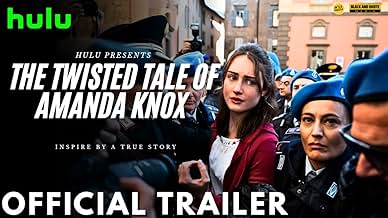
Raconte le parcours éprouvant d'Amanda Knox, emprisonnée à tort pour le meurtre de sa colocataire, et son combat pour prouver son innocence et retrouver sa liberté.Raconte le parcours éprouvant d'Amanda Knox, emprisonnée à tort pour le meurtre de sa colocataire, et son combat pour prouver son innocence et retrouver sa liberté.Raconte le parcours éprouvant d'Amanda Knox, emprisonnée à tort pour le meurtre de sa colocataire, et son combat pour prouver son innocence et retrouver sa liberté.
- Création originale
- Stars
Parcourir les épisodes
6,63.3K
1
2
3
4
5
6
7
8
9
10
Avis à la une
Redeeming value is Grace Van Patten
Knowing that Amanda Knox herself produced this series already sets the table for what you're about to get, because this isn't some objective recounting, this isn't a detached courtroom transcript, this is her side of the story, her version, her spin, and so really the title might as well read "The Twisted Tale by Amanda Knox." From the very beginning, I've believed she wasn't guilty - because the idea that this bright, naive, 20-year-old with a bubbly personality could commit the dark, violent acts she was accused of has always felt absurd, almost grotesque, like trying to fit the wrong puzzle piece into a picture that never matched. Her story deserves the light, no question, but the way this series chose to tell it often felt too heavy-handed, weighed down by its own intentions, more forceful than compelling, and it struggled to truly pull me in. I have no problem with foreign dialogue and subtitles - in fact, I usually welcome them - but here the Italian scenes had moments where the script veered too far, too loose, almost like it lost the thread of its own rhythm. Episode five, with its focus on Raffaele, left me bored, my least favorite of the bunch, and some of the supporting characters felt flat, painted in broad, two-dimensional strokes that robbed them of any real spark. And yet, in the middle of those missteps, stood Grace Van Patten, luminous and fierce, a performer who didn't just play Amanda Knox but gave her flesh and blood, heart and wounds, fragility and steel. She learned the language, she carried the burden, and she managed to make Knox human again - not the caricature in headlines, not the accused in courtrooms, but a young woman broken open and exposed. If Amanda Knox wanted a measure of justice, if she wanted someone to finally show her vulnerability with honesty and heat, she got it in Grace Van Patten.
Great
So refreshing to be able to hear her tell her story. I don't understand the negative reviews saying it is a "biased" account when half of Italy thinks she's still guilty despite any actual evidence (there's the true bias for you)!
It's a great portrayal of how romantic Italian storytelling can sell anyone on anything. Let her tell her story of the gross misconduct and sexism underlying how she was treated. Poor girl deserves all those formative years of her life back; at least give her this.
Being able to tell her side is deserved justice
The show itself is about a 6 or 7. But regardless, it's an important story to tell.
She did 4 years in prison for a crime she didn't do.
The breakdown of any reputable criminology in this case should be a case study in what not to do.
I loved living in Italy for 10 years. Amazing places and people. However, I have to admit every aspect of her telling her side of the story is very believable. The way the story is told emphasizes a reality of soft sciences and ancient Whats if thinking and calling it soft sciences. Overlooking leads because of leniency towards soft crimes like bulgary and picketpocking, which was the number 1 error of logic in this case. And it was only under appeals that that she found a judiciary that was willing to see the egregious and erroneous investigation and evidence mishandling. It was in par with Salem and witch trials And even after being acquitted they still held her because she said a cop hit her. Which is believable.
I'm glad she gets a chance to finally be heard. I hope she gets peace. And while it's not her number 1 reason to do this series, I hope she gets paid a ton to make up for the injustice.
She did 4 years in prison for a crime she didn't do.
The breakdown of any reputable criminology in this case should be a case study in what not to do.
I loved living in Italy for 10 years. Amazing places and people. However, I have to admit every aspect of her telling her side of the story is very believable. The way the story is told emphasizes a reality of soft sciences and ancient Whats if thinking and calling it soft sciences. Overlooking leads because of leniency towards soft crimes like bulgary and picketpocking, which was the number 1 error of logic in this case. And it was only under appeals that that she found a judiciary that was willing to see the egregious and erroneous investigation and evidence mishandling. It was in par with Salem and witch trials And even after being acquitted they still held her because she said a cop hit her. Which is believable.
I'm glad she gets a chance to finally be heard. I hope she gets peace. And while it's not her number 1 reason to do this series, I hope she gets paid a ton to make up for the injustice.
Why Amanda Knox Deserves to Monetize Her Ordeal
The series dedicated to Amanda Knox manages to clearly show how, from the beginning, the press contributed to creating a deliberately unsympathetic image of her. This narrative facilitated public opinion siding with those conducting the investigations, making it more difficult to believe in her innocence and that of Raffaele Sollecito. Even though romanticized, the representation of the Police and Judiciary appears credible: prosecutor Giuliano Mignini and the head of Perugia's Mobile Squad, Monica Napoleoni, were later reported and convicted for other crimes, from ideological forgery to abuse of office, episodes that show how certain investigative methods were anything but impeccable.
Many critics point out the little attention dedicated to Meredith Kercher. It's true: the series doesn't delve into her story, but not to diminish her memory. The focus is Amanda's journey, her personal experience, the media and judicial persecution she suffered, and the slow path toward rehabilitation. The chosen perspective is clear: to give voice to someone who was turned into a scapegoat and treated as guilty well before the final sentences.
I find it right that Amanda today monetizes her ordeal. It's not an unusual privilege, but a way to reclaim part of what was taken from her. We're not just talking about financial compensation, but the possibility of publicly rehabilitating her own image. That there are still those who continue not to believe her, despite the only guilty party having been convicted, demonstrates a common paradox: justice, even when it arrives, never satisfies everyone.
If this series exists today, it's because the press, with the support of the Police and Judiciary, immediately transformed a drama into a spectacle. Chasing a "media-effective" culprit, they ended up disrespecting not only Amanda, but also Meredith. Now Amanda tells her version: why should this be upsetting, if it was precisely the initial spectacularization that made this story necessary?
Many critics point out the little attention dedicated to Meredith Kercher. It's true: the series doesn't delve into her story, but not to diminish her memory. The focus is Amanda's journey, her personal experience, the media and judicial persecution she suffered, and the slow path toward rehabilitation. The chosen perspective is clear: to give voice to someone who was turned into a scapegoat and treated as guilty well before the final sentences.
I find it right that Amanda today monetizes her ordeal. It's not an unusual privilege, but a way to reclaim part of what was taken from her. We're not just talking about financial compensation, but the possibility of publicly rehabilitating her own image. That there are still those who continue not to believe her, despite the only guilty party having been convicted, demonstrates a common paradox: justice, even when it arrives, never satisfies everyone.
If this series exists today, it's because the press, with the support of the Police and Judiciary, immediately transformed a drama into a spectacle. Chasing a "media-effective" culprit, they ended up disrespecting not only Amanda, but also Meredith. Now Amanda tells her version: why should this be upsetting, if it was precisely the initial spectacularization that made this story necessary?
It's Good!
Everyone who dislikes the Italian sub titles doesn't get it!! Of course Amanda's interactions need to show the disconnect with her not understanding the language. She responded the best way she could; with not always understanding what was being asked of her. THAT IS WHY ALL THE SUBTITLES!!! We are suppose to feel the frustration/disconnect; just like she did being in a foreign country.
Le saviez-vous
- AnecdotesMargaret Qualley was originally attached but dropped out due to scheduling conflicts.
- ConnexionsReferenced in Les Griffin: Boopa-dee Bappa-dee (2013)
Meilleurs choix
Connectez-vous pour évaluer et suivre la liste de favoris afin de recevoir des recommandations personnalisées
Détails
- Couleur
- Mixage
- Rapport de forme
- 2.00 : 1
Contribuer à cette page
Suggérer une modification ou ajouter du contenu manquant