
अपनी भाषा में प्लॉट जोड़ेंA troubled child tries to patch up her parents' broken marriage by running away.A troubled child tries to patch up her parents' broken marriage by running away.A troubled child tries to patch up her parents' broken marriage by running away.
- पुरस्कार
- कुल 1 जीत




Jack Baxley
- Leyton - Druggist
- (बिना क्रेडिट के)

Jack Donohue
- Actor
- (बिना क्रेडिट के)

Doris Nolan
- Undetermined Role
- (अपुष्टिकृत)
- (बिना क्रेडिट के)

6.3579
1
2
3
4
5
6
7
8
9
10
फ़ीचर्ड समीक्षाएं
Thoughtful for parents
Back in the 1930s, divorce wasn't nearly as common as it is today. In fact, it wasn't common at all! So, even though a lot of Shirley Temple movies feature her as an orphan or motherless and needing care and comfort, Our Little Girl tackles the terrible subject of divorce. Her parents, Joel McCrea and Rosemary Ames, are having a lot of problems, and their happy home is being threatened on three fronts: Joel is tempted by his secretary, Erin O'Brien-Moore; Rosemary is tempted by an old friend, Lyle Talbot; and they both feel stale and unseen. So, while Shirley treasures their family picnics, she doesn't know that those rituals are about to be taken away.
Although this one isn't really as dark as Shirley's movies can sometimes be, because it doesn't involve death, it does have a dark cloud hanging over it. From a child's perspective, this probably won't be anyone's favorite. There are no "animal crackers" or jump rope tap dancing. But from an adult's point of view, it's a very thoughtful movie. The parents aren't just parents, they are people. They have feelings and frustrations, and even though they have the greatest little girl in the entire world in their family, it sometimes isn't enough. When Lyle treats Rosemary like a woman, it's really refreshing for her. She has to weigh the importance of her own life versus giving up everything for her child. Of course, making the decision to become a parent means that you agree to come second for the rest of your life. But sometimes in movies, and in life, parents forget about that bargain. What will Rosemary and Joel decide? Will Shirley come first, or will she do something terrible and extremely dangerous, like run away from home? You'll have to watch Our Little Girl to find out.
Although this one isn't really as dark as Shirley's movies can sometimes be, because it doesn't involve death, it does have a dark cloud hanging over it. From a child's perspective, this probably won't be anyone's favorite. There are no "animal crackers" or jump rope tap dancing. But from an adult's point of view, it's a very thoughtful movie. The parents aren't just parents, they are people. They have feelings and frustrations, and even though they have the greatest little girl in the entire world in their family, it sometimes isn't enough. When Lyle treats Rosemary like a woman, it's really refreshing for her. She has to weigh the importance of her own life versus giving up everything for her child. Of course, making the decision to become a parent means that you agree to come second for the rest of your life. But sometimes in movies, and in life, parents forget about that bargain. What will Rosemary and Joel decide? Will Shirley come first, or will she do something terrible and extremely dangerous, like run away from home? You'll have to watch Our Little Girl to find out.
Molly in the Middle
OUR LITTLE GIRL (Fox, 1935), directed by John Robertson, a domestic drama taken from a story "Heaven's Gate," stars Shirley Temple, Joel McCrea and someone by the name of Rosemary Ames (in her final screen appearance following a very brief movie career). Similar in theme to RKO Radio's WEDNESDAY'S CHILD (1934) that revolves around a boy (Frankie Thomas) whose happy home is disrupted by the separation of his parents (Edward Arnold and Karen Morley), OUR LITTLE GIRL centers around the moppet Temple facing the same situation of her own, but without any courtroom or child custody battles, which might have helped quicken the pace or added more interest to a somewhat slow scenario.
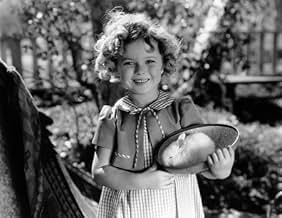
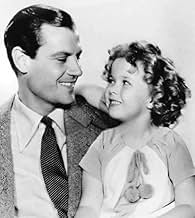
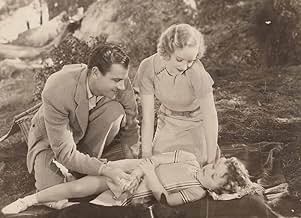
Set in a small town, the plot introduces the Middletons as a happy family: Donald (Joel McCrea), a respectable doctor; Elsa (Rosemary Ames), his loving wife, and their little girl, Molly (Shirley Temple) who looks forward to their twice a year family picnic each May and September Saturday at a park called Heaven's Gate. Donald works long and hard on his experiments along with his assistant, Sarah Boiton (Erin O'Brien-Moore), a nurse who's secretly in love with him. Because he's away from home too often, Elsa spends much of her lonely hours with Rolfe Brent (Lyle Talbot), her former horse breading beau who recently has moved into town from Europe. Due to Donald's misunderstanding and jealously towards Elsa and Rolfe, the couple argue, leading little Molly to find herself caught in the middle of things, and unable to comprehend why her father will no longer be living with them anymore. After overhearing a conversation between her mother and Rolfe that has her believing that she's the cause for her parent's separation, Molly decides to take matters into her own hands by leaving home.
A minor Temple drama with little of the Temple formula intact. Aside from singing a lullaby to her doll and later playing Stephen Foster's "Banjo on My Knee" on the piano, there are no songs nor dance numbers. Considering its theme, song interludes have no precedence in the story, though some slight doses of humor including Temple on the seesaw with her dog, Sniffy, as examples that keep the narrative from becoming strictly melodramatic. Unlike her more recent releases, OUR LITTLE GIRL, is the only one of Temple's leading roles that can be categorized as strictly "B" product, considering it being the shortest (63 minutes) of her starring film roles.
Others in the supporting cast consist of Poodles Hannerton as the Circus Performer; Margaret Armstrong (Amy, the Middleton housekeeper); Ruth Owin (Alice) and Leonard Carey (Jackson), each as Brent's servants; and best of all, J. Farrell MacDonald billed as Mr. Tramp, playing a homeless man who comforts little Molly by listening to her story as to why she's leaving home. This little scene is well handled, with some humor in spoken dialog by Shirley thrown in for good measure. Watch for it.
OUR LITTLE GIRL became one of many Temple movies to become available on video cassette during the late 1980s and then on DVD in both black and white and colorized formats. Formerly presented on The Disney Channel in the 1980s in colorized version, it then turned up on American Movie Classics as part of its Sunday morning "Kids Classics" (1996-2001), and finally on the Fox Movie Channel in its original black and white format. Bob Dorian, former host of AMC, once commented in his profile about OUR LITTLE GIRL in saying that its working title "Heaven's Gate" had been changed prior to release due to it the name suggesting a cemetery, leaving an indication as being a movie about death.
Although OUR LITTLE GIRL didn't turn out as interesting as the rarely seen WEDNESDAY'S CHILD (1934), nor become the Academy Award winner as KRAMER Vs. KRAMER (1979), it's one of those little movies that might have been better had it not been hampered by a weak script. Had it not been for "Our Little Girl" Shirley Temple in the title role keeping the story alive with her know-how performance, then this minor effort of hers would certainly have ended up along with many old Fox Films to be either lost, forgotten or both. (**1/2)
Set in a small town, the plot introduces the Middletons as a happy family: Donald (Joel McCrea), a respectable doctor; Elsa (Rosemary Ames), his loving wife, and their little girl, Molly (Shirley Temple) who looks forward to their twice a year family picnic each May and September Saturday at a park called Heaven's Gate. Donald works long and hard on his experiments along with his assistant, Sarah Boiton (Erin O'Brien-Moore), a nurse who's secretly in love with him. Because he's away from home too often, Elsa spends much of her lonely hours with Rolfe Brent (Lyle Talbot), her former horse breading beau who recently has moved into town from Europe. Due to Donald's misunderstanding and jealously towards Elsa and Rolfe, the couple argue, leading little Molly to find herself caught in the middle of things, and unable to comprehend why her father will no longer be living with them anymore. After overhearing a conversation between her mother and Rolfe that has her believing that she's the cause for her parent's separation, Molly decides to take matters into her own hands by leaving home.
A minor Temple drama with little of the Temple formula intact. Aside from singing a lullaby to her doll and later playing Stephen Foster's "Banjo on My Knee" on the piano, there are no songs nor dance numbers. Considering its theme, song interludes have no precedence in the story, though some slight doses of humor including Temple on the seesaw with her dog, Sniffy, as examples that keep the narrative from becoming strictly melodramatic. Unlike her more recent releases, OUR LITTLE GIRL, is the only one of Temple's leading roles that can be categorized as strictly "B" product, considering it being the shortest (63 minutes) of her starring film roles.
Others in the supporting cast consist of Poodles Hannerton as the Circus Performer; Margaret Armstrong (Amy, the Middleton housekeeper); Ruth Owin (Alice) and Leonard Carey (Jackson), each as Brent's servants; and best of all, J. Farrell MacDonald billed as Mr. Tramp, playing a homeless man who comforts little Molly by listening to her story as to why she's leaving home. This little scene is well handled, with some humor in spoken dialog by Shirley thrown in for good measure. Watch for it.
OUR LITTLE GIRL became one of many Temple movies to become available on video cassette during the late 1980s and then on DVD in both black and white and colorized formats. Formerly presented on The Disney Channel in the 1980s in colorized version, it then turned up on American Movie Classics as part of its Sunday morning "Kids Classics" (1996-2001), and finally on the Fox Movie Channel in its original black and white format. Bob Dorian, former host of AMC, once commented in his profile about OUR LITTLE GIRL in saying that its working title "Heaven's Gate" had been changed prior to release due to it the name suggesting a cemetery, leaving an indication as being a movie about death.
Although OUR LITTLE GIRL didn't turn out as interesting as the rarely seen WEDNESDAY'S CHILD (1934), nor become the Academy Award winner as KRAMER Vs. KRAMER (1979), it's one of those little movies that might have been better had it not been hampered by a weak script. Had it not been for "Our Little Girl" Shirley Temple in the title role keeping the story alive with her know-how performance, then this minor effort of hers would certainly have ended up along with many old Fox Films to be either lost, forgotten or both. (**1/2)
At Heaven's Gate With Shirley Temple
OUR LITTLE GIRL struggles valiantly to understand why her loving parents can no longer love each other.
Little Shirley Temple, Hollywood's greatest star at the time, enlivens what might without her have been just another soap opera. With smiles & tears, she beguiles the audience into completely identifying with her joys & tribulations. Even in a minor picture such as this, her abundant charm & talent still bare testimony to her utterly unassailable niche in American film history.
As her parents - and it's rare for Shirley to have both throughout an entire film - Rosemary Ames & Joel McCrea both nicely underplay their roles, providing strong assistance to Shirley but without overshadowing her, as is proper. McCrea's medical researches & Miss Ames' horseback riding are mere contrivances used to move the plot along - they are never allowed to eclipse the Tiny Tot.
Lyle Talbot & Erin O'Brien-Moore deftly play the significant others in the lives of Shirley's parents; thankfully, each is presented gently, leaving the story without any unnecessary abrasion. Wonderful character actor J. Farrell MacDonald sparks the end of the film with his sympathetic portrayal of a wise, friendly tramp.
Little Shirley Temple, Hollywood's greatest star at the time, enlivens what might without her have been just another soap opera. With smiles & tears, she beguiles the audience into completely identifying with her joys & tribulations. Even in a minor picture such as this, her abundant charm & talent still bare testimony to her utterly unassailable niche in American film history.
As her parents - and it's rare for Shirley to have both throughout an entire film - Rosemary Ames & Joel McCrea both nicely underplay their roles, providing strong assistance to Shirley but without overshadowing her, as is proper. McCrea's medical researches & Miss Ames' horseback riding are mere contrivances used to move the plot along - they are never allowed to eclipse the Tiny Tot.
Lyle Talbot & Erin O'Brien-Moore deftly play the significant others in the lives of Shirley's parents; thankfully, each is presented gently, leaving the story without any unnecessary abrasion. Wonderful character actor J. Farrell MacDonald sparks the end of the film with his sympathetic portrayal of a wise, friendly tramp.
One Of The Few Unappealing Temple Movies
Shirley Temple was in a few - not many - movies that just were not appealing. In most of her films, she overcomes a bad start in life (orphanages, etc.) or overcomes an evil, nasty person (usually Edna Mae Oliver or someone similar) but is seen happy most of the time and singing and dancing here and there. It's when the negative elements of the story are overemphasized (i.e. Blue Bird, Baby Take A Bow) that her films often lose appeal. That's the case in this movie.
"Our Little Girl" is simply too depressing, a negative storyline in which Shirley's parents are ready for a divorce. Her mother has an affair with a friend and the father is away all the time on business, ignoring the family.
When Temple ("Molly Middleton") is happy or cute, she's too cute in here, her sugary personality overdone. Meanhwhile, there is only one song and no dance numbers. People buy or rent Shirley Temple movies to feel good, not to get depressed or weighed down with broken-family soaps. There are plenty of other movies like that.
"Our Little Girl" is simply too depressing, a negative storyline in which Shirley's parents are ready for a divorce. Her mother has an affair with a friend and the father is away all the time on business, ignoring the family.
When Temple ("Molly Middleton") is happy or cute, she's too cute in here, her sugary personality overdone. Meanhwhile, there is only one song and no dance numbers. People buy or rent Shirley Temple movies to feel good, not to get depressed or weighed down with broken-family soaps. There are plenty of other movies like that.
Warning: Diabetes-inducing
The issue of divorce and how it affects children is only marginally dealt with in this cloying story of a happy family torn apart by a rotten script. Too much time is spent on the cutesy antics of Shirley Temple, while too little time is devoted to the development of the plot and characters. In this 65-minute programmer, things happen at lightning speed, with little logic or motivation behind them. Thus, the marital split of the two leads comes too suddenly and seems unrealistic. The same can be said about the relationship between the soon-to-be-ex-wife and her wealthy suitor. The adult cast is passable, but Temple is unbearably sugary. Director John S. Robertson, used to handling costume pictures during the silent era, should have realized that less is more when it comes to baby grins and baby pouts. Make sure you check your blood-sugar level after watching this one.


क्या आपको पता है
- ट्रिवियाThe studio thought that this film's original title, "Heaven's Gate," sounded too much like a cemetery and changed it to "Our Little Girl."
- भाव
Elsa Middleton: Mother's going away for a little while. And, when she comes back, she won't be married to Daddy anymore.
Molly Middleton: Who will you be married to, Mommy?
- कनेक्शनFeatured in Biography: Shirley Temple: The Biggest Little Star (1996)
- साउंडट्रैकLullaby to a Doll
(1935) (uncredited
Music by Lew Pollack
Lyrics by Paul Francis Webster
Sung by Shirley Temple
टॉप पसंद
रेटिंग देने के लिए साइन-इन करें और वैयक्तिकृत सुझावों के लिए वॉचलिस्ट करें
विवरण
- चलने की अवधि
- 1 घं 5 मि(65 min)
- रंग
- पक्ष अनुपात
- 1.37 : 1
इस पेज में योगदान दें
किसी बदलाव का सुझाव दें या अनुपलब्ध कॉन्टेंट जोड़ें