VALUTAZIONE IMDb
7,6/10
28.370
LA TUA VALUTAZIONE


Il giovane erede viziato della decadente fortuna di Amberson si trova tra la madre vedova e l'uomo che ha sempre amato.Il giovane erede viziato della decadente fortuna di Amberson si trova tra la madre vedova e l'uomo che ha sempre amato.Il giovane erede viziato della decadente fortuna di Amberson si trova tra la madre vedova e l'uomo che ha sempre amato.
- Regia
- Sceneggiatura
- Star
- Candidato a 4 Oscar
- 9 vittorie e 4 candidature totali


Orson Welles
- Narrator
- (voce)

Edwin August
- Citizen
- (non citato nei titoli originali)

Georgia Backus
- Matron
- (non citato nei titoli originali)
Harry A. Bailey
- Citizen
- (non citato nei titoli originali)
Olive Ball
- Mary - Maid
- (non citato nei titoli originali)
Jack Baxley
- Reverend Smith
- (non citato nei titoli originali)
William Blees
- Young Man at Accident
- (non citato nei titoli originali)
Lyle Clement
- Citizen
- (non citato nei titoli originali)
Bobby Cooper
- George Minafer as a Boy
- (non citato nei titoli originali)

Don Dillaway
- Wilbur Minafer
- (non citato nei titoli originali)
7,628.3K
1
2
3
4
5
6
7
8
9
10
Recensioni in evidenza
10Don-102
Welles' slicing look at the downfall of a careless family parallels the film's treatment in 1942...
People may initially be thrown by the title MAGNIFICENT AMBERSONS. Some may consider it a stuffy period piece before seeing it if they know only of the novel. Don't make this mistake if you have not witnessed this cinematic milestone. The title, of course, is caustic and refers to the 19th century family sarcastically. Who else but the great Orson Welles could follow up a masterwork like CITIZEN KANE with such a cynical and important drama. The "magnificence of the Ambersons" is neither grand, nor respectable. It is tragic and doomed, epitomized by young "Georgie" (played by Tim Holt), whose main ambition in life is to be a yachtsmen. He is buried under the lore of his family name and he is headed towards his well-deserved "comeuppance".
The film itself, like many of Welles' great pictures, was absolutely butchered by the studio (RKO Pictures) and destroyed the credibility of the young auteur. In many ways, the mess surrounding the film's release, the tragedy and loss of the Ambersons, and the theme of modern technology "taking over" all come together to leave all parties disappointed. Disapproving moviegoers miscalculated the message, led the studio to make the cuts behind Welles' back, and placed a lot of artists in some bad situations. (For an excellent account of this truly remarkable story behind the film, read Joseph McBride's bio "Orson Welles") 50 minutes of film were burned, however, the 88 minutes left for us to see contain some incredible, even revolutionary moments.
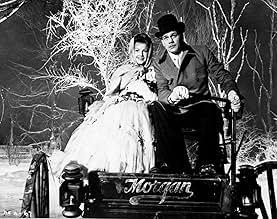
Joseph Cotten plays his consummate "2nd place" character, a man unable to have his real true love. (See THE THIRD MAN, NIAGARA) He is in love with an "Amberson" (probably the only righteous family member played by Dolores Costello) but loses out to a more "respectable" man. The essential themes of industrialism and change that will ruin the Amberson family stem from Cotten's position as an inventor. He has created the horseless carriage, or automobile, however primitive, which is continuously trashed by the hateful "Georgie". Cotten's invention is part of the growth and change that many families of the late 19th century may have ignored, only to have their lives passed over and fortunes lost. Plot elements aside, this central theme is the powerful backbone that leads to the inevitable destruction of the narrow-minded Tim Holt.
The latter aspects come across on screen so memorably because of Orson Welles' continued experimentation with film. Incredible b & w photography, at first a hazy glow depicting the early prime years of the Ambersons, then a stark, dark force portraying shame and sadness, is amazing to see. Overlapping dialogue is used even better here than in KANE and Welles' narration is so omniscient and on the mark, relaying the town's thoughts on this once grand family. Long tracking shots throughout the constantly changing town go unnoticed unless seen a couple of times. When you realize the passage of time through these devices, you will be in awe.
Again, there is tragedy in both the film itself and its shoddy release and treatment in 1942. If only Welles stayed in America at the time and protected THE MAGNIFICENT AMBERSONS from the long arm of the near-sighted studio system, he may have had #'s 1 and 2 on the AFI's list of 100 Greatest American films.
The film itself, like many of Welles' great pictures, was absolutely butchered by the studio (RKO Pictures) and destroyed the credibility of the young auteur. In many ways, the mess surrounding the film's release, the tragedy and loss of the Ambersons, and the theme of modern technology "taking over" all come together to leave all parties disappointed. Disapproving moviegoers miscalculated the message, led the studio to make the cuts behind Welles' back, and placed a lot of artists in some bad situations. (For an excellent account of this truly remarkable story behind the film, read Joseph McBride's bio "Orson Welles") 50 minutes of film were burned, however, the 88 minutes left for us to see contain some incredible, even revolutionary moments.
Joseph Cotten plays his consummate "2nd place" character, a man unable to have his real true love. (See THE THIRD MAN, NIAGARA) He is in love with an "Amberson" (probably the only righteous family member played by Dolores Costello) but loses out to a more "respectable" man. The essential themes of industrialism and change that will ruin the Amberson family stem from Cotten's position as an inventor. He has created the horseless carriage, or automobile, however primitive, which is continuously trashed by the hateful "Georgie". Cotten's invention is part of the growth and change that many families of the late 19th century may have ignored, only to have their lives passed over and fortunes lost. Plot elements aside, this central theme is the powerful backbone that leads to the inevitable destruction of the narrow-minded Tim Holt.
The latter aspects come across on screen so memorably because of Orson Welles' continued experimentation with film. Incredible b & w photography, at first a hazy glow depicting the early prime years of the Ambersons, then a stark, dark force portraying shame and sadness, is amazing to see. Overlapping dialogue is used even better here than in KANE and Welles' narration is so omniscient and on the mark, relaying the town's thoughts on this once grand family. Long tracking shots throughout the constantly changing town go unnoticed unless seen a couple of times. When you realize the passage of time through these devices, you will be in awe.
Again, there is tragedy in both the film itself and its shoddy release and treatment in 1942. If only Welles stayed in America at the time and protected THE MAGNIFICENT AMBERSONS from the long arm of the near-sighted studio system, he may have had #'s 1 and 2 on the AFI's list of 100 Greatest American films.
Cinema at its purest.
In many way this is a more brillant film than Kane. Kane was technically advanced, but somewhat distant. This is a much more intimate story. The romance between Eugene and Isabele is one of the most wonderful tales of unrequinted love ever put on film. I especially love the opening sequence which introduces us to the life -styles and habits of the Ambersons. I like the way Wells dwells on their array of evening wear, summer wear etc... He creates a great sense of calmness in a timeless era.
Agnes Moorehead is incredible in the role of Fanny. She has to scream for attension every time, like her character in the film. Tim Holt is great as a young Orson Wells (who was still young at the time). This spoilt brat was I'm sure very similar to Wells, or so he'd have us believe.
Obivously we all know what happened to the final cut. It was, and probably still is the greatest crime in cinema history. Its like painting a moustache on the Mona Lisa. At the end of this version when Eugene and Fanny are walking off into the sunset, and Eugene looks down at Fanny and says that he was "true to his own dear love" (meaning Fanny), its so absurd. Its the worst tacked-on ending I've ever seen. Eugene was never in love with Fanny, it was always Isabele, but Fanny loved Eugene. Hollywood made a joke of it. The Amberson family had finally got their comeuppance only for hollywood to decide it was too grim, and put on an ending that looked like ot came from another movie.
Initally it was such a piece of genius from Wells to film a story about the downfall of a family rather than their or rise to power, to tell the story in reverse.
Its so sad that we can never see the real version. I really feel that we are missing out on what could have been the greatest film ever made.
Agnes Moorehead is incredible in the role of Fanny. She has to scream for attension every time, like her character in the film. Tim Holt is great as a young Orson Wells (who was still young at the time). This spoilt brat was I'm sure very similar to Wells, or so he'd have us believe.
Obivously we all know what happened to the final cut. It was, and probably still is the greatest crime in cinema history. Its like painting a moustache on the Mona Lisa. At the end of this version when Eugene and Fanny are walking off into the sunset, and Eugene looks down at Fanny and says that he was "true to his own dear love" (meaning Fanny), its so absurd. Its the worst tacked-on ending I've ever seen. Eugene was never in love with Fanny, it was always Isabele, but Fanny loved Eugene. Hollywood made a joke of it. The Amberson family had finally got their comeuppance only for hollywood to decide it was too grim, and put on an ending that looked like ot came from another movie.
Initally it was such a piece of genius from Wells to film a story about the downfall of a family rather than their or rise to power, to tell the story in reverse.
Its so sad that we can never see the real version. I really feel that we are missing out on what could have been the greatest film ever made.
Irony in the ending
This is a wonderful film, one of great pathos and sensitivity. Orson Welles was drawn to Tarkington's novel because Tarkington had been a friend of Welles' father and Welles identified strongly with the story, seeing something of his own family's history there.
Whether it is better than Kane is a fun question for film clubs to debate (I did once but I don't now), but it is interesting to note that while Orson Welles was particularly bitter that RKO re-shot his ending to make it more appealing to audiences, if you read the novel you will see that it is the novel's ending that RKO tacked on. Welles' ending was of his own invention and would have given the film a completely different tone.
So it is ironic that Welles always seemed to claim that RKO had destroyed the integrity of the novel's story when they only preserved it, if rather poorly in execution.
Whether it is better than Kane is a fun question for film clubs to debate (I did once but I don't now), but it is interesting to note that while Orson Welles was particularly bitter that RKO re-shot his ending to make it more appealing to audiences, if you read the novel you will see that it is the novel's ending that RKO tacked on. Welles' ending was of his own invention and would have given the film a completely different tone.
So it is ironic that Welles always seemed to claim that RKO had destroyed the integrity of the novel's story when they only preserved it, if rather poorly in execution.
Magnificent is right
I think I'd give just about anything to see a restored version of this film, like "Touch of Evil."
Its reputation is quite justified, however, and the top critics of today have generally agreed that it's one of Welles' best efforts as director. Some have even said that, scene for scene, it's a better film than "Citizen Kane."
The opening montage, set to Welles' narration, is as good as anything of its kind that's been done before or after -- brilliantly, and I hate to use that word because it's so often overused, it achieves two things: 1) it sets up the dramatic side of the story, with Eugene's fawning for and losing the affections of Isabel, and 2) putting us in a specific, historical time and place. The story of George Minafer's downfall parallels the changing times of America during that time, as well as American aristocracy.
Then there's Agnes Moorehead, who does the most amazing work as Fanny Minafer, George's aunt. She's a pressure cooker to begin with, but when the Ambersons hit rock-bottom she lets go, in a torrential, hysterical performance that's still getting praise today.
"The Magnificent Ambersons" also carries an equally dramatic story of Hollywood's assault on artistic expression; almost everyone knows that RKO seized the film and cut it to pieces while Welles was out doing his documentary "It's All True." Today there's other ways for great directors (Kubrick, Altman) to dodge the system, but film stock and equipment in those days could only be procured from big studios, and for the remainder of Welles' career his genius would only be seen fleetingly (his adaptations of Shakespeare, Kafka's "The Trial"). It's a story as tragic as George Minafer's.
Its reputation is quite justified, however, and the top critics of today have generally agreed that it's one of Welles' best efforts as director. Some have even said that, scene for scene, it's a better film than "Citizen Kane."
The opening montage, set to Welles' narration, is as good as anything of its kind that's been done before or after -- brilliantly, and I hate to use that word because it's so often overused, it achieves two things: 1) it sets up the dramatic side of the story, with Eugene's fawning for and losing the affections of Isabel, and 2) putting us in a specific, historical time and place. The story of George Minafer's downfall parallels the changing times of America during that time, as well as American aristocracy.
Then there's Agnes Moorehead, who does the most amazing work as Fanny Minafer, George's aunt. She's a pressure cooker to begin with, but when the Ambersons hit rock-bottom she lets go, in a torrential, hysterical performance that's still getting praise today.
"The Magnificent Ambersons" also carries an equally dramatic story of Hollywood's assault on artistic expression; almost everyone knows that RKO seized the film and cut it to pieces while Welles was out doing his documentary "It's All True." Today there's other ways for great directors (Kubrick, Altman) to dodge the system, but film stock and equipment in those days could only be procured from big studios, and for the remainder of Welles' career his genius would only be seen fleetingly (his adaptations of Shakespeare, Kafka's "The Trial"). It's a story as tragic as George Minafer's.
"Loose Quicksilver In A Nest Of Cracks"
In a Mid Western town at the turn of the century, an ostentatious family lives in an ostentatious house and arrogantly considers itself superior to all the other folks. Isabelle Amberson is the doyenne of the family, and is courted by Eugene Morgan, a bright young engineer. Isabelle rejects Eugene because of an imagined slight, and marries the worthy if unspectacular Wilbur Minafer. This sets in train a tragedy of unrequited love as Eugene continues over the years to yearn for Isabelle, while Isabelle's plain sister Fanny carries a secret flame for Eugene. Isabelle's imperious son George grows up and, thwarted in his own love for Lucy Morgan, develops an intense antipathy towards Eugene, the ever-present guest at the Ambersons' dinner table.
Welles' affection for the Booth Tarkington novel which inspired this masterpiece is easy to understand. It is set in the snowbound countryside of the northern Mid West, the very place where Welles was born and raised, and the Ambersons are just the kind of upper middle class family from which Welles sprang. More than this, George Minafer IS Welles. Spoiled and deferred to as a child, George grows up knowing no bounds to his whimsy. The monster that he becomes is oddly attractive, partly because of his utter self-belief. Welles himself was such a man. He must surely have contemplated casting himself as George: Tim Holt, who actually appears in the role, resembles Welles uncannily, with his pudgy good looks and resonant baritone speaking voice. Welles had an inordinate fondness for strawberry shortcake, and so does George.
The sombre, brooding atmosphere of the film is reinforced by its symbolic scheme. It is a film of departures and sunderings, with characters forever disappearing on long vacations, dying or merely vanishing behind closing doors, as when Fanny scurries away, devastated by the courtship joke.
As with "Citizen Kane" in the previous year, the film's stylistic approach is to show groups of interlocutors as ensembles, without the camera moving in on the individual speaker. Some of the faces remain in shadow or are otherwise obscured. The viewer works out from the context whose words he is hearing. In "Kane", the device helped to show the many-faceted nature of a human life. Here, it underscores the centrality of the family. Each of the Ambersons is subordinate to the family itself, and the family is the continuum, the amber in which these characters are trapped. Another of the "Kane" themes is developed here - that wealth and status cannot protect anyone against unhappiness. Welles' fascination with mirror images, indulged here in the brief bathroom scene, was to emerge again in "The Lady From Shanghai".
George Minafer and his "grand, gloomy and peculiar way" is at the heart of this film. He clashes unpleasantly with Eugene for two important reasons - George, the classic 'mommy's boy', sees Isabelle's lover as a rival, and Eugene is despicable because he is 'in trade' - and therefore far too vulgar a man to be lounging around the Amberson drawing-room. George's excuse for the confrontation is his ostensible desire to protect his mother from scandal, but this convinces nobody. In the climactic scene where George refuses Eugene admission to the house, we see George first through etched glass, emphasising his emotional aloofness, and his essentially defensive posture. Mrs. Johnson addresses George as "Mr. Amberson", then corrects herself and gives him his actual title, "Mr. Minafer". The error is significant, because George is the archetypal Amberson - sneering, haughty and strangely dissatisfied with life. In the scene where George and Lucy sever their connection, George protests indignantly that the emotional stress is going to make him faint. He doesn't collapse, but Lucy does. This is typical of George - he is quick to make his own selfish position clear, but does not in fact share the emotional vulnerability of the rest of humanity. His arrogance seals him off. Lucy's discourse on indian names throws up 'Ven Do Nah', the legendary hero whose name means 'Rides Down Everything'. It is, of course, a veiled allusion to George. Perhaps 'They Couldn't Help It' is a reference to the decline of the Ambersons.
After the death of Wilbur, and a seemly period of mourning, Eugene tries again to court Isabelle. In this saga of lost love, Eugene's suffering is the most acute. When he writes to Isabelle after the rift with George, he pleads with her most touchingly not to "strike my life down twice". Eugene's forbearance and dignity are ever-present. Joseph Cotten plays him as a man who endures his misery with stoicism. His speech at the dinner table on the dubious benefits of the automobile is powerful, generous - and a classic Welles creation.
It is Lucy's fate to repeat her father's tragedy, growing old in the absence of love. Ann Baxter is charming as Lucy, and the ageing process is convincingly depicted. Her forced levity in the scene where George breaks with her is very moving.
Welles' record is unique: two years, two films, two masterpieces.
Welles' affection for the Booth Tarkington novel which inspired this masterpiece is easy to understand. It is set in the snowbound countryside of the northern Mid West, the very place where Welles was born and raised, and the Ambersons are just the kind of upper middle class family from which Welles sprang. More than this, George Minafer IS Welles. Spoiled and deferred to as a child, George grows up knowing no bounds to his whimsy. The monster that he becomes is oddly attractive, partly because of his utter self-belief. Welles himself was such a man. He must surely have contemplated casting himself as George: Tim Holt, who actually appears in the role, resembles Welles uncannily, with his pudgy good looks and resonant baritone speaking voice. Welles had an inordinate fondness for strawberry shortcake, and so does George.
The sombre, brooding atmosphere of the film is reinforced by its symbolic scheme. It is a film of departures and sunderings, with characters forever disappearing on long vacations, dying or merely vanishing behind closing doors, as when Fanny scurries away, devastated by the courtship joke.
As with "Citizen Kane" in the previous year, the film's stylistic approach is to show groups of interlocutors as ensembles, without the camera moving in on the individual speaker. Some of the faces remain in shadow or are otherwise obscured. The viewer works out from the context whose words he is hearing. In "Kane", the device helped to show the many-faceted nature of a human life. Here, it underscores the centrality of the family. Each of the Ambersons is subordinate to the family itself, and the family is the continuum, the amber in which these characters are trapped. Another of the "Kane" themes is developed here - that wealth and status cannot protect anyone against unhappiness. Welles' fascination with mirror images, indulged here in the brief bathroom scene, was to emerge again in "The Lady From Shanghai".
George Minafer and his "grand, gloomy and peculiar way" is at the heart of this film. He clashes unpleasantly with Eugene for two important reasons - George, the classic 'mommy's boy', sees Isabelle's lover as a rival, and Eugene is despicable because he is 'in trade' - and therefore far too vulgar a man to be lounging around the Amberson drawing-room. George's excuse for the confrontation is his ostensible desire to protect his mother from scandal, but this convinces nobody. In the climactic scene where George refuses Eugene admission to the house, we see George first through etched glass, emphasising his emotional aloofness, and his essentially defensive posture. Mrs. Johnson addresses George as "Mr. Amberson", then corrects herself and gives him his actual title, "Mr. Minafer". The error is significant, because George is the archetypal Amberson - sneering, haughty and strangely dissatisfied with life. In the scene where George and Lucy sever their connection, George protests indignantly that the emotional stress is going to make him faint. He doesn't collapse, but Lucy does. This is typical of George - he is quick to make his own selfish position clear, but does not in fact share the emotional vulnerability of the rest of humanity. His arrogance seals him off. Lucy's discourse on indian names throws up 'Ven Do Nah', the legendary hero whose name means 'Rides Down Everything'. It is, of course, a veiled allusion to George. Perhaps 'They Couldn't Help It' is a reference to the decline of the Ambersons.
After the death of Wilbur, and a seemly period of mourning, Eugene tries again to court Isabelle. In this saga of lost love, Eugene's suffering is the most acute. When he writes to Isabelle after the rift with George, he pleads with her most touchingly not to "strike my life down twice". Eugene's forbearance and dignity are ever-present. Joseph Cotten plays him as a man who endures his misery with stoicism. His speech at the dinner table on the dubious benefits of the automobile is powerful, generous - and a classic Welles creation.
It is Lucy's fate to repeat her father's tragedy, growing old in the absence of love. Ann Baxter is charming as Lucy, and the ageing process is convincingly depicted. Her forced levity in the scene where George breaks with her is very moving.
Welles' record is unique: two years, two films, two masterpieces.


Lo sapevi?
- QuizThe consensus of opinion according to nearly everyone who saw the original conclusion - which included a tour of the decaying Amberson mansion - was that it was much more powerful than the tacked-on "happy" ending.
- BlooperTowards the end of a long tracking shot with George and Lucy in a horse-drawn carriage, a portion of the rear end of a camera car and some sort of filmmaking equipment briefly enter the left side of frame.
- Curiosità sui creditiAll of the credits except the RKO logo, the film's title and the copyright notice are recited orally (by Orson Welles) at the end of the film, not written out onscreen. As Welles recites the names of the production crew, items are seen, such as a motion picture camera when he says "Director of Photography", a pair of hands turning knobs as he says the words "Sound Recording By", etc.
- Versioni alternativeFrom "Magnificent Obsession," a Vanity Fair article by David Kamp from April 2000: "On March 11, Robert Wise sent a 132-minute composite print (a print with picture and soundtrack synchronized) to Rio for Orson Welles to review. This is the version that scholars and Wellesophiles consider to be the 'real' Magnificent Ambersons. Curiously enough, the first blow against this version was dealt not by RKO but by Welles himself. Before he'd even received the composite print, he impulsively ordered Wise to cut 22 minutes from the middle of the film, mostly scenes concerning George Minafer's efforts to keep his mother and Eugene apart. Wise complied, and on March 17, 1942, The Magnificent Ambersons, in this form, had its first preview screening, in the Los Angeles suburb of Pomona."
- ConnessioniEdited into Histoire(s) du cinéma: Une histoire seule (1989)
- Colonne sonoreThe Man Who Broke the Bank at Monte Carlo
(1892) (uncredited)
Music and Lyrics by Fred Gilbert
Sung a cappella by Joseph Cotten, Dolores Costello, Anne Baxter,
Tim Holt, Agnes Moorehead and Ray Collins
I più visti
Accedi per valutare e creare un elenco di titoli salvati per ottenere consigli personalizzati
- How long is The Magnificent Ambersons?Powered by Alexa
Dettagli
Botteghino
- Budget
- 850.000 USD (previsto)
- Tempo di esecuzione
- 1h 28min(88 min)
- Colore
- Proporzioni
- 1.37 : 1
Contribuisci a questa pagina
Suggerisci una modifica o aggiungi i contenuti mancanti