

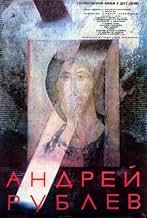
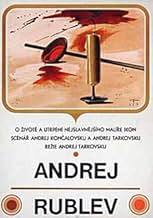
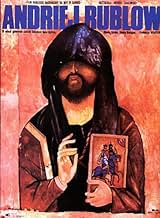
Andrej Rublëv narra la vita del grande pittore di icone vissuto in Russia nel turbolento XV° secolo, epoca marcata da sanguinosi conflitti tra pincipi rivali e dalla terribile invasione dei ... Leggi tuttoAndrej Rublëv narra la vita del grande pittore di icone vissuto in Russia nel turbolento XV° secolo, epoca marcata da sanguinosi conflitti tra pincipi rivali e dalla terribile invasione dei Tartari.Andrej Rublëv narra la vita del grande pittore di icone vissuto in Russia nel turbolento XV° secolo, epoca marcata da sanguinosi conflitti tra pincipi rivali e dalla terribile invasione dei Tartari.
- Regia
- Sceneggiatura
- Star
- Premi
- 4 vittorie e 1 candidatura in totale



- Durochka
- (as Irma Raush)


- Patrikey, monakh
- (as Yu. Nikulin)

- Skomorokh
- (as R. Bykov)

- Stepan, sotnik Velikogo knyazya
- (as N. Grabbe)

- Foma, monakh
- (as M. Kononov)

- Starshiy liteyshchik
- (as S. Krylov)

- Tatarskiy khan
- (as B. Beyshenaliev)

- Aleksey, monakh
- (as A. Obukhov)
- Sergey
- (as Volodya Titov)
- Efim
- (as N. Glazkov)
Recensioni in evidenza
Knowledge as an Impediment
But there is another thread, one that eschews selfaware structure -- where idea is anathema. Nature is celebrated. Rich intuition and meditative spontaneity are sufficiently nutritious in some hands, but these are amazingly few. The so-called 'new wave' tried it, at least initially. Lots of other appearances as well, mostly failures, some lovely. Among the attempts, I know of only two filmmakers who have mastered this tricky approach of avoiding knowledge: Tarkovsky and Malick. Of these, Malick is more abstractly sensual.
After all, Tarkovsky must deal with that dark cloth of Russian self-pity, that tradition of grand themes and epic fate, something which does not burden Malick. So the metaphoric content is heavy. That's fine, an acceptable skeleton for a nearly three hour meditation. All is self-referential: a set of images about an imagemaker: the actor's wife played the retarded girl who factors so importantly. During the production he was cheating on her with who was to become his second wife. The girl goes off with a Tartar, leaving Rublev. Many other scenes refer to Rublev's situation, resolved by Tarkovsky's action. For instance, we have a sequence where Rublev hesitates to paint a scene of fateful pain. This is followed by Tarkovsky doing just that. The extension of metaphor among parts of the film (ballooner and bellringer to Rublev's story) extends from the film to the filmmaker and thence from him to us.
What I found even more interesting was his confidence in complex compositions and long, long multiperspective tracking shots. Compared to other swoopers, this camera seems curious, impetuous, not at all as if the shots were planned. Hard to believe it is only his second feature. This alone expands one's imagination with only a couple viewings, but combined with the notion of folded metaphor (including visual metaphor) it becomes a truly great and singular work.
(Some classical symmetries touch multiple places: a jester within the play; solitude in the context of relationship; creating in the unknown; broken symmetry through one twin killing another. Some new ones: pagan fire and water underlying ritual exuberance, either sex or religious art.)
Alas, the DVD has a discouragingly vapid commentary. But then I guess that's the whole point, and with the loss of potatohead Soviets, we need to substitute the next best thing.
A true masterpiece!
There are no cliches here, no stereotypes and no sucking up to the audience. A brutally honest and yet very moving, touching and optimistic film. And it is not about the nature of a genius. Rather, it is about a man's ability and duty to preserve and be true to his humanity, his freedom, his soul, his heart and his gift, no matter what century it is or what the circumstances are. Watch it to remind yourself of what it really means to be human.
The most profoundly affecting film of my life
"You'll cast bells, I'll paint icons"
Andrei Tarkovsky released his first feature-length film, 'Ivan's Childhood,' in 1962. Even prior to its release, the director had already expressed interest in filming the life of great Russian iconographer Andrei Rublev, even though very little is actually known about his life. Working with a screenplay written by himself and Andrei Konchalovsky, Tarkvosky began filming in 1964, and a 205-minute cut was screened for a private audience in Moscow in 1966. The critical response, however, was mixed, and sizeable cuts were made to the film's running time, before a 186-minute version screened out of competition at the Cannes Film Festival in 1969. I'm not entirely sure which version I ended up watching; the time counter indicated somewhere around 165 minutes, though my brief research couldn't uncover any major missing sequences. In hindsight, I should probably have held out for longer and acquired the Criterion Collection DVD, which restores the picture to its four-hour glory. In several years' time, when I inevitably decide to revisit Tarkovsky's film, I'll make certain to do just that.
'Andrei Rublev' is divided into nine distinct segments, including a colour epilogue displaying Rublev's weathered icons as they exist today. They each explore a facet of the great painter's life, placing particular emphasis on his faith in God and how it relates to his work on frescos and icons. Interestingly, though Rublev (Anatoli Solonitsyn) himself appears in most of the stories, he is often hidden in the background, a passive observer on the behaviour of others, including Kirill (Ivan Lapikov), who is jealous of Rublev's recognition, and young Boriska (Nikolai Burlyayev), who successfully casts a bell using faith rather than knowledge. One consequence of this narrative format is a lack of cohesiveness in Tarkovsky's storytelling. We adequately follow the plot of each segment, but, as the whole, the film doesn't seem to build towards any notable climactic revelation the completed film is equal to the sum of its parts, which is still very impressive, but pulls it short of being a masterpiece. Once again, however, I must acknowledge that the 205-minute version may potentially correct this problem.
One statement that can not be disputed, however, is that 'Andrei Rublev' really is a beautiful piece of film-making. Vadim Yusov's black-and-white photography captures the exquisite delicateness of nature with almost heartbreaking intricacy; even the raindrops of a midday shower are imbued with the gentle elegance of the Heaven from which they ostensibly fell. Tarkovsky finds simple beauty in the quiver of a tree branch in the breeze, the leisurely flow of a river, herds of livestock fleeing from an aerial balloon. In portraying the complete opposite, the destruction of nature, the director is capable but not quite the master he is otherwise. The raiding of Vladimir by a troop of Tatars was obviously supposed to be the centrepiece of the picture, but Tarkovsky underplays every detail to such an extent that his "chaos" ultimately winds down into a staged conflict. Compare this sequence with Sergei Bondarchuk's burning of Moscow in 'War and Peace (1967),' in which one feels as though he has descended into the fires of Hell, and the contrast is telling.
What side will you take?
The medieval society was deeply religious. The church influenced every aspect of people's lives from birth to death and was part of the state. It means religious leaders were as important as rulers.
In Russian society men were wearing beards and women covered hairs. Remove a beard from a man or uncover woman's hair and you will humiliate them, they would feel like modern people being undressed in public.
Paganism is a form of religion, where people believe in many gods instead of one. The main Russian pagan gods are the goddess of the earth and the god of the sun. Among others - the god of storms and lightning, the mythical young women living in forests and rivers. Despite many centuries of suppression of paganism by authorities some in modern Russia still celebrate the feast of Ivan Kupala (which could be translated as Ivan Gathering) depicted in the movie.
Also I have to mention, that Soviet censors told Tarkovski the movie is too cruel. They told him the scene with a burning cow, for example, is absolutely unacceptable. Tarkovski tried to defend the movie. The cow wasn't harmed, was his reasoning. Still the film was cut. The censors knew better what is good and what is not for the viewer.
This brings us to what is the message of Tarkovski in this film. There are many messages actually. I'll be telling only about one here, because it is not hidden. It is there, in the dispute between Rublov and Theophanes The Greek. They both are talented, both want to bring people to humanity. Theophanes is tired, he says - common people live in darkness, they are completely consumed by sin and the only way to make them humans is to scare them and punish them. Rublov advocates for love. He says: people live very difficult life, it's amazing how they endure it. We have to love them, to remind them, they are humans, they are Russians. You see, the first is the position of the Soviet system, the second - of Jesus Christ.
Me? I'm still sitting on the fence. :)
I recommend to watch this movie many times. You will do it without my recommendation though, if you (like me) will not understand everything from the first view and you like to think. The mesmerizing beauty of this movie will help you to return easier. For the first time be prepared for not a cakewalk. There are two things to consider here. One is the cruelty. Though it is absolutely necessary in this film, most of us living in a comfort of modern society are not ready to it. The other is the pace. Often it is a pace of real life.
Peace.


Lo sapevi?
- QuizFilm debut of Anatoliy Solonitsyn, and the first of four movies he made together with director Andrei Tarkovsky before his death from cancer in 1982. Had Solonitsyn lived, he would also have played protagonist Andrei Gorchakov in Tarkovsky's Nostalghia (1983), as well as star in a project titled 'The Witch' which eventually became Tarkovsky's final production, Sacrificio (1986).
- BlooperThe smoothly-cut logs that feature many times in the early scenes are clearly cut with machinery not available in the early fifteenth century.
- Citazioni
Andrei Rublyov: You just spoke of Jesus. Perhaps he was born and crucified to reconcile God and man. Jesus came from God, so he is all-powerful. And if He died on the cross it was predetermined and His crucifixion and death were God's will. That would have aroused hatred not in those that crucified him but in those that loved him if they had been near him at that moment, because they loved him as a man only. But if He, of His own will, left them, He displayed injustice, or even cruelty. Maybe those who crucified him loved him because they helped in this divine plan.
- Versioni alternativeSoviet television created a severely trimmed 101-minute version that the director did not authorize. Notable scenes removed from this version were the raid of the Tatars and the scene showing naked pagans. The epilogue showing details of Andrei Rublev's icons was in black and white as the Soviet Union had not yet fully transitioned to color TV.
- ConnessioniEdited into Ombres vives ...une autre histoire du cinema... (2013)
I più visti
- How long is Andrei Rublev?Powered by Alexa
Dettagli
- Data di uscita
- Paese di origine
- Lingue
- Celebre anche come
- Andrej Rubliov
- Luoghi delle riprese
- Aziende produttrici
- Vedi altri crediti dell’azienda su IMDbPro
Botteghino
- Budget
- 1.000.000 RUR (previsto)
- Lordo Stati Uniti e Canada
- 124.189 USD
- Fine settimana di apertura Stati Uniti e Canada
- 11.537 USD
- 15 set 2002
- Lordo in tutto il mondo
- 181.010 USD
- Tempo di esecuzione
- 3h 9min(189 min)
- Colore
- Mix di suoni
- Proporzioni
- 2.35 : 1