

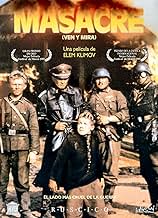
Dopo aver trovato un vecchio fucile, un ragazzino si unisce al movimento di Resistenza sovietica contro le spietate forze tedesche, vivendo sulla sua pelle gli orrori della Seconda guerra mo... Leggi tuttoDopo aver trovato un vecchio fucile, un ragazzino si unisce al movimento di Resistenza sovietica contro le spietate forze tedesche, vivendo sulla sua pelle gli orrori della Seconda guerra mondiale.Dopo aver trovato un vecchio fucile, un ragazzino si unisce al movimento di Resistenza sovietica contro le spietate forze tedesche, vivendo sulla sua pelle gli orrori della Seconda guerra mondiale.
- Regia
- Sceneggiatura
- Star
- Premi
- 3 vittorie totali




Aleksey Kravchenko
- Flyora Gayshun
- (as A. Kravchenko)

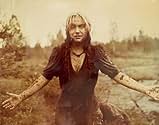
Olga Mironova
- Glasha
- (as O. Mironova)

Liubomiras Laucevicius
- Kosach
- (as L. Lautsyavichius)

Vladas Bagdonas
- Rubezh
- (as V. Bagdonas)

Jüri Lumiste
- Obersturmführer
- (as J. Lumiste)

Viktors Lorencs
- Sturmbannführer
- (as V. Lorents)
Kazimir Rabetsky
- Village Headman
- (as K. Rabetsky)

Evgeniy Tilicheev
- Gezhel
- (as E. Tilicheev)
Igor Gnevashev
- Yankel
- (as I. Gnevashev)

Vasiliy Domrachyov
- Little Policeman
- (as V. Domrachev)

Evgeniy Kryzhanovskiy
- Partisan with glasses
- (as E. Kryzhanovsky)

Viktor Manaev
- Partisan
- (as V. Manaev)
Takhir Matyullin
- Elderly partisan
- (as T. Matiulin)
8,3118.4K
1
2
3
4
5
6
7
8
9
10
Riepilogo
Reviewers say 'Come and See' is a harrowing portrayal of war, focusing on brutal realities and psychological impact through young Florya. The film is praised for its realistic depiction, eschewing heroic narratives for a visceral experience. Themes of innocence lost and dehumanizing conflict are central. Critics commend powerful cinematography, sound design, and Aleksei Kravchenko's performance. Some find scenes overly graphic or tone inconsistent, leading to mixed but generally positive reception.
Recensioni in evidenza
Quite possibly the most powerful film I have ever seen.
Come and See is one of the rare films that I can remember being emotionally drained upon its conclusion. The expression on my face as I sat there watching the credits scroll by seemed as worn and broken as that of the protagonist, Florya.
The film follows Florya as he "joins" (i.e. obtains a gun) a partisan group resisting the German advancements in the forests of his native Byelorussia during World War II. What he witnesses at the ripe age of 12 changes a once open-eyed, smiling face into a weathered, traumatized one that has experienced the unimaginable.
And of course the unimaginable were the Nazi atrocities committed during the war. Come and See does not focus on what the German Army did to the Jewish population but rather what they did to the native Soviet population. The Nazis were not only concerned with the utter destruction of the Jews but of the Bolshevik Party as well. And to Hitler that meant any man, woman, or child living under communist rule. And this "cleansing" fell into the hands of the SS who, as depicted in the movie, literally destroyed every sign of life.
Florya is able to escape death, unlike the rest of his family, but serves as a witness to the destruction and in this sense "dies" as his innocence and youth is lost. Klimov does a masterful job and depicting this slow death by concentrating on the facial expressions of Florya versus that of the Germans and both of their transformations over time. Klimov's Hitler montage at the end is especially moving and puts an interesting spin on the whole "what if" question.
This is the most historically accurate war movie I have ever seen and would highly recommend it to any war/history enthusiast. But I would also recommend it to any film watcher that realizes the goal of the medium which is to evoke emotion in the audience, and Come and See does just that.
The film follows Florya as he "joins" (i.e. obtains a gun) a partisan group resisting the German advancements in the forests of his native Byelorussia during World War II. What he witnesses at the ripe age of 12 changes a once open-eyed, smiling face into a weathered, traumatized one that has experienced the unimaginable.
And of course the unimaginable were the Nazi atrocities committed during the war. Come and See does not focus on what the German Army did to the Jewish population but rather what they did to the native Soviet population. The Nazis were not only concerned with the utter destruction of the Jews but of the Bolshevik Party as well. And to Hitler that meant any man, woman, or child living under communist rule. And this "cleansing" fell into the hands of the SS who, as depicted in the movie, literally destroyed every sign of life.
Florya is able to escape death, unlike the rest of his family, but serves as a witness to the destruction and in this sense "dies" as his innocence and youth is lost. Klimov does a masterful job and depicting this slow death by concentrating on the facial expressions of Florya versus that of the Germans and both of their transformations over time. Klimov's Hitler montage at the end is especially moving and puts an interesting spin on the whole "what if" question.
This is the most historically accurate war movie I have ever seen and would highly recommend it to any war/history enthusiast. But I would also recommend it to any film watcher that realizes the goal of the medium which is to evoke emotion in the audience, and Come and See does just that.
Masterpiece alert!
Even before the final credits rolled, I strongly suspected this movie would end up on my Top 20; in fact, perhaps even my Top 10. A teenage boy, his hearing impaired from having just been at the site of a bombing, and a young woman clutching at him, the two of them stumbling and sludging through a slimy, smelly bog. A stork in the woods as it rains. A cluster of dolls piled up on the floor with flies buzzing all over the room. You don't need vast, elaborately choreographed battle scenes to bring home the message of the senselessness and pain of war. Reading viewers' comments on the movie, it seems that most found the second half which admittedly contained some of the most powerful massacre scenes ever filmed as the most "satisfying". A few other viewers seem to imply the movie doesn't really get going until the second half. For me, it was the first half that got under my skin the most, for its cinematic originality, poetry and symbolic power. War is experienced by civilians as well as by soldiers: this may seem like an obvious statement, but it's only after watching Come and See that you realise how few war movies are truly about the suffering of the ordinary man and woman, defenseless child and frail senior citizen. Also, never before had I seen the plight of raped women in war so powerfully conveyed, and all this without the movie ever being voyeuristic or graphic. In cinema, rape is often portrayed as something that looks like rough sex. It isn't always quite clear why women get so upset over it. In Come and See, rape is shown as nothing but pure, unadulterated, hate-fuelled violence with only a superficial, external resemblance to sex. Unlike other raped women on film, you cannot imagine those in Come and See ever healing from their scars.
On another subject, whoever thinks this movie contains "propaganda" is obviously prejudiced against the movie simply because it's a Soviet production, and should think things over a little more carefully. It's astonishing how you can still find little traces of the Cold War mentality surviving to this day, even in younger viewers... The fact that as detractors of Come and See claim, Stalin "was no better than Hitler" has nothing to do with anything at all, in this movie's context - Klimov's picture is NOT about nationalistic oneupmanship on who had the worst tyrant - it's about the basic suffering of ordinary humanity in war - ANY war, though this one happened to be going on in Bielorussia. There was in fact ten times more propaganda in ten minutes of Saving Private Ryan than the whole of Come and See. This is painful, sublime cinema. I've always believed there's something special about Russians when it comes to producing art, especially literature - this movie goes some way towards reinforcing that impression in me.
On another subject, whoever thinks this movie contains "propaganda" is obviously prejudiced against the movie simply because it's a Soviet production, and should think things over a little more carefully. It's astonishing how you can still find little traces of the Cold War mentality surviving to this day, even in younger viewers... The fact that as detractors of Come and See claim, Stalin "was no better than Hitler" has nothing to do with anything at all, in this movie's context - Klimov's picture is NOT about nationalistic oneupmanship on who had the worst tyrant - it's about the basic suffering of ordinary humanity in war - ANY war, though this one happened to be going on in Bielorussia. There was in fact ten times more propaganda in ten minutes of Saving Private Ryan than the whole of Come and See. This is painful, sublime cinema. I've always believed there's something special about Russians when it comes to producing art, especially literature - this movie goes some way towards reinforcing that impression in me.
One of the greatest wars films ever made
One of the greatest of all war films, Klimov's stunning work stands amongst such works in which the horror and sorrow of conflict are made fresh over again for the viewer, left to stumble numb from the cinema thereafter. Produced for the 40th anniversary of Russia's triumph over the German invaders in WW2, based upon a novella by a writer who was a teenage partisan during the war, the propagandist use to which it was later put - when the GDR was still in the Eastern Bloc, citizens were forced to watch this to warn them of another rise of fascism - does not impair its effect today at all. It echoes intensity found in another masterpiece by the director. Klimov's shorter Larissa (1980) is a remorseful elegy to his late wife. Poetic and very personal, its sense of shock anticipates the heightened anguish that ultimately reverberates through Come And See. Through his images, the director stares uncomprehendingly at a world where lives are removed cruelly and without reason, if on this occasion not just one, but thousands.
At the heart of the narrative is Floyra, both viewer and victim of the appalling events making up the film's narrative, his history a horrendous coming-of-age story. It begins with him laboriously digging out a weapon to use and much changed at the end, he finally uses one. As he travels from initial innocence, through devastating experience, on to stunned hatred, in a remarkable process he ages before our eyes, both inside and out. His fresh face grows perceptibly more haggard as the film progresses, frequently staring straight back at the camera, as if challenging the viewer to keep watching; or while holding his numbed head, apparently close to mental collapse. Often shot directly at the boy or from his point of view, the formal quality of Klimov's film owes something to Tarkovsky's use of the camera in Ivan's Childhood, although the context is entirely different.
The film's title is from the Book of Revelations, referring to the summoning of witnesses to the devastation brought by the Four Horsemen of the Apocalypse. 'Come and See' is an invitation for its youthful protagonist to arm up and investigate the war, but also one for the audience to tread a similarly terrible path, witnessing with vivid immediacy the Belorussion holocaust at close hand. Here, the intensity of what is on offer justifies amplification by the use of a travelling camera, point-of-view shots, and some startlingly surreal effects pointing up unnatural events: the small animal clinging nervously to the German commander's arm for instance, soundtrack distortions, or the mock Hitler sculpted out of clay and skull.
Main character Floyra is the director's witness to events, a horrified visitor forced, like us to 'see' - even if full comprehension understandably follows more slowly. For instance during their return to the village, there is some doubt as to if Floyra is yet, or will be ever, able to fully acknowledge the nature of surrounding events. In one of the most disturbing scenes out of a film full of them, Glasha's reaction to off-screen smells and sights is profoundly blithe and unsettling. So much so, we wonder for a brief while if the youngsters really know what is going on. Its a watershed of innocence: one look back as the two leave and the reality of the situation would surely overwhelm Floyra - just as later, more explicit horrors do the viewer.
Come And See was not an easy shoot. It lasted over nine months and during the course of the action the young cast were called upon to perform some unpleasant tasks including, at one point, wading up to their necks through a freezing swamp. Kravchenko's face is unforgettable during this and other experiences, and there are claims that he was hypnotised in order to simulate the proper degree of shell shock during one of the major early sequences. The sonic distortion created on the soundtrack at this point later appeared to a lesser extent in Spielberg's Saving Private Ryan, as did elements of a much-commented scene where a cow is caught in murderous crossfire. Klimov's camera ranges through and around the atrocities, although one doubts that a steady cam was available. By the end Florya is isolated from humanity, technically as well as mentally, by a striking shot that excludes the middle foreground. Disturbingly expressionistic though these scenes are, others such as the scene where Florya and the partisan girl Rose visit the forest after the bombing, achieve an eerie lyricism that are however entirely missing from the Hollywood production. And whereas Spielberg's work concludes with a dramatic irony that's perhaps a little too neat, contrived for different audience tastes, Klimov's less accommodating epic finishes on a unique, cathartic moment - no doubt partly chosen to avoid any bathos after events just witnessed, but one which sends real blame back generations.
Hallucinatory, heartrending, traumatic and uncompromising, such a movie will not to be all tastes. It certainly does not make for relaxing viewing, although those who see it often say it remains with them for years after. This was Klimov's last film for, as he said afterwards "I lost interest in making films. Everything that was possible I felt had already been done," no doubt referring to the emotional intensity of his masterpiece, which would be hard to top. By the end of their own viewing, any audience ought to be shocked enough to pick up a rifle themselves and vengefully join the home army setting out to fight the Great Patriotic War - a necessarily stalwart response without limit of participation, symbolised by the director who tracks a camera through the dense forest before finally rejoining a column of soldiers heading to the front. If you feel, like I do, that any real war film should succeed in conveying the power and pity of it all, then Come And See is an absolute go and watch.
At the heart of the narrative is Floyra, both viewer and victim of the appalling events making up the film's narrative, his history a horrendous coming-of-age story. It begins with him laboriously digging out a weapon to use and much changed at the end, he finally uses one. As he travels from initial innocence, through devastating experience, on to stunned hatred, in a remarkable process he ages before our eyes, both inside and out. His fresh face grows perceptibly more haggard as the film progresses, frequently staring straight back at the camera, as if challenging the viewer to keep watching; or while holding his numbed head, apparently close to mental collapse. Often shot directly at the boy or from his point of view, the formal quality of Klimov's film owes something to Tarkovsky's use of the camera in Ivan's Childhood, although the context is entirely different.
The film's title is from the Book of Revelations, referring to the summoning of witnesses to the devastation brought by the Four Horsemen of the Apocalypse. 'Come and See' is an invitation for its youthful protagonist to arm up and investigate the war, but also one for the audience to tread a similarly terrible path, witnessing with vivid immediacy the Belorussion holocaust at close hand. Here, the intensity of what is on offer justifies amplification by the use of a travelling camera, point-of-view shots, and some startlingly surreal effects pointing up unnatural events: the small animal clinging nervously to the German commander's arm for instance, soundtrack distortions, or the mock Hitler sculpted out of clay and skull.
Main character Floyra is the director's witness to events, a horrified visitor forced, like us to 'see' - even if full comprehension understandably follows more slowly. For instance during their return to the village, there is some doubt as to if Floyra is yet, or will be ever, able to fully acknowledge the nature of surrounding events. In one of the most disturbing scenes out of a film full of them, Glasha's reaction to off-screen smells and sights is profoundly blithe and unsettling. So much so, we wonder for a brief while if the youngsters really know what is going on. Its a watershed of innocence: one look back as the two leave and the reality of the situation would surely overwhelm Floyra - just as later, more explicit horrors do the viewer.
Come And See was not an easy shoot. It lasted over nine months and during the course of the action the young cast were called upon to perform some unpleasant tasks including, at one point, wading up to their necks through a freezing swamp. Kravchenko's face is unforgettable during this and other experiences, and there are claims that he was hypnotised in order to simulate the proper degree of shell shock during one of the major early sequences. The sonic distortion created on the soundtrack at this point later appeared to a lesser extent in Spielberg's Saving Private Ryan, as did elements of a much-commented scene where a cow is caught in murderous crossfire. Klimov's camera ranges through and around the atrocities, although one doubts that a steady cam was available. By the end Florya is isolated from humanity, technically as well as mentally, by a striking shot that excludes the middle foreground. Disturbingly expressionistic though these scenes are, others such as the scene where Florya and the partisan girl Rose visit the forest after the bombing, achieve an eerie lyricism that are however entirely missing from the Hollywood production. And whereas Spielberg's work concludes with a dramatic irony that's perhaps a little too neat, contrived for different audience tastes, Klimov's less accommodating epic finishes on a unique, cathartic moment - no doubt partly chosen to avoid any bathos after events just witnessed, but one which sends real blame back generations.
Hallucinatory, heartrending, traumatic and uncompromising, such a movie will not to be all tastes. It certainly does not make for relaxing viewing, although those who see it often say it remains with them for years after. This was Klimov's last film for, as he said afterwards "I lost interest in making films. Everything that was possible I felt had already been done," no doubt referring to the emotional intensity of his masterpiece, which would be hard to top. By the end of their own viewing, any audience ought to be shocked enough to pick up a rifle themselves and vengefully join the home army setting out to fight the Great Patriotic War - a necessarily stalwart response without limit of participation, symbolised by the director who tracks a camera through the dense forest before finally rejoining a column of soldiers heading to the front. If you feel, like I do, that any real war film should succeed in conveying the power and pity of it all, then Come And See is an absolute go and watch.
I saw a film today , oh boy...
I have a bad habit of reading too many reviews and comments about a film before I've seen it, mainly to get an idea about whether it's going to be worth a couple of hours of my time watching it. As a result, I am often slightly disappointed with much of what I see, as all the hype that I've read about a film kind of blows my expectations out of all proportion. I had a feeling this would be the case with Elem Klimov's 'Come and See', a film I'd read a lot about, particularly here on the IMDb. (Imagine my "excitement" when, having tried to see the film for nearly a year, I discovered it was to be released on DVD a week or two ago from today!) Well, I finally watched the film yesterday and... well, nothing could have prepared me for the sheer intensity and unflinching visceral horror of the atrocities that 'Come and See' invites us to... come and see. (Has anyone commented before on what a clever title that actually is...?) This is one of those films, like, say, 'Requiem For A Dream' or 'The Magdalene Sisters' (both of which, though great films, are simply not in the same league as Klimov's film), that one does not (obviously) so much enjoy as submit oneself to. By the end of such films we are left numbed and shell-shocked, wondering what we are supposed to do with the intense emotions that have been evoked within us. Yes, I felt like the ground had been pulled from beneath me; yes, what I saw in that film made my blood boil, my head hurt and my heart pound; and, yes, it showed me things I'd seen before but to a degree of intensity and detail that I had not experienced before. The point though, I guess, is that the role of cinema (and art in general) is not to offer answers or tell us what to think but to simply show us particular events and characters and allow us to come to our own decisions about what those things 'mean'. I'm rambling now, but I'll simply end by saying that 'Come and See' is, with its outstanding technical and artistic credentials aside, a film whose very title alone demands that it be seen. It is the work of a visionary, a cry of despair from the depths of hell, and an important reminder of humanity's capacity for inhumanity Go and see...
unremitting graphical terror and accumulating atrocities
Elem Klimov and Aleksei Rodionov's handheld cinematography, present the viewer with the mental and physical destruction of a boy who changes in front of your eyes beyond recognition.
Cacophoneous, industrial sounds and sometimes cryptic story-elements (for as far as there is a story) contribute to this ruthlessly escalating history lesson about Nazi's who burned down hundreds of villages in 1943 in Russia. The realism makes you wonder how many people were harmed making the film, while the score represents the mindnumbing experiences of Florya, a tour-de-force performance by Aleksei Kravchenko (16 at the time). All along, somehow Klimov knows very well how to prevent the audience from becoming numb.
ILM's specialFX are smoother, but the FX here in 'Come and see' are so realistic, it's almost unreal: reminiscent of the first 30 min of Saving private Ryan, Thin red line (watch the animals), Apocalypse Now and the painstaking 'Band of brothers'. Indeed forget about the rest of 'SPR', Platoon and even Full Metal Jacket. However, I would like to recommend Deer Hunter (Cimino, 1978) and Hotaru no haka (1988). But I never suspected there was something massive like this. 10/10
Cacophoneous, industrial sounds and sometimes cryptic story-elements (for as far as there is a story) contribute to this ruthlessly escalating history lesson about Nazi's who burned down hundreds of villages in 1943 in Russia. The realism makes you wonder how many people were harmed making the film, while the score represents the mindnumbing experiences of Florya, a tour-de-force performance by Aleksei Kravchenko (16 at the time). All along, somehow Klimov knows very well how to prevent the audience from becoming numb.
ILM's specialFX are smoother, but the FX here in 'Come and see' are so realistic, it's almost unreal: reminiscent of the first 30 min of Saving private Ryan, Thin red line (watch the animals), Apocalypse Now and the painstaking 'Band of brothers'. Indeed forget about the rest of 'SPR', Platoon and even Full Metal Jacket. However, I would like to recommend Deer Hunter (Cimino, 1978) and Hotaru no haka (1988). But I never suspected there was something massive like this. 10/10


Lo sapevi?
- QuizLive ammunition was used during filming. In interviews, Aleksey Kravchenko has described bullets passing 10 centimeters above his head.
- BlooperMany of the vehicles are post-World War II Soviet vehicles with slapped-on German Army markings.
- Citazioni
Flyora Gaishun: To love... to have children...
- ConnessioniFeatured in The Story of the Film 'Come and See' (1985)
I più visti
Accedi per valutare e creare un elenco di titoli salvati per ottenere consigli personalizzati
- How long is Come and See?Powered by Alexa
Dettagli
Botteghino
- Lordo Stati Uniti e Canada
- 71.909 USD
- Fine settimana di apertura Stati Uniti e Canada
- 16.053 USD
- 23 feb 2020
- Lordo in tutto il mondo
- 20.929.648 USD
Contribuisci a questa pagina
Suggerisci una modifica o aggiungi i contenuti mancanti