VALUTAZIONE IMDb
7,7/10
37.446
LA TUA VALUTAZIONE


Infelice e tormentato amore di due giovani gay cinesi in una livida e notturna Buenos Aires, agli antipodi della loro Hong Kong.Infelice e tormentato amore di due giovani gay cinesi in una livida e notturna Buenos Aires, agli antipodi della loro Hong Kong.Infelice e tormentato amore di due giovani gay cinesi in una livida e notturna Buenos Aires, agli antipodi della loro Hong Kong.
- Premi
- 7 vittorie e 20 candidature totali
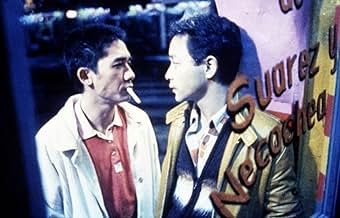
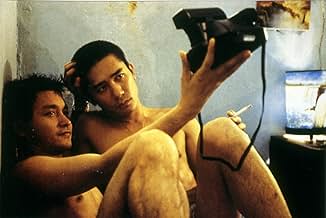
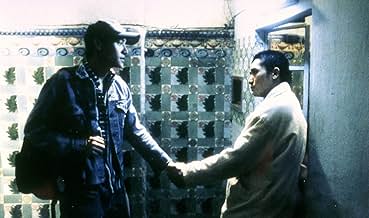



Tony Leung Chiu-wai
- Lai Yiu-fai
- (as Tony Chiu Wai Leung)


Shirley Kwan
- Fai's Girlfriend
- (scene tagliate)
7,737.4K
1
2
3
4
5
6
7
8
9
10
Recensioni in evidenza
A study of a traumatic relationship
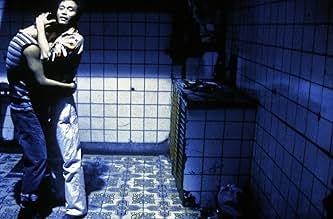
"Happy Together " is essentially a study of a couple falling in and out of love. Their sex - they are a gay couple from Hong Kong - hardly matters: the film could just as well have been about a straight or lesbian couple. The fact that very near the beginning there is as explicit a scene of male anal intercourse as one is likely to encounter in mainstream commercial cinema is far from gratuitously sensational. As the film is meant to start on a passionate high, this is the most convincing way of doing it - so be it. The director has the integrity not to repeat this for the reason that the couple never quite feel the same about each other again - indeed there is a great deal of alienation. Both have arrived in Argentina in search of work. Although the jobs undertaken by one of the pair, Lai, are fairly menial, first as a doorman at a Tango club and then a kitchen worker, he seems more stable than his companion, Ho, who does little but hustle, gets beaten up fairly early on and spends much of his time in an incapacitated state. In the room they share there is a lampshade depicting the Izuazi Falls. The cascade almost becomes a symbol for the relationship they would ideally like to achieve. Early on they hire a car to look for it but lose their way. After their relationship has finally broken Lai finds it, but as he is alone, the landmark seems sadly lacking in excitement. There is a third main character, a straight guy from Taiwan, who works in the kitchen with Lai. With his amiable self-sufficiency he seems to have been introduced to provide a balance to the angst of the main pair, a device that works well as it reinforces our sympathy for them. "Happy Together" looks rough and crude. A hand held camera is used with frenetic nervousness. Sequences of monochrome alternate with scenes that are almost perversely over-coloured. I know it is fashionable to give some films a nightmarish look. Here I found it a distinct stumbling block to be got over for the sake of a work that says so much about loneliness, homesickness and the struggle of people simply to be "happy together".
A Highly Stylized Emotional Roller Coaster
Happy Together is a throbbing, raw, and profoundly nostalgic lament from two displaced traveling Chinamen yearning for emotional soundness, for their homeland, and for each other. Wong doesn't front us any of the flickering that can still be struck between lovers who fight all the time. There is no deep poetic interpretation of the story itself, but by leaving so much unsaid, writer-director Wong Kar-Wai doesn't make the misstep of suffocating his characters' relationship with trite soap dialogue. That is not to say, however, that the film even remotely knows the meaning of the phrase "less is more."
You don't watch this film as much as seize on to it. Letting it yank you every which way is a raucous yet intriguing excursion, with fertile visual stylizations that trail you long after seeing the film, all with the impact to communicate directly with the heart. The visuals make the film come alive, and make material the displacement, and thus the unhinging, that the main characters feel from their surroundings and each other. Rather than using dialogue, this highly stylized romance chiefly imparts its themes and moods through its images, and Wong fashions an interior audiovisual composition about the mood swings of a love affair. Wong's use of images for purely emotional photogenic value, feverish camera movements, jukebox soundtrack and his improvisation and experimentation with the actors have an effect reminiscent of Scorsese's Mean Streets. In Wong's emotional roller coaster of a film, the characters seem to have a formidable intuitive certainty that their relationship is star- crossed sooner or later, but they follow passionate impulses regardless, giving the film a dreamy texture that it can't shake as its lovers turn-step to and fro during their free-form Argentine spree.
Wong gradually layers the relationship, just like it would happen in real life, and the doubts and obscurities are constant. He extracts powerful performances from his lead actors. While Leslie Cheung gracefully fluctuates his moments between yearning, resentment, and anger, Tony Leung Chiu-Wai is the calm eye of the storm.
Leung acts from the inside. We intuit his feelings through his natural physical subtleties, chiefly through the sensitive eyes. Even purely physical scenes, like the fights he has with Leslie Cheung's character, don't happen suddenly. Leung winds up for these moments instinctively and then defensively underplays them. And when the tears come, they pour without affectation, making me wonder from what part of Leung's soul he quietly unearths these moments from as Wong rolls the camera.
You don't watch this film as much as seize on to it. Letting it yank you every which way is a raucous yet intriguing excursion, with fertile visual stylizations that trail you long after seeing the film, all with the impact to communicate directly with the heart. The visuals make the film come alive, and make material the displacement, and thus the unhinging, that the main characters feel from their surroundings and each other. Rather than using dialogue, this highly stylized romance chiefly imparts its themes and moods through its images, and Wong fashions an interior audiovisual composition about the mood swings of a love affair. Wong's use of images for purely emotional photogenic value, feverish camera movements, jukebox soundtrack and his improvisation and experimentation with the actors have an effect reminiscent of Scorsese's Mean Streets. In Wong's emotional roller coaster of a film, the characters seem to have a formidable intuitive certainty that their relationship is star- crossed sooner or later, but they follow passionate impulses regardless, giving the film a dreamy texture that it can't shake as its lovers turn-step to and fro during their free-form Argentine spree.
Wong gradually layers the relationship, just like it would happen in real life, and the doubts and obscurities are constant. He extracts powerful performances from his lead actors. While Leslie Cheung gracefully fluctuates his moments between yearning, resentment, and anger, Tony Leung Chiu-Wai is the calm eye of the storm.
Leung acts from the inside. We intuit his feelings through his natural physical subtleties, chiefly through the sensitive eyes. Even purely physical scenes, like the fights he has with Leslie Cheung's character, don't happen suddenly. Leung winds up for these moments instinctively and then defensively underplays them. And when the tears come, they pour without affectation, making me wonder from what part of Leung's soul he quietly unearths these moments from as Wong rolls the camera.
Sculpting in time; Wong's hypnotic rumination on love and dislocation
Something of an obvious precursor to the subsequent masterpiece In the Mood for Love (2000); Happy Together (1997) is a tragic love story by way of recollection. If you're at all familiar with the work of director Wong Kar-Wai - from his breakthrough film Days of Being Wild (1991), to his more recent masterwork, the unsung 2046 (2004) - then you'll be accustomed to his personal approach to cinema; from that continually drifting sense of quiet melancholy and disconnected ennui - all captured by a roving camera that conspires to alienate characters from one another by intrusive shot composition and naturalist production design - and a beguiling approach to the concept of time continually abstracted in order to create drama from moments of fond reminisce. Once again, the feeling expressed in Happy Together is that of loneliness and despair, as characters drift spectre-like through desolate cities attempting to cling to moments and memories as if gasping for their final breath; and all the while distorted by a frequently hypnotic approach to music, structure, pace and cinematography.
If the film lacks the sophistication of the aforementioned In the Mood for Love, it is only because the process of refinement has replaced the edginess and earthiness of this film, with a studied, technical grandeur and ornate beauty that is really quite transcendent. Nonetheless, the style and tone of Happy Together fits the mood of the film perfectly; capturing the feckless uncertainly of the character's lives - both together and apart - and concurrently suggesting the idea of memory and repetition that plays an important role in the way the narrative ultimately plays out. The first viewing might very well be confusing, with scenes occurring that seem to simultaneously represent both the past and the present, and with information presented in a series of incredibly quick cuts, disconnected voice-over and a continually jarring cross-cutting back and forth between lurid colour and an oddly tinted monochrome, which seems to work on an emotional level, as opposed to any kind of narrative convention.
That said, the grittiness of the film suggests an uncompromising and starkly unconventional beauty in keeping with the film's central relationship; with the violent and volatile shifts in stock capturing the same unpredictable impulses and urges of the central characters as they fight, break-up, reconcile and drift apart against a rolling backdrop of exotic and atmospheric locations. The use of Buenos Aires as the central setting adds texture to the film, and the vibrant way in which the director captures the strange, mysterious and nocturnal atmosphere of the city is evocative to say the least. Here, the rhythm of the film becomes tuned to that of the Argentine tango that swirls through the bar where the characters rediscover one another; with the staccato rhythms of the movement underscored by the sad reflections of the accordion music and the stampeding percussion of feet against floors, combined with continual hints of tortured romanticism - touching without feeling, sensing without sensuality, etc - that are so central to these characters and the odd situation they find themselves in.
The location also ties in with the filmmaker's fondness for the work of author Manuel Puig; whose style of writing has some influence on the tone and languid energy of the film in question, with Wong and his crew - and in particular cinematographer Christopher Doyle - expressing certain unspoken facets of this relationship through framing, movement, colour and rhythm. The fact that the film focuses on a homosexual relationship is ultimately secondary. As is often the case with Wong Kar-Wai, the film is about that urge and desire to belong to something - or someone - and the pursuit of an unrequited love that is powerful enough to drive you to the end of the world. We see these themes repeated again and again, from the inter-linked meta-romance of Days of Being Wild, In the Mood for Love and 2046, to the brilliance of Chungking Express (1994). Through the jarring nature of the relationship between the reckless and subtly abusive Ho Po-Wing and the more sensitive and brooding Lai Yiu-fai, Wong is able to express a series of thoughts and ruminations of the notions of love in a way that is intelligent, but always easy to identify with, regardless of gender or sexuality.
Later in the film, the director expresses slightly more profound feelings through the friendship of Lai Yiu-fai and the young runaway Chang. Here, we see a mutual respect and unspoken love that goes beyond sex and sexuality; creating a pure statement on the notion of love and the desire to belong to someone or something, within a certain time or place. A love so great that the person would be willing to carry your own sadness to the end of the world, to lessen the burdens of life and open the door to a new beginning free of difficulties and strife. There are deeper themes expressed throughout - too many to go into in this review - nonetheless, the film is understated and brimming with emotion; in keeping with the director's more iconic or well-regarded films, such as the ones aforementioned, and continuing a number of important themes and motifs that are both thought-provoking and affecting. The film also benefits from the fine performances of the three lead actors, stunning locations, cinematography, great atmosphere, mood and spirit; and an overall approach to cinema that is poetic, to say the least.
If the film lacks the sophistication of the aforementioned In the Mood for Love, it is only because the process of refinement has replaced the edginess and earthiness of this film, with a studied, technical grandeur and ornate beauty that is really quite transcendent. Nonetheless, the style and tone of Happy Together fits the mood of the film perfectly; capturing the feckless uncertainly of the character's lives - both together and apart - and concurrently suggesting the idea of memory and repetition that plays an important role in the way the narrative ultimately plays out. The first viewing might very well be confusing, with scenes occurring that seem to simultaneously represent both the past and the present, and with information presented in a series of incredibly quick cuts, disconnected voice-over and a continually jarring cross-cutting back and forth between lurid colour and an oddly tinted monochrome, which seems to work on an emotional level, as opposed to any kind of narrative convention.
That said, the grittiness of the film suggests an uncompromising and starkly unconventional beauty in keeping with the film's central relationship; with the violent and volatile shifts in stock capturing the same unpredictable impulses and urges of the central characters as they fight, break-up, reconcile and drift apart against a rolling backdrop of exotic and atmospheric locations. The use of Buenos Aires as the central setting adds texture to the film, and the vibrant way in which the director captures the strange, mysterious and nocturnal atmosphere of the city is evocative to say the least. Here, the rhythm of the film becomes tuned to that of the Argentine tango that swirls through the bar where the characters rediscover one another; with the staccato rhythms of the movement underscored by the sad reflections of the accordion music and the stampeding percussion of feet against floors, combined with continual hints of tortured romanticism - touching without feeling, sensing without sensuality, etc - that are so central to these characters and the odd situation they find themselves in.
The location also ties in with the filmmaker's fondness for the work of author Manuel Puig; whose style of writing has some influence on the tone and languid energy of the film in question, with Wong and his crew - and in particular cinematographer Christopher Doyle - expressing certain unspoken facets of this relationship through framing, movement, colour and rhythm. The fact that the film focuses on a homosexual relationship is ultimately secondary. As is often the case with Wong Kar-Wai, the film is about that urge and desire to belong to something - or someone - and the pursuit of an unrequited love that is powerful enough to drive you to the end of the world. We see these themes repeated again and again, from the inter-linked meta-romance of Days of Being Wild, In the Mood for Love and 2046, to the brilliance of Chungking Express (1994). Through the jarring nature of the relationship between the reckless and subtly abusive Ho Po-Wing and the more sensitive and brooding Lai Yiu-fai, Wong is able to express a series of thoughts and ruminations of the notions of love in a way that is intelligent, but always easy to identify with, regardless of gender or sexuality.
Later in the film, the director expresses slightly more profound feelings through the friendship of Lai Yiu-fai and the young runaway Chang. Here, we see a mutual respect and unspoken love that goes beyond sex and sexuality; creating a pure statement on the notion of love and the desire to belong to someone or something, within a certain time or place. A love so great that the person would be willing to carry your own sadness to the end of the world, to lessen the burdens of life and open the door to a new beginning free of difficulties and strife. There are deeper themes expressed throughout - too many to go into in this review - nonetheless, the film is understated and brimming with emotion; in keeping with the director's more iconic or well-regarded films, such as the ones aforementioned, and continuing a number of important themes and motifs that are both thought-provoking and affecting. The film also benefits from the fine performances of the three lead actors, stunning locations, cinematography, great atmosphere, mood and spirit; and an overall approach to cinema that is poetic, to say the least.
Raw, Imperfect, Intense
"Happy Together" is a depressing film. Yet it's one which I keep coming back to when I feel down and heartbroken.
Lost souls, lonely, longing, and lovelorn, are staples in the Wong Kar-Wai universe. His best works uncannily portray the beauty and misery of being struck by love and its multiple variations and illusions. His fluid, script-free, improvisational style of work is now legendary and applies well to the unpredictable nature of this subject matter while giving his works a raw, open-ended quality. "Happy Together" is quite probably his rawest work to date and, as a result, one of the most difficult to watch (this honor goes to "Ashes of Time"). The rawness makes it seem organic. It feels as if it's an ever-evolving creature which hides and exposes its multiple facets with each different viewing.
Argentina sounds like a great romantic escape for most of us but for our couple, Po-wing (Leslie Cheung) and Yiu-fai (Tony Leung), it's a lonely, bleak, melancholic place on the edge of the world. Travelogue film this isn't. Buenos Aires may have initially held romantic promise for them. "Let's start over," Po-wing asks Yiu-fai yet again, and off they go to South America to work things out. Soon, however, the place becomes a physical representation of their relationship. It's claustrophobic and oppressive, something that could've been so beautiful yet one which they now need to escape from. Wong beautifully portrays spectacular Iguazu Falls with mythical significance throughout the film. Initially nothing more than amusing kitsch, it eventually progresses as the defining geographical manifestation of their amorous aspirations. It achieves such heavy, symbolic power, the last time we see it is one of the most memorable scenes in the film.
If the homosexual angle seems downplayed here, it is to parallel the film's treatment. It's so matter-of-fact it's irrelevant and even embarrassing to make an issue out of it. This is a couple who just happens to be gay. Indeed, there is nothing gay-specific about the film, the couple may well have been straight and it wouldn't make a difference at all.
"Happy Together" is such a vivid examination of a relationship, it's occasionally painful to watch. The emotional authenticity, however, makes it quite absorbing. Wong Kar-Wai often aims for the heart and, with the possible exception of "In the Mood for Love", he's never been closer to his target.
Lost souls, lonely, longing, and lovelorn, are staples in the Wong Kar-Wai universe. His best works uncannily portray the beauty and misery of being struck by love and its multiple variations and illusions. His fluid, script-free, improvisational style of work is now legendary and applies well to the unpredictable nature of this subject matter while giving his works a raw, open-ended quality. "Happy Together" is quite probably his rawest work to date and, as a result, one of the most difficult to watch (this honor goes to "Ashes of Time"). The rawness makes it seem organic. It feels as if it's an ever-evolving creature which hides and exposes its multiple facets with each different viewing.
Argentina sounds like a great romantic escape for most of us but for our couple, Po-wing (Leslie Cheung) and Yiu-fai (Tony Leung), it's a lonely, bleak, melancholic place on the edge of the world. Travelogue film this isn't. Buenos Aires may have initially held romantic promise for them. "Let's start over," Po-wing asks Yiu-fai yet again, and off they go to South America to work things out. Soon, however, the place becomes a physical representation of their relationship. It's claustrophobic and oppressive, something that could've been so beautiful yet one which they now need to escape from. Wong beautifully portrays spectacular Iguazu Falls with mythical significance throughout the film. Initially nothing more than amusing kitsch, it eventually progresses as the defining geographical manifestation of their amorous aspirations. It achieves such heavy, symbolic power, the last time we see it is one of the most memorable scenes in the film.
If the homosexual angle seems downplayed here, it is to parallel the film's treatment. It's so matter-of-fact it's irrelevant and even embarrassing to make an issue out of it. This is a couple who just happens to be gay. Indeed, there is nothing gay-specific about the film, the couple may well have been straight and it wouldn't make a difference at all.
"Happy Together" is such a vivid examination of a relationship, it's occasionally painful to watch. The emotional authenticity, however, makes it quite absorbing. Wong Kar-Wai often aims for the heart and, with the possible exception of "In the Mood for Love", he's never been closer to his target.
WONDERFUL.
A poignant portrait of a relationship between two men uprooted from their home country, Happy Together explores the ups and downs, the pros and cons of commitment, as the lead characters careen and collide against each other with their discordant personalities acted out wonderfully.


Lo sapevi?
- QuizChang Chen's storyline was completely improvised. Director Wong Kar-Wai discovered the restaurant, China Central, by chance and, seizing Leslie Cheung's absence due to a concert tour, decided to keep shooting. Chang's plot was thus created.
- BlooperWhen Po-Wing knocks the packs of cigarettes off the clock, it says 2:38, but then it cuts to another angle of him doing this with the clock saying 3:33, and then it cuts again to the clock saying 2:38.
- Citazioni
Lai Yiu-fai: Turns out that lonely people are all the same.
- Curiosità sui creditiIn some prints, Jacques Picoux (the French subtitle translator) is listed twice in a row in the closing credits.
- Versioni alternativeDuring a fire accident in 2019 while the 4K digital restoration was in progress, some of the original 35mm camera negative was lost. In the ensuing months the negative was attempted to be restored as much possible, but a portion of it had been permanently damaged. Lost was not only some of the picture but also the sound in those reels. As a result, Wong had to shorten some of Tony Leung's monologues, but with the work of the restoration crew of L'Immagine Ritrovata, they managed to restore most of the scenes to better quality.
- ConnessioniFeatured in The Movie Show: Episodio datato 25 maggio 1997 (1997)
- Colonne sonoreCucurrucucu Paloma
by Caetano Veloso
I più visti
Accedi per valutare e creare un elenco di titoli salvati per ottenere consigli personalizzati
- How long is Happy Together?Powered by Alexa
Dettagli
- Data di uscita
- Paesi di origine
- Lingue
- Celebre anche come
- Happy Together. Historia de un encuentro
- Luoghi delle riprese
- Aziende produttrici
- Vedi altri crediti dell’azienda su IMDbPro
Botteghino
- Budget
- 4.200.000 USD (previsto)
- Lordo Stati Uniti e Canada
- 320.319 USD
- Lordo in tutto il mondo
- 1.540.521 USD
- Tempo di esecuzione
- 1h 36min(96 min)
- Colore
- Mix di suoni
- Proporzioni
- 1.85 : 1
Contribuisci a questa pagina
Suggerisci una modifica o aggiungi i contenuti mancanti