

Due donne condannate a morte nella Chicago degli anni 20 competono per l'attenzione del pubblico e del loro avvocato.Due donne condannate a morte nella Chicago degli anni 20 competono per l'attenzione del pubblico e del loro avvocato.Due donne condannate a morte nella Chicago degli anni 20 competono per l'attenzione del pubblico e del loro avvocato.
- Regia
- Sceneggiatura
- Star
- Vincitore di 6 Oscar
- 60 vittorie e 129 candidature totali




7,2253.9K
1
2
3
4
5
6
7
8
9
10
Recensioni in evidenza
Well worth seeing.
In 1924, Cook County (Chicago) had two trials of women who killed their lovers. Both Beaulah Annan and Belva Gaertner inexplicably were found innocent--and the media loved it. As a result, in 1927, a silent fictionalized movie called "Chicago" debuted. Then, in 1942, Ginger Rogers starred in a remake called "Roxie Hart". In the mid-1970s, a musical version of "Roxie Hart" debuted on Broadway. And, in 2002, the filmed version of the 70s musical was released. Now that is a long and interesting pedigree! As for the film, it's an interesting melange. The songs are great and the film is very impressive...yet it's so incredibly anachronistic that it made my brain hurt. Now some of this I could understand--it was more like a filmed version of the play than most musicals. But why they chose to have ridiculously modern outfits and backup dancers confused me. Why did Catherine Zeta-Jones, Renée Zellweger and Richard Gere dress and look like they were from the 1920s--yet the rest of the dancers look right off the stage of Broadway circa 2002?! The fishnet stockings, 2002 hairstyles and the like really confused the crap out of me--especially since I am a history teacher.
Still, I must point out the singing and songs were great and the story was a huge improvement over the Ginger Rogers film (which was wretched). It was well made and I was particularly impressed by Zeta-Jones (who won the Best Supporting Actress Oscar for it), Gere and John C. Reilly. They really worked their butts off and impressed me. So, because so much was right about this film I certainly recommend it. It's just too bad they didn't get the details right or even try when it came to all the minor characters and costumes. Oh well, you can't win 'em all.
Still, I must point out the singing and songs were great and the story was a huge improvement over the Ginger Rogers film (which was wretched). It was well made and I was particularly impressed by Zeta-Jones (who won the Best Supporting Actress Oscar for it), Gere and John C. Reilly. They really worked their butts off and impressed me. So, because so much was right about this film I certainly recommend it. It's just too bad they didn't get the details right or even try when it came to all the minor characters and costumes. Oh well, you can't win 'em all.
Jailhouse Tango--Take Me Away!
I've been a tap & jazz dancer most of my life. Chicago "razzle-dazzled" me into a state of great stage memories & utter delight in the revival of a dynamite musical. Bring them on! Don't know about you, but I need real entertainment... considering I live in the US during it's most politically corrupt decade. I need a dance, singing & music that is equal in intensity to my blues symptoms. "Chicago" is one of my 'cures'.
My favorite production is "The Jailhouse Tango." It made me reach way back to Elvis's "Jailhouse Rock." However, the stage of this era is much more well equipped to do such a gigantic show-stopping, lengthy, hysterically funny & ever so well danced & sung routine. I can watch that 1 number time & again & find something new I love about it. I also have to agree with the other commentators who couldn't find a single 'bad' number in the entire show.
Yes, Richard Gere can certainly dance & sing in a musical. I found the editing of the trial & Gere's tap dance utterly fascinating. You know, when a dancer is being filmed doing a routine we never know who or what will be in the final cuts. For instance, in "Staying Alive." I knew those dance routines & a few of the dancers. They were truly peeved at the nasty chop job that was done to great dance routines. Not so in "Chicago." Credit has to go also to terrific camera work which did the best job I've ever seen to avoid losing any parts of the stage or the all of dancers' movements.
Most outstanding is "Mr. Cellophane." Shirley Maclaine once did a TV version of "One" using her gorgeous figure & a simple hat, plus a series of ever so subtle dance moves that expressed pure classiness of pure Shirley the marvelous dancer. Reilly uses his costume & hat with those very few subtle moves to express the whole character he plays. It's easy to write he is quite emotionally moving & sings very well.
The contrast between the big production number of The Jailhouse Tango & Mr. Cellophane couldn't be greater. Tango is way high energy, lots of lovely female dancers & singers, with the exception of a very few males: Mr. Cellophane is nearly done in one man's singular slow motion. The choreography had to have been the dancers' delight! Yum.
Zellwenger & Zeta Jones make for a very similar contrast in both their dancing & singing styles. I was nearly shocked that Zeta-Jones could belt out a song Ethel Merman style! At times she brought Merman back to life. Zellwenger belongs in musicals she's so sizzling hot in dance costumes that accentuate a dancer's body & she can really sing while she's performing the piece quite exotically. I can see why prudish folks detest the show. It's sensuous with lots of sexy body work going on. Puritanicals Beware! Nevertheless, the way The Jailhouse Tango started off quite cleverly with such a simple sound as the drip, drip of a jail cell faucet to pace the rhythmic beat at the beginning of the production number was unique & brilliant. So that's one reason why I write that number is the one that stands out most to me. But just as I write that I recall the big number of the live human 'puppets'. How clever was that. Zellwenger & Gere pulled that one off masterfully together with much of the cast as their backup chorus.
I can't possibly understand anyone who writes that it was a flop or they didn't like it. But I do respect your opinions. 10 of 10, undoubtedly. (Chicago makes "Moulin Rouge" look like gooey overly-romantic, made for teenagers, face sucking >blek<. I'm too old to appreciate that nonsense. Give me the all out flaming musical for adults ::winking::).
PS--If you love song & dance musicals, or want to, see "Cats." (Or perhaps fast forward to Grizabella's scene singing & acting out Andrew Lloyd Webber's classic rendition of "Memories"). Musicals can take us away from the heaviness of today to another realm to view the insides of another character through their movements & songs. Thank you for reading me~
My favorite production is "The Jailhouse Tango." It made me reach way back to Elvis's "Jailhouse Rock." However, the stage of this era is much more well equipped to do such a gigantic show-stopping, lengthy, hysterically funny & ever so well danced & sung routine. I can watch that 1 number time & again & find something new I love about it. I also have to agree with the other commentators who couldn't find a single 'bad' number in the entire show.
Yes, Richard Gere can certainly dance & sing in a musical. I found the editing of the trial & Gere's tap dance utterly fascinating. You know, when a dancer is being filmed doing a routine we never know who or what will be in the final cuts. For instance, in "Staying Alive." I knew those dance routines & a few of the dancers. They were truly peeved at the nasty chop job that was done to great dance routines. Not so in "Chicago." Credit has to go also to terrific camera work which did the best job I've ever seen to avoid losing any parts of the stage or the all of dancers' movements.
Most outstanding is "Mr. Cellophane." Shirley Maclaine once did a TV version of "One" using her gorgeous figure & a simple hat, plus a series of ever so subtle dance moves that expressed pure classiness of pure Shirley the marvelous dancer. Reilly uses his costume & hat with those very few subtle moves to express the whole character he plays. It's easy to write he is quite emotionally moving & sings very well.
The contrast between the big production number of The Jailhouse Tango & Mr. Cellophane couldn't be greater. Tango is way high energy, lots of lovely female dancers & singers, with the exception of a very few males: Mr. Cellophane is nearly done in one man's singular slow motion. The choreography had to have been the dancers' delight! Yum.
Zellwenger & Zeta Jones make for a very similar contrast in both their dancing & singing styles. I was nearly shocked that Zeta-Jones could belt out a song Ethel Merman style! At times she brought Merman back to life. Zellwenger belongs in musicals she's so sizzling hot in dance costumes that accentuate a dancer's body & she can really sing while she's performing the piece quite exotically. I can see why prudish folks detest the show. It's sensuous with lots of sexy body work going on. Puritanicals Beware! Nevertheless, the way The Jailhouse Tango started off quite cleverly with such a simple sound as the drip, drip of a jail cell faucet to pace the rhythmic beat at the beginning of the production number was unique & brilliant. So that's one reason why I write that number is the one that stands out most to me. But just as I write that I recall the big number of the live human 'puppets'. How clever was that. Zellwenger & Gere pulled that one off masterfully together with much of the cast as their backup chorus.
I can't possibly understand anyone who writes that it was a flop or they didn't like it. But I do respect your opinions. 10 of 10, undoubtedly. (Chicago makes "Moulin Rouge" look like gooey overly-romantic, made for teenagers, face sucking >blek<. I'm too old to appreciate that nonsense. Give me the all out flaming musical for adults ::winking::).
PS--If you love song & dance musicals, or want to, see "Cats." (Or perhaps fast forward to Grizabella's scene singing & acting out Andrew Lloyd Webber's classic rendition of "Memories"). Musicals can take us away from the heaviness of today to another realm to view the insides of another character through their movements & songs. Thank you for reading me~
Murder, music, media, and all that jazz
Fictional characters, as a whole, get away with more than is permissible in reality. They do things we would never condone in our peers, yet still manage to elicit our sympathy. Maybe it's a form of catharsis--instead of inflicting violence on other people, we watch someone onscreen do so and cheer them on. Such is the case with "Chicago"--the film features a large rogue's gallery of criminals, con men, and crooks, yet most of these are surprisingly likeable. And yet, the urge to root for the bad guys is somewhat unsettling, for "Chicago" is a story about people beating the rap by manipulating the public, illiciting their sympathy and playing on their deep-seated need for the bizarre and bloody.
Told one way, the story of "Chicago" sounds like a showbusiness drama: a young girl dreams of stardom. She is initailly naive but learns quickly, rising into the blaze of limelight while an older, more experienced rival resents the new face that's stealing the show. The twist is that the art is murder, and the stage is comprised of the papers, the radio, the courthouse, and the all-devouring public eye. The veteran is Velma Kelly (Catherine Zeta-Jones), a nightclub singer who did in her husband and sister after finding them in what is usually called "a compromising position." The newcomer is Roxie Hart (Renee Zelweiger), a cutie-pie who shot her lover after finding out he was using her, and who expects her husband Amos (John C. Reilly, excellent as the quintessentail doormat) to stand by her afterwards. Both women are represented by Billy Flynn (Richard Gere), who brags he can beat any rap for the right price and is probably what Shakespeare had in mind when he made that crack about killing all the lawyers. Flynn's formula is simple: turn the client into a media darling, spin a tragic tale of the good girl ruined by bad choices, and an aquittal is certain.
"Chicago" is a musical, and the film uses a gimmick of establishing two worlds: the real Chicago and a surreal fantasy world in the form of a Jazz-Age theater, where the song and dance takes place. In many musicals this wouldn't work, but here it makes sense. Director Rob Marshall fuses the two worlds together very well, creating images that compliment each other effectively. Some of the concepts look like things you'd see in an editorial cartoon: a press conference becomes a ventroliquist act and puppet show, a trial is depicted as a literal circus. Others offer a reflection of the character's inner self: Amos, in the guise of a baggy-pants comic, bemoans the fact that, like all second banannas, nobody really notices him--even the fantasy audience seems indifferent to his performance (which is, in truth, wonderful).
The ensemble all turns in excellent performances in the acting category, but the singing is more uneven. Zeta-Jones has by far the best voice of the leads, as exemplified by the casually sensual "All That Jazz." Zelweiger is passable, mostly because one gets the impression that her Roxie has more charm and determination than actual talent. Gere only barely manages with the music, and does so mainly on the grounds that Billy Flynn isn't one of the more vocally difficult roles in the music theater cannon. But what he lacks in pipes he makes up for in the character department: his Flynn is a perfectly charismatic scoundrel, one whose talent and danger is in his ability to be so charming. Taye Diggs, who presides over the dream world as the Bandleader, doesn't get to sing, which is a shame because he can--he was in the original cast of "Rent"--but works very well with what he's given.
The mix of glitter and grime in "Chicago" is reminicent of last year's "Moulin Rouge," but those who thought the latter too excessive will probably find this one more appealing. Any fan of music theater, however, will not want to miss this film--it may just be the rebirth of the movie musical we've been hearing about.
Told one way, the story of "Chicago" sounds like a showbusiness drama: a young girl dreams of stardom. She is initailly naive but learns quickly, rising into the blaze of limelight while an older, more experienced rival resents the new face that's stealing the show. The twist is that the art is murder, and the stage is comprised of the papers, the radio, the courthouse, and the all-devouring public eye. The veteran is Velma Kelly (Catherine Zeta-Jones), a nightclub singer who did in her husband and sister after finding them in what is usually called "a compromising position." The newcomer is Roxie Hart (Renee Zelweiger), a cutie-pie who shot her lover after finding out he was using her, and who expects her husband Amos (John C. Reilly, excellent as the quintessentail doormat) to stand by her afterwards. Both women are represented by Billy Flynn (Richard Gere), who brags he can beat any rap for the right price and is probably what Shakespeare had in mind when he made that crack about killing all the lawyers. Flynn's formula is simple: turn the client into a media darling, spin a tragic tale of the good girl ruined by bad choices, and an aquittal is certain.
"Chicago" is a musical, and the film uses a gimmick of establishing two worlds: the real Chicago and a surreal fantasy world in the form of a Jazz-Age theater, where the song and dance takes place. In many musicals this wouldn't work, but here it makes sense. Director Rob Marshall fuses the two worlds together very well, creating images that compliment each other effectively. Some of the concepts look like things you'd see in an editorial cartoon: a press conference becomes a ventroliquist act and puppet show, a trial is depicted as a literal circus. Others offer a reflection of the character's inner self: Amos, in the guise of a baggy-pants comic, bemoans the fact that, like all second banannas, nobody really notices him--even the fantasy audience seems indifferent to his performance (which is, in truth, wonderful).
The ensemble all turns in excellent performances in the acting category, but the singing is more uneven. Zeta-Jones has by far the best voice of the leads, as exemplified by the casually sensual "All That Jazz." Zelweiger is passable, mostly because one gets the impression that her Roxie has more charm and determination than actual talent. Gere only barely manages with the music, and does so mainly on the grounds that Billy Flynn isn't one of the more vocally difficult roles in the music theater cannon. But what he lacks in pipes he makes up for in the character department: his Flynn is a perfectly charismatic scoundrel, one whose talent and danger is in his ability to be so charming. Taye Diggs, who presides over the dream world as the Bandleader, doesn't get to sing, which is a shame because he can--he was in the original cast of "Rent"--but works very well with what he's given.
The mix of glitter and grime in "Chicago" is reminicent of last year's "Moulin Rouge," but those who thought the latter too excessive will probably find this one more appealing. Any fan of music theater, however, will not want to miss this film--it may just be the rebirth of the movie musical we've been hearing about.
~Rob Marshell's Masterpiece!~
I saw Chicago with my sister yesterday and we were hoping that he movie as going to be fun. We were fulfilled to the fullest. The movie Lavishly well done, energetic and fun to listen to, Chicago is easily on the top 10 best musicals ever. The music in the movie, the rhythm just utterly spellbinding, that's how incredible Chicago is. The movie mostly benefits from it extremely talented cast. Catherine Zeta-Jones shines in Chicago and gives the performance of her lifetime. She well-deserved her Oscar. John C. Rielly, Renee Zellwegger and Queen Latifa deserved their Oscar Nominations.
The cinematography, sound, art directions, and especially the costume design they were all expertly done. I resisting the urge to dance and tap my shoe. What an amazing production it took to create this film. Everyone deserved their Oscar Wins or nominations whomever took part in the production. 1920s Chicago comes alive in breathtaking detail. Everyone whom likes musicals or music should definitely have a listen and watch Chicago.
Rob Marshell truly out did himself in this masterpiece. 10/10
The cinematography, sound, art directions, and especially the costume design they were all expertly done. I resisting the urge to dance and tap my shoe. What an amazing production it took to create this film. Everyone deserved their Oscar Wins or nominations whomever took part in the production. 1920s Chicago comes alive in breathtaking detail. Everyone whom likes musicals or music should definitely have a listen and watch Chicago.
Rob Marshell truly out did himself in this masterpiece. 10/10
Tuneful entertainment with a message
"Chicago" represents the latest salvo in a mini-revival of one of Hollywood's most venerated genres: the live-action musical. Since the end of the golden age of big-budget studio song and dance extravaganzas, musicals have appeared only at irregular intervals, and most have met with mixed critical response and equally indifferent gross figures (the most recent example: Alan Parker's box-office also-ran "Evita"). But the holiday-season success of the Coen brothers' music-filled Depression comedy "O Brother, Where Art Thou?" (2000) indicated a new song filling the Hollywood air, a notion confirmed last May with the release of "Moulin Rouge". Baz Luhrmann's phantasmagorical tale of 19th-century Parisian decadence, memorably scored with contemporary pop tunes, may not have set the summer box office on fire, but it was heaped with critical raves, won an enthusiastic cult following, and became the first musical in decades to receive a Best Picture Oscar nomination.
"Chicago", the feature-film debut of veteran stage director / choreographer Rob Marshall, is not as radical or experimental as Luhrmann's picture. Like "Evita", it is a cinematic adaptation of a hit Broadway show, namely Bob Fosse's tale of two 1920s murderesses who milk their crimes for headline-grabbing glory. And, like Parker's film, it doesn't attempt to re-invent the musical; it's content to be a solid, well-crafted genre product that knows what audiences expect from a musical and delivers in spades.
Indeed, the story (adapted from the original musical by "Gods and Monsters" scribe Bill Condon) is the most radical thing here, following as it does the exhilarating up-and-down fame rollercoaster of two cold-blooded killers. Roxie Hart (Renee Zellweger) is a wannabe, a small-time song-and-dance girl who looks at the bright lights of the Chicago clubs and longs for her night in the spotlight. She gets it in a rather unexpected way after she kills her lover (Dominic West), a sleazy furniture salesman who'd filled her heads with lies about showbiz connections. Sent to prison, Roxie finds that the public's thirst for scandalous headlines has turned her into a celebrity, and the scared, confused young murderess transforms into a media monster, playing the people like an orchestra and turning her crime into an act of self-sacrifice. Roxie's rise to fame incurs the wrath of her one-time showbiz idol, Velma Kelly (Catherine Zeta-Jones), a Louise-Brooks-bobbed former chorine who's doing time for killing her sister and philandering hubby...and who was the number-one star of Murderess Row until Roxie sauntered in. Caught between these two vixens is Billy Flynn (Richard Gere), Chi-town's biggest celebrity lawyer, who's representing them both...and who has a few "razzle-dazzle" tricks of his own up his sleeve.
As anyone who ever saw Bob Fosse's films ("Cabaret", "STAR80") can attest, the man had a cynical streak a mile wide, so it's not hard to see why the tawdry material of "Chicago" (based on a real 1920s murder case) was attractive to him. Condon, fortunately, does not file down the story's rough edges, and his script scores some trenchant observations on the curious nature of modern celebrity. Velma and Roxie are just like Lorena Bobbitt, Kato Kaelin, and all those other small-timers who, through one stupid action or simply by being in the wrong place at the right time, become famous beyond any right they actually have to achieve such heights. And who lets such undeserved accolades come their way? Us, of course. The film's howling chorus of reporters and courtroom gawkers eagerly sucking up the latest sensational story are the on-screen stand-ins for the audience, whose appetite for scandal and thrills has become so insatiable that the unremarkable are remarked upon, the unworthy celebrated, the evil elevated.
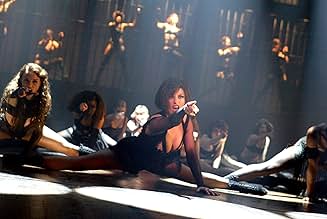
It's a deep message for what is essentially a song-and-dance comedy, but Condon allows himself to engage its darker implications without cramming "message" down our throats. We are, after all, mainly here to see the numbers, and Marshall's expertise with choreography and music makes sure the songs (composed by "Cabaret's" John Kander and Fred Ebb) pack a satisfying punch. "Roxie" is our little killer's exhilarating ode to her impending fame, complete with her name in big red lights. "Cell Block Tango" finds Velma and a gaggle of murderesses singing about how their victims all "had it comin'", complete with some admirably sleazy choreography. Marshall's imaginative staging of "We Both Reached For The Gun", a musical press conference, has Roxie as Billy's wooden ventriloquist's dummy and the reporters as marionettes under his control. And, of course, there's a knockout closing duet for Velma and Roxie, the biting, excitingly filmed "Nowadays". I've never seen "Chicago" onstage, but if this movie captures the energy of the show, it must be one showstopper after another.
Marshall's direction is not always as assured as his staging of the musical numbers. Oddly, the film almost feels like it was shot in sequence, as Marshall's initially choppy editing and scene-pacing grows progressively more seamless as the picture goes along. This is crucial, as the numbers all take place in a sort of fantasy nightclub cut off from the main action. Still, Marshall generally gets high marks for his debut, and he is ably abetted by a top-notch technical crew. In addition to the aforementioned editing (by Martin Walsh), strong work is put forward by costume designer Colleen Atwood (who nicely recreates the sometimes anachronistically revealing dance outfits of the stage show), cinematographer Dion Beebe, and the set design crew, led by production designer John Myrhe, who are able to make their squalor a little more authentic than what one would see on a stage.
Of course, as with any musical, the lion's share of the picture's success rests on the shoulders of its performers, and while Astaire and Garland aren't losing any sleep, "Chicago"'s cast members acquit themselves surprisingly well as song-and-dance artists. Gere, slick with oily charm, displays a witty way with a lyric and a nice relaxed tap-dance style. Zeta-Jones, a dancer in London before she hit the silver screen, shows off the flashiest moves of anyone here, all the while oozing fearsome sexuality. Also turning in fine work are Queen Latifah as the corrupt warden of the women's prison and John C. Reilly as Roxie's hapless cuckold of a husband, whose "Mr. Cellophane" poignantly sums up his nowhere-man status.
As far as I'm concerned, though, this is Renee Zellweger's show all the way. For me, Zellweger's onscreen work has been wildly uneven, ranging from the agreeable "Jerry Maguire" to "Me Myself & Irene", where she seemed stunned to find herself in front of a movie camera. Here, however, her confidence is exhilarating, and as Roxie transforms from a timid criminal to a vampish media super-vixen, Zellweger projects sex, sarcasm, and sweetness (often insincerely) like nothing I've seen from her before. Her dancing is not as polished as Zeta-Jones's, but she more than holds her own, and her numbers are easily the most memorable of the film. Roxie may not be a star, but Zellweger certainly is here; I'm rooting for her to take home a Best Actress Oscar for this.
"Chicago" is not quite the masterpiece some of the early reviews have suggested. The lack of a more experienced director keeps it from being more than a top-notch screen transfer of a venerated stage work. Nevertheless, the film is funny and exciting, with plenty of memorable numbers, and it proves for sure that the success of "Moulin Rouge" wasn't a fluke.
Now...how about that Sweeney Todd movie finally?
"Chicago", the feature-film debut of veteran stage director / choreographer Rob Marshall, is not as radical or experimental as Luhrmann's picture. Like "Evita", it is a cinematic adaptation of a hit Broadway show, namely Bob Fosse's tale of two 1920s murderesses who milk their crimes for headline-grabbing glory. And, like Parker's film, it doesn't attempt to re-invent the musical; it's content to be a solid, well-crafted genre product that knows what audiences expect from a musical and delivers in spades.
Indeed, the story (adapted from the original musical by "Gods and Monsters" scribe Bill Condon) is the most radical thing here, following as it does the exhilarating up-and-down fame rollercoaster of two cold-blooded killers. Roxie Hart (Renee Zellweger) is a wannabe, a small-time song-and-dance girl who looks at the bright lights of the Chicago clubs and longs for her night in the spotlight. She gets it in a rather unexpected way after she kills her lover (Dominic West), a sleazy furniture salesman who'd filled her heads with lies about showbiz connections. Sent to prison, Roxie finds that the public's thirst for scandalous headlines has turned her into a celebrity, and the scared, confused young murderess transforms into a media monster, playing the people like an orchestra and turning her crime into an act of self-sacrifice. Roxie's rise to fame incurs the wrath of her one-time showbiz idol, Velma Kelly (Catherine Zeta-Jones), a Louise-Brooks-bobbed former chorine who's doing time for killing her sister and philandering hubby...and who was the number-one star of Murderess Row until Roxie sauntered in. Caught between these two vixens is Billy Flynn (Richard Gere), Chi-town's biggest celebrity lawyer, who's representing them both...and who has a few "razzle-dazzle" tricks of his own up his sleeve.
As anyone who ever saw Bob Fosse's films ("Cabaret", "STAR80") can attest, the man had a cynical streak a mile wide, so it's not hard to see why the tawdry material of "Chicago" (based on a real 1920s murder case) was attractive to him. Condon, fortunately, does not file down the story's rough edges, and his script scores some trenchant observations on the curious nature of modern celebrity. Velma and Roxie are just like Lorena Bobbitt, Kato Kaelin, and all those other small-timers who, through one stupid action or simply by being in the wrong place at the right time, become famous beyond any right they actually have to achieve such heights. And who lets such undeserved accolades come their way? Us, of course. The film's howling chorus of reporters and courtroom gawkers eagerly sucking up the latest sensational story are the on-screen stand-ins for the audience, whose appetite for scandal and thrills has become so insatiable that the unremarkable are remarked upon, the unworthy celebrated, the evil elevated.
It's a deep message for what is essentially a song-and-dance comedy, but Condon allows himself to engage its darker implications without cramming "message" down our throats. We are, after all, mainly here to see the numbers, and Marshall's expertise with choreography and music makes sure the songs (composed by "Cabaret's" John Kander and Fred Ebb) pack a satisfying punch. "Roxie" is our little killer's exhilarating ode to her impending fame, complete with her name in big red lights. "Cell Block Tango" finds Velma and a gaggle of murderesses singing about how their victims all "had it comin'", complete with some admirably sleazy choreography. Marshall's imaginative staging of "We Both Reached For The Gun", a musical press conference, has Roxie as Billy's wooden ventriloquist's dummy and the reporters as marionettes under his control. And, of course, there's a knockout closing duet for Velma and Roxie, the biting, excitingly filmed "Nowadays". I've never seen "Chicago" onstage, but if this movie captures the energy of the show, it must be one showstopper after another.
Marshall's direction is not always as assured as his staging of the musical numbers. Oddly, the film almost feels like it was shot in sequence, as Marshall's initially choppy editing and scene-pacing grows progressively more seamless as the picture goes along. This is crucial, as the numbers all take place in a sort of fantasy nightclub cut off from the main action. Still, Marshall generally gets high marks for his debut, and he is ably abetted by a top-notch technical crew. In addition to the aforementioned editing (by Martin Walsh), strong work is put forward by costume designer Colleen Atwood (who nicely recreates the sometimes anachronistically revealing dance outfits of the stage show), cinematographer Dion Beebe, and the set design crew, led by production designer John Myrhe, who are able to make their squalor a little more authentic than what one would see on a stage.
Of course, as with any musical, the lion's share of the picture's success rests on the shoulders of its performers, and while Astaire and Garland aren't losing any sleep, "Chicago"'s cast members acquit themselves surprisingly well as song-and-dance artists. Gere, slick with oily charm, displays a witty way with a lyric and a nice relaxed tap-dance style. Zeta-Jones, a dancer in London before she hit the silver screen, shows off the flashiest moves of anyone here, all the while oozing fearsome sexuality. Also turning in fine work are Queen Latifah as the corrupt warden of the women's prison and John C. Reilly as Roxie's hapless cuckold of a husband, whose "Mr. Cellophane" poignantly sums up his nowhere-man status.
As far as I'm concerned, though, this is Renee Zellweger's show all the way. For me, Zellweger's onscreen work has been wildly uneven, ranging from the agreeable "Jerry Maguire" to "Me Myself & Irene", where she seemed stunned to find herself in front of a movie camera. Here, however, her confidence is exhilarating, and as Roxie transforms from a timid criminal to a vampish media super-vixen, Zellweger projects sex, sarcasm, and sweetness (often insincerely) like nothing I've seen from her before. Her dancing is not as polished as Zeta-Jones's, but she more than holds her own, and her numbers are easily the most memorable of the film. Roxie may not be a star, but Zellweger certainly is here; I'm rooting for her to take home a Best Actress Oscar for this.
"Chicago" is not quite the masterpiece some of the early reviews have suggested. The lack of a more experienced director keeps it from being more than a top-notch screen transfer of a venerated stage work. Nevertheless, the film is funny and exciting, with plenty of memorable numbers, and it proves for sure that the success of "Moulin Rouge" wasn't a fluke.
Now...how about that Sweeney Todd movie finally?
Oscars Best Picture Winners, Ranked
Oscars Best Picture Winners, Ranked
See the complete list of Oscars Best Picture winners, ranked by IMDb ratings.


Lo sapevi?
- QuizIn the beginning of the scene introducing Matron Mama Morton (Queen Latifah) to the new inmates, Roxie Hart (Renée Zellweger) has a brief conversation with a woman smoking a cigarette. That character is played by long-time Broadway actress Chita Rivera, who portrayed Velma Kelly in the original 1975 production of "Chicago."
- BlooperThere are 50 stars on the US flag in the courtroom (should be 48).
- Citazioni
June: I'm standin' in the kitchen, carving up a chicken for dinner, minding my own business, when in storms my husband, Wilbur, in a jealous rage. "You've been screwing the milkman," he said. He was crazy, and he kept on screaming, "You've been screwing the milkman." And then he ran into my knife... he ran into my knife ten times.
- Curiosità sui creditiNear the end of the credits, just so there are no doubts: Catherine Zeta-Jones' singing and dancing performed by Catherine Zeta-Jones Renée Zellweger's singing and dancing performed by Renée Zellweger Richard Gere's singing and dancing performed by Richard Gere
- Versioni alternativeThe musical number "Class," featuring Queen Latifah and Catherine Zeta-Jones, was deleted from the final version of the film. However, it was recut into the movie for a brief, extremely limited theatrical re-release in the summer of 2003. It then appeared on DVD as a bonus feature, but was NOT intercut there.
- Colonne sonoreOverture/And All That Jazz
Music by John Kander
Lyrics by Fred Ebb
Performed by Catherine Zeta-Jones, Renée Zellweger, and Taye Diggs
Published by Unichappell Music, Inc. (BMI)
I più visti
Accedi per valutare e creare un elenco di titoli salvati per ottenere consigli personalizzati
Everything New on Paramount+ in December
Everything New on Paramount+ in December
Settle in for entertainment-packed viewing on Paramount+ this month, featuring exciting new series launches and a stellar collection of films ready to stream.

Dettagli
- Data di uscita
- Paesi di origine
- Siti ufficiali
- Lingue
- Celebre anche come
- Chicago: The Musical
- Luoghi delle riprese
- Ontario Legislature Building, Queen's Park, Toronto, Ontario, Canada(as courthouse steps for press conference)
- Aziende produttrici
- Vedi altri crediti dell’azienda su IMDbPro
Botteghino
- Budget
- 45.000.000 USD (previsto)
- Lordo Stati Uniti e Canada
- 170.687.518 USD
- Fine settimana di apertura Stati Uniti e Canada
- 2.074.929 USD
- 29 dic 2002
- Lordo in tutto il mondo
- 306.777.683 USD
- Tempo di esecuzione
- 1h 53min(113 min)
- Colore
- Mix di suoni
- Proporzioni
- 1.85 : 1
Contribuisci a questa pagina
Suggerisci una modifica o aggiungi i contenuti mancanti