

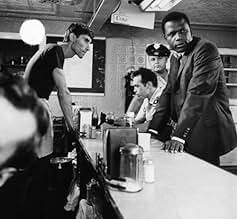
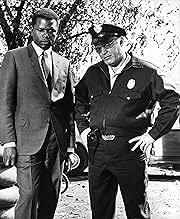
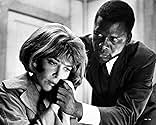
Um detetive da polícia negro é convidado a investigar um assassinato em uma cidade do sul racialmente hostil.Um detetive da polícia negro é convidado a investigar um assassinato em uma cidade do sul racialmente hostil.Um detetive da polícia negro é convidado a investigar um assassinato em uma cidade do sul racialmente hostil.
- Direção
- Roteiristas
- Estrelas
- Ganhou 5 Oscars
- 23 vitórias e 16 indicações no total




William Watson
- McNeil
- (as William C. Watson)
- Direção
- Roteiristas
- Elenco e equipe completos
- Produção, bilheteria e muito mais no IMDbPro
7,989.5K
1
2
3
4
5
6
7
8
9
10
Avaliações em destaque
flawless movie, deserved Best Picture
There are many bad "issues" movies out there, but this is not one of them. In a bad movie, all of the racist characters would be one dimensional and one hundred percent evil; here, Steiger is allowed to play a prejudiced man who is actually sympathetic and capable of growth (hence the Oscar). In a great twist, Virgil Tibbs himself is shown to be capable of prejudice, as he pursues Endicott without sufficient evidence. It's refreshing to see a movie that portrays the entire spectrum of racism, from the crazy extremists (and there are plenty of those on hand here) to the more subtly prejudiced.
"Mississippi Burning," a weaker effort, is not only more tediously didactic, but also less progressive; that film doesn't feature a protagonist like Virgil Tibbs, and instead focuses on the actions of two white federal agents. In this case, the old movie really is the better movie; produced at the height of the civil rights struggle, "In the Heat of the Night" feels more immediate and passionate than preachy films on the subject that were made years later, after the tension had died down.
Some reviewers complain that the mystery segments of the film are confusing, but I follow them without much trouble. Tibbs does a great Sherlock Holmes routine throughout, as he pieces together the solution based on clues that are also available to viewers. Sure, the ending is surprising, but it doesn't come entirely out of left field; I actually admire the subtle ways that clues are sewn throughout the film. If you're not used to mysteries, the barrage of red herrings and dead-end clues might surprise you, but it's pretty standard stuff for the genre.
I knew about the classic line "They call me Mr. Tibbs!" long before I actually saw this movie. I used to wonder why the line was so famous; it doesn't sound that exciting, does it? But when I finally heard Poitier say it in context, I asked my brother to pause the tape so I could cheer without missing any of the subsequent dialog. That's how excited I get during this movie. The performances are so naturalistic, and the racial conflict so vividly drawn, that I get pulled into the action completely. Though 1967 was a strong year for films, I still think that the right one got Best Picture, and not just because it was topical; "In the Heat of the Night" is a well-directed, superb character study, populated by some of the most vivid characters I've ever encountered in a movie.
"Mississippi Burning," a weaker effort, is not only more tediously didactic, but also less progressive; that film doesn't feature a protagonist like Virgil Tibbs, and instead focuses on the actions of two white federal agents. In this case, the old movie really is the better movie; produced at the height of the civil rights struggle, "In the Heat of the Night" feels more immediate and passionate than preachy films on the subject that were made years later, after the tension had died down.
Some reviewers complain that the mystery segments of the film are confusing, but I follow them without much trouble. Tibbs does a great Sherlock Holmes routine throughout, as he pieces together the solution based on clues that are also available to viewers. Sure, the ending is surprising, but it doesn't come entirely out of left field; I actually admire the subtle ways that clues are sewn throughout the film. If you're not used to mysteries, the barrage of red herrings and dead-end clues might surprise you, but it's pretty standard stuff for the genre.
I knew about the classic line "They call me Mr. Tibbs!" long before I actually saw this movie. I used to wonder why the line was so famous; it doesn't sound that exciting, does it? But when I finally heard Poitier say it in context, I asked my brother to pause the tape so I could cheer without missing any of the subsequent dialog. That's how excited I get during this movie. The performances are so naturalistic, and the racial conflict so vividly drawn, that I get pulled into the action completely. Though 1967 was a strong year for films, I still think that the right one got Best Picture, and not just because it was topical; "In the Heat of the Night" is a well-directed, superb character study, populated by some of the most vivid characters I've ever encountered in a movie.
The Growing Pains of the New South
In order to understand what's happening in In the Heat of the Night you have to realize that it is set in a very specific time period. The Civil Rights Act had been passed in 1964 and the Voting Rights Act was passed in 1965. But the impact of those laws was only beginning to be felt.
Especially the Voting Rights Act. The town of Sparta, Mississippi where William Schallert was Mayor and Rod Steiger was sheriff now has a significant new voting population and blacks might be a majority in that county. But even if they aren't, they know have a voice in the electoral process. Someone like Steiger has to take that into account now. Of course some of his deputies might not yet be with the program which explains why when a murder/robbery is committed of a very prominent northern businessman, Warren Oates sees fit to roust Sidney Poitier who's an unfamiliar black face in that town.
What a surprise they all get when they find out he's a top Philadelphia, Pennsylvania homicide detective and when his identity is established, his boss in Philly offers his services.
Poitier and Steiger both have to work through their prejudices, how each sees the other to solve this mystery which writer Stirling Silliphant gives us several red herrings before we learn the truth. Though Steiger got the Oscar for Best Actor, it should really have been a joint award. Their conflict and growing respect for each other drives the film. Steiger needs his expertise and respects him for that and Poitier comes to respect Steiger for his honesty.
Norman Jewison got great performances from his stars and the supporting cast of whom Warren Oates as the dimwit redneck deputy really shines.
Though set in a very narrow period of our history, In the Heat of the Night holds up very well with some eternal truths in its story. And it's the story of times that were a changing as one spokesman of the sixties put it.
Especially the Voting Rights Act. The town of Sparta, Mississippi where William Schallert was Mayor and Rod Steiger was sheriff now has a significant new voting population and blacks might be a majority in that county. But even if they aren't, they know have a voice in the electoral process. Someone like Steiger has to take that into account now. Of course some of his deputies might not yet be with the program which explains why when a murder/robbery is committed of a very prominent northern businessman, Warren Oates sees fit to roust Sidney Poitier who's an unfamiliar black face in that town.
What a surprise they all get when they find out he's a top Philadelphia, Pennsylvania homicide detective and when his identity is established, his boss in Philly offers his services.
Poitier and Steiger both have to work through their prejudices, how each sees the other to solve this mystery which writer Stirling Silliphant gives us several red herrings before we learn the truth. Though Steiger got the Oscar for Best Actor, it should really have been a joint award. Their conflict and growing respect for each other drives the film. Steiger needs his expertise and respects him for that and Poitier comes to respect Steiger for his honesty.
Norman Jewison got great performances from his stars and the supporting cast of whom Warren Oates as the dimwit redneck deputy really shines.
Though set in a very narrow period of our history, In the Heat of the Night holds up very well with some eternal truths in its story. And it's the story of times that were a changing as one spokesman of the sixties put it.
Well-Crafted Murder Mystery With A Twist
IN THE HEAT OF THE NIGHT is a well-crafted murder mystery with a twist. Sidney Poitier is a big city detective wrongfully arrested by a racist small police detachment after the brutal murder of the town's would-be financial savior. Once the matter is resolved and Poitier released, he finds himself aiding his former captors, including Police Chief Rod Steiger, in their quest to get to the bottom of the crime.
An Academy Award winner for Best Picture, IN THE HEAT OF THE NIGHT works on so many levels. It's a solid, unpredictable whodunit with beautiful cinematography and crisp direction from Norman Jewison. All the actors are on top of their games, particularly Steiger, whose not-entirely-likable chief gradually looks past his prejudices to warm up to Poitier. Poitier is his usual superb self, once again maintaining his vast dignity as the target of bigotry, much like he did in THE DEFIANT ONES.
And like THE DEFIANT ONES, a key theme in IN THE HEAT OF THE NIGHT is racism. In fact the racism on display here is so fierce and perverse that it's almost hard to believe (though I'm sure it didn't stretch a thing). You can't help but feel an emotional attachment to Poitier as he's subjected to taunts, attempted attacks, and off-color remarks from those who either don't realize the power of their words or don't care. Poitier proves again why he is perhaps the finest African-American actor ever to grace the screen.
IN THE HEAT OF THE NIGHT is one of those movies that, while not perfect, is impossible to dislike. It's classic, though still relevant, entertainment.
An Academy Award winner for Best Picture, IN THE HEAT OF THE NIGHT works on so many levels. It's a solid, unpredictable whodunit with beautiful cinematography and crisp direction from Norman Jewison. All the actors are on top of their games, particularly Steiger, whose not-entirely-likable chief gradually looks past his prejudices to warm up to Poitier. Poitier is his usual superb self, once again maintaining his vast dignity as the target of bigotry, much like he did in THE DEFIANT ONES.
And like THE DEFIANT ONES, a key theme in IN THE HEAT OF THE NIGHT is racism. In fact the racism on display here is so fierce and perverse that it's almost hard to believe (though I'm sure it didn't stretch a thing). You can't help but feel an emotional attachment to Poitier as he's subjected to taunts, attempted attacks, and off-color remarks from those who either don't realize the power of their words or don't care. Poitier proves again why he is perhaps the finest African-American actor ever to grace the screen.
IN THE HEAT OF THE NIGHT is one of those movies that, while not perfect, is impossible to dislike. It's classic, though still relevant, entertainment.
Genuinely Shocking but no Surprise...
Outstanding performances from Poitier & Steiger in a film that's genuinely shocking once you consider the prejudice and evil it contains, even more so when you witness those same traits in society over 50 years later. Will we ever learn!
Through The Mississippi Darkness
Gritty realism and a strong performance by Rod Steiger rev up the technical quality of this taut drama about a visiting Northern Black detective named Virgil Tibbs (Sidney Poitier) who gets nailed as a suspect, foolishly, in the murder of a local VIP, in a small town in Mississippi. Eventually, the town's White police chief, the gum chewing Gillespie (Rod Steiger), accepts Tibbs' innocence. And the two of them then work together, reluctantly, to solve the case.
Forty years after the film was made, the racial themes seem just a tad heavy-handed. Whites are always backward and racist. And Tibbs is smart, urbane, and sophisticated. But back in the 1960s, the filmmaker probably did need to be blunt. And the point is made that Blacks and Whites, working together, can accomplish worthy aims, even though old Black Joe is still pickin' cotton at the Endicott Cotton Company.
As a whodunit, the story is fairly good, convenient coincidences notwithstanding. The clue to the killer's identity is pleasantly subtle.
The film's cinematography and production design are terrific. Many scenes take place at night. And the opaque lighting makes for a moody, slightly dangerous look and feel. Loved how they photographed that train moving down the tracks in the Mississippi darkness, a metaphor related to the film's theme. And the sound of a train whistle adds to the mournful realism.
Interiors look authentic. The masking tape that covers rips in a big leather chair in Gillespie's shabby office is so true to life. A single white light bulb hangs down from the ceiling in a small neighborhood grocery store, where the shelves are filled with empty fruit jars. And that greasy spoon called Comptons reeks of 1960's Southern rural reality.
My only complaint with this film is the background music. Some of the jukebox songs are not consistent with the film's overall tone.
"In The Heat Of The Night" is a technically well made, and quite interesting, murder mystery. Yet, it will always be remembered, rightfully, as the film that offered hope of racial harmony, during a decade in which there was none. Its "Best Picture" Oscar award is thus explained.
Forty years after the film was made, the racial themes seem just a tad heavy-handed. Whites are always backward and racist. And Tibbs is smart, urbane, and sophisticated. But back in the 1960s, the filmmaker probably did need to be blunt. And the point is made that Blacks and Whites, working together, can accomplish worthy aims, even though old Black Joe is still pickin' cotton at the Endicott Cotton Company.
As a whodunit, the story is fairly good, convenient coincidences notwithstanding. The clue to the killer's identity is pleasantly subtle.
The film's cinematography and production design are terrific. Many scenes take place at night. And the opaque lighting makes for a moody, slightly dangerous look and feel. Loved how they photographed that train moving down the tracks in the Mississippi darkness, a metaphor related to the film's theme. And the sound of a train whistle adds to the mournful realism.
Interiors look authentic. The masking tape that covers rips in a big leather chair in Gillespie's shabby office is so true to life. A single white light bulb hangs down from the ceiling in a small neighborhood grocery store, where the shelves are filled with empty fruit jars. And that greasy spoon called Comptons reeks of 1960's Southern rural reality.
My only complaint with this film is the background music. Some of the jukebox songs are not consistent with the film's overall tone.
"In The Heat Of The Night" is a technically well made, and quite interesting, murder mystery. Yet, it will always be remembered, rightfully, as the film that offered hope of racial harmony, during a decade in which there was none. Its "Best Picture" Oscar award is thus explained.
Oscars Best Picture Winners, Ranked
Oscars Best Picture Winners, Ranked
See the complete list of Oscars Best Picture winners, ranked by IMDb ratings.


Você sabia?
- CuriosidadesSidney Poitier insisted that the movie be filmed in the North because of an incident in which he and Harry Belafonte were almost killed by Ku Klux Klansmen during a visit to Mississippi. That's why Sparta, IL, was chosen for location filming. Nevertheless, the filmmakers and actors did venture briefly into Tennessee for the outdoor scenes at the cotton plantation, because there was no similar cotton plantation in Illinois that could be used. Poitier slept with a gun under his pillow during production in Tennessee. He did receive threats from local racist thugs, so the shoot was cut short and production returned to Illinois.
- Erros de gravaçãoThe police chase Harvey Oberst through the yellow leaves of an advanced autumn forest . This film takes place on September 13, as indicated by the calendar in the Sheriff's office. In mid-September in Mississippi, the leaves on the trees would still be almost entirely green.
- Citações
Gillespie: Virgil? That's a funny name for a nigger boy that comes from Philadelphia. What do they call you up there?
Virgil Tibbs: They call me MISTER TIBBS!
- Cenas durante ou pós-créditosNo uppercase ("capital") letters are used in the opening and closing credits, including the film's title, cast and characters, crew and job titles, and company credits.
- Versões alternativasThe VHS prints use the 1982 United Artist variant.
- ConexõesFeatured in Film Review: Film Review (1967)
- Trilhas sonorasIn the Heat of the Night
Music by Quincy Jones (uncredited)
Lyrics by Alan Bergman (uncredited) and Marilyn Bergman (uncredited)
Sung by Ray Charles
Principais escolhas
Faça login para avaliar e ver a lista de recomendações personalizadas
Detalhes
- Data de lançamento
- País de origem
- Idioma
- Também conhecido como
- Al calor de la noche
- Locações de filme
- Sparta, Illinois, EUA(Sparta, Mississippi)
- Empresa de produção
- Consulte mais créditos da empresa na IMDbPro
Bilheteria
- Orçamento
- US$ 2.000.000 (estimativa)
- Faturamento bruto mundial
- US$ 27.669
- Tempo de duração
- 1 h 50 min(110 min)
- Cor
- Proporção
- 1.85 : 1
Contribua para esta página
Sugerir uma alteração ou adicionar conteúdo ausente