AVALIAÇÃO DA IMDb
8,0/10
15 mil
SUA AVALIAÇÃO
Esta é a história de vida de três noivas desde a juventude até o outono. Seus sonhos e desejos, amor e decepções.Esta é a história de vida de três noivas desde a juventude até o outono. Seus sonhos e desejos, amor e decepções.Esta é a história de vida de três noivas desde a juventude até o outono. Seus sonhos e desejos, amor e decepções.
- Direção
- Roteiristas
- Estrelas
- Ganhou 1 Oscar
- 3 vitórias e 1 indicação no total
Vladlen Paulus
- Pyotr Lednev
- (as V. Paulus)
- Direção
- Roteiristas
- Elenco e equipe completos
- Produção, bilheteria e muito mais no IMDbPro
8,015.4K
1
2
3
4
5
6
7
8
9
10
Avaliações em destaque
Let's remember this is a Russian Comedy
Being of Russian descent and a first generation Australian, I first saw this film in the original Russian a year or two after it came out. At the time I thought it was one of the funniest things I had seen in a long long time. I saw it again when our World Movie channel broadcast it and I laughed just as hard and just as long. To understand the comedy in what appears to be a story of feminist angst you need to be Russian. There is no other way to see it. We don't see that the supposed conflict between between the heroine and her lover is that she is a manager and he is not. It's much more primal than that. It is because she EARNS more than he does. Women held managerial positions in the USSR since they first began driving tanks and tractors during the second world war. Most of us are brought up to believe that we can do just about anything, and a lot of the time we have to. So please, if you see this film, remember to laugh. Remember that Yes, Russians aren't happy unless they're miserable but the story of this film is also about the joy of rebuilding lives and relationships for both men and women and about the triumph of the human spirit over seemingly impossible odds.
a nice movie. Splendid, in one word
This is a tribute to the Soviet era some people in Ukraine still consider to be the best years of their lives.I saw the movie in my child years, but didn't pay much attention to it. Now, when I study film history and techniques, the movie revealed to me some dark sides. "Moskva sliezam nie verit", I guess, tells a story of a humble Soviet woman in pursuit for happiness with a beloved man. This woman does not care about feminism. True love of a man-"stronghold", a man who is ready to comfort her any time she needs--that is what she is searching for in life. The movie shows some cloudy moments in the way to happiness three female friends go along. And the movie ends up where it should--an "island of placid" I watch it in original. Have to say, many phrases from the movie are cited in Ukrainian and Russian-speaking communities these days.
story about Soviet Cinderella
If you try to understand the meaning of Soviet mode of life (especially place of woman in Soviet society), this film represents the best one you can find for this purpose. The destinies of three women are depicted in clear and awesome way, and the most important you can see is that whatever happens in life, try to be optimist and to do everything not to give up living and being happy.
Good beginning, disintegrates into stereotypes
This film makes one wonder what exactly the heroine worked so hard for. A young girl from a small town comes to Moscow and becomes pregnant. Her lover repudiates her, the lover's mother humiliates her, telling her that she is not a good fit for her big-city dandy son. Rather than leave Moscow and go back to her parents, or try to perform an abortion on herself, the heroine has the baby. She works hard at the factory, getting up at 5 AM every morning, passes grueling entrance exams into college, becomes an engineer -- all while raising her little girl as a single parent and an unwed mother. Bold subject matter for a Soviet movie made in the seventies.
Then -- a compromise: the heroine who, sixteen years after her ordeal, has a good life, a good home, and a prestigious managerial job, falls head over heals for a man who treats her like dirt.
"Moscow Does Not Believe in Tears" was made almost at the same time as the equally celebrated "Workplace Romance" ("Sluzhebnyj Roman"), and they are, in a sense, competitors. Both movies are about single women in their mid- to late thirties who made a brilliant career but were never married. Both heroines are presented as strong-willed, independent individuals in managerial positions, whose lives are nevertheless missing something. But if "Sluzhebnyj Roman" says that life is incomplete without love, "Moscow Does Not Believe in Tears" says that life is incomplete without a man.
Women of the older generation are all in love with "Moscow"'s main male character -- the heroine's ultimate husband. I cannot fathom why -- the actor's cute, but his character is unnerving. One does not need to be a feminist to have a strong urge to throw this man down the stairs. He stifles every impulse of individuality in her; he presumes to know what she wants, what's proper for her and what's not; he patronizes her; he pushes her around. On the train, he begins their acquaintance by commenting: "You have the eyes of a woman who is not married." (What kind of eyes are those?) I cannot see why one would find any charm in such familiarity and cocky self-assurance from a stranger.
It's worth noting that the corresponding character in "Sluzhenyj Roman" -- an excessively mild-mannered, shy man -- learns to stand up to the bossy heroine, but does so without disrespecting her. The character in "Moscow", on the contrary, puts the heroine in her proper place -- which is to be quiet and follow orders.
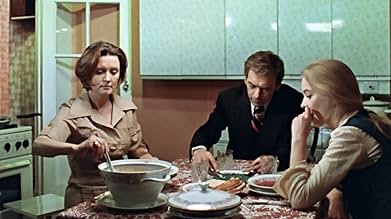
I think that a Western critic would perceive the ending of "Moscow Does Not Believe in Tears" as ironic and sad. The heroine, a woman who spent her life making something of herself by overcoming seemingly insurmountable obstacles, is last shown fussing around her kitchen for the benefit of a man who was not with her on that long journey, who dares to raise his voice at her in her own home, while eating her food, and who acts as if his very physical presence at the table confers a rare privilege on a woman whose clock is ticking.
Then -- a compromise: the heroine who, sixteen years after her ordeal, has a good life, a good home, and a prestigious managerial job, falls head over heals for a man who treats her like dirt.
"Moscow Does Not Believe in Tears" was made almost at the same time as the equally celebrated "Workplace Romance" ("Sluzhebnyj Roman"), and they are, in a sense, competitors. Both movies are about single women in their mid- to late thirties who made a brilliant career but were never married. Both heroines are presented as strong-willed, independent individuals in managerial positions, whose lives are nevertheless missing something. But if "Sluzhebnyj Roman" says that life is incomplete without love, "Moscow Does Not Believe in Tears" says that life is incomplete without a man.
Women of the older generation are all in love with "Moscow"'s main male character -- the heroine's ultimate husband. I cannot fathom why -- the actor's cute, but his character is unnerving. One does not need to be a feminist to have a strong urge to throw this man down the stairs. He stifles every impulse of individuality in her; he presumes to know what she wants, what's proper for her and what's not; he patronizes her; he pushes her around. On the train, he begins their acquaintance by commenting: "You have the eyes of a woman who is not married." (What kind of eyes are those?) I cannot see why one would find any charm in such familiarity and cocky self-assurance from a stranger.
It's worth noting that the corresponding character in "Sluzhenyj Roman" -- an excessively mild-mannered, shy man -- learns to stand up to the bossy heroine, but does so without disrespecting her. The character in "Moscow", on the contrary, puts the heroine in her proper place -- which is to be quiet and follow orders.
I think that a Western critic would perceive the ending of "Moscow Does Not Believe in Tears" as ironic and sad. The heroine, a woman who spent her life making something of herself by overcoming seemingly insurmountable obstacles, is last shown fussing around her kitchen for the benefit of a man who was not with her on that long journey, who dares to raise his voice at her in her own home, while eating her food, and who acts as if his very physical presence at the table confers a rare privilege on a woman whose clock is ticking.
10akoumare
Very good movie
This was one of the last movies I have seen before leaving Russia. I am watching it every time with a lot of pleasure. It is funny, and touching to tears some moments. It is also very realistic, as many women in Russia went through the same problems as the three girls, and it touches most of people in Russia. It is also showing that it is never late to restart and suceed in your life, and in spite of difficulties it is possible to reach your goal and success (whatever it means for you).
Você sabia?
- CuriosidadesOne of four Russian films ever to win Academy Award for Best Foreign Language Film. The other are Guerra e Paz (1965), Dersu Uzala (1975) and O Sol Enganador (1994).
- Erros de gravaçãoWhen Lyudmila and her friend approach the office building she is wearing a pair of white shoes. Once inside the building the shoes color changes to black.
- Citações
Lyudmila Gurina: Don't cry.
Lyudmila Gurina: You know what Moscow thinks of tears.
Lyudmila Gurina: We shouldn't be sitting around, we should do something.
- ConexõesFeatured in Amor e Pombos (1985)
- Trilhas sonorasAleksandra, Aleksandra
Music by Sergey Nikitin
Lyrics by Dmitriy Sukharyov and Yuriy Vizbor
Performed by Tatyana Nikitina and Sergey Nikitin
Principais escolhas
Faça login para avaliar e ver a lista de recomendações personalizadas
- How long is Moscow Does Not Believe in Tears?Fornecido pela Alexa
Detalhes
- Data de lançamento
- País de origem
- Central de atendimento oficial
- Idioma
- Também conhecido como
- Moscow Does Not Believe in Tears
- Locações de filme
- Empresas de produção
- Consulte mais créditos da empresa na IMDbPro
Bilheteria
- Orçamento
- US$ 900.000 (estimativa)
- Faturamento bruto mundial
- US$ 217
- Tempo de duração
- 2 h 30 min(150 min)
- Proporção
- 1.37 : 1
Contribua para esta página
Sugerir uma alteração ou adicionar conteúdo ausente