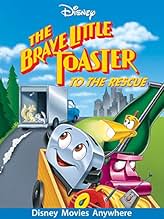
A Torradeira Valente Vai à Escola
Título original: The Brave Little Toaster to the Rescue
AVALIAÇÃO DA IMDb
6,1/10
2 mil
SUA AVALIAÇÃO

Adicionar um enredo no seu idiomaThe Brave Little Toaster and friends must rescue the animals at a veterinary hospital from being sent to a testing laboratory.The Brave Little Toaster and friends must rescue the animals at a veterinary hospital from being sent to a testing laboratory.The Brave Little Toaster and friends must rescue the animals at a veterinary hospital from being sent to a testing laboratory.
- Direção
- Roteiristas
- Estrelas




Jessica Tuck
- Chris
- (narração)

Chris Young
- Rob
- (narração)
Roger Kabler
- Radio
- (narração)
Deanna Oliver
- Toaster
- (narração)

Eric Lloyd
- Blanky
- (narração)
Thurl Ravenscroft
- Kirby
- (narração)

Timothy Stack
- Lampy
- (narração)
- (as Tim Stack)

Andy Milder
- Ratso
- (narração)

Alfre Woodard
- Maisie
- (narração)

Danny Nucci
- Alberto
- (narração)

Andy Daly
- Murgetroid
- (narração)

Eddie Bracken
- Sebastian
- (narração)


Kevin Meaney
- Computer
- (narração)
- (as Kevin Meany)

Victoria Jackson
- Mouse
- (narração)

Eddie Deezen
- Charlie
- (narração)

Brian Doyle-Murray
- Wittgenstein
- (narração)

Paddi Edwards
- Lab Computer
- (narração)
- (as Patti Edwards)
6,11.9K
1
2
3
4
5
6
7
8
9
10
Avaliações em destaque
I feel it's a very cute film for what it is
The Brave Little Toaster remains one of Disney's most unusual and charming animated films, a story that dares to shift away from the typical formula of animals or humans as leads and instead centers its narrative around household appliances. This bold creative decision gives the movie a distinct personality, immediately setting it apart from other animated classics of its time. The adventure these characters embark on-an emotional journey to reunite with their beloved owner-offers a surprising amount of heart, humor, and suspense. It's a film that doesn't rely on spectacle but rather on relatability and imagination, showing how far unlikely heroes will go when loyalty drives them.
One of the film's most impressive strengths is the way each appliance is given such a vivid personality. The vacuum's constant grumpiness plays perfectly against the sweetness and innocence of Blankey, who embodies the sensibility of a young child longing for comfort and belonging. The radio, the lamp, and Toaster himself round out the group with thoughtfully crafted traits, each adding momentum and emotional resonance to the journey. These personalities interact in a way that feels organic and truly endearing, keeping the film engaging even in quieter moments.
What makes these characters work so well is how the film's writing and animation treat them not simply as objects but as souls with emotional arcs. Blankey's vulnerability, in particular, tugs at the heart, grounding the narrative with a sense of genuine innocence. Meanwhile, Toaster's determination and loyalty give the story its spine. Disney's animators and writers showed an impressive ability to imbue inanimate objects with depth, humor, and relatability, a creative risk that pays off because it's handled with sincerity rather than gimmick.
Despite its creativity, The Brave Little Toaster is one of Disney's forgotten films-underappreciated during its release and overshadowed over time by flashier titles. Yet, those who revisit it often remember just how inventive, emotional, and daring it truly is. Its quieter release shouldn't overshadow its craftsmanship, which includes memorable scenes, imaginative set pieces, and themes of belonging, resilience, and friendship that remain universal.
The film's narrative pacing and adventurous spirit keep it consistently enjoyable, with each new challenge the appliances face feeling meaningful and fun. Their journey through forests, junkyards, thunderstorms, and scrapyards gives the film a surprising depth and tension, mixing whimsy with moments of genuine peril. These tonal shifts work because the characters are compelling enough to carry them, making the film more emotionally layered than one might expect from its premise.
Ultimately, The Brave Little Toaster is a creatively ambitious, emotionally rich animated film that deserves far more recognition than it receives. It's beautifully crafted, heartfelt, and full of personality, offering something entirely unique within Disney's catalog. While it may not have achieved the commercial success of the studio's biggest hits, it remains an imaginative and touching experience that rewards both newcomers and returning fans. It's a film worth revisiting-one that proves bold storytelling can turn even the simplest objects into unforgettable characters.
One of the film's most impressive strengths is the way each appliance is given such a vivid personality. The vacuum's constant grumpiness plays perfectly against the sweetness and innocence of Blankey, who embodies the sensibility of a young child longing for comfort and belonging. The radio, the lamp, and Toaster himself round out the group with thoughtfully crafted traits, each adding momentum and emotional resonance to the journey. These personalities interact in a way that feels organic and truly endearing, keeping the film engaging even in quieter moments.
What makes these characters work so well is how the film's writing and animation treat them not simply as objects but as souls with emotional arcs. Blankey's vulnerability, in particular, tugs at the heart, grounding the narrative with a sense of genuine innocence. Meanwhile, Toaster's determination and loyalty give the story its spine. Disney's animators and writers showed an impressive ability to imbue inanimate objects with depth, humor, and relatability, a creative risk that pays off because it's handled with sincerity rather than gimmick.
Despite its creativity, The Brave Little Toaster is one of Disney's forgotten films-underappreciated during its release and overshadowed over time by flashier titles. Yet, those who revisit it often remember just how inventive, emotional, and daring it truly is. Its quieter release shouldn't overshadow its craftsmanship, which includes memorable scenes, imaginative set pieces, and themes of belonging, resilience, and friendship that remain universal.
The film's narrative pacing and adventurous spirit keep it consistently enjoyable, with each new challenge the appliances face feeling meaningful and fun. Their journey through forests, junkyards, thunderstorms, and scrapyards gives the film a surprising depth and tension, mixing whimsy with moments of genuine peril. These tonal shifts work because the characters are compelling enough to carry them, making the film more emotionally layered than one might expect from its premise.
Ultimately, The Brave Little Toaster is a creatively ambitious, emotionally rich animated film that deserves far more recognition than it receives. It's beautifully crafted, heartfelt, and full of personality, offering something entirely unique within Disney's catalog. While it may not have achieved the commercial success of the studio's biggest hits, it remains an imaginative and touching experience that rewards both newcomers and returning fans. It's a film worth revisiting-one that proves bold storytelling can turn even the simplest objects into unforgettable characters.
Don't stop making films Disney
I saw this film a long time ago compliments of my mother. The Brave Little Toaster and her friends go to rescue animals from a vet who plans to send them to a testing laboratory. Kirby denies anything is wrong with his friend Sebastain but Kirby soon discovers what's under Sebastian's bandage. There we're problems in the computer area while Rob was finishing his 600 page theis homework. Toaster and her friends actually get to learn about the internet. Radio was blamed for stealing something that goes to a computer.
So check it out
So check it out
An okay followup that could've been worse
During much of the 1980s, Disney was not performing well financially or critically. Release after release, almost all of their films weren't making the cut. Whether it was based on content or something else, viewers and critics alike at the time were unimpressed. That's not the case now however for many of the once unnoticed movies have found a home for those who appreciate the quality they gave. But of those, there were some movies that got recognized for being well done. A couple years before Disney hit it big with The Little Mermaid (1989), another animated film came out that has made a lasting memory for many children, that being The Brave Little Toaster (1987). As odd as the premise was audiences and critics were surprised to see how mature some of the basic themes and concepts were for the plot. Not surprisingly, Disney went on to release a Direct-to-Video sequel of the original 10 years later. Even though it was a few years in where Disney started cranking out sequels, it could've been bad but it holds up somewhat here.
Picking up some time after the first events, audiences rejoin the living household items once more but this time, they're in the master's (Rob) veterinary clinic. The master is also ready to graduate and in order to do so, he must submit his 600-page thesis. One night while doing the finishing touches, a power surge occurs causing Rob to lose all his work. Fearing he won't graduate, it's up to the little toaster and friends along with some animals to save the day. Directed by Robert C. Ramirez who's better known for directing The Prince of Egypt (1998) prequel Joseph: King of Dreams (2000) and written by Willard Carroll who served as executive producer to The Brave Little Toaster (1987), manage to put together an acceptable sequel considering the circumstances. It's not at the same level as the original but it's an allowable follow-up. What doesn't work in this sequel are a few components. The most typical of reasons being continuity errors; ones that go beyond the physical realm that the first had established. Things don't just materialize.
The other two problems deal with characters. The new animal additions to the original group is okay but they do feel a bit tacked on. It just feels very obligatory and one of the main animal's motive changes without reason. Then there's the role of Rob's underling named Mack who works as an assistant to him. Right when the character is introduced, his personality immediately gives away what kind of character he will be. No questions. Aside from these problems, there isn't much else to point out. Even with these problems dealing with development in certain characters, the script still contains some material that is dark when looked at under certain lenses. With that said, credit is due for at least not making the overall execution feel completely pointless. Some sequels get completely diluted and end up having no risk involved. When it comes to characters, unless the viewer wanted to know who voiced them, most would unknowingly discover that the majority of the original cast from the original did not return.
Since the release of this was a decade later, seeing why some actors who voiced childlike characters is understandable. Yet as to why Jon Lovitz, Timothy E. Day, Wayne Kaatz and Colette Savage did not return is beyond understanding. They did after all voice important characters. Thankfully the actors who do replace the old cast maintain the same quality performances. Jessica Tuck who voices Chris, Chris Young as Rob, Eric Lloyd as Blanky and Roger Kabler as Radio all sound very similar to that of the original actors and that's great. Returning from the original is Deanna Oliver as Toaster, Thurl Ravenscroft as Kirby and Timothy Stack as Lampy, which is great to hear as well. For new members of the cast, Jay Mohr plays the voice of Mack, Andy Milder voices the scruffy Ratso, Alfre Woodard voices Maisie the mama cat, Danny Nucci plays a Hispanic Chiwawa, Andrew Daly plays Murgetroid the snake and veteran actor Eddie Bracken voices Sebastian the monkey. There's even a voice appearance from Brian Doyle-Murray playing a computer.
The animation is actually another decent quality to this sequel. This is mostly because The Brave Little Toaster (1987) itself did not set such a high bar. If anything, the animation here is on par with its predecessor and that's okay. Taking into account that it was also animated on a smaller budget is important to recognize if the quality remains fairly the same. The film score was unfortunately not composed again by David Newman. In replace of him, Alexander Janko composed the music. This was Janko's first film composition and seeing that he frequently orchestrates more than composes, it's interesting that Janko made out rather sufficiently. The score itself consists of organic orchestra and uses those elements to its advantage. By this, the cues that involve the darker themes work properly. The songs that the actual characters sing aren't that bad either. Tunes like "Remember That Day", "Tap to the Super Highway" and especially "Chomp and Munch" are fairly catchy and can get the viewer to emote.
The sequel itself isn't memorable as to its predecessor but it isn't all fluff either. There are some mature themes involved, the music is composed nicely and the voice cast perform well. It's just all the extra characters and an unexplained motivation that make it feel forgettable to some degree.
Picking up some time after the first events, audiences rejoin the living household items once more but this time, they're in the master's (Rob) veterinary clinic. The master is also ready to graduate and in order to do so, he must submit his 600-page thesis. One night while doing the finishing touches, a power surge occurs causing Rob to lose all his work. Fearing he won't graduate, it's up to the little toaster and friends along with some animals to save the day. Directed by Robert C. Ramirez who's better known for directing The Prince of Egypt (1998) prequel Joseph: King of Dreams (2000) and written by Willard Carroll who served as executive producer to The Brave Little Toaster (1987), manage to put together an acceptable sequel considering the circumstances. It's not at the same level as the original but it's an allowable follow-up. What doesn't work in this sequel are a few components. The most typical of reasons being continuity errors; ones that go beyond the physical realm that the first had established. Things don't just materialize.
The other two problems deal with characters. The new animal additions to the original group is okay but they do feel a bit tacked on. It just feels very obligatory and one of the main animal's motive changes without reason. Then there's the role of Rob's underling named Mack who works as an assistant to him. Right when the character is introduced, his personality immediately gives away what kind of character he will be. No questions. Aside from these problems, there isn't much else to point out. Even with these problems dealing with development in certain characters, the script still contains some material that is dark when looked at under certain lenses. With that said, credit is due for at least not making the overall execution feel completely pointless. Some sequels get completely diluted and end up having no risk involved. When it comes to characters, unless the viewer wanted to know who voiced them, most would unknowingly discover that the majority of the original cast from the original did not return.
Since the release of this was a decade later, seeing why some actors who voiced childlike characters is understandable. Yet as to why Jon Lovitz, Timothy E. Day, Wayne Kaatz and Colette Savage did not return is beyond understanding. They did after all voice important characters. Thankfully the actors who do replace the old cast maintain the same quality performances. Jessica Tuck who voices Chris, Chris Young as Rob, Eric Lloyd as Blanky and Roger Kabler as Radio all sound very similar to that of the original actors and that's great. Returning from the original is Deanna Oliver as Toaster, Thurl Ravenscroft as Kirby and Timothy Stack as Lampy, which is great to hear as well. For new members of the cast, Jay Mohr plays the voice of Mack, Andy Milder voices the scruffy Ratso, Alfre Woodard voices Maisie the mama cat, Danny Nucci plays a Hispanic Chiwawa, Andrew Daly plays Murgetroid the snake and veteran actor Eddie Bracken voices Sebastian the monkey. There's even a voice appearance from Brian Doyle-Murray playing a computer.
The animation is actually another decent quality to this sequel. This is mostly because The Brave Little Toaster (1987) itself did not set such a high bar. If anything, the animation here is on par with its predecessor and that's okay. Taking into account that it was also animated on a smaller budget is important to recognize if the quality remains fairly the same. The film score was unfortunately not composed again by David Newman. In replace of him, Alexander Janko composed the music. This was Janko's first film composition and seeing that he frequently orchestrates more than composes, it's interesting that Janko made out rather sufficiently. The score itself consists of organic orchestra and uses those elements to its advantage. By this, the cues that involve the darker themes work properly. The songs that the actual characters sing aren't that bad either. Tunes like "Remember That Day", "Tap to the Super Highway" and especially "Chomp and Munch" are fairly catchy and can get the viewer to emote.
The sequel itself isn't memorable as to its predecessor but it isn't all fluff either. There are some mature themes involved, the music is composed nicely and the voice cast perform well. It's just all the extra characters and an unexplained motivation that make it feel forgettable to some degree.
The Brave Little Toaster takes on animal cruelty.
The set-up for the original Brave Little Toaster movie was strangely plausible despite its weirdness, because of the themes revolving around these abandoned appliances, and while some of those themes are recaptured in both its sequels, the same depth or magic is lacking and the missions they embark on seem too far fetched in comparison (don't get me started on their trip to mars).
But here their master, Rob, is studying to become a veterinarian and takes care of a group of animals while he is finishing his thesis. He also tries to keep up with his girlfriend, so the movie is half about those two and our gang of appliances and the animals whose lives end up in the hands of a dangerous friend of Rob's.
His villainous role is not hidden at all, and you know it from the start. We also get a nice take on what the internet is which leads to some interesting moments and a touching action from Radio.
But yeah, the same problems occurs in this sequel as in the next one. The setting is a little too far fetched, even though it still retains some of the darker passages like in the original, and the songs are forgettable and some of them out of nowhere.
A tad better than the next sequel, but lacks the magic of the original.
But here their master, Rob, is studying to become a veterinarian and takes care of a group of animals while he is finishing his thesis. He also tries to keep up with his girlfriend, so the movie is half about those two and our gang of appliances and the animals whose lives end up in the hands of a dangerous friend of Rob's.
His villainous role is not hidden at all, and you know it from the start. We also get a nice take on what the internet is which leads to some interesting moments and a touching action from Radio.
But yeah, the same problems occurs in this sequel as in the next one. The setting is a little too far fetched, even though it still retains some of the darker passages like in the original, and the songs are forgettable and some of them out of nowhere.
A tad better than the next sequel, but lacks the magic of the original.
A fun movie, great for kids.
It is my favorite of the three Brave Little Toaster Movies and we finally get the whole story. This one puts the story line of all three movies in perspective. Wittginstein the old computer is a great character and we meet Ratso who introduces us to him. My three year old got if for Christmas and just loves it.


Você sabia?
- CuriosidadesThe Wittgenstein supercomputer reveals that he is living on one rare tube, named the "WFC 11-12-55". WFC are also the executive producer, Willard F. Carroll's initials and 11/12/55 is his birthday.
- Erros de gravaçãoAt one point after Wittgenstein's tube is replaced and he is restored to perfect condition, he is seen from behind and a vent is missing, leaving wires exposed. This is how he looked before being revived, but not after.
- Trilhas sonorasRemember That Day
Music by William Finn
Lyrics by Ellen Fitzhugh
Arrangement by Alexander Janko
Performed by Danny Nucci, Alfre Woodard, Andy Daly, Eddie Bracken, Thurl Ravenscroft, Eric Lloyd, Deanna Oliver, Roger Kabler, Jim Cummings and Chorus
Principais escolhas
Faça login para avaliar e ver a lista de recomendações personalizadas
Detalhes
- Data de lançamento
- País de origem
- Central de atendimento oficial
- Idioma
- Também conhecido como
- The Brave Little Toaster Goes to School
- Empresas de produção
- Consulte mais créditos da empresa na IMDbPro
Contribua para esta página
Sugerir uma alteração ou adicionar conteúdo ausente