

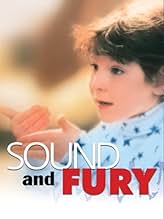
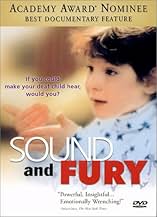
Adicionar um enredo no seu idiomaIf you could make your deaf child hear, would you? Academy Award-nominated "Sound and Fury" follows the intimate, heart-rending tale of the Artinians, an extended family of deaf and hearing ... Ler tudoIf you could make your deaf child hear, would you? Academy Award-nominated "Sound and Fury" follows the intimate, heart-rending tale of the Artinians, an extended family of deaf and hearing members, across three generations. Together they confront a technological device that can ... Ler tudoIf you could make your deaf child hear, would you? Academy Award-nominated "Sound and Fury" follows the intimate, heart-rending tale of the Artinians, an extended family of deaf and hearing members, across three generations. Together they confront a technological device that can help the deaf to hear but may also threaten deaf culture--and their bonds with one another... Ler tudo
- Indicado a 1 Oscar
- 3 vitórias e 5 indicações no total

- Self
- (narração)
- Self
- (narração)
- Self
- (narração)
- Self - Peter Artinian
- (narração)
- Self
- (narração)
- Self
- (narração)
- Self
- (narração)
- Self
- (narração)
- Self
- (narração)
- Self
- (narração)
- Self
- (narração)
- Self
- (narração)
- Self
- (narração)
- Self
- (narração)
- Self
- (narração)
Avaliações em destaque
Another worthwhile documentary
Like another reviewer noted, I found myself getting a little emotional at the end. In fact, throughout the movie I was emotionally involved with a subject matter I would never thought I would.
I was struck by the elitist nature of a certain element of the deaf community. Many of the deaf people in the film were extremely antagonistic toward anything that would remove deafness or a deaf person from their community. While this is understandable, I found it extremely selfish. Not only were many in complete denial that deafness inhibited their quality of life whatsoever (are we still allowed to use the word handicapped???), some considered it superior to the "hearing world." I noted with irony that many of the deaf family members at the picnic who were so repulsed by the idea of a cocklear implant were wearing glasses; obviously they considered being born with or having deteriorating eyesight something in need of fixing. Their attitude reminded me of other defensive groups such as un(der)educated parents (hey, I did OK, why does my son need to go to college) or racial minorities (oh, you just want to make her "white").
Even without the controversial subject of the cocklear implant this is a great study in generations as it is the old story of parents either wanting their kids (adult kids) wanting them to either be like them or to have it better than they had it.
To see and also hear . . . that is the question
SOUND AND FURY deals with the questions raised by the development of cochlear implants which can restore hearing for those with congenital deafness. Very few (if any) people in the hearing world would think this to be a bad thing, but within the deaf community some see this as encroaching technology which will eventually obliterate deaf culture and sign language.
This is one of the best documentaries I've seen in some time - partly because it really made me think (reminding me of the statement 'If you make people think they're thinking - they'll love you. If you *really* make them think, they'll hate you.')
I didn't feel hate - but I experienced some very strong emotions. Not nearly as much as those on screen, though. I was exposed to a situation in which I didn't think there could be more than one side - and was brought to the realization that there was. A very provocative film.
There was a forum after the screening of the film I attended with Josh Aronson (the director), a local pediatric surgeon who's done a number of implants, the mother of a young girl who'd had an implant operation by this surgeon, and a person from the Theatre for the Deaf in the area. I was best able to appreciate the feeling of some of those in the deaf community when the theatre director made an analogy to the Borg in STAR TREK (I paraphrase): A lot of people in the deaf community see cochlear implants like the Borg - instead of going through the eye, the implants go through the skull by the ear. It seems like hearing society is saying to the deaf society "You will be assimilated - resistance is futile."
How important is deaf culture? Whose responsibility is it to choose whether a child should get an implant? To delay and "let the child make the choice later" can very much be like choosing no, as the window for brain plasticity for language narrows with every passing year. Are parents who don't get an implant for their child, thereby keeping them in the deaf community "abusive"?
An interesting film raising intriguing questions.
Heartbreaking
Mostly this was hard for me because my mother, deaf from birth, had a cochlear implant over four years ago, with wildly successful results. She did not have the implant because people were pressuring her to do so, nor did she do it because she did not like herself the way she was, she did it in order to experience sound.
She was warned that it was very unlikely for her to develop speech recognition, and that the most she could hope for were recognition of environmental sounds. She asked me what I thought about it, and I said, "Go for it! It's worth a shot!" To me, and most of my family, the chance to hear music seemed worth it alone. So what she never becomes a "hearing person"- truly that's not the goal anyway. The point is that hearing sound is a tremendous experience most of the hearing world takes for granted, and if you have the opportunity to hear even some of the world of sound, why not take it?
My mother has never really been part of the deaf culture as defined by this film, she learned to lipread and speak excellently and was able to function very successfully without the ability to hear, as many deaf individuals do.
After she got the implant, my mother worked incredibly hard to develop speech recognition, astounding her audiologists. She truly proves that if you are highly motivated you can do it. She was also amazed at the things that made sound, plastic bags crinkling, dry autumn leaves under your feet, and the buzz of street lamps.
My mom would be the first to tell you that it's worth the risk, recovery and work required. Not because you become part of "the hearing world" but because you gain a sense. You can hear a child cry, a dog bark, a bird sing.
Personally, I feel really disgusted with parents of children who are eligible for the surgery and don't go for it. It's not a question of deaf culture or not- it's a question of knowingly depriving a child of the chance to develop their sense of hearing.
I object strongly to the deaf community's feeling that hearing people can't accept them the way they are. That may be some people's thinking, but it's not everyone's. I certainly didn't think that when my mother decided against the implant years ago, then for it four years ago. It was up to her at that point. With children, the chance for developing speech and speech recognition is so great, and so much slimmer if they were to wait- that deciding against it for a child is really taking away an opportunity that is once in a life time.
Is development of speech and the sense of hearing necessary for a child? Hearing people would say yes, many deaf people would say no. Fair enough. I agree that it's not necessary, but rather a luxury? Why not allow a person the opportunity to do it if the technology exists? Sign language and deaf culture will never be extinct, because the cochlear implant is not for every kind of hearing loss. It is also not a cure-all- an implant patient only hears when his or her implant is turned on. They are still deaf.
And in all honesty- does it really matter? If you have the chance to make your child's life easier and fuller by giving him or her the ability to hear sounds that perhaps you as a deaf parent never heard, it is selfish to stop them just because you yourself may never have the opportunity. A hearing child will still be a part of your family, hearing or not.
This film was a more than fair look at both sides of the issue, and produced in me a myriad of emotions and thoughts.
Deaf World vs CI
It also did not talk about the dangers of the CI surgery. It is brain surgery and it is seldom that the dangers of infections to the brain and the resulting consequences are spoken of. It didn't talk of the paralysis that sometimes occurs or the fact that it might not work. The surgeon told the parents that their son would hear. He didn't tell them any negatives. Personally, I would not want to have surgery until I could understand all of the ramifications and risks involved.
I felt that this film leaned heavily on the promotion of CI surgery as a cure-all for deafness. It left many issues untouched. The Deaf parents were called abusive by several of the people in the film. I don't see it as abuse. They were willing to allow their child to make the decision at a later date. The girl was learning language, it just wasn't spoken. The CI by it's very nature turns a deaf child away from the culture by emphasizing speech and hearing and de-emphasizing sign language. The hearing mother of the deaf son was making sure that it would be difficult for her son to communicate with her Deaf parents. She is content to take from the Deaf world as an interpreter, but she is also willing to insult it when her own child is born deaf. The film was interesting, but it did not come close to looking at many of the important issues of the Deaf World and CI.
Told by an idiot signifying nothing
That struts and frets his hour upon the stage, And then is heard no more; it is a tale
Told by an idiot, full of sound and fury,
Signifying nothing.
MacBeth, v. iii.
Sound and fury is as robust a movie as I can recall having ever seen. It speaks heartily of life and of the dilemmas and difficult decisions we all face. It confronts modernity and the extinction of culture. This film speaks of decisions made that are incomprehensible to other members of the same family. It speaks of steps that are superficially modest but whose consequences are mammoth. These are the decisions that we make daily and may eventually destroy human life on this rock. Sound and fury asks each of us in a soft voice if we are part of the problem or the solution. It is a moving picture.


Você sabia?
- Erros de gravaçãoWhen Peter asks Nancy (the girl with the cochlear implant from the deaf family) if she socializes more with deaf or hearing, the voice-over says, "Mostly deaf people." However, she is actually signing, "Grandma and grandpa."
- Versões alternativasA 60-minute version of this film is available from the Filmaker's Library.
Principais escolhas
- How long is Sound and Fury?Fornecido pela Alexa
Detalhes
- Data de lançamento
- Países de origem
- Central de atendimento oficial
- Idiomas
- Também conhecido como
- Sound and Fury
- Empresas de produção
- Consulte mais créditos da empresa na IMDbPro
Bilheteria
- Faturamento bruto nos EUA e Canadá
- US$ 114.882
- Fim de semana de estreia nos EUA e Canadá
- US$ 7.104
- 29 de out. de 2000
- Faturamento bruto mundial
- US$ 114.882
- Tempo de duração
- 1 h 20 min(80 min)
- Cor
- Mixagem de som
- Proporção
- 1.33 : 1