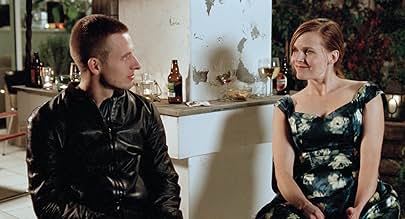
Um dia na vida de Anders, um jovem toxicodependente em recuperação, que tira uma breve licença do seu centro de tratamento para fazer uma entrevista para um emprego e pôr a conversa em dia c... Ler tudoUm dia na vida de Anders, um jovem toxicodependente em recuperação, que tira uma breve licença do seu centro de tratamento para fazer uma entrevista para um emprego e pôr a conversa em dia com velhos amigos em Oslo.Um dia na vida de Anders, um jovem toxicodependente em recuperação, que tira uma breve licença do seu centro de tratamento para fazer uma entrevista para um emprego e pôr a conversa em dia com velhos amigos em Oslo.
- Direção
- Roteiristas
- Estrelas
- Prêmios
- 19 vitórias e 21 indicações no total
Aksel Thanke
- Terapeut
- (as Aksel M. Thanke)
Tone Beate Mostraum
- Tove
- (as Tone B. Mostraum)
- Direção
- Roteiristas
- Elenco e equipe completos
- Produção, bilheteria e muito mais no IMDbPro
7,632.4K
1
2
3
4
5
6
7
8
9
10
Avaliações em destaque
Minimal, stylistic, tragic and utterly engrossing.
The sober rationality of the young Norwegian intellectual classes provides a perfectly blank canvas on which to paint the conversely complex neuroses of the anti-hero, Anders. Anders is an intelligent and gifted opinionist and writer, but his addiction has left him riddled with insecurity. The film focuses on the most pivotal moment of this young man's life as he's tragically stuck between recovery and regression: that moment is both sprinkled with glimmers of hope and drenched in melancholia. Anders' contradiction is the eternal paradox of the addict, and perhaps Trier is presenting it as an allegory of the modern human condition. Anders Danielsen Lie gives an incredible performance as the enigmatic hero and the acting throughout is consistently authentic, convincing and engrossing. The soft-focus cinematography (Jakob Ihre) works well with a particularly engaging sound design which, along with very conscious direction, editing and general production design, makes for technically masterful cinema with an aesthetic that is both selectively minimal and enjoyably rich. Oslo is a tragedy. Its simple, melancholic tone and metropolitan landscapes make the film undeniably reminiscent of the French New Wave - think Hiroshima Mon Amour in present day Oslo. The film is minimal and stylized, presenting social realism in an artistic form without losing any of its dramatic potency to surrealism. Utterly convincing and captivating: an instant indie classic.
Joachim Trier does it again.
After seeing Reprise some years ago I had been eagerly awaiting for Joachim Trier's next film. Loosely based on the same novel Louis Malle's Le Feu Follet is based on by Pierre Drieu La Rochelle, Oslo, August 31st retells this story for the new age. By no means this movie happens to be a remake. The movie happens to have some similar basic elements here and there, as well as different encounters for the main character played this time out by Anders Danielsen Lie who was also happened to be one of the leads in Reprise who this time around plays a wonderful role on his own .
This is a story about a 34 year old recovering drug addict who has screwed up his life due to excessive partying, doing heavy drugs and alienating his loved ones that at his age he finds himself stuck and unable to move forward in his life. As he's about to finish his rehab stint, he's allowed to go into town for a job interview and in the process he decides to use this opportunity to visit old friends and relatives which in a way ends up making matters much worse for him. With all his old friends now married with children and successful careers he feels completely useless and overwhelmed. As he's end up being given the sympathetic pep talks, or being lectured at by unsympathetic characters who are trying to protect themselves throughout the day he finds himself challenging their personal views head on while struggling to convey his frustrations that no one seems to fully understand yet take personally.
In my opinion there's not much to compare Oslo, August 31st to Le Feu Follet. Louis Malle's version (1963) which I am a huge fan of is one of those cinematic gems that story-wise packs a punch. Le Feu Follet also stands next to other classic black and white pictures like Fellini's 8 ½ as one of the best looking black and white movies ever made and I highly recommend everyone to see it.
Oslo, August 31st in itself has an entirely different approach and has a more melancholic feel throughout the film. With almost 50 year gap difference from Le Feu Follet to be told as a modern day tale this story depicts modern day tactlessness that society potentially sees these situations as almost insignificant when dealing with recovering addicts. Sure, maybe some people will try to try and understand but the world is also more likely to let a person deal with his/her own demons for they can't be bothered and even distance themselves for they have their own problems to deal with no matter how much a friend or a loved one really needs their help to get through life.
Oslo, August 31st has been called a "Devastating and Heartbreaking" Film by some, and I agree. If you're expecting to see another Reprise this might probably not be it, but it could be just as great of a film depending on the person. I will even go as far as to say this can be a total "hit and miss" for some viewers. To me this is still a beautiful film that really moved me and made me feel sad watching it. I will definitely be on the lookout for the DVD when it finally comes out for sale. Overall, make sure to watch this movie with an open mind then make your own opinion. 7 out of 10.
This is a story about a 34 year old recovering drug addict who has screwed up his life due to excessive partying, doing heavy drugs and alienating his loved ones that at his age he finds himself stuck and unable to move forward in his life. As he's about to finish his rehab stint, he's allowed to go into town for a job interview and in the process he decides to use this opportunity to visit old friends and relatives which in a way ends up making matters much worse for him. With all his old friends now married with children and successful careers he feels completely useless and overwhelmed. As he's end up being given the sympathetic pep talks, or being lectured at by unsympathetic characters who are trying to protect themselves throughout the day he finds himself challenging their personal views head on while struggling to convey his frustrations that no one seems to fully understand yet take personally.
In my opinion there's not much to compare Oslo, August 31st to Le Feu Follet. Louis Malle's version (1963) which I am a huge fan of is one of those cinematic gems that story-wise packs a punch. Le Feu Follet also stands next to other classic black and white pictures like Fellini's 8 ½ as one of the best looking black and white movies ever made and I highly recommend everyone to see it.
Oslo, August 31st in itself has an entirely different approach and has a more melancholic feel throughout the film. With almost 50 year gap difference from Le Feu Follet to be told as a modern day tale this story depicts modern day tactlessness that society potentially sees these situations as almost insignificant when dealing with recovering addicts. Sure, maybe some people will try to try and understand but the world is also more likely to let a person deal with his/her own demons for they can't be bothered and even distance themselves for they have their own problems to deal with no matter how much a friend or a loved one really needs their help to get through life.
Oslo, August 31st has been called a "Devastating and Heartbreaking" Film by some, and I agree. If you're expecting to see another Reprise this might probably not be it, but it could be just as great of a film depending on the person. I will even go as far as to say this can be a total "hit and miss" for some viewers. To me this is still a beautiful film that really moved me and made me feel sad watching it. I will definitely be on the lookout for the DVD when it finally comes out for sale. Overall, make sure to watch this movie with an open mind then make your own opinion. 7 out of 10.
Alienation in Oslo
Triers second film in his Oslo trilogy depicts the complexities of how it is to return to a familiar place under different circumstances.
In Oslo, August 31st, we meet Anders (Anders Danielsen Lie), a former drug addict. Anders is on his day out from rehab in Oslo to attend a job interview. Before and after the interview, he takes the opportunity to meet up with friends, and problems left undone.
This is one of the best norwegian films out there, mainly because of how it depicts the urban city life in Oslo, and the challenges which follows a recovering drug addict. As a norwegian and a former Oslo citizen, this film hit me hard. With its social realistic style, this film makes you not just reflect upon the lives of drug addicts through the perspective of Anders, but also life in general through the conversation that Anders has with his friends.
Oslo, August 31st is a socratic masterpiece.
In Oslo, August 31st, we meet Anders (Anders Danielsen Lie), a former drug addict. Anders is on his day out from rehab in Oslo to attend a job interview. Before and after the interview, he takes the opportunity to meet up with friends, and problems left undone.
This is one of the best norwegian films out there, mainly because of how it depicts the urban city life in Oslo, and the challenges which follows a recovering drug addict. As a norwegian and a former Oslo citizen, this film hit me hard. With its social realistic style, this film makes you not just reflect upon the lives of drug addicts through the perspective of Anders, but also life in general through the conversation that Anders has with his friends.
Oslo, August 31st is a socratic masterpiece.
The end of the world
This guy gets out of rehab. One of the reasons he's been there is Oslo, but it's Oslo he returns to, when leaving.
Life is about to proceed. The lives of others, that is. The guy from rehab slowly understands that he is dead and there is no way of getting back to what he anyway never had. Oslo is merciless.
Strong drama about the hopelessness a person feels while entering middle-age knowing that he has no experiences, no history, except for the well-known feeling of being worthless. Which isn't an experience in itself. It all ends with a cliffhanger. The chasm is the possibility of getting older.
Life is about to proceed. The lives of others, that is. The guy from rehab slowly understands that he is dead and there is no way of getting back to what he anyway never had. Oslo is merciless.
Strong drama about the hopelessness a person feels while entering middle-age knowing that he has no experiences, no history, except for the well-known feeling of being worthless. Which isn't an experience in itself. It all ends with a cliffhanger. The chasm is the possibility of getting older.
Drug addiction is tough *sigh*
The opening and closing minutes of Oslo, August 31rst are peerless filmmaking, a simultaneously nostalgic and disturbing slideshow of images from the titular city, which appears as some kind of larger supernatural entity with a will of its own. The film that they bracket is pretty decent too. It's a quiet slice of cinema verite about Anders, a recovering drug addict.
This isn't your standard AA-approved narrative of redemption, and that's what makes it good. Anders discovers that the world outside is frosty, ambivalent towards him, and most of all banal and meaningless. Of course, the difficulty is portraying banality without being banal yourself, and Trier doesn't entirely succeed here. But it does provide, on top of the more philosophical statement, a great representation of the difficulty of getting back into society after leaving it. Oslo, August 31rst is smart enough to see the social barriers that make the standard addiction narrative so deceitful.
Other than the immediately striking opening, there's nothing overtly impressive about this film. It has its flaws, such as the ending, which seems contrived compared to everything that's come before. But it's a quietly solid picture that certainly deserves a little of your time.
This isn't your standard AA-approved narrative of redemption, and that's what makes it good. Anders discovers that the world outside is frosty, ambivalent towards him, and most of all banal and meaningless. Of course, the difficulty is portraying banality without being banal yourself, and Trier doesn't entirely succeed here. But it does provide, on top of the more philosophical statement, a great representation of the difficulty of getting back into society after leaving it. Oslo, August 31rst is smart enough to see the social barriers that make the standard addiction narrative so deceitful.
Other than the immediately striking opening, there's nothing overtly impressive about this film. It has its flaws, such as the ending, which seems contrived compared to everything that's come before. But it's a quietly solid picture that certainly deserves a little of your time.
Você sabia?
- CuriosidadesRenate Reinsve's feature film debut. She had two lines. She would later reunite with director Joachim Trier, as the lead in A Pior Pessoa do Mundo (2021).
- ConexõesFollowed by A Pior Pessoa do Mundo (2021)
- Trilhas sonorasPatch To Lucy
Written by E. Skodvin/O. Totland
Performed by Deaf Center
© 2005 Type Records
Principais escolhas
Faça login para avaliar e ver a lista de recomendações personalizadas
- How long is Oslo, August 31st?Fornecido pela Alexa
Detalhes
- Data de lançamento
- Países de origem
- Central de atendimento oficial
- Idiomas
- Também conhecido como
- Oslo, 31 de agosto
- Locações de filme
- Henrik Ibsens Gate 36, Oslo, Noruega(restaurant where Anders meets his sister's girlfriend)
- Empresas de produção
- Consulte mais créditos da empresa na IMDbPro
Bilheteria
- Faturamento bruto nos EUA e Canadá
- US$ 101.475
- Fim de semana de estreia nos EUA e Canadá
- US$ 9.564
- 27 de mai. de 2012
- Faturamento bruto mundial
- US$ 1.481.665
- Tempo de duração
- 1 h 35 min(95 min)
- Cor
- Mixagem de som
- Proporção
- 1.85 : 1
Contribua para esta página
Sugerir uma alteração ou adicionar conteúdo ausente