

This love story chronicles the lifelong relationship of conductor-composer Leonard Bernstein and actress Felicia Montealegre Cohn Bernstein.This love story chronicles the lifelong relationship of conductor-composer Leonard Bernstein and actress Felicia Montealegre Cohn Bernstein.This love story chronicles the lifelong relationship of conductor-composer Leonard Bernstein and actress Felicia Montealegre Cohn Bernstein.
- Nominated for 7 Oscars
- 27 wins & 180 nominations total






- Director
- Writers
- All cast & crew
- Production, box office & more at IMDbPro
6.568.3K
1
2
3
4
5
6
7
8
9
10
Featured reviews
Netflix Best Oscar Hope Misses the Mark
Even with its 4 strong nominations at the Golden Globes (Picture, Director, Actor, Actress), I must say my appreciation of Cooper's new film is not as stellar, as organic and fantastic as A Star Is Born (2018) - 8 Oscar noms.
Netflix's firs real Oscar contender was Alfonso Cuarón's Roma (2018) which won 3 of its 10 nominations. Last year's Germany's remake of All Quiet on the Western Front (2022) was nominated for 9 Oscars and won 4. My all-time Netflix favorite is Noah Baumbach's Marriage Story which I rewatched recently. It is much better than that year's Best Picture co-nominee Martin Scorsese's The Irishman (2019) which was still as solid movie. Neither won and Netflix's overall 8 Best Picture nominees did not win since a decade at the Oscars.
This year, Scorsese produces Maestro (2023) with Spielberg, but his own slow burn of a movie Killers of the Flower Moon (2023) has more flair yet not a Netflix production (he produces it with DiCaprio). I think this year's Netflix better picture is Todd Haynes's May December (2023 - also nominated for 4 Golden Globes). So why did Bradley Cooper not exactly deliver?
Carey Mulligan's performance is certainly good, yet his directing lacks the creation of intimacy like he did with Lady Gaga in A Star Is Born. Most interactions are superficial, and you have to wait until the 75th minute to see the first powerful scene with strong dialogue and directing. The intro scenes are compelling up until the two main characters meet, but I found the rest of the first hour a mess. The second half of the film is surely better yet lacks urgency or dramatic tension in directing, even in the hospital scene. There is also a shortage of real wisdom or realisation in the script. We are left with a light and superficial understanding of the two main characters, even to the point where their respective love for music and acting and their love for each other is not really felt. Nolan's Oppenheimer (2023) was much more successful in that aspect and Emily Blunt's performance.
Cooper's acting also lacked some charm in my view, save perhaps a few scenes like in the end when he teaches a young conductor.
Finally, Cooper's directing choices for cinematography left the very talented Matthew Libatique with not much to work with. In Black & White, 4:3 aspect ratio or even 16:9 color, few scenes seem to tell the story like a more claustrophobic The Whale (2022) was able to with his Darren Aronofsky collaboration. Libatique was nominated for an Oscar for his work with Aronofsky's fantastic Black Swan (2011) and with Cooper's sublime A Star is Born (2018).
Better luck next time Coop! Good effort. 6.5/10.
We can still see growth, grit and gusto, but misses the mark as a whole.
Netflix's firs real Oscar contender was Alfonso Cuarón's Roma (2018) which won 3 of its 10 nominations. Last year's Germany's remake of All Quiet on the Western Front (2022) was nominated for 9 Oscars and won 4. My all-time Netflix favorite is Noah Baumbach's Marriage Story which I rewatched recently. It is much better than that year's Best Picture co-nominee Martin Scorsese's The Irishman (2019) which was still as solid movie. Neither won and Netflix's overall 8 Best Picture nominees did not win since a decade at the Oscars.
This year, Scorsese produces Maestro (2023) with Spielberg, but his own slow burn of a movie Killers of the Flower Moon (2023) has more flair yet not a Netflix production (he produces it with DiCaprio). I think this year's Netflix better picture is Todd Haynes's May December (2023 - also nominated for 4 Golden Globes). So why did Bradley Cooper not exactly deliver?
Carey Mulligan's performance is certainly good, yet his directing lacks the creation of intimacy like he did with Lady Gaga in A Star Is Born. Most interactions are superficial, and you have to wait until the 75th minute to see the first powerful scene with strong dialogue and directing. The intro scenes are compelling up until the two main characters meet, but I found the rest of the first hour a mess. The second half of the film is surely better yet lacks urgency or dramatic tension in directing, even in the hospital scene. There is also a shortage of real wisdom or realisation in the script. We are left with a light and superficial understanding of the two main characters, even to the point where their respective love for music and acting and their love for each other is not really felt. Nolan's Oppenheimer (2023) was much more successful in that aspect and Emily Blunt's performance.
Cooper's acting also lacked some charm in my view, save perhaps a few scenes like in the end when he teaches a young conductor.
Finally, Cooper's directing choices for cinematography left the very talented Matthew Libatique with not much to work with. In Black & White, 4:3 aspect ratio or even 16:9 color, few scenes seem to tell the story like a more claustrophobic The Whale (2022) was able to with his Darren Aronofsky collaboration. Libatique was nominated for an Oscar for his work with Aronofsky's fantastic Black Swan (2011) and with Cooper's sublime A Star is Born (2018).
Better luck next time Coop! Good effort. 6.5/10.
We can still see growth, grit and gusto, but misses the mark as a whole.
Too much Leonard, not enough Bernstein
It's an old (and unanswerable) question: to what extent is it possible - or desirable - to separate the art from the artist? Is it possible to appreciate the art simply as art, and not to delve into the (sometimes tawdry) details of the artist? Or are the art and the artist so inextricably entwined that you cannot understand the one without knowing the other?
I very much lean towards separation. I fell in love with Bernstein's music the first time I saw West Side Story mumble years ago at an impressionable age; which is why I was disappointed that there was so little West Side Story in this film. Surely a biopic of a composer should feature that composer's music pretty heavily?
Of course, we all know that beneath every great artist is a human being - usually with a collection of human flaws. But does this matter? Well, it matters here. What we mostly get is a film about Leonard the man, and his complicated marriage to Felicia Montealegre. Much of this was new to me. I knew that Bernstein was bisexual, but didn't care. I find that I also don't care about most of the other details of his life which were revealed to me - although if the film was truly about the man, not his music, his record as a human rights activist should probably have been at least touched on. But never mind that: I came for the music, and didn't get enough.
Not that this film is without merit. Bradley Cooper's performance is first class - there's one sequence in which he truly shows us the passion of a great conductor - and Carey Mulligan is as riveting as ever. Cinematography and sound are both excellent.
Overall, this is a good film, but ultimately a disappointing one.
I very much lean towards separation. I fell in love with Bernstein's music the first time I saw West Side Story mumble years ago at an impressionable age; which is why I was disappointed that there was so little West Side Story in this film. Surely a biopic of a composer should feature that composer's music pretty heavily?
Of course, we all know that beneath every great artist is a human being - usually with a collection of human flaws. But does this matter? Well, it matters here. What we mostly get is a film about Leonard the man, and his complicated marriage to Felicia Montealegre. Much of this was new to me. I knew that Bernstein was bisexual, but didn't care. I find that I also don't care about most of the other details of his life which were revealed to me - although if the film was truly about the man, not his music, his record as a human rights activist should probably have been at least touched on. But never mind that: I came for the music, and didn't get enough.
Not that this film is without merit. Bradley Cooper's performance is first class - there's one sequence in which he truly shows us the passion of a great conductor - and Carey Mulligan is as riveting as ever. Cinematography and sound are both excellent.
Overall, this is a good film, but ultimately a disappointing one.
How is it possbile to make Leonard Bernstein uninteresting?
The acting is superb and particularly Carey Mulligan who is astonishing, as usual, and Bradley Cooper's transformation is incredible. The look and feel throughout is very polished. But, and this isn't a minor quibble -- I found it really hard to understand the dialogue! Characters speak so quickly, in a mumble, that I actually considered putting on subtitles. Anyway, it wouldn't have made a difference, I thought the movie was so empty and plotless and uninteresting. There was really no tension in the wife's dealing with her husband's bisexuality, no real exploration or understanding of Bernstein's conflicts, and no delving into his achievements or their context, so there wasn't much left!
Beautiful to look at, gorgeous music, but no story.
I went to Maestro expecting a film that would chronicle the life of one of America's, if not the world's, great composer/conductors. I've seen Leonard Bernstein many, many times, starting at age 8 when my grandfather took me to Bernstein's music for kids on Saturday mornings at Lincoln Center. I had no idea who he was at the time, only that people called him Lenny. My grandpa took me to meet him and he was spellbinding. I remember him looking right threw me with his expressive eyes.
He loved kids and loved to teach them about music. Turns out grandpa and Lenny went to Harvard together, hence I got a personal introduction. Bernstein is the guy that got me hooked on classical music and music in general, but I didn't learn anything about his musical career, his childhood, his years at Harvard, his work in Europe, who inspired him, etc.
The making of West Side Story is really interesting (if you know the story) but nothing about it in this film and I mean "nothing.; We get a tiny glimpse of Candide, but nothing about its composition or insight into the Maestro's process. We get zero insight into his Missa Brevis, perhaps on the highlights of his career.
Bradley Cooper blew me away. I've seen Lenny up close many times and I've talked to him a few times. Cooper nailed it, and the scene at St John of the Divine is probably one of the greatest musical scenes ever captured on film. Cooper's conducting is simply amazing. He worked very very hard to capture the speech, mannerisms, and the Bernstein attitude and texture toward music. I cannot speak highly enough of Cooper's performance, but we get so little insight into the musician, and that was so disappointing.
Carey Mulligan? Her performance is nothing less than spectacular, in fact all the acting is extraordinary, but it's not a story. The Bernstein children really have nothing to do in this film, and I have no idea why Lenny's sister was included as she has very little to say or do. Overall, a very perplexing film ... not sure what he was going for. In fact, I kept waiting for it to start. The emphasis was all on style, and believe me, it's beautiful to look at.
He loved kids and loved to teach them about music. Turns out grandpa and Lenny went to Harvard together, hence I got a personal introduction. Bernstein is the guy that got me hooked on classical music and music in general, but I didn't learn anything about his musical career, his childhood, his years at Harvard, his work in Europe, who inspired him, etc.
The making of West Side Story is really interesting (if you know the story) but nothing about it in this film and I mean "nothing.; We get a tiny glimpse of Candide, but nothing about its composition or insight into the Maestro's process. We get zero insight into his Missa Brevis, perhaps on the highlights of his career.
Bradley Cooper blew me away. I've seen Lenny up close many times and I've talked to him a few times. Cooper nailed it, and the scene at St John of the Divine is probably one of the greatest musical scenes ever captured on film. Cooper's conducting is simply amazing. He worked very very hard to capture the speech, mannerisms, and the Bernstein attitude and texture toward music. I cannot speak highly enough of Cooper's performance, but we get so little insight into the musician, and that was so disappointing.
Carey Mulligan? Her performance is nothing less than spectacular, in fact all the acting is extraordinary, but it's not a story. The Bernstein children really have nothing to do in this film, and I have no idea why Lenny's sister was included as she has very little to say or do. Overall, a very perplexing film ... not sure what he was going for. In fact, I kept waiting for it to start. The emphasis was all on style, and believe me, it's beautiful to look at.
The Best Intensions. But Not the Best Result.
I had hoped to enjoy 'Maestro'. It is a film for adult audiences, featuring actors I appreciate (Bradley Cooper and Carey Mulligan) and directed by that same Bradley Cooper. It deals with a true American Icon (composer / conductor Leonard Bernstein) and deals with the 'man' inside that icon. In this time of Holiday Blockbusters it promised to appeal to an audience like me. And, in fact, it did. The theatre was two-thirds full; a first-time-since-the-Pandemic at this small art house.
The film, however, is something of a mess. It is confused about the type of picture it wants to be. In its first thirty minutes it takes on a flight-of-fancy aura; it is as though Bernstein and his soon to be wife are in a musical-comedy with the background stage settings changing as if by magic. The film's first half is in black and white; I imagine a testament to The Forties and early Fifties (the time period covered by those scenes) but, in fact, lots of color-films were made at that time.
Leonard Bernstein was bisexual. And that bisexuality is, in fact, revealed, but revealed in a coy, teasing, easy-to-misunderstand way. And then there is the background music, all of which was composed by Bernstein, but not all of which fits the scene it backgrounds. The selection from his 'West Side Story' is the most emblematic of this. But not the only example.
For me, the story belongs to Bernstein's wife Felicia (played by Mulligan). She is the wife of a bisexual man; a fact that is problematic enough. But he is a man who is always center-stage, and for whom she gave up a promising career to raise their children, support her husband, and who suffers in silence until she can suffer silently no longer. But even here (and though Mulligan has long been a favorite of mine), there is a smile on her character that (a) rings insincere and (b) is repeated so often that I wanted to scream, No more. But, sadly, there is more; the most cinematic, most hard-to-believe smile coming, in a hard-to believe scene, in London's Westminster Cathedral.
Finally there is the finale. I will give nothing away when I say that the film ends one scene too late, it is one scene too long. A scene in which Bernstein instructs a young orchestra conductor would be as appropriate an ending as one could hope for.
But then .....
The film, however, is something of a mess. It is confused about the type of picture it wants to be. In its first thirty minutes it takes on a flight-of-fancy aura; it is as though Bernstein and his soon to be wife are in a musical-comedy with the background stage settings changing as if by magic. The film's first half is in black and white; I imagine a testament to The Forties and early Fifties (the time period covered by those scenes) but, in fact, lots of color-films were made at that time.
Leonard Bernstein was bisexual. And that bisexuality is, in fact, revealed, but revealed in a coy, teasing, easy-to-misunderstand way. And then there is the background music, all of which was composed by Bernstein, but not all of which fits the scene it backgrounds. The selection from his 'West Side Story' is the most emblematic of this. But not the only example.
For me, the story belongs to Bernstein's wife Felicia (played by Mulligan). She is the wife of a bisexual man; a fact that is problematic enough. But he is a man who is always center-stage, and for whom she gave up a promising career to raise their children, support her husband, and who suffers in silence until she can suffer silently no longer. But even here (and though Mulligan has long been a favorite of mine), there is a smile on her character that (a) rings insincere and (b) is repeated so often that I wanted to scream, No more. But, sadly, there is more; the most cinematic, most hard-to-believe smile coming, in a hard-to believe scene, in London's Westminster Cathedral.
Finally there is the finale. I will give nothing away when I say that the film ends one scene too late, it is one scene too long. A scene in which Bernstein instructs a young orchestra conductor would be as appropriate an ending as one could hope for.
But then .....


Did you know
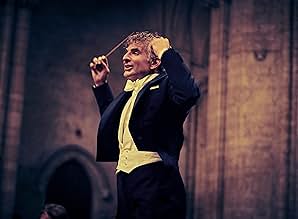
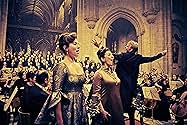
- TriviaOf the scene in which Leonard Bernstein conducts the London Symphony Orchestra at the Ely Cathedral in 1976, Bradley Cooper said, "That scene I was so worried about because we did it live... I was recorded live. I had to conduct them. And I spent six years learning how to conduct six minutes and 21 seconds of music. I was able to get the raw take where I just watched Leonard Bernstein [conduct] at Ely Cathedral... And so I had that to study."
- GoofsThe day after Bernstein makes his wildly successful debut with the N.Y. Philharmonic in November of 1943, the story is carried on the front page of the N.Y. Times. One of his friends notes that the front page also includes a headline reading "Hitler Bombs Poland." Germany had bombed and conquered Poland in September, 1939, so the country had already been under German occupation for over four years at the time of Bernstein's debut concert.
- Quotes
Leonard Bernstein: Summer sang in me a little while, it sings in me no more. Edna St. Vincent Millay.
Felicia Montealegre: If the summer doesn't sing in you, then nothing sings in you. And if nothing sings in you, then you can't make music.
- ConnectionsFeatured in Chris Plante: The Right Squad: Episode #1.70 (2023)
- How long is Maestro?Powered by Alexa
Details
- Release date
- Countries of origin
- Official site
- Language
- Also known as
- Rybernia
- Filming locations
- Production companies
- See more company credits at IMDbPro
Box office
- Budget
- $80,000,000 (estimated)
- Gross worldwide
- $383,532
- Runtime
- 2h 9m(129 min)
- Color
- Sound mix
- Aspect ratio
- 1.33 : 1
Contribute to this page
Suggest an edit or add missing content