
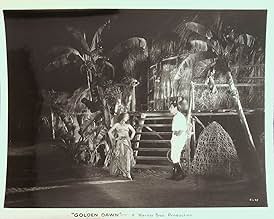
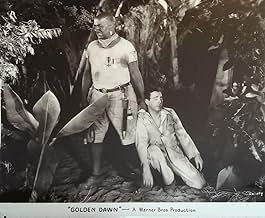
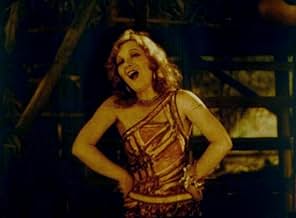
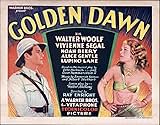
"Golden Dawn" is a musical operetta released by Warner Brothers, photographed entirely in Technicolor, and starring Walter Woolf King and Noah Beery. The film is based on the semi-hit stage ... Read all"Golden Dawn" is a musical operetta released by Warner Brothers, photographed entirely in Technicolor, and starring Walter Woolf King and Noah Beery. The film is based on the semi-hit stage musical of the same name by Oscar Hammerstein II and Otto Harbach."Golden Dawn" is a musical operetta released by Warner Brothers, photographed entirely in Technicolor, and starring Walter Woolf King and Noah Beery. The film is based on the semi-hit stage musical of the same name by Oscar Hammerstein II and Otto Harbach.
- Director
- Writers
- Stars

Walter Woolf King
- Tom Allen
- (as Walter Woolf)


Sôjin Kamiyama
- Piper
- (as Sojin)


Eduardo Cansino
- Secondary Supporting Role
- (uncredited)

Nigel De Brulier
- Hasmali - the Witch Doctor
- (uncredited)
Nick De Ruiz
- Napoli
- (uncredited)
Frank Dunn
- Secondary Supporting Role
- (uncredited)


Ivan F. Simpson
- Secondary Supporting Role
- (uncredited)
- Director
- Writers
- All cast & crew
- Production, box office & more at IMDbPro
4.5180
1
2
3
4
5
6
7
8
9
10
Featured reviews
10woid
A real jaw-dropper
and one of the funniest movies I've ever seen.
Not intentionally, though.
It's an operetta set at a camp for English prisoners being held by the Germans somewhere in the African jungle. There are dozens of native extras, all of them black actors, whose main function in the story is to prostrate themselves toward whichever white lead happens to be singing in the vicinity.
And yes, all of the lead actors are white, a little awkward since many of them are playing natives of the same tribe as the actually black extras. Their skin tones range from burnt cork (Noah Beery) to snow white (the golden Dawn herself). The plot revolves around whether the obviously white Dawn is really black. I can't tell you how it comes out -- that would be a spoiler.
Dawn's mother, a slightly darker shade of makeup, wears earrings and pearls and sort of resembles Margaret Dumont.
Speaking of whom, the male lead is played by Walter Woolf, who, as Walter Woolf King, plays the villain tenor Rodolfo Lassparri in "A Night At The Opera." When this, uh, dawned on me, I actually shouted out, just like Groucho as Otis B. Driftwood, "Lassparri?!?!?!"
This is racism too ridiculous to be objectionable. Instead, like the (intentional) loony racial stereotypes in "Blazing Saddles," it's hysterical.
Noah Beery (brother of Wallace, father of Jr.) plays Shep Keyes, who speaks and sings in an exaggerated stereotypical southern black dialect, full of "gwines" and so on. Is he supposed to be American? African? No idea. Then there's the native second female lead character, apparently (made up to be) African, but doing the same shufflin' accent as Beery. Is it just me, or does she bear a startling resemblance to Andrea Martin?
There are so many little delights, other absurd characters and "comic" subplots, moments to cherish. The Whip song! My Bwana! A Tigah! The final, shocking, revelations! Why are you reading this? Go forth, do whatever it takes to find a copy of this movie, and watch it!
Not intentionally, though.
It's an operetta set at a camp for English prisoners being held by the Germans somewhere in the African jungle. There are dozens of native extras, all of them black actors, whose main function in the story is to prostrate themselves toward whichever white lead happens to be singing in the vicinity.
And yes, all of the lead actors are white, a little awkward since many of them are playing natives of the same tribe as the actually black extras. Their skin tones range from burnt cork (Noah Beery) to snow white (the golden Dawn herself). The plot revolves around whether the obviously white Dawn is really black. I can't tell you how it comes out -- that would be a spoiler.
Dawn's mother, a slightly darker shade of makeup, wears earrings and pearls and sort of resembles Margaret Dumont.
Speaking of whom, the male lead is played by Walter Woolf, who, as Walter Woolf King, plays the villain tenor Rodolfo Lassparri in "A Night At The Opera." When this, uh, dawned on me, I actually shouted out, just like Groucho as Otis B. Driftwood, "Lassparri?!?!?!"
This is racism too ridiculous to be objectionable. Instead, like the (intentional) loony racial stereotypes in "Blazing Saddles," it's hysterical.
Noah Beery (brother of Wallace, father of Jr.) plays Shep Keyes, who speaks and sings in an exaggerated stereotypical southern black dialect, full of "gwines" and so on. Is he supposed to be American? African? No idea. Then there's the native second female lead character, apparently (made up to be) African, but doing the same shufflin' accent as Beery. Is it just me, or does she bear a startling resemblance to Andrea Martin?
There are so many little delights, other absurd characters and "comic" subplots, moments to cherish. The Whip song! My Bwana! A Tigah! The final, shocking, revelations! Why are you reading this? Go forth, do whatever it takes to find a copy of this movie, and watch it!
You won't be bored...
...and isn't boredom the worst cinematic experience one can have anyways? I watched Golden Dawn expecting a bore-fest full of static performances and wretched operatic screeching, having heard its reputation as the worst surviving movie musical ever made. Instead I experienced something so campy it is worthy of TCM Underground's Friday night cult film festivals.
This film definitely did not turn out like Warner Brothers expected, I'm sure. It failed at the box office and is today a very unintentionally funny film. The film is set during the first World War in Africa. It is about a native girl, Dawn (Vivienne Segal), who has supposedly been blessed by the gods to appear white, thus marking her as the future bride of the native's god - a statue that appears to be a giant likeness of Mr. Bill from the old 70's skits on Saturday Night Live. A British soldier loves Dawn, but their love is thwarted at every turn both by the fact that the occupying Europeans don't want any trouble with the natives, which they'd have if Tom Allen (Walter Woolf King) eloped with the bride of the native god, and by Shep Keyes, a native bully and strong man who wants Dawn for himself.
Shep (Noah Beery) is supposed to be an African native, yet his name and his accent are purely Gone with the Wind. Plus his black-face makeup is very obviously melting off of his body through his clothing under the hot Technicolor lights, but nobody seems to notice.
There are a large group of civilian Americans and Europeans in the story, and the reason for their presence in this remote African village is never explained. Neither is any reason given as to why they all speak like they're from Queens. One of the things in this film that does work as funny and probably intentionally so is the wiry anemic Ned Sparks-like Lee Moran as Blink and Marion Byron as Joanna, Blink's rough and bossy girlfriend. The one number that works in this film is their rendition of the Song "A Tiger", which Joanna certainly is and Blink definitely is not.
This film, made in 1930, is still using title cards to transition between scenes, something that was still common in the late Vitaphone era. However, even here there are laughs to be found. One title card reads "There was no joy among the natives. A draught was destroying them." As there is no mention of beer or wind in this film, I can only assume the title card writer meant "draught" to be "drought".
For a little over an hour of campy fun in the tradition of "The Dueling Cavalier" in Singin in the Rain, you just can't beat this one.
This film definitely did not turn out like Warner Brothers expected, I'm sure. It failed at the box office and is today a very unintentionally funny film. The film is set during the first World War in Africa. It is about a native girl, Dawn (Vivienne Segal), who has supposedly been blessed by the gods to appear white, thus marking her as the future bride of the native's god - a statue that appears to be a giant likeness of Mr. Bill from the old 70's skits on Saturday Night Live. A British soldier loves Dawn, but their love is thwarted at every turn both by the fact that the occupying Europeans don't want any trouble with the natives, which they'd have if Tom Allen (Walter Woolf King) eloped with the bride of the native god, and by Shep Keyes, a native bully and strong man who wants Dawn for himself.
Shep (Noah Beery) is supposed to be an African native, yet his name and his accent are purely Gone with the Wind. Plus his black-face makeup is very obviously melting off of his body through his clothing under the hot Technicolor lights, but nobody seems to notice.
There are a large group of civilian Americans and Europeans in the story, and the reason for their presence in this remote African village is never explained. Neither is any reason given as to why they all speak like they're from Queens. One of the things in this film that does work as funny and probably intentionally so is the wiry anemic Ned Sparks-like Lee Moran as Blink and Marion Byron as Joanna, Blink's rough and bossy girlfriend. The one number that works in this film is their rendition of the Song "A Tiger", which Joanna certainly is and Blink definitely is not.
This film, made in 1930, is still using title cards to transition between scenes, something that was still common in the late Vitaphone era. However, even here there are laughs to be found. One title card reads "There was no joy among the natives. A draught was destroying them." As there is no mention of beer or wind in this film, I can only assume the title card writer meant "draught" to be "drought".
For a little over an hour of campy fun in the tradition of "The Dueling Cavalier" in Singin in the Rain, you just can't beat this one.
Pre-Code, Pre-Taste
The reviews of this one simply compelled me to give it a try; I wasn't disappointed. I love films made at the dawn of sound, and in this case also the dawn of taste, apart from often being entertaining they usually tell me a lot about who we were and who we now are. All white people back then apparently considered they were innately superior to all other races, nowadays gifted with movie-hindsight all races can all afford to be retrospectively superior to everyone in the primitive past, and in both cases, innocently. Where we will end up though is another matter – it even tells me something that the original New York stage play ran to 184 performances in 1927, and that this film in black and white (if you "know black from white") has actually survived Time when much worthier films were left to rot.
Dawn is a white native goddess with a hazy past, white Britisher Tom Allen loves her purely but jet blacked-up native Shep Keyes lusts after her. It was still clunky old Noah Beery for all the make-up though – I just had to laugh at the blackened armpits of his shirt. He's worth watching singing to his whip too. The first song is shrilled out by a blackface Margaret Dumont lookalike – I looked out in vain for Captain Spaulding. Vivienne Segal and Walter Woolf King (pre-Marx's Lasspari) are excellent in their lead roles with every word and every lyric perfectly enunciated, every emotion delivered complete with Capital Letters. I loved Woolf's line at one point about not letting Segal sacrifice herself and "go through with this savage religious stupidity" – out of the mouths of babes! The songs, even when the lyrics make you sit up are in the main dull as ditchwater except for We Two (I was wishing for Eddie Cantor though) and the energetic A Tiger (the routine later bettered in King Of Jazz's Ragamuffin Romeo).
It's exhilaratingly barmy doing Vienna in the jungle, but it must have played pretty old-fashioned and pointless even in 1930. So if you decide to hunt this down as it's probably banned from TV and watch it, keep it in the strict amber of context and you will have a unique experience no matter what your colour or prejudices. Unfortunately I can't say the same for Blazing Saddles (my personal bête noire) which was not innocent but malicious.
Dawn is a white native goddess with a hazy past, white Britisher Tom Allen loves her purely but jet blacked-up native Shep Keyes lusts after her. It was still clunky old Noah Beery for all the make-up though – I just had to laugh at the blackened armpits of his shirt. He's worth watching singing to his whip too. The first song is shrilled out by a blackface Margaret Dumont lookalike – I looked out in vain for Captain Spaulding. Vivienne Segal and Walter Woolf King (pre-Marx's Lasspari) are excellent in their lead roles with every word and every lyric perfectly enunciated, every emotion delivered complete with Capital Letters. I loved Woolf's line at one point about not letting Segal sacrifice herself and "go through with this savage religious stupidity" – out of the mouths of babes! The songs, even when the lyrics make you sit up are in the main dull as ditchwater except for We Two (I was wishing for Eddie Cantor though) and the energetic A Tiger (the routine later bettered in King Of Jazz's Ragamuffin Romeo).
It's exhilaratingly barmy doing Vienna in the jungle, but it must have played pretty old-fashioned and pointless even in 1930. So if you decide to hunt this down as it's probably banned from TV and watch it, keep it in the strict amber of context and you will have a unique experience no matter what your colour or prejudices. Unfortunately I can't say the same for Blazing Saddles (my personal bête noire) which was not innocent but malicious.
There went an hour and 20 minutes of my life I will never get back...
I guess the novelty of sound was what got this quickie musical produced. It had a rather unsuccessful run on stage and here we see why. Noah Beery in awful blackface that stains his clothes singing a song about his whip and how it makes him the Boss man. His accent, while supposedly an African native is pure Black Southern "You-all" and "we'all". The "natives" are painted in random patterns, looking like skeleton men extras from the "Danger Island" series that used to play along with the "Banana Splits" on Saturday mornings. The music is okay, the lyrics atrocious. Lovely and talented Vivienne Segal sings a love song about "My Bwana", Alice Gentle sings the opening solo, which is basically telling the Africans how great the White men are and to obey them. Lupino Lane the comedian will remind many of Stan Laurel in his speech. I made it through the whole thing, call me a masochist. It does show that just because it is old and Black & White, doesn't always mean it is a "classic".
Beautiful enchanting music - Great film.
I love this film. The music is perfect. Alice Gentle has a gorgeous voice. Her rendition of "Africa Smiles No More" is lovely. I could listen to her singing for hours. It is such a shame that she only was only featured in two feature films and the other ("Song of the Flame" 1930) is now unfortunately lost. The only other extant film is a Technicolor Vitaphone short entitled "A Scene from Carmen" (1929) which features her singing but is not readily available.
The songs which were written by Otto A. Harbach & Oscar Hammerstein II are superb. I especially love the song "Dawn" as sung by Walter Woolf King who has a delightful baritone voice.
Noah Beery is great as the villain and his bass voice is amazing. Vivienne Segal has the least impressive voice of the cast but is still pleasing.
"In a Jungle Bungalow" sung by Lupino Lane and chorus is another pleasing song.
Some of the reviewers on here are clearly clueless. There is nothing racist about this film. As a matter of fact, the film was banned from many Southern states because it was the exact opposite. Racist audiences were offended by a white man (Walter Woolf King) falling in love with a woman (Vivienne Segal) who had a black mother (Alice Gentle). If you examine the period film trade publications made available by the Media History on the Internet Archive you can verify this fact.
Calling Noah Beery racist for portraying a black man is as absurd as calling Lon Chaney's portrayal of a Chinese man racist in the 1927 picture "Mister Wu." Anyone who knows anything about this period in film history knows that Noah Beery was typecast by Warner Bros. as the studio villain and he played pretty much the same character in all his early talking pictures. For example, in "Bright Lights" (1931) he portrays a villain who is supposed to be Portuguese while in "Oh Sailor Behave" (1930) he portrays a villain who is supposed to be Romanian while in "Song of the Flame" (1930) he was a Russian villain. Are these portrayals likewise racist since he plays for laughs and acts in a stereotypical manner? Absurd.
The songs which were written by Otto A. Harbach & Oscar Hammerstein II are superb. I especially love the song "Dawn" as sung by Walter Woolf King who has a delightful baritone voice.
Noah Beery is great as the villain and his bass voice is amazing. Vivienne Segal has the least impressive voice of the cast but is still pleasing.
"In a Jungle Bungalow" sung by Lupino Lane and chorus is another pleasing song.
Some of the reviewers on here are clearly clueless. There is nothing racist about this film. As a matter of fact, the film was banned from many Southern states because it was the exact opposite. Racist audiences were offended by a white man (Walter Woolf King) falling in love with a woman (Vivienne Segal) who had a black mother (Alice Gentle). If you examine the period film trade publications made available by the Media History on the Internet Archive you can verify this fact.
Calling Noah Beery racist for portraying a black man is as absurd as calling Lon Chaney's portrayal of a Chinese man racist in the 1927 picture "Mister Wu." Anyone who knows anything about this period in film history knows that Noah Beery was typecast by Warner Bros. as the studio villain and he played pretty much the same character in all his early talking pictures. For example, in "Bright Lights" (1931) he portrays a villain who is supposed to be Portuguese while in "Oh Sailor Behave" (1930) he portrays a villain who is supposed to be Romanian while in "Song of the Flame" (1930) he was a Russian villain. Are these portrayals likewise racist since he plays for laughs and acts in a stereotypical manner? Absurd.


Did you know
- TriviaThe Technicolor version is apparently lost; only the black and white version survives.
- GoofsComposer Herbert Stothart is billed as "Hubert" in the opening credits.
- SoundtracksAfrica Smiles No More
(1930) (uncredited)
Music by Harry Akst
Lyrics by Grant Clarke
Sung by Alice Gentle
Details
- Runtime
- 1h 21m(81 min)
- Color
- Color(2-strip Technicolor, original print)
Contribute to this page
Suggest an edit or add missing content