IMDb RATING
7.1/10
3.5K
YOUR RATING
Just before his wedding, the bridegroom hears a complex tale painting his lovely bride as devilish and unbalanced.Just before his wedding, the bridegroom hears a complex tale painting his lovely bride as devilish and unbalanced.Just before his wedding, the bridegroom hears a complex tale painting his lovely bride as devilish and unbalanced.
- Awards
- 4 wins total
- Director
- Writers
- All cast & crew
- Production, box office & more at IMDbPro
7.13.5K
1
2
3
4
5
6
7
8
9
10
Featured reviews
Maltin doesn't know what he is talking about!!
This is a great movie! I wasn't expecting to like it but boy, was I in for a suprise. The flashback within a flashback within a flashback (Is there another one?) theme is so great and is never the least bit confusing. Laraine Day, Brian Aherne, Robert Mithchum, and Gene Raymond give great performances in this thriller.
Interesting structure
This film by underrated director John Brahm is one of the more interesting works of the 1940s (not one of the best, but different).
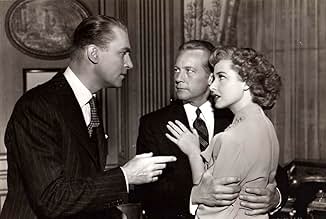
Laraine Day plays Nancy, about to marry and hiding some dark secrets in her past. She was excellent at this kind of thing. Gene Raymond (not the most charismatic of actors but surprisingly good here) plays her intended, with Brian Aherne as the psychiatrist who knows about her previous life.
In flashback we see Nancy and her husband (a young Robert Mitchum) and then into another flashback (daring to attempt this at the time when many films were still pursuing conventional structure).
'The Locket' of the title obviously holds the key to the mystery, and we have an absorbing time pulling all the loose ends together. Reginald Denny, Ricardo Cortez, and Ellen Corby decorate an accomplished cast.
Laraine Day plays Nancy, about to marry and hiding some dark secrets in her past. She was excellent at this kind of thing. Gene Raymond (not the most charismatic of actors but surprisingly good here) plays her intended, with Brian Aherne as the psychiatrist who knows about her previous life.
In flashback we see Nancy and her husband (a young Robert Mitchum) and then into another flashback (daring to attempt this at the time when many films were still pursuing conventional structure).
'The Locket' of the title obviously holds the key to the mystery, and we have an absorbing time pulling all the loose ends together. Reginald Denny, Ricardo Cortez, and Ellen Corby decorate an accomplished cast.
Interesting Noir
Brahm's intricately constructed film is based on the obvious conceit of a locket: in psychoanalytical terms, it symbolises repressed memory and of the 'opening up' of hidden psychosis. In a filmic sense of course, The Locket itself is a cinematic 'locket', the flashbacks within flashback structure reflecting the secret enclosure typical of such a piece of jewellery.
In fact I can't think of another film that takes this much commented narrative technique to such extremes. Mitchum of course was well used to playing heros faced with abnormal feminine psychology. He faces similar femme fatales in Preminger's 'Angel Face' for instance and in Farrow's 'Where Danger Lives' - all made at around the same time (end 40's, start of 50's). This may reflect something of the obsession that Hollywood had with cod Freudianism just as much as noir convention, but there is no doubting that Mitchum's peculiar manner as an actor, his doe-eyed sleep-walking acting style, made his starring excursions into the dangers of the subconscious peculiarly effective.
Brahm, one of Hollywoods most neglected directors at least for the work that he did at this time in his career, makes the somewhat over- stretched structure of the film work, pun intended, like a dream. Nancy's final walk to the altar, immediately before her mental and psychic collapse, although necessarily melodramatic, is very effective version of a personal calvary and she seems stunned and trance like. In retrospect, of course, it is easy to see how the whole of the preceding film has been leading up to this sequence, (just as how the flashback structure of the film reminds one in passing of 'Citizen Kane') but the sound and vision montage is still powerful.
By setting the bulk of the film in flashback, Brahm places it in the past - or, more precisely, in the imaginatively reconstructed past, and it is this dream-sense that retains a powerful grip on the viewer as events unfold. This almost hallucinatory sense, together with a feeling of 'drifting with fate', marks out some of the greatest noirs and B-mysteries made at this time and is what makes this film still very watchable today.
A 'Locket' well worth looking into.
In fact I can't think of another film that takes this much commented narrative technique to such extremes. Mitchum of course was well used to playing heros faced with abnormal feminine psychology. He faces similar femme fatales in Preminger's 'Angel Face' for instance and in Farrow's 'Where Danger Lives' - all made at around the same time (end 40's, start of 50's). This may reflect something of the obsession that Hollywood had with cod Freudianism just as much as noir convention, but there is no doubting that Mitchum's peculiar manner as an actor, his doe-eyed sleep-walking acting style, made his starring excursions into the dangers of the subconscious peculiarly effective.
Brahm, one of Hollywoods most neglected directors at least for the work that he did at this time in his career, makes the somewhat over- stretched structure of the film work, pun intended, like a dream. Nancy's final walk to the altar, immediately before her mental and psychic collapse, although necessarily melodramatic, is very effective version of a personal calvary and she seems stunned and trance like. In retrospect, of course, it is easy to see how the whole of the preceding film has been leading up to this sequence, (just as how the flashback structure of the film reminds one in passing of 'Citizen Kane') but the sound and vision montage is still powerful.
By setting the bulk of the film in flashback, Brahm places it in the past - or, more precisely, in the imaginatively reconstructed past, and it is this dream-sense that retains a powerful grip on the viewer as events unfold. This almost hallucinatory sense, together with a feeling of 'drifting with fate', marks out some of the greatest noirs and B-mysteries made at this time and is what makes this film still very watchable today.
A 'Locket' well worth looking into.
Little-known noir gem
Knowing that this is the movie with the famous "flashback within a flashback within a flashback" draws people in, but the device never comes across as forced or artificial, and it works.
Like a lot of other people, I think Leonard Maltin underrates this one. "The Locket" is fun and suspenseful, as all "did she or didn't she" stories are when they're told right. This is Laraine Day's finest hour, and Robert Mitchum is very good in a sympathetic role. They are ably supported by Brian Aherne and Gene Raymond.
It's nice to see so many of the wonderful old thrillers from the 40s enjoying a revival. So many little gems like "The Locket" come in at under 90 minutes; they benefit from tight writing, intriguing premises and neat plot twists. Like "Detour," "Phantom Lady," "Follow Me Quietly" and many others, "The Locket" does not disappoint.
This is the kind of movie you think about all day long, and maybe the day after, if you happen upon it at 3:00 a.m. on TCM.
Like a lot of other people, I think Leonard Maltin underrates this one. "The Locket" is fun and suspenseful, as all "did she or didn't she" stories are when they're told right. This is Laraine Day's finest hour, and Robert Mitchum is very good in a sympathetic role. They are ably supported by Brian Aherne and Gene Raymond.
It's nice to see so many of the wonderful old thrillers from the 40s enjoying a revival. So many little gems like "The Locket" come in at under 90 minutes; they benefit from tight writing, intriguing premises and neat plot twists. Like "Detour," "Phantom Lady," "Follow Me Quietly" and many others, "The Locket" does not disappoint.
This is the kind of movie you think about all day long, and maybe the day after, if you happen upon it at 3:00 a.m. on TCM.
Flashback within a flashback within a flashback!
Yes! This is the movie that does just that - but it's worth watching for more than that. It is an inspired piece of film-making with excellent direction and fine photography. It also features some strong performances especially from the (is she or isn't she evil) Laraine Day, and the wonderful Brian Aherne. And Robert Mitchum's pretty good too. The best bits are almost expressionist - especially the music box shots - and it's full of the pseudo psychological nonsense that Hollywood loved so much in this era. Highly enjoyable.
Did you know
- TriviaNorma Barzman's lengthy treatment for this film, which Sheridan Gibney revised into a screenplay, was inspired by a true event which was recounted to her by financier George Peabody Gardner and his sister Belle. When younger, the Gardners eschewed their aristocratic upbringing partly in reaction to an incident in their youth: As children they became friendly with the daughter of the family's housekeeper. It transpired that the daughter was wrongly accused of stealing a locket, leading to the firing and departure of the housekeeper and her daughter. Years later, they learned that the daughter suffered from depression and was implicated in a theft, a consequence for which the Gardners felt their family was partly responsible.
- GoofsAmerican ambulances, shown driven with left-hand drive, were not used in wartime London.
- Quotes
Norman Clyde: I don't take money for nothing. I'm not conducting a class so the parasitic rich can escape boredom. I'm not that hard up.
Nancy Patton: Well, I hope you never will be, Mr. Clyde. I admire your principles. I wish I could say the same for your disposition.
- ConnectionsEdited into Histoire(s) du cinéma: Fatale beauté (1994)
Details
- Runtime
- 1h 25m(85 min)
- Color
- Aspect ratio
- 1.33 : 1
Contribute to this page
Suggest an edit or add missing content