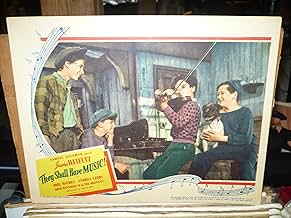
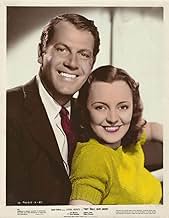
A boy runs away from home and ends up at a music school for poor children. When the school suffers hard times, he enlists the aid of violinist Heifetz to save the day.A boy runs away from home and ends up at a music school for poor children. When the school suffers hard times, he enlists the aid of violinist Heifetz to save the day.A boy runs away from home and ends up at a music school for poor children. When the school suffers hard times, he enlists the aid of violinist Heifetz to save the day.
- Nominated for 1 Oscar
- 3 wins & 1 nomination total
Gale Sherwood
- Betty
- (as Jacqueline Nash)
Alexander Schoenberg
- Menken
- (as Alexander Schonberg)
- Director
- Writers
- All cast & crew
- Production, box office & more at IMDbPro
6.9585
1
2
3
4
5
6
7
8
9
10
Featured reviews
Cinematic treasure of 20th century's greatest violinist
Although many audio recordings of great musicians like Jascha Heifetz survive, the cinematic or televised record is limited indeed. This is why musical offerings like "They Shall Have Music" are such rare gems. While, with modern eyes and ears, one can quibble about the plot, the perceptive viewer should put this film's unique delights in their proper perspective. The plot was designed to appeal to both young and old audiences of the era, but it remains enjoyable to this day. A important aspect of the experience of watching classic films is to see them through the eyes of the moviegoer of that era.
I must take issue with reviewer who complains about a film that is in black and white, or who feel obliged to report that their students express such reservations. These are juvenile complaints which reflect a limited historical perspective. For the teacher, this should offer up an educational opportunity to explain the unique qualities of black and white photography and its place in cinematic history. Color can, in fact, get in the way of a good storyline, or the music. For example, the black and white photography of John Ford's "Stagecoach," is, like the still photographs of Ansel Adams, an artistic masterpiece.
As for Heifetz being wooden, I could not disagree more. If you want blatant emotional posturing, go to a rock concert. The role of a classical musician like Heifetz is to move the audience, not him or herself. Heifetz's emotion is conveyed through his playing, not through his body language. He had a rare ability to extract every emotional nuance out of the music and transfer it to his listeners. It is the listener who should be moved, not the artist.
Incidentally, one reviewer asked about seeing Heifetz on YouTube playing the 1st movement of the Tchaikovsky Violin Concerto, with Frank McHugh in the audience. This is from the 1947 film "Carnegie Hall," not "They Shall Have Music" "Carnegie Hall" is an even greater treasure of many great classical artists in their prime. We are blessed that there were film producers who, at least in these limited instances, chose to showcase these artists. In was still an era not totally overwhelmed by the lowest common denominator tripe we get today.
I must take issue with reviewer who complains about a film that is in black and white, or who feel obliged to report that their students express such reservations. These are juvenile complaints which reflect a limited historical perspective. For the teacher, this should offer up an educational opportunity to explain the unique qualities of black and white photography and its place in cinematic history. Color can, in fact, get in the way of a good storyline, or the music. For example, the black and white photography of John Ford's "Stagecoach," is, like the still photographs of Ansel Adams, an artistic masterpiece.
As for Heifetz being wooden, I could not disagree more. If you want blatant emotional posturing, go to a rock concert. The role of a classical musician like Heifetz is to move the audience, not him or herself. Heifetz's emotion is conveyed through his playing, not through his body language. He had a rare ability to extract every emotional nuance out of the music and transfer it to his listeners. It is the listener who should be moved, not the artist.
Incidentally, one reviewer asked about seeing Heifetz on YouTube playing the 1st movement of the Tchaikovsky Violin Concerto, with Frank McHugh in the audience. This is from the 1947 film "Carnegie Hall," not "They Shall Have Music" "Carnegie Hall" is an even greater treasure of many great classical artists in their prime. We are blessed that there were film producers who, at least in these limited instances, chose to showcase these artists. In was still an era not totally overwhelmed by the lowest common denominator tripe we get today.
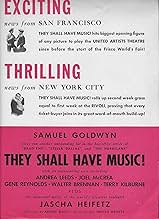
music of the heart
You may have heard that music is the universal language. Nowhere is that more true than in Archie Mayo's "They Shall Have Music". It focuses on a troubled boy who runs away from home and joins a struggling music school. Things take a turn when Jascha Heifetz (playing himself) enters the scene.
The movie addresses poverty and funding for the arts. And in the process, we get to hear some masterful performances of works by the great composers (and of course, during the Barber of Seville overture, I pictured Bugs Bunny subjecting Elmer Fudd to all sorts of humiliation to the tune of the overture). No surprise that the children perform the music exquisitely, since Samuel Goldwyn hired the Meremblum Orchestra to star in the movie.
It might not be the greatest movie ever made, but I hope that it reminds people of the importance of the arts. Indeed, during WWII, Winston Churchill got asked if he planned to cut funding for the arts to redirect the money to the armed forces, and he said "Then what are we fighting for?" Alfred Newman's Academy Award-nominated score is like a character by itself. I definitely recommend this movie.
The movie addresses poverty and funding for the arts. And in the process, we get to hear some masterful performances of works by the great composers (and of course, during the Barber of Seville overture, I pictured Bugs Bunny subjecting Elmer Fudd to all sorts of humiliation to the tune of the overture). No surprise that the children perform the music exquisitely, since Samuel Goldwyn hired the Meremblum Orchestra to star in the movie.
It might not be the greatest movie ever made, but I hope that it reminds people of the importance of the arts. Indeed, during WWII, Winston Churchill got asked if he planned to cut funding for the arts to redirect the money to the armed forces, and he said "Then what are we fighting for?" Alfred Newman's Academy Award-nominated score is like a character by itself. I definitely recommend this movie.
Heifetz is fabulous
They Shall Have Music from 1939 stars violinist Jascha Heifetz as himself, Joel McCrea, Gene Reynolds, Walter Brennan, Marjorie Main, and a favorite performer of mine, Zero the Dog. Directed by Archie Mayo.
The basic story concerns a boy (Reynolds) who runs away from home and winds up in a music school for kids. Gifted musically, he attempts to help the school stay open by appealing to Heifetz.
The star, of course, is Heifetz' magnificent playing. Though the film states he plays a Stradivarius, that violin name was thought to be more recognizable to audiences than his actual instrument, a Guarnarius. How wonderful to have Heifetz' gorgeous work on film.
If you like opera, you haven't lived until you've heard nine-year-old Gale Sherwood singing Caro Nome. I know hearing a child squeak out the coloratura was a life-changing experience for me.
In fact, Gale Sherwood grew up to be a lovely soprano who made films, did a nightclub act with Nelson Eddy, performed The Desert Song on tv, and Showboat at the LA Music Center. Then she moved to Florida and retired. She can be heard as an adult on YouTube.
I saw Zero the Dog in High Sierra. His role on that film was a tad more dramatic, but he was a delightful thespian and did a great job in this.
The basic story concerns a boy (Reynolds) who runs away from home and winds up in a music school for kids. Gifted musically, he attempts to help the school stay open by appealing to Heifetz.
The star, of course, is Heifetz' magnificent playing. Though the film states he plays a Stradivarius, that violin name was thought to be more recognizable to audiences than his actual instrument, a Guarnarius. How wonderful to have Heifetz' gorgeous work on film.
If you like opera, you haven't lived until you've heard nine-year-old Gale Sherwood singing Caro Nome. I know hearing a child squeak out the coloratura was a life-changing experience for me.
In fact, Gale Sherwood grew up to be a lovely soprano who made films, did a nightclub act with Nelson Eddy, performed The Desert Song on tv, and Showboat at the LA Music Center. Then she moved to Florida and retired. She can be heard as an adult on YouTube.
I saw Zero the Dog in High Sierra. His role on that film was a tad more dramatic, but he was a delightful thespian and did a great job in this.
Another uncredited and unmentioned cast member?
I caught a clip of this film with Heifetz's performance of Tchaikovsky's Violin Concerto on YouTube - which was phenomenal. Watching the performance from the wings with Andrea Leeds was an actor who looks exactly like Frank McHugh (with mustache), but there's no mention of him in the cast, or of this appearance on his biography page. I assume he was an extra even though he was rather prominent in this single(?), non-speaking appearance in the film. Can anyone confirm if it was him, one way or the other?
Does anyone know if this movie is available on VHS or DVD? I remember seeing it, I believe, on TV, but I'm not certain as to whether I watched a clip of it in a documentary biography of Heifetz, or saw the film, itself.
Pleasant fiction with great music!
A bright youngster interested in "serious" music (admittedly a vanishing breed--who'll play the fiddle when no one can play the violin??"--could find this an interesting fiction about street kids and great musical stars. Heifitz was indeed the greatest violinist of his generation and the film gives him a rare on-screen chance to display his technique. The kids, especially Gene Reynolds, are fine and, all in all, the pic is a good example of first-rate studio family fare of the late 30's. It doesn't hit the top of the great '39 list, but it's a nice way for an intelligent family to spend a rainy afternoon with AMC or the Video Store--- good luck at Blockbuster!!!!
Did you know
- TriviaIn the movie, the newspaper account lists Jascha Heifetz's stolen violin as a Stradivarius. Heifetz used a Guarnarius in the picture and favored that violin in real life, but the producers felt that the name of Stradivarius would be more recognizable.
- GoofsThroughout the picture, the kids in the orchestra are caught looking into the camera or eyeing it sideways, licking their lips, fidgeting, etc.
- ConnectionsFeatured in Monty and the Movies
- SoundtracksAndante cantabile
from "String Quartet No.1 in D, Op.11" (1871) (uncredited)
Written by Pyotr Ilyich Tchaikovsky
In the score during the opening credits
Reprised a bit by Gene Reynolds (violin)
- How long is They Shall Have Music?Powered by Alexa
Details
- Release date
- Country of origin
- Language
- Also known as
- Rapsodia de juventud
- Filming locations
- Production company
- See more company credits at IMDbPro
- Runtime
- 1h 42m(102 min)
- Color
- Aspect ratio
- 1.37 : 1
Contribute to this page
Suggest an edit or add missing content