

At the turn of the century in a Welsh mining village, the Morgans, he stern, she gentle, raise coal-mining sons and hope their youngest will find a better life.At the turn of the century in a Welsh mining village, the Morgans, he stern, she gentle, raise coal-mining sons and hope their youngest will find a better life.At the turn of the century in a Welsh mining village, the Morgans, he stern, she gentle, raise coal-mining sons and hope their youngest will find a better life.
- Won 5 Oscars
- 19 wins & 6 nominations total


- Ceinwen
- (as Ann Todd)


- Director
- Writers
- All cast & crew
- Production, box office & more at IMDbPro
Featured reviews
Maybe it deserved that Best Picture Oscar after all... maybe...
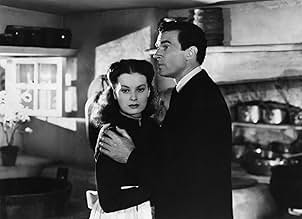
... and how red were Maureen O'Sullivan's hair... in her loveless marriage to the mine owner's son, she walks with the solemnity of Marie Antoinette taken to the guillotine, her long veil embracing the wind and trying to fly away like some encaged bird. The veil stays in place... and so does the man she loved whose silhouette appears behind in the distance.
A lesser director would have gratified us with a close-up showing the man's devastation but Ford cares for the big picture. One large shot speaks a thousand words, and "How Green Was My Valley" counts hundreds of such eloquent shots. Here's another one: in "The Grapes of Wrath", as the Joads move out to California, Ma Joad (Jane Darnell) chooses not to give a last look toward their farm for time is not for the past. "How Green" opens with a close-up of an aging woman looking toward the mines with eyes that convey both nostalgia and sadness.
This is a woman who didn't move and witnessed the slow decay of the once green valley through the darkening effect of industrialization. That image captures the emotional spirit of John Ford's Best Picture winner (yes, the one that beat "Citizen Kane" and "The Maltese Falcon") : the universal paradox of life is that it takes climbing the valley to admire how beautiful the view was, especially with children's eyes of wonder. And never has such a vision been so hypnotically beautiful as in the adaptation of Richard Llewely's book.
It might strike as an ironic title for a movie made of black-and-white splendor, but the green is secondary when it's all about emotions. This is not a movie for purists determined to spot the flaws within accents and proudly state the obvious, this is a film for viewers who wish to have an instant of pure old-school Hollywood-style melodrama from its most emblematic director: John Ford. Ford said it was his favorite movie and so did Clint Eastwood. Interesting from two men who owed their stardom to the Western genre to pick a movie that is just a slice of life tainted with pure nostalgia.
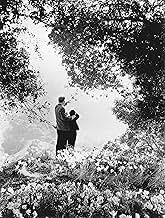
Or maybe is it because Western was embodying the "childhood" of America and this is why "How Green Was My Valley" hits that sensitive chord. It echoes a sublimated vision of a past that no longer exists, an order sacrificed at the altar of modernity and materialism, like a purified vision of the Old West (without the desperadoes). It is an idealistic dream from the start, the valley of Wales (which strangely resemble the industrialist setting of Zola's masterpiece "Germinal") looks like the pastoral heaven where coal miners work hard, ruled by entrusted owners, women keeping the house, and priests herding their sheep.
The story is told from a narrator who's living after fifty years, assembling his belongings in the shawl that belonged to his mother. He's Huw, the youngest of the Morgan boys, played by Roddy McDowall. He captures the spirit of the film, the fact that we all look at our past with our child eyes, reminiscing an idyllic time where each member was set on a pedestal of love and respectability. And like a romantic painter, Ford addresses a magnificent portrait of the Morgan family as a monument of stability at a time where Old Europe became the arena of bloody battles.
It was the war indeed that prevented the shooting to be set in Wales and turned the Malibu valley into a Welsh village. Needless to say that Darryl Zanuck had to downplay his ambitions to make his "Gone With the Wind", a four-hour epic in all Technicolor. But Ford knew that black-and-white was the best way to express the film's old-fashioned values through his mastery of large and haunting shots and a palette of darkness and lighting. John Ford was one hell of a storyteller and where any lesser director could have turned the melodrama into something linear and mawkish, Ford turns it into a work of art that conveys his own nostalgia of Ireland.
Yes, there are instants where the film feels preachy when too socially loaded or stagey when too melodramatic but the child perspective is the soul of the film. The film opens with the family reunion, the patriarch Mr. Morgan (Donald Crisp) cuts the bread to his sons, makes the prayer while the mother (Sara Allgood) is the last to start the meal and the first to finish, she's the pillar of the little community and while the film strikes as a man's movie, it leaves no doubt about who's the real boss in the house. The idyllic picture doesn't last for too long as we're quickly immersed in the workers' plight and the threats of strikes pending over them.
The workers' plights are less to emphasize the political content but to show how, in one instant, the father has turned into an old relic of the part. And this is what the father is, and the last monologue conveys the idea that men like him can never die, and that one can live without the past. Maybe this is why the film was such an instant favorite, it reconciled Americans with a past when the present was grim and the future uncertain. Maybe this is why it is the most Fordian of all Ford's films.
There are a few oddities here and there, keeping Roddy McDowall instead of hiring an older actor made a few interactions rather awkward, the actor who played the bigot priest was overacting, Walter Pidgeon's performance better fitted for a movie directed by Wyler (he was the initial choice)... but the film is so full of visual and haunting scenery that one can't ignore its emotional beauty, it is a vision embellished from the past that emphasizes the dissolution of many American values just like "Citizen Kane" did... in a more intellectual way.
Maybe it deserved that Best Picture after all...
A Welch valley
Mr. Ford uses songs in most of his films. In this movie as well as in The Quiet Man, this device enhances what we are watching. The songs are diversions for the stark reality in the miners' lives. Their every day misery is somehow eased when they sing with clear voices ancient folk melodies they, and their forefathers, have always known.
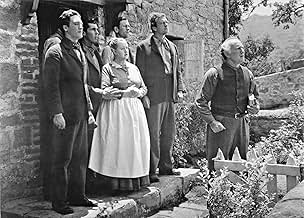
The Morgan family is at the center of the story. We hear the narration from Huw, the youngest member of this family. All the men work in the mine; they are all disillusioned by the working conditions and meager wages that they give without hesitation to the matriarch when they are paid. They appear content at the beginning of the film, but we watch them gradually abandon their village in search of a better life; who can blame them?
The cast assembled by Mr. Ford is first rate. Donald Crisp, as the patriarch of the Morgan family outdoes himself in this film. Walter Pidgeon as the local church pastor is excellent. The young and radiant beauty of Maureen O'Hara was so powerful, we can't stop watching her for a moment when she is on screen. Roddy McDowall as the youngest child of the clan in his first appearance is also a magnetic presence that holds the viewer's attention all the time.
The rest of the actors do incredible ensemble work to support the principals. Anna Lee, John Loder, Barry Fitzgerald, Anne Todd make us believe they are the characters they are playing.
Ultimately this is a John Ford's triumph. He is the force that welds everything together and in spite of all the bad things that happen to the family and the town, he seems to be telling us there still is hope and life will continue.
A John Ford Masterpiece
There is not much, if anything, to criticize in this movie, it's one of the best ever.
Yes, You Can Almost Feel The Grime
Walter Pigeon is the likable minister, and lead character, "Mr. Gruffydd." He's likable because he doesn't judge people as the head deacon does. The latter is portrayed ludicrously by Barry Fitzgerald, much to the delight of secular-minded film critics, who loved his performance. Nonetheless, there is a lot of "religion" pictured positively in this film, a lot of spiritual scenes and most were done well.
Roddy McDowell plays the most memorable character, I thought: "Huw," a young boy who went through some really tough times, as did most of the townsfolk.
If you are used to modern films, be warned this film does drag in spots. It is a fine movie, to be sure, and a powerful and emotional story.
Regal and Beautiful
Oscars Best Picture Winners, Ranked
Oscars Best Picture Winners, Ranked


Did you know
- TriviaRoddy McDowall had been in the United States for only two weeks before being cast in the leading role of Huw. He had been evacuated from the UK with his mother and sister to keep out of harm's way during the Blitz.
- GoofsThe wage reduction proclamation contains the word "labor" (American spelling) rather than "labour" as any British Islander would spell it.
- Quotes
Mr. Gruffydd: You've been lucky, Huw. Lucky to suffer and lucky to spend these weary months in bed. For so God has given you a chance to make the spirit within yourself. And as your father cleans his lamp to have good light, so keep clean your spirit... By prayer, Huw. And by prayer, I don't mean shouting, mumbling, and wallowing like a hog in religious sentiment. Prayer is only another name for good, clean, direct thinking. When you pray, think. Think well what you're saying. Make your thoughts into things that are solid. In that way, your prayer will have strength, and that strength will become a part of you, body, mind, and spirit.
- Alternate versionsOriginal stereophonic soundtrack recovered and restored for later video and cable TV release.
- ConnectionsEdited into The Time Tunnel: End of the World (1966)
- SoundtracksRhyfelgyrch Gwyr Harlech
(uncredited)
(Men of Harlech)
Traditional Welsh folk song
Played and Sung during the opening credits
Details
Box office
- Budget
- $1,250,000 (estimated)
- Gross worldwide
- $865
- Runtime
- 1h 58m(118 min)
- Color
- Aspect ratio
- 1.37 : 1