

When a commercial airliner develops engine problems on a trans-Pacific flight and the pilot loses his nerve, it is up to the washed-up co-pilot Dan Roman to bring the plane in safely.When a commercial airliner develops engine problems on a trans-Pacific flight and the pilot loses his nerve, it is up to the washed-up co-pilot Dan Roman to bring the plane in safely.When a commercial airliner develops engine problems on a trans-Pacific flight and the pilot loses his nerve, it is up to the washed-up co-pilot Dan Roman to bring the plane in safely.
- Won 1 Oscar
- 5 wins & 7 nominations total


Pedro Gonzalez Gonzalez
- Gonzales
- (as Gonzalez Gonzalez)


- Director
- Writer
- All cast & crew
- Production, box office & more at IMDbPro
6.66.9K
1
2
3
4
5
6
7
8
9
10
Featured reviews
That Majestic Theme Song
Has there ever been a more majestic film score? Slightly melancholy and beautifully haunting, Dimitri Tiomkin's Academy Award winning music gives us a grand and expansive auditory experience comparable perhaps to what a soaring eagle must feel, in its own way, as it glides high above a landscape of the mundane and the mediocre.
In the early 50s, people were just getting used to the idea that they could climb aboard a big man-made eagle and soar above cars, buses, and trains. It was a thrilling, but scary, idea, not unlike traveling on the Titanic. And so, with "The High And The Mighty", Hollywood created the first big budget movie that conveyed the idea of risk, in commercial air travel. Throughout the film, the overriding emotion is insecurity, not only among passengers but among the crew as well. Since the film was a cinematic prototype, I can see how its nerve-wracking story would appeal to moviegoers of that era. The film's angelic theme music thus provided inspiration to help viewers overcome their fear of something new and different, something potentially life threatening.
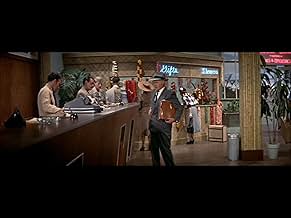
Since the early 50s, air travel has lost its sense of adventure. The film to us seems quaint and dated. What seemed odd to me, for example, was the ticket counter. The pace was leisurely, and the attention was very personal. Then, on board the plane, the stewardess made sure that the passengers got personalized attention. At one point, even the captain, upon request, reassured a nervous passenger. Those were the days.
First time viewers also need to be aware that this film is talky and dreamily melodramatic. The emphasis is on story and acting, not special effects or high-powered action. And then there is that final Act. It is different perhaps from what most of us probably would expect. But again, we must take into account the era in which the film was made.
Fifty years after its release, "The High And The Mighty", as a film, cannot compete with its own theme music. The sweeping orchestration, like music generally, transcends time and spans the generations. By contrast, technology, and mankind's reaction to technology, changes. The film's story thus has a different meaning to us than it did to the original moviegoers. If you can place the film in its proper historic context, you have a better chance of appreciating the film for what it was then, not for what it is now.
In the early 50s, people were just getting used to the idea that they could climb aboard a big man-made eagle and soar above cars, buses, and trains. It was a thrilling, but scary, idea, not unlike traveling on the Titanic. And so, with "The High And The Mighty", Hollywood created the first big budget movie that conveyed the idea of risk, in commercial air travel. Throughout the film, the overriding emotion is insecurity, not only among passengers but among the crew as well. Since the film was a cinematic prototype, I can see how its nerve-wracking story would appeal to moviegoers of that era. The film's angelic theme music thus provided inspiration to help viewers overcome their fear of something new and different, something potentially life threatening.
Since the early 50s, air travel has lost its sense of adventure. The film to us seems quaint and dated. What seemed odd to me, for example, was the ticket counter. The pace was leisurely, and the attention was very personal. Then, on board the plane, the stewardess made sure that the passengers got personalized attention. At one point, even the captain, upon request, reassured a nervous passenger. Those were the days.
First time viewers also need to be aware that this film is talky and dreamily melodramatic. The emphasis is on story and acting, not special effects or high-powered action. And then there is that final Act. It is different perhaps from what most of us probably would expect. But again, we must take into account the era in which the film was made.
Fifty years after its release, "The High And The Mighty", as a film, cannot compete with its own theme music. The sweeping orchestration, like music generally, transcends time and spans the generations. By contrast, technology, and mankind's reaction to technology, changes. The film's story thus has a different meaning to us than it did to the original moviegoers. If you can place the film in its proper historic context, you have a better chance of appreciating the film for what it was then, not for what it is now.
Fine Characters; Well-Acted; Most Realistic Airplane Film
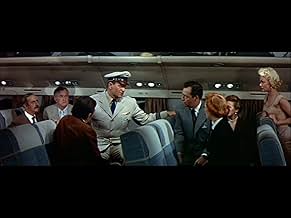
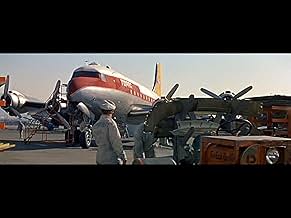
Several younger reviewers, posing as critics, have projected their post-1994 angst onto "The High and the Mighty". They have tried to make its virtues into defects I suggest because they have failed to understand the normative, non-surreal self-responsibility requirements that individuals in the 1950s tacitly accepted as their price for exercising U.S. rights under regulation. They also do not understand apparently that this flight was being undertaken as a very-long flight, and barely seven years after the end of WWII. One complained that there was talk of disaster from the beginning; I found none except some fear on the part of one neurotic passenger. And there is something else that needs to be said about the film. It was directed by William Wellman, aviation's greatest champion in Hollywood history. That may be one reason why the resulting film is in my judgment the most realistic portrayal of a 1950s airport, airplane crew, airplane flight and airplane disaster-near disaster film in history--to this day... I flew on prop planes in 1950; this is the real thing. As for the emotional belief that it is "corny', its script telegraphs some of its punches concerning passengers' ideas, but only the surreal philosophy of statist-postmodernist thinkers could see in this beautifully- thought-out film as anything but what most viewers believe it to be--the very entertaining fictional account of a distrusted loner saving an entire planeload of interesting passengers from a physical disaster to whose impending happening each reacts in his own individual way. The film opens at Honolulu Airport as flight 420 is being readied for takeoff. A succession of passengers come to the desk manned by an airline official and the flight's stewardess; so the viewer is thus cleverly allowed to discover a good bit about each one at the same time as do the refreshingly judgmental pair of officers. At the same time, we are told the story of nice-guy Dan Roman, played by John Wayne; he was the pilot of a plane that once ran into wind shear; the rear of that plane was destroyed; on impact.; he survived the death of his wife and son to fly again. The list of those aboard is long and fascinating. In addition to cynical young crewman William Campbell, uxorious navigator Wally Brown, up-tight young Robert Stack and Wayne, we meet Sidney Blackmer, overwrought and insistent; ebullient Phil Harris and his wife Ann Doran, sensible and prolific Johna Qualen, intelligent Claire Trevor, Jan Sterling as an aging beauty queen worried about meeting her new mail-contact fiancée, handsome couple John Smith and Karen Sharpe as newlyweds, Paul Fix who is elderly and unflappable, Dorothy Chen, John Howard, flight-fearing Robert Newton and his loyal wife lovely Julie Bishop, secret-keeping Paul Kelly and dynamic David Brian, and a little boy, among others. The story develops as the great airplane shudders in mid-air; gradually a crisis develops with an engine losing power. Then it is hit by a bullet, and a fire disables it and must be extinguished. The exact number of gallons of high-octane fuel aboard then becomes critical. The threat of a disaster is told in five parts--the inception; examinations and worsenings; the potential of having to ditch is faced; Wayne forces Stack to try for the coast instead of ditching; and the final climax plays out as the onshore wind gives them their last chance to make one try at the runway--with ultimately only 30 gallons of fuel left. As the potential problem develops, the passengers and crew must deal with the film's plot-theme--"taking charge of one's own life"; one man pulls a gun on the man he suspects of having made love to his wife; others have to be stopped from screaming, others face issues long put aside, others express regrets, hopes or fears; others demand or ask for information; and the crew face their own problems as well. Uniting the whole taut drama is the towering experience, calm and underplaying by Wayne and the thin-voice maturity, intelligence and normalcy of Doe Avedon as the chief stewardess. The other unusual feature of the film is Wellman's use of extended flashbacks for a number of persons, which is a feature that indicates to viewers information as well as passage of time. Here it is used in several innovative ways-to indicate character, to reinforce dramatic points and to strengthen the presentation of values such as a nuclear scientist's reasons for quitting his job, etc. The script for the novel was written by the author of the original novel "The High and the Mighty", aviation fiction expert Ernest K. Gann. The cinematography was done by Archie J. Stout, and the music which uses Wayne whistling the main theme among other presentations was done by Dimitri Tiomkin, co-author of the famous and popular title song, which was a hit both with and without lyrics. Among the solid cast also one should note Regis Toomey, Laraine Day, Douglas Kennedy, and Gonzales Gonzales. Among the main characters, Wayne, David Brian, Sindey Blackmer, Claire Trevor, John Howard, Julie Bishop, Robert Newton, Phil Harris, John Qualen and Robert Stack all do standout work. The scene where luggage is jettisoned to lighten the plane, the gradual revelation of the aircraft's problems, the dialogue sequences and the entire atmosphere of the film--as well as the gripping climactic approach to San Francisco--are all memorable.achievements in my view. Watch for Wayne's explanation that they will probably have to ditch, addressed to all the passengers. This is a nearly-great and unarguably a deservedly popular film.
Mike and Pat--Don't hold this one back
Probably the most popular film that has never been released to any video medium, The High and the Mighty is th4e granddaddy of all of those disaster pictures that became popular in the 70s, but they do not hold a candle to this one.
The Wayne Family in general, and I would assume sons Michael and Patrick in particular, own the film along with some others. One has to wonder why they do not release it. I have a copy I recorded from HBO many years ago and when aired it was a great print. I am fortunate to be able to see it now and then at my own leisure.
The plot of a crippled airliner in the middle of the Pacific doesn't accurately describe this film. It is a true character study with some of the finest actors of the day on hand delivering brilliant performances. Those that stand out include Jan Sterling (oscar nominee and Golden Globe winner), Claire Trevor (Oscar nominated), Phil Harris, Robert Newton, and David Brian. But each and every one in the rest of the cast can take a bow for a job well done. And That includes Wayne himself. His Dan Roman is complete, a man with strengths and weaknesses, but a man who eventually is the only one to step up in a time of crisis. It is one of his best performances.
William Wellman's direction keeps the film moving, Dimitri Tiomkin's Oscar winning score had viewers whistling along with Whistling Dan.
Mike and Pat, please let this one out before it becomes an antique. A new generation of your father's fans await this classic. It is not fair to deny them their chance to see him. And by the way. John Wayne was not the original choice to play Dan Roman. When He acquired the rights to the film he just wanted to produce it ( a la Bullfighter and the Lady). His choice wanted to play the role, but schedule conflicts prevented this, thus John Wayne had to play the role he offered to Spencer Tracy
The Wayne Family in general, and I would assume sons Michael and Patrick in particular, own the film along with some others. One has to wonder why they do not release it. I have a copy I recorded from HBO many years ago and when aired it was a great print. I am fortunate to be able to see it now and then at my own leisure.
The plot of a crippled airliner in the middle of the Pacific doesn't accurately describe this film. It is a true character study with some of the finest actors of the day on hand delivering brilliant performances. Those that stand out include Jan Sterling (oscar nominee and Golden Globe winner), Claire Trevor (Oscar nominated), Phil Harris, Robert Newton, and David Brian. But each and every one in the rest of the cast can take a bow for a job well done. And That includes Wayne himself. His Dan Roman is complete, a man with strengths and weaknesses, but a man who eventually is the only one to step up in a time of crisis. It is one of his best performances.
William Wellman's direction keeps the film moving, Dimitri Tiomkin's Oscar winning score had viewers whistling along with Whistling Dan.
Mike and Pat, please let this one out before it becomes an antique. A new generation of your father's fans await this classic. It is not fair to deny them their chance to see him. And by the way. John Wayne was not the original choice to play Dan Roman. When He acquired the rights to the film he just wanted to produce it ( a la Bullfighter and the Lady). His choice wanted to play the role, but schedule conflicts prevented this, thus John Wayne had to play the role he offered to Spencer Tracy
I've Got it
I was just sitting in my barrack's room watching this film today and I am so lucky to have it. It is a priceless treasure and it is what a great film is all about. It is a classic and I wish that everyone could see it. I cannot believe how selfish and wrong John Wayne's family are to keep the public from seeing this classic. SHAME ON THEM!!!!They are hiding a priceless treasure from all of us. THIS IS JOHN WAYNE"S FINEST FILM EVER!!!!He won an Academy Award for True Grit and should have won one for his portrayal of Dan Roman in this film. In 1988, they re-released The Manchurian Candidate so that a whole new generation of film goers could enjoy its greatness. They should do the same to this film. They should get the finest film technicians available to do a restoration of it and release it so that people today could see what a great film is. Look at the movies they come out with today, all the filth and violence and filty words they use. It is a disgrace. All the actors in this film do an amazing job.
Not the classic everyone "remembers"
I went to the DVD premiere screening of THE HIGH AND THE MIGHTY tonight (12 June 2005) at Paramount studios. It was a big red-carpet event, and I saw a number of people associated with the film there, though there are a scant handful of the cast still surviving. Pedro Gonzalez-Gonzalez, William Campbell, and Robert Easton were there, and from bits of applause during the screening, I suspect that a few others were there as well. Of course, all of the major character players are gone: Wayne, Stack, Trevor, Day, Sterling, Harris, Newton, Brian, Kelly, Blackmer, and Qualen. Other than Karen Sharpe and William Schallert, I'm not certain whether anyone yet unmentioned is still alive. Doe Avedon probably is (she was really lovely as the flight attendant).
As some have speculated, there's no way for this film to live up to the hype that has grown up because of its near-forty year unavailability. It's been beautifully restored. The picture quality seems to my uneducated eye to be impeccable, and the sound is really magnificent. And there are some moments of nice performance, particularly by Wayne, Robert Stack, Jan Sterling, and John Qualen. But as much as I would love to say this is a resurrected masterpiece, it simply isn't possible for me to do so honestly. After AIRPLANE!, I'm not sure it's reasonable to expect people to take a Fifties airliner disaster movie seriously. But the level of corn and hokum and treacle and syrup in which the film wallows (especially in the primary sections dealing with the passengers rather than the crew) is simply intolerable in today's world. I'm not referring to the fact that it's a different practical world now, one in which it would be ludicrous to show a passenger pulling a gun on another passenger on an airliner of today. I'm referring rather to the simple unbelievability of the human behavior exhibited. I'm willing to accept a passenger getting aboard a trans-Pacific airliner with a gun in his pocket in 1954. I'm not willing to accept him pulling that gun, threatening other passengers with it, having it taken from him, and later having it handed back to him just because he says, "I'm all right now, I've calmed down." Phil Harris, fifty at the time and looking sixty, plays a 38-year-old, and 43-year-old Ann Doran plays his 30-year-old wife. Laraine Day berates her husband and demands a divorce, and good ol' Phil says to the husband, "You think you got problems?" and proceeds to tell him about how rain and crummy hotels ruined his vacation, and the husband (John Howard) thus sees his own life in a new perspective. Every cliché imaginable comes into play, and rarely is there a moment that can be easily swallowed, even with Herculean efforts to place oneself mentally in the zeitgeist of the film.
Only in the cockpit are things comparatively realistic and believable, and even there big pills must be swallowed. One of the reasons John Wayne comes off so well in this film is he has relatively little to say. It's probably the lowest line-count of any of Wayne's leading roles, and thus unsaddled with the maudlinities and sappiness of the dialog the passengers are stuck with, he comes off better than anyone in the picture. Spencer Tracy was supposed to play Wayne's role but turned it down (according to various stories) either because he thought the script was lousy or he didn't want to work for taskmaster William Wellman. I'm betting on the former reason.
There are still things to like in THE HIGH AND THE MIGHTY (Dimitri Tiomkin's Oscar-winning score among them), but an awful lot of people have been waiting forty years to see this "masterwork" again, and an awful lot of them are going to be either seriously disappointed or forced to convince themselves that it's not as bad as it seems.
As some have speculated, there's no way for this film to live up to the hype that has grown up because of its near-forty year unavailability. It's been beautifully restored. The picture quality seems to my uneducated eye to be impeccable, and the sound is really magnificent. And there are some moments of nice performance, particularly by Wayne, Robert Stack, Jan Sterling, and John Qualen. But as much as I would love to say this is a resurrected masterpiece, it simply isn't possible for me to do so honestly. After AIRPLANE!, I'm not sure it's reasonable to expect people to take a Fifties airliner disaster movie seriously. But the level of corn and hokum and treacle and syrup in which the film wallows (especially in the primary sections dealing with the passengers rather than the crew) is simply intolerable in today's world. I'm not referring to the fact that it's a different practical world now, one in which it would be ludicrous to show a passenger pulling a gun on another passenger on an airliner of today. I'm referring rather to the simple unbelievability of the human behavior exhibited. I'm willing to accept a passenger getting aboard a trans-Pacific airliner with a gun in his pocket in 1954. I'm not willing to accept him pulling that gun, threatening other passengers with it, having it taken from him, and later having it handed back to him just because he says, "I'm all right now, I've calmed down." Phil Harris, fifty at the time and looking sixty, plays a 38-year-old, and 43-year-old Ann Doran plays his 30-year-old wife. Laraine Day berates her husband and demands a divorce, and good ol' Phil says to the husband, "You think you got problems?" and proceeds to tell him about how rain and crummy hotels ruined his vacation, and the husband (John Howard) thus sees his own life in a new perspective. Every cliché imaginable comes into play, and rarely is there a moment that can be easily swallowed, even with Herculean efforts to place oneself mentally in the zeitgeist of the film.
Only in the cockpit are things comparatively realistic and believable, and even there big pills must be swallowed. One of the reasons John Wayne comes off so well in this film is he has relatively little to say. It's probably the lowest line-count of any of Wayne's leading roles, and thus unsaddled with the maudlinities and sappiness of the dialog the passengers are stuck with, he comes off better than anyone in the picture. Spencer Tracy was supposed to play Wayne's role but turned it down (according to various stories) either because he thought the script was lousy or he didn't want to work for taskmaster William Wellman. I'm betting on the former reason.
There are still things to like in THE HIGH AND THE MIGHTY (Dimitri Tiomkin's Oscar-winning score among them), but an awful lot of people have been waiting forty years to see this "masterwork" again, and an awful lot of them are going to be either seriously disappointed or forced to convince themselves that it's not as bad as it seems.


Did you know
- TriviaErnest Gann's novel clearly indicates that the character of Sally McKee has resorted to prostitution in order to survive. The film version, made at the height of Hollywood censorship, was unable to explicitly state this; however, Gann slyly managed to insinuate the information during Sally's entrance, wherein two sailors at the Honolulu airport recognize her and pointedly remark, "Hey, look! Remember?"
- GoofsNear the end of the film, Air Traffic Control clears the aircraft to land on "runway 39" This is impossible. Runways are numbered are within 10 degrees of their actual magnetic heading, and since there are only 360 degrees on the compass, the highest runway number possible is "runway 36".
- Quotes
Alsop: She may be put together with paste and flour, but that woman has something. What would you say it was?
Miss Spalding: Practice. Plenty of practice.
- Alternate versionsThe song "The High and the Mighty" (with lyrics) does not appear in the original 1954 release of this film. However, the studio wanted the hugely popular, chart-topping song to be nominated for the Best Song Academy Award that year. According to AMPAS regulations, the song could not be nominated because it was no officially sung in the film, even if would be heard elsewhere. To satisfy these regulations, a version was released towards the tail-end of 1954 for a few nights only with the song inserted into an Exit Music. The Academy then decided to give the song a nomination on the basis of these screenings. The song lost to "Three Coins in a Fountain".
- ConnectionsEdited into The FBI Story (1959)
- How long is The High and the Mighty?Powered by Alexa
Details
- Release date
- Country of origin
- Language
- Also known as
- William A. Wellman's The High and the Mighty
- Filming locations
- Production company
- See more company credits at IMDbPro
Box office
- Budget
- $1,470,000 (estimated)
- Gross worldwide
- $4,334
- Runtime
- 2h 27m(147 min)
- Sound mix
- Aspect ratio
- 2.55 : 1
Contribute to this page
Suggest an edit or add missing content