

When his family goes away for summer vacation, a hitherto faithful husband with an overactive imagination is tempted by a sexy new neighbor.When his family goes away for summer vacation, a hitherto faithful husband with an overactive imagination is tempted by a sexy new neighbor.When his family goes away for summer vacation, a hitherto faithful husband with an overactive imagination is tempted by a sexy new neighbor.
- Nominated for 1 BAFTA Award
- 2 wins & 3 nominations total






Tom Ewell
- Richard Sherman
- (as Tommy Ewell)


Dolores Rosedale
- Elaine
- (as Roxanne)


Brandon Beach
- Commuter at Station
- (uncredited)
Steven Benson
- Kid at Train Station
- (uncredited)

George Bruggeman
- Commuter at Station
- (uncredited)
George Chester
- Porter
- (uncredited)

Noble 'Kid' Chissell
- Train Station Gateman
- (uncredited)
Richard Elmore
- Commuter at Station
- (uncredited)

Duke Fishman
- Commuter at Station
- (uncredited)
- Director
- Writers
- All cast & crew
- Production, box office & more at IMDbPro
7.045.4K
1
2
3
4
5
6
7
8
9
10
Featured reviews
A so-so comedy that's just not for me.
Something that irritates me about the IMBD is that if you criticise a movie that was made before 1980, a truckload of idiots send you messages telling you how much you hate old movies. Let me say right away, I don't. I like films from pretty much every era of cinema that I've had the chance to see, but, having had common sense recently installed, I've come to realise that age doesn't automatically make a movie great, just as modernity doesn't automatically make a movie bad.
So bearing in mind that I'm talking about this one movie, and not every movie made in the 1950s, The Seven Year Itch is as average as they come. The minimal plot sees Tom Ewell's `summer bachelor' trying to resist the charms of neighbour Marilyn Monroe while his wife and son are shipped off for the season. Very obviously adapted from a play, there are few characters, few sets, and even fewer laughs. That it succeeds at all is due to the charm of the leads and the occasional good joke that sneaks its way into the script.
The film's main problem comes in how it tells its story. First, it depends on Ewell constantly talking to himself, babbling on endlessly about what he's doing, what he might do, what he's never done, and what other people will think he's doing, done and about to do. Secondly, he is constantly daydreaming, the film constantly dissolving into one of his fantasies that are unfortunately no funnier than reality. If you find this storytelling approach irritating, as I did, the film's potential is lost immediately.
You'll no doubt be shocked to learn that in this film Marilyn Monroe is cast as a dumb blonde. Most people in the world seem to immediately pitch a trouser tent at the thought of Norma Jean, but I can't say I count myself among them. The problem with a dumb blonde is that she's dumb, so to find her attractive, you have to be attracted to stupidity. I'm not, so it doesn't matter how much she pouts, or how often we're treated to shots of her hourglass figure; she's as thick as a lobotomised footballer and therefore unattractive. She's basically got the personality and intelligence of a six year old, and, not being Gary Glitter, I can't say that appeals to me.
A comedy with few laughs, a sex symbol who doesn't float my boat, and a classic that just doesn't do it for me. I guess there's another bunch of snide messages coming my way.
So bearing in mind that I'm talking about this one movie, and not every movie made in the 1950s, The Seven Year Itch is as average as they come. The minimal plot sees Tom Ewell's `summer bachelor' trying to resist the charms of neighbour Marilyn Monroe while his wife and son are shipped off for the season. Very obviously adapted from a play, there are few characters, few sets, and even fewer laughs. That it succeeds at all is due to the charm of the leads and the occasional good joke that sneaks its way into the script.
The film's main problem comes in how it tells its story. First, it depends on Ewell constantly talking to himself, babbling on endlessly about what he's doing, what he might do, what he's never done, and what other people will think he's doing, done and about to do. Secondly, he is constantly daydreaming, the film constantly dissolving into one of his fantasies that are unfortunately no funnier than reality. If you find this storytelling approach irritating, as I did, the film's potential is lost immediately.
You'll no doubt be shocked to learn that in this film Marilyn Monroe is cast as a dumb blonde. Most people in the world seem to immediately pitch a trouser tent at the thought of Norma Jean, but I can't say I count myself among them. The problem with a dumb blonde is that she's dumb, so to find her attractive, you have to be attracted to stupidity. I'm not, so it doesn't matter how much she pouts, or how often we're treated to shots of her hourglass figure; she's as thick as a lobotomised footballer and therefore unattractive. She's basically got the personality and intelligence of a six year old, and, not being Gary Glitter, I can't say that appeals to me.
A comedy with few laughs, a sex symbol who doesn't float my boat, and a classic that just doesn't do it for me. I guess there's another bunch of snide messages coming my way.
Magic on the screen: Monroe fights the New York heat and gives pleasure to Ewell
In the 'fifties Hollywood created its biggest, best-loved and most powerful sex symbol of allMarilyn Monroe
Marilyn's appeal was, perhaps, in her weakness, in that revealing look of innocence and confidence, in her intense desire to be loved
The 'seven year itch' points out the instinctive desire to be disloyal after seven years of matrimony, with a longing to satisfy one's sexual needs
This amusing film was adapted from a Broadway play of the same name by George Axelrod, with Tom Ewell reprising his Broadway role, walking, worrying, and sweating
Tom and Evelyn Kayes have been married for seven years While he remains in Manhattan on business, Evelyn and their son Ricky (Butch Bernard) go off to Maine to escape the sweltering summer
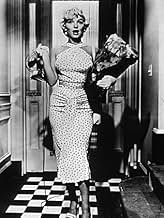
The apartment upstairs has been rented to a television blonde model (Marilyn Monroe). When she forgot her front door key, she had to ring Ewell's bell to let her into the building
When Marilyn accidentally knocks a tomato plant onto Tom's terrace, the happily man invites the luscious young beauty downstairs for a drink, indulging in fantasies about taking her in his arms and kissing her 'very quickly and very hard'
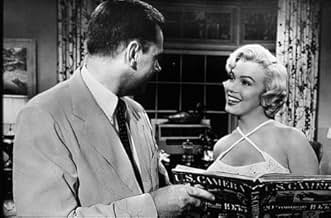
Marilyn comes in, explaining that she feels safe with married men... He makes a clumsy pass while they are at the piano but both fall off the seat He stammers an apology, but she pretends it is nothing
When Marilyn returns to her apartment, Tom envisions his wife having an affair in Maine with their big neighbor, Tom McKenzie (Sonny Tufts) Then he sees himself lost between foolish fantasies of seduction, and terrible ideas of his wife capturing him in action Finally he decides to put an end to his visions and asks Marilyn out to a movie...
On their way home, they stop on a subway
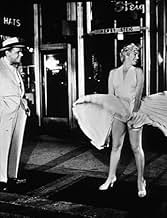
As the trains go by underneath, Marilyn's skirts billow up
It is so hot in the city she presumably loves the rush of air on her thighs
Marilyn plays the scene in innocent delight And Billy Wilder's shot shows a strapping blonde with a white skirt blown out like a spinnaker above her waist
For this famous shot alone, the movie is a must see
Marilyn's appeal was, perhaps, in her weakness, in that revealing look of innocence and confidence, in her intense desire to be loved
The 'seven year itch' points out the instinctive desire to be disloyal after seven years of matrimony, with a longing to satisfy one's sexual needs
This amusing film was adapted from a Broadway play of the same name by George Axelrod, with Tom Ewell reprising his Broadway role, walking, worrying, and sweating
Tom and Evelyn Kayes have been married for seven years While he remains in Manhattan on business, Evelyn and their son Ricky (Butch Bernard) go off to Maine to escape the sweltering summer
The apartment upstairs has been rented to a television blonde model (Marilyn Monroe). When she forgot her front door key, she had to ring Ewell's bell to let her into the building
When Marilyn accidentally knocks a tomato plant onto Tom's terrace, the happily man invites the luscious young beauty downstairs for a drink, indulging in fantasies about taking her in his arms and kissing her 'very quickly and very hard'
Marilyn comes in, explaining that she feels safe with married men... He makes a clumsy pass while they are at the piano but both fall off the seat He stammers an apology, but she pretends it is nothing
When Marilyn returns to her apartment, Tom envisions his wife having an affair in Maine with their big neighbor, Tom McKenzie (Sonny Tufts) Then he sees himself lost between foolish fantasies of seduction, and terrible ideas of his wife capturing him in action Finally he decides to put an end to his visions and asks Marilyn out to a movie...
On their way home, they stop on a subway
As the trains go by underneath, Marilyn's skirts billow up
It is so hot in the city she presumably loves the rush of air on her thighs
Marilyn plays the scene in innocent delight And Billy Wilder's shot shows a strapping blonde with a white skirt blown out like a spinnaker above her waist
For this famous shot alone, the movie is a must see
Rachmaninoff and Marilyn
Peak Marilyn. She's funny, sexy, and absolutely charming, and it's also of course got that iconic moment over the subway grate. I've also always liked Tom Ewell in this. As silly as his character is and as stagey as his monologues are, I think he's funny and satirizes married men with wandering eyes pretty well. He has ridiculous fantasies, clumsily tries to put the moves on a younger woman, and is wracked by guilt. I absolutely love the scene where he plays Rachmaninoff's Piano Concerto #2 to set the mood (both in fantasy and reality), and how it was incorporated into the soundtrack. Another nice little moment is when he's fixing a couple of Tom Collins for the two of them, going on about how it couldn't have been chance for them to have met, while she's talking to herself about needing to return a fan to a store. I like how spare the story is, and the various one-liners in the script. Director Billy Wilder lamented making the film under the Production Code, and it is a shame that some things were censored, but Monroe's appeal can't be denied. I like it for what it is, a product of its time for sure, and a harmless sex comedy.
Favorite line: "Miss Morris, I'm perfectly capable of fixing my own breakfast. As a matter of fact, I had a peanut butter sandwich and two whiskey sours."
Favorite line: "Miss Morris, I'm perfectly capable of fixing my own breakfast. As a matter of fact, I had a peanut butter sandwich and two whiskey sours."
Naive and Innocent in the Present Days, Tested the Limit of Censorship in the 50's
In summertime in Manhattan, the plain and average Richard Sherman (Tom Ewell) sends his wife and son for vacation in the country. Sherman is the key man of a publishing firm, Brady & Company, which publishes cheap pocket books. The faithful Sherman has a routine life with his family and dreams on being successful with women. When a beautiful and sexy blonde lodges the upstairs apartment of his small building, Sherman first opens the front door for her and then he invites her to have a drink with him after the fall of her tomato vase on his chair on the backyard. Along the days, he spends some time with the girl and feels tempted by her, but later he misses his family and travels to meet them.
"The Seven Year Itch" is a naive and innocent romantic comedy in accordance with the contemporary moral standards, but actually this feature tested the limits of censorship in a time when Hollywood was ruled by a rigid moral code. The story is based on a George Axelrod popular 1952 Broadway play about a man that has an affair with his upstairs neighbor. Unfortunately in the 50's, the American cinema did not have the same artistic freedom as theater. The screenplays and movies were submitted to the scrutiny of the powerful Hayes office, the censorship of Hollywood. There was a Production Code in Hollywood that stated that adultery should not be the subject of comedy or laughs, and this story violated the Code. Billy Wilder was fascinated by this story and purchased the rights of George Axelrod. However, to make the movie was a challenge for this great director, since many scenes and lines were ripped away by the censorship and by the National Legion of Decency, mutilating the plot.
Marilyn Monroe was selected to the cast, but Billy Wilder wanted a plain, average and non-handsome actor for the role of Sherman. His first choice was Walter Matthaus, but Fox direction did not want to take the risk of an unknown lead actor, therefore they selected Tom Ewell. The most famous scene of Marilyn Monroe, with her dress being lifted by the air of the subway, was first an exterior scene, but later Billy Wilder needed to shot again in the set because the noise and whistles of the viewers spoiled the original footage. This external scene also provoked the end of the marriage of Marilyn with Joe Dimaggio, who felt humiliated with the manifestation of the public.
One dialog that I particularly like is when Sherman and the blonde leave the movie theater and she says that the creature needed to be loved, in an analogy between Sherman and the creature of the black lagoon. The restored DVD is fantastic and this is the most sexually suggested role of Marilyn Monroe to date. My vote is seven.
Title (Brazil): "O Pecado Mora ao Lado" ("The Sin Lives on the Next Door")
"The Seven Year Itch" is a naive and innocent romantic comedy in accordance with the contemporary moral standards, but actually this feature tested the limits of censorship in a time when Hollywood was ruled by a rigid moral code. The story is based on a George Axelrod popular 1952 Broadway play about a man that has an affair with his upstairs neighbor. Unfortunately in the 50's, the American cinema did not have the same artistic freedom as theater. The screenplays and movies were submitted to the scrutiny of the powerful Hayes office, the censorship of Hollywood. There was a Production Code in Hollywood that stated that adultery should not be the subject of comedy or laughs, and this story violated the Code. Billy Wilder was fascinated by this story and purchased the rights of George Axelrod. However, to make the movie was a challenge for this great director, since many scenes and lines were ripped away by the censorship and by the National Legion of Decency, mutilating the plot.
Marilyn Monroe was selected to the cast, but Billy Wilder wanted a plain, average and non-handsome actor for the role of Sherman. His first choice was Walter Matthaus, but Fox direction did not want to take the risk of an unknown lead actor, therefore they selected Tom Ewell. The most famous scene of Marilyn Monroe, with her dress being lifted by the air of the subway, was first an exterior scene, but later Billy Wilder needed to shot again in the set because the noise and whistles of the viewers spoiled the original footage. This external scene also provoked the end of the marriage of Marilyn with Joe Dimaggio, who felt humiliated with the manifestation of the public.
One dialog that I particularly like is when Sherman and the blonde leave the movie theater and she says that the creature needed to be loved, in an analogy between Sherman and the creature of the black lagoon. The restored DVD is fantastic and this is the most sexually suggested role of Marilyn Monroe to date. My vote is seven.
Title (Brazil): "O Pecado Mora ao Lado" ("The Sin Lives on the Next Door")
It's all a dream
A conclusion I came to some time ago (and that doesn't seem to be reflected in any of the other reviews here) is that the whole story is a dream, a waking fantasy, on the part of Richard Sherman (Tom Ewell). There were no scenes where there is any objective confirmation of the existence of the Marilyn Monroe character, where anyone else could confirm any of the events between them; even the scene where Kruhulik (Robert Strauss) walks in is just the three of them, and Kruhulik is drunk, thus unreliable as a witness. Add to that the fact that Marilyn's character has no actual name, and is only referred to in the credits as "the girl", leads me to believe that the whole thing is Sherman's fantasy, that "the girl" never actually existed, that it's all a guilt-driven fantasy on the part of a 39-year-old middle-class white guy confronted with a "summer bachelorhood" in the City without his family. 🤔😉😊


Did you know
- TriviaBilly Wilder preferred shooting in black and white, but Marilyn Monroe's contract with Fox called for all of her movies to be shot in color. Monroe always thought that she looked far more attractive and glamorous in color than in black and white.
- GoofsBoth Richard and his boss, who are in the book publishing industry, refer to "The Portrait of Dorian Gray". The actual title of the Oscar Wilde novel is "The Picture of Dorian Gray".
- Crazy creditsWhen the title appears, one arm of the T in ITCH reaches down and scratches the stem of the letter.
- Alternate versionsVersion released in then West Germany contains some profanity.
- ConnectionsFeatured in Marilyn (1963)
- SoundtracksPiano Concerto #2
Composed by Sergei Rachmaninoff (as S. Rachmaninoff)
Played on a record and often in the score
Details
- Release date
- Country of origin
- Language
- Also known as
- La comezón del séptimo año
- Filming locations
- 164 East 61st Street, Manhattan, New York City, New York, USA(exterior of Richard's apartment)
- Production companies
- See more company credits at IMDbPro
Box office
- Budget
- $1,800,000 (estimated)
- Gross worldwide
- $22,277
- Runtime
- 1h 45m(105 min)
- Color
- Aspect ratio
- 2.55 : 1
Contribute to this page
Suggest an edit or add missing content