
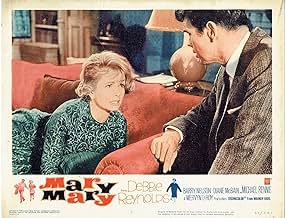
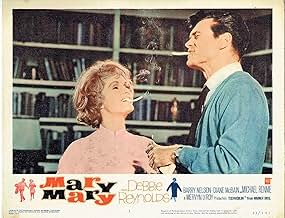
Bob and Mary, recently divorced, reunite to settle tax issues. Bob plans to marry Tiffany, while Mary is drawn to Dirk, a Hollywood star. Tensions arise as Bob fears being alone with Mary, r... Read allBob and Mary, recently divorced, reunite to settle tax issues. Bob plans to marry Tiffany, while Mary is drawn to Dirk, a Hollywood star. Tensions arise as Bob fears being alone with Mary, reflecting their complicated dynamic after split.Bob and Mary, recently divorced, reunite to settle tax issues. Bob plans to marry Tiffany, while Mary is drawn to Dirk, a Hollywood star. Tensions arise as Bob fears being alone with Mary, reflecting their complicated dynamic after split.


- Cleaning Woman
- (uncredited)
- Woman at Restaurant
- (uncredited)

- Husband in Elevator
- (uncredited)
- Secretary
- (uncredited)

- Old Timer
- (uncredited)

- Wife in Elevator
- (uncredited)
- Doorman
- (uncredited)

- Newscaster
- (voice)
- (uncredited)

- Waiter
- (uncredited)
- Director
- Writers
- All cast & crew
- Production, box office & more at IMDbPro
Featured reviews
Debbie, Debbie...
It would have been a much better film if Debbie Reynolds been given better (or any) direction.
Debbie was sometimes not adept at playing it real, there was sometimes a sense that she was making an effort. But at her best, she was spontaneous and delightful - especially in her earlier efforts like Singin' In The Rain, Athena, Give A Girl A Break, I Love Melvin, etc.
Take a look at Debbie in Susan Slept Here (written and directed by Frank Tashlin) if you don't think she could be real, believable, touching, funny, and everything else she is supposed to be here, and isn't. There's a reason she became a bigger star than many of the MGM girls she originally appeared in support of - and guys, for that matter. Even when she isn't too good (as in this film) it's obvious that she has star power. Imagine a film starring the other four leads and no Debbie.
The trouble here is that, rather than relying on her own vocal inflections, and her proved ability to deliver comic dialogue, she gives an imitation of Barbara Bel Geddes (the original star of the Broadway show)! I don't know whose idea this was, but it wasn't a good one.
It's a decent romantic comedy that has a lot of pretty good jokes about the contemporary fads and foibles of the day. The action really doesn't leave the apartment set. The set and costumes are in deliberately neutral tones, like they were designed to be shot in black and white. (The brightest colors are in the title sequence.) Like Debbie's performance, the stylized color scheme serves to distance us from the story, since it encourages us not to forget we're watching something unreal. The whole thing is shot at some distance from the actors - though this seems to have been Mervyn LeRoy's later style, in general. This also hampers involvement.
The performances of Barry Nelson and Michael Rennie - the original Broadway stars - as well as Hiram Sherman, who took over on Broadway from John Cromwell, the actor and director ("Since You Went Away"), are quite good, and Diane MacBain is charming.
A nearly perfect Broadway transfer
Of course, we know that charming Barry Nelson and suave Michael Rennie repeated their stage roles. Given his long list of screen roles as the perfect British detective, it's amazing John Cromwell didn't repeat his stage role as Oscar Nelson, the accountant who brings the formerly married but still fond Bob and Mary (Nelson and...we'll get to that) together to go over tax matters. Presumably Cromwell was busy, because the film makers went with his first stage replacement, Hiram Sherman (who did the role on Broadway from May 13 to September 1, 1963).
Diane McBain didn't do her role on Broadway, but was excellent as the deceptively pretty but self aware young thing Bob is currently dating.
The film's unappreciated coup sprang from the Hollywood gimmick of insisting on a MOVIE name to help with the box office. In this case it was the oft' over praised Debbie Reynolds, and she was just fine as the brittle but brilliant Mary.
What made it a "coup" was that Reynolds was a far better mimic than she was (based on Hollywood outings in things like THE UNSINKABLE MOLLY BROWN or BUNDLE OF JOY or her Broadway fumble in IRENE) actress. It wasn't until I saw Barbara Bel Geddes, the original Broadway Mary, years later in another Jean Kerr play on stage that I realized that what Reynolds had given us in this delightful film was Bel Geddes' original Broadway performance - very movement, gesture and vocal inflection - letter perfect!
An intimate, five character, wonderfully written comedy, and with "three and a half" of the Broadway cast. One might say "no wonder it worked so well," but also credit film producer/director Mervyn Leroy who got the appropriate screen performances (performances don't always transfer intact - stage star Stockard Channing, while fine in SIX DEGREES OF SEPARATION, isn't nearly as effective on screen as she had been on stage with better direction) and Harry Stradling's perfect cinematography for never allowing the piece to seen static, confined or "stagey."
Thank heavens for films like this that once kept mature, literate audiences both young and old coming back to the movies all the time.Modern movie fans accustomed to expect nothing but action, titillation and pratt falls in a "comedy" may be amazed how good a film can be when dialogue matters - whether in a little gem like this or in lavish, big films like MOONSTRUCK or Shakespeare IN LOVE!
To quote Bob and Mary: "Mmmm. That's good coffee!"
Debbie? Plain?
That said, there is something impenetrable about watching Debbie Reynolds looking positively gorgeous as she tells Michael Rennie of the trials and tribulations of being a "plain" girl and woman. The part of Mary was written for Barbara Bel Geddes, who fit that dialogue perfectly (see her Midge in "Vertigo"). Debbie, on the other hand, was simply too radiant to give credibility to a character who supposedly compensated for insecurity about her looks with unceasing wit.
Hit Broadway show falls flat on the big screen...
Debbie does Warner Brothers!
When Warner Brothers gave Mervyn LeRoy the directorial reigns on their Burbank soundstages, Debbie Reynolds was awarded the title role, co-starring with Barry Nelson who had appeared in the stage version. It was always the way, when the studio system still held sway, that the obvious and only choice was a bonafide Hollywood movie star to headline a project such as this, and so the very appealing Barbara Bel Geddes, who had played Mary McKellaway on the stage to excellent notices, was not to repeat her role before the Technicolor cameras. Debbie, as she had in her previous M-G-M starring roles, didn't disappoint, however, and she was ably supported by Mr. Nelson, the gorgeous Diane McBain, and, in a witty turn (and a departure from the usually more serious roles assigned to him), Michael Rennie.
An acquaintance of mine worked in the sound editing department at Warner Brothers when this was being filmed and he confided to me that Ms. Reynolds played an anxious visit to a screening/editing room during filming, somewhat concerned that her performance wouldn't strike just the right comical note. I seem to recall that she was reassured by that technician and his coworkers and the reviewers and the film's audiences were eventually in agreement.


Did you know
- TriviaThis is one of the few instances when a movie was released while the Broadway play was still running.
- GoofsWoken by a ringing bell Mary opens the door and lets Tiffany in who crosses the room and opens the curtains revealing that it's daylight . Strong shadows point in all directions as being from studio lights.
- Quotes
Bob McKellaway: [lovingly] I married Mary because she was so direct, and straightforward, and said exactly what she meant.
Oscar Nelson: Why did you divorce her?
Bob McKellaway: [sternly] Because she was so direct, and straightforward, and said exactly what she meant.
- ConnectionsReferenced in To Tell the Truth: Tom Poston, Betty White, Barry Nelson, Kitty Carlisle (1962)
- How long is Mary, Mary?Powered by Alexa
Details
- Release date
- Country of origin
- Language
- Also known as
- Meine geschiedene Frau
- Filming locations
- Production companies
- See more company credits at IMDbPro
- Runtime
- 2h 6m(126 min)
- Aspect ratio
- 1.66 : 1