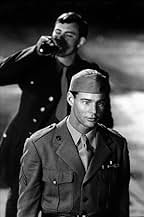
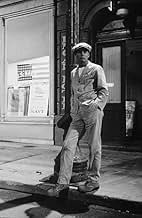
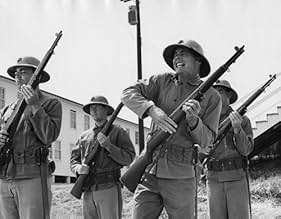
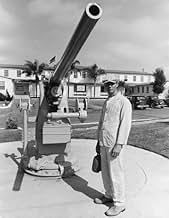
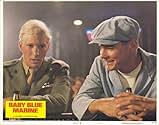
A Marine recruit fails basic training and is sent home wearing the "baby blue" fatigues of a washout. En route, he's mugged by a battle-fatigued Marine Raider who leaves him to hitch-hike ho... Read allA Marine recruit fails basic training and is sent home wearing the "baby blue" fatigues of a washout. En route, he's mugged by a battle-fatigued Marine Raider who leaves him to hitch-hike home wearing the hero's uniform left by the Raider.A Marine recruit fails basic training and is sent home wearing the "baby blue" fatigues of a washout. En route, he's mugged by a battle-fatigued Marine Raider who leaves him to hitch-hike home wearing the hero's uniform left by the Raider.
- Director
- Writer
- Stars
Bruno Kirby
- Pop Mosley
- (as B. Kirby Jr.)
Kenneth Tobey
- Buick Driver
- (as Ken Tobey)
- Director
- Writer
- All cast & crew
- Production, box office & more at IMDbPro
6.1741
1
2
3
4
5
6
7
8
9
10
Featured reviews
Courage was something you found. Love was something you won.
Very appealing stateside WWII drama stars then-hot Jan-Michael Vincent as Marion "Hedge" Hedgepeth, who, before long, flunks out of his basic training as a Marine, and is sent home in a baby blue uniform in disgrace. During the journey, he encounters an actual young veteran (Richard Gere, in a memorable bit) who's desperate to avoid being sent back into battle. So the vet mugs Hedge (well, so to speak...he actually LEAVES him a few dollars), and all Hedge has to wear is the vets' uniform. On his way back home, he stops in a small Colorado town, and is naturally thought to be a war hero by the locals. He's so endearing to them, and they to him, that he can't bring himself to tell them the truth.
Written by Stanford Whitmore ("Hammersmith Is Out", "The Dark"), and directed by John D. Hancock ("Let's Scare Jessica to Death", "Bang the Drum Slowly"), this is an enjoyable little film worth rediscovering. While not altogether believable (for some reason, there's a Japanese internment camp right in the woods near this town), it gets by on a certain amount of charm, just like its lead character. In fact, a citizen named Hudkins (Bert Remsen), with whose daughter Rose (Glynnis O'Connor) Hedge falls in love, surmises that he's too *nice* and *innocent* to seem like a hardened killer.
Overall, the film does get pretty dramatic, and takes on the tone of a fable, but it never veers too far into unpleasantness. Excellent location shooting in & near the California towns of Weed and McCloud gives it atmosphere and a fine feeling of Americana, and the score by Fred Karlin is excellent.
Vincent was then at the peak of his career as a leading man in film, and he couldn't be more likable. O'Connor is adorable as the romantic interest, and Katherine Helmond, Dana Elcar, Bert Remsen, Bruno Kirby, Gere (sporting shocking bleach blonde hair), Art Lund, Michael Conrad, Allan Miller, Kenneth Tobey, Lelia Goldoni, Marshall Efron, and Barton Heyman comprise a rock solid supporting cast. Adam Arkin has one of his earliest big screen roles as a boy named "Rupe".
Well worth a look, especially if you like cinema set during this period, or are a fan of Vincent.
Seven out of 10.
Written by Stanford Whitmore ("Hammersmith Is Out", "The Dark"), and directed by John D. Hancock ("Let's Scare Jessica to Death", "Bang the Drum Slowly"), this is an enjoyable little film worth rediscovering. While not altogether believable (for some reason, there's a Japanese internment camp right in the woods near this town), it gets by on a certain amount of charm, just like its lead character. In fact, a citizen named Hudkins (Bert Remsen), with whose daughter Rose (Glynnis O'Connor) Hedge falls in love, surmises that he's too *nice* and *innocent* to seem like a hardened killer.
Overall, the film does get pretty dramatic, and takes on the tone of a fable, but it never veers too far into unpleasantness. Excellent location shooting in & near the California towns of Weed and McCloud gives it atmosphere and a fine feeling of Americana, and the score by Fred Karlin is excellent.
Vincent was then at the peak of his career as a leading man in film, and he couldn't be more likable. O'Connor is adorable as the romantic interest, and Katherine Helmond, Dana Elcar, Bert Remsen, Bruno Kirby, Gere (sporting shocking bleach blonde hair), Art Lund, Michael Conrad, Allan Miller, Kenneth Tobey, Lelia Goldoni, Marshall Efron, and Barton Heyman comprise a rock solid supporting cast. Adam Arkin has one of his earliest big screen roles as a boy named "Rupe".
Well worth a look, especially if you like cinema set during this period, or are a fan of Vincent.
Seven out of 10.
I feel it's a movie that should be seen.
This film was seen by me in a movie theater when it came out in 1976. (I haven't seen it since.) The recent passing of Jan Michael Vincent brought the memory of it back to me. I have no allegiance to Mr. Vincent, but considering his reportedly troubled life, I wanted to note that his performance in this film was truly empathetic and moving. Thus, he could certainly handle himself on screen. The film was sort of a surprise, with an excellent cast of familiar actors of that era. I particularly also recall the performance of John Lund in a very pivotal role. This picture was extremely well done, and, obviously, for me, especially memorable.
Gere gets the goods though.
Made in the mid 70s when it looked like Jan Michael Vincent might translate into a romantic male lead, this thoughtful and sensitive film just slipped into nowhere instead, along with his prospects. Richard Gere seen in a minor role as a marine in a lounge somewhere, seemed to overtake JMV from this film and go into Mr Goodbar, Gigolo and Sexy leading man stardom. Like BUSTER AND BILLIE also marred by the VIGILANTE FORCE and WHITE LINE FEVER type violence, BABY BLUE MARINE is actually a charming romantic drama and quite an acting suprise for any viewer who believes JMV is an action star of the time.
A Time Lost Forever
Just saw Baby Blue Marine again after 30 years. I still find it a pleasant and romantic film which catches a time which has been lost forever. The innocence and purity of a time now long gone, is truthfully captured in this small film. The acting is above average and Richard Gere's brief appearance as a shell-shocked Raider Marine war hero, holds a keen interest for any film buff or Gere fan. Jan-Micheal Vincent is in his prime and looks and acts like the "All-American" boy. The late Bruno Kirby (who was billed as B.Kirby, Jr.) has a meaty role as "Pop", a peace-loving, Marine Corp reject, dreaming of getting back home to his wife. If you're looking for sex, drugs, or rock and roll, this movie is not for you. If you're looking for action and adventure, the same applies. However, if you want to recapture a time in America of innocence, honor, romance, and love, then Baby Blue Marine is a movie for you.
The supporting players make it worthwhile
Jan-Michael Vincent plays a "Baby Blue Marine" (i.e., a Marine boot camp failure) during World War II. He's initially sent home in disgrace after just five weeks--wearing baby blue fatigues--until he's knocked unconscious (by a white-haired Richard Gere), forcing him into a different uniform: that of a Raider Marine. Original screenplay by Stanford Whitmore opens with a hilarious loser's outfit overseen by an incredulous drill instructor (Michael Conrad, who's terrific). The rest of the film isn't quite so good, especially with Whitmore's overripe narrative playing out like a Preston Sturges wannabe accented with barracks talk, introspective drama, and curlicues of wobbly comedy. Vincent (laying on the sensitive soul routine) isn't the recruit I wanted to follow, anyway; that honor would go to Bruno Kirby (B. Kirby Jr.) as a fake bed-wetter who just wants to get home to his lonely wife. **1/2 from ****
Did you know
- TriviaUncredited final theatrical feature film of John Drew Barrymore. After finishing this film he left the industry and became a recluse for the next 25 years.
- GoofsDuring the flag ceremony at the Japaneses Internment Camp, the wrong bugle call is sounded. Lowering the flag at the end of the day is called a "Retreat" ceremony. The bugle call played is, "Retreat", which is the first of two bugle calls that are sounded. When "Retreat" is sounded, it lets everyone know to stop what they're doing and face the flag. The salute isn't presented until the second bugle call, "To The Colors" begins as the flag is being lowered. In this movie, the bugle call, "To The Colors" is not played.
- ConnectionsFeatures Dark Victory (1939)
- How long is Baby Blue Marine?Powered by Alexa
Details
- Release date
- Country of origin
- Language
- Also known as
- Парень из морской пехоты
- Filming locations
- Production companies
- See more company credits at IMDbPro
Contribute to this page
Suggest an edit or add missing content