

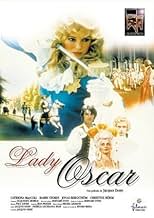
The story of Lady Oscar, a female military commander who served during the time of the French Revolution.The story of Lady Oscar, a female military commander who served during the time of the French Revolution.The story of Lady Oscar, a female military commander who served during the time of the French Revolution.
- Director
- Writers
- Stars


- Director
- Writers
- All cast & crew
- Production, box office & more at IMDbPro
5.8741
1
2
3
4
5
6
7
8
9
10
Featured reviews
Barry Lyndon's Callgirl
The sad truth is that Jaques Demy is a horrible filmmaker. The much celebrated "Umbrella's of Cherbourg" was dreadful. Absolutely dreadful, but pretty in a stagy way. There isn't much you can say when you encounter something pretty but hollow. Of course it happens all the time to me, that I find movies with no soul. like girls trained to be empty.
But there is something notable when something is so very pretty as this is, and so very empty at the same time.
The provenance of this is at least interesting: a Japanese comic book. And if you wish to sit through it, you'll see copious references to "Barry Lyndon," on which this is clearly modeled. Now the magic of that was its carefully spaced vacuums. It had engineered emptiness, something that only a master could do.
This. This is just empty.
Ted's Evaluation -- 1 of 3: You can find something better to do with this part of your life.
But there is something notable when something is so very pretty as this is, and so very empty at the same time.
The provenance of this is at least interesting: a Japanese comic book. And if you wish to sit through it, you'll see copious references to "Barry Lyndon," on which this is clearly modeled. Now the magic of that was its carefully spaced vacuums. It had engineered emptiness, something that only a master could do.
This. This is just empty.
Ted's Evaluation -- 1 of 3: You can find something better to do with this part of your life.
It's an average movie
Actually,to correct what another reviewer said(wanting also to correct a supposed error,but making a mistake),the anime "Lady Oscar(Rose of Versailles)" came AFTER the movie(that means almost an year after the movie was made) and WAS ALSO TARGETED TOWARDS THE CHILDREN.So,the movie is based ONLY upon the manga and NOT AT ALL upon the anime.Also,the "historical clichés" aren't "cliches",but REAL HISTORICAL FACTS and I really don't see why the movie shouldn't present them,like the manga did,too. To talk about the movie,as a Lady Oscar's fan,I would consider it somehow average.It has some good-or even very good-parts(the costumes,the sets,the music,some aspects of the play of some characters-I disagree with someone who said that the acting is "incredibly weak all around",because it's clearly not like that!) and some more bad parts(the way in which most of the characters were presented,different from the ones in the original story,the fact that some important events in the story aren't showed at all,the play of some actors,the ending which is an almost complete nonsense).But,in the end,it's,like I said,it's an average movie,though enough fans are,quite rightfully,disappointed of it.
Just for fans
I love the Rose of Versailles (Lady Oscar in West) original comics and was a pleasure to watch this movie. However it's necessary to say it's just for fans. When you previously know the characters and want to get in touch with an alternative point of view, it's OK, but if you take Lady Oscar as a movie about the French Revolution's or a cross dresser heroine, you probably would feel disappointed.
The work was not as good as it would be; some actors and actresses were not well chosen; main events were forgotten; and Oscar's personal drama lost force. But as I said, I liked it a little, because any Lady Oscar's product would attract me.
The work was not as good as it would be; some actors and actresses were not well chosen; main events were forgotten; and Oscar's personal drama lost force. But as I said, I liked it a little, because any Lady Oscar's product would attract me.
Anti-adventure
Jacques Demy's movie of Lady Oscar frequently moved me. It is not a "swashbuckler" in spirit, it does not glamourise violence; it is not a movie about "girl power". It is a tragedy that raises important questions about freedom and gender. After becoming father to a series of daughters whose mother dies in childbirth, Général de Jarjayes decides that his latest daughter will in fact be a son, Oscar, and brings her up to be an heir and defender of the de Jarjayes name. He is delighted to find her a position as bodyguard to Marie Antoinette. Oscar is unquestioning of the system into which she is inducted, a bubble of privilege, acid wit, and decadence. She is dutiful and she "knows her place". At the same time the young boy and later groom who was her companion when Oscar grew up seems to have much more class consciousness.
What her gender transformation helps to do is to de-romanticise the material, when Oscar accepts a duel, the result, devoid of machismo, comes off as a banal murder, which is precisely what it is. It is difficult to wholeheartedly see Oscar as an éoniste or transgender hero as her identity as Oscar is created for her by her father. Indeed her self-actualisation is intertwined with her accepting a more female identity. On the other hand she does use her identity as Oscar to react against male society, and becomes a role model for some of the Versailles women.
Oscar, despite adopting a male role, is not free. This is potentially quite an important point of the movie, equality and freedom are not the same thing. Her role is to hang around the wilful and indolent Antoinette, and she develops a strong sense that her life has become meaningless. To become a man is not to have meaning, it's an escape from a trap within a trap, the outer trap being the Ancien Régime in the case of this movie. When Oscar attempts to enter a regiment, her male soldiers refuse to obey her, and her superior officer gives her no support whatever. In any case the regiment only exists to suppress the people.
At a very late stage Oscar finds freedom in an act of defiance. You can feel the weight lift off her shoulders as she spends her first day as a truly free adult, despite residing in a prison cell. This feels very contemporary, freedom is something very few of us are born with, it's something we have to seize, it's profoundly personal and cathartic.
Another reviewer on this site refers to Barry Lyndon as inspiration, "Now the magic of that was its carefully spaced vacuums. It had engineered emptiness, something that only a master could do." That is definitely something Lady Oscar is attempting, in my belief it worked better than my fellow reviewer felt.
A note on historical accuracy. Thomas Jefferson described Marie Antoinette as, "...proud, disdainful of restraint, indignant at all obstacles to her will, eager in the pursuit of pleasure, and firm enough to hold to her desires, or perish in their wreck." That is exactly how she is portrayed in Lady Oscar by Christine Böhm. Jefferson also describes the relationship between the King and the Queen thus, "he had a Queen of absolute sway over his weak mind and timid virtue..." Again this seems to have been very well captured in the movie.
Lady Oscar is a politically complex movie which seems often to have been misjudged by relying on a fruitless comparative analysis with the animé and manga sources of the story. Whilst actually quite serious it does however have its gorgeous moments.
What her gender transformation helps to do is to de-romanticise the material, when Oscar accepts a duel, the result, devoid of machismo, comes off as a banal murder, which is precisely what it is. It is difficult to wholeheartedly see Oscar as an éoniste or transgender hero as her identity as Oscar is created for her by her father. Indeed her self-actualisation is intertwined with her accepting a more female identity. On the other hand she does use her identity as Oscar to react against male society, and becomes a role model for some of the Versailles women.
Oscar, despite adopting a male role, is not free. This is potentially quite an important point of the movie, equality and freedom are not the same thing. Her role is to hang around the wilful and indolent Antoinette, and she develops a strong sense that her life has become meaningless. To become a man is not to have meaning, it's an escape from a trap within a trap, the outer trap being the Ancien Régime in the case of this movie. When Oscar attempts to enter a regiment, her male soldiers refuse to obey her, and her superior officer gives her no support whatever. In any case the regiment only exists to suppress the people.
At a very late stage Oscar finds freedom in an act of defiance. You can feel the weight lift off her shoulders as she spends her first day as a truly free adult, despite residing in a prison cell. This feels very contemporary, freedom is something very few of us are born with, it's something we have to seize, it's profoundly personal and cathartic.
Another reviewer on this site refers to Barry Lyndon as inspiration, "Now the magic of that was its carefully spaced vacuums. It had engineered emptiness, something that only a master could do." That is definitely something Lady Oscar is attempting, in my belief it worked better than my fellow reviewer felt.
A note on historical accuracy. Thomas Jefferson described Marie Antoinette as, "...proud, disdainful of restraint, indignant at all obstacles to her will, eager in the pursuit of pleasure, and firm enough to hold to her desires, or perish in their wreck." That is exactly how she is portrayed in Lady Oscar by Christine Böhm. Jefferson also describes the relationship between the King and the Queen thus, "he had a Queen of absolute sway over his weak mind and timid virtue..." Again this seems to have been very well captured in the movie.
Lady Oscar is a politically complex movie which seems often to have been misjudged by relying on a fruitless comparative analysis with the animé and manga sources of the story. Whilst actually quite serious it does however have its gorgeous moments.
Inaccurate to the manga or not, this is a poor film
I only read the first few chapters of the Rose of Versailles manga years and years ago, so this review is not coming from the point of view of someone biased against this film on the grounds of inaccuracy to the source material. Because even when measured on its own merits, Lady Oscar (1979)is a weak movie.
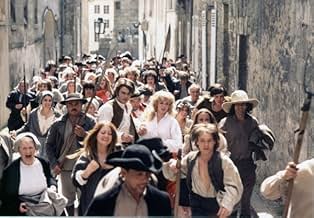
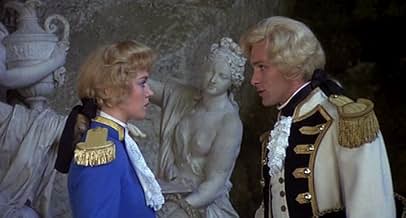
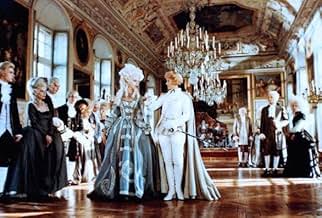
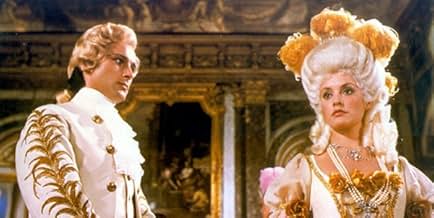
It's a shame, because this is a pretty production. The 18th century costumes and lavish sets are wonderfully realized, pastel-colored and almost fairy tale-like. They contrast well with the squalor of the lower classes. Michel Legrand's score is lovely and emotional.
Too bad everything else is borderline terrible. The dialogue ranges between passable and cringe-worthy. Exposition is delivered via clumsy lines and voice-over. The story is epic in scope, yet it rushes through events and years, leaving us little time to get to know the characters since the script is more obsessed with racing to the next plot point.
The acting is not wooden or too over-the-top, but it is incredibly weak all around. No one seems to contain much passion or enthusiasm for the material. The leading lady in particular possesses too little inner strength or charisma to hold our admiration. Heck, she's supposed to be a military officer and yet she cannot mount a horse without aid!
I was disappointed with Jacques Demy's direction, which had little verve or flow to it. It was as distant and disinterested in the action as the performers seemed to be. The editing was especially clumsy and confusing at moments.
The worst aspect of this movie may be the characters and the way they were written. Marie Antoinette is made into an idiot. Louis XVI is antagonistic. Andre is a creepy jerk. And Oscar is unbelievably wimpy for someone so respected by the other characters. Her appearance and manner are also not as androgynous as they should be.
I think this story could have made for a solid swashbuckling melodrama, but as it is, this feels like a lifeless TV movie. While I feel there is a good movie lurking within this mess, the few good things there are cannot save it from mediocrity.
It's a shame, because this is a pretty production. The 18th century costumes and lavish sets are wonderfully realized, pastel-colored and almost fairy tale-like. They contrast well with the squalor of the lower classes. Michel Legrand's score is lovely and emotional.
Too bad everything else is borderline terrible. The dialogue ranges between passable and cringe-worthy. Exposition is delivered via clumsy lines and voice-over. The story is epic in scope, yet it rushes through events and years, leaving us little time to get to know the characters since the script is more obsessed with racing to the next plot point.
The acting is not wooden or too over-the-top, but it is incredibly weak all around. No one seems to contain much passion or enthusiasm for the material. The leading lady in particular possesses too little inner strength or charisma to hold our admiration. Heck, she's supposed to be a military officer and yet she cannot mount a horse without aid!
I was disappointed with Jacques Demy's direction, which had little verve or flow to it. It was as distant and disinterested in the action as the performers seemed to be. The editing was especially clumsy and confusing at moments.
The worst aspect of this movie may be the characters and the way they were written. Marie Antoinette is made into an idiot. Louis XVI is antagonistic. Andre is a creepy jerk. And Oscar is unbelievably wimpy for someone so respected by the other characters. Her appearance and manner are also not as androgynous as they should be.
I think this story could have made for a solid swashbuckling melodrama, but as it is, this feels like a lifeless TV movie. While I feel there is a good movie lurking within this mess, the few good things there are cannot save it from mediocrity.


Did you know
- TriviaThe major sponsor of the film was the Japanese cosmetics company Shiseido. Catriona MacColl (Oscar) promoted a red lipstick for the spring cosmetic line that year.
- GoofsIn the ballroom scene we see a string quartet and a harpsichordist. However, we hear the soundtrack of a string orchestra.
- ConnectionsFeatured in The World of Jacques Demy (1995)
- How long is Lady Oscar?Powered by Alexa
Details
- Runtime
- 2h 4m(124 min)
- Sound mix
- Aspect ratio
- 2.35 : 1
Contribute to this page
Suggest an edit or add missing content