
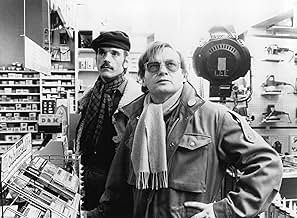
Nowak (Irons), a Polish contractor, leads a group of workmen to London so they can provide cheap labor for a government official based there. Nowak must manage the project and the men as the... Read allNowak (Irons), a Polish contractor, leads a group of workmen to London so they can provide cheap labor for a government official based there. Nowak must manage the project and the men as they encounter the temptations of the West and loneliness and separation from their families.... Read allNowak (Irons), a Polish contractor, leads a group of workmen to London so they can provide cheap labor for a government official based there. Nowak must manage the project and the men as they encounter the temptations of the West and loneliness and separation from their families. Nowak is the only one of the group who speaks English, and he uses this as a tool over hi... Read all
- Awards
- 3 wins & 3 nominations total


- Wolski
- (as Jirí Stanislav)


- Builders' Merchant
- (as Mike Sarne)


- Director
- Writer
- All cast & crew
- Production, box office & more at IMDbPro
Featured reviews
Loneliness and unrest
Can see whole-heartedly why 'Moonlighting' was so highly recommended, and would do the very same with fellow Jeremy Irons fans who haven't yet seen the film or with anybody looking for a non-UK/US film to watch. It really is deserving of all the praise it gets and is actually deserving of more in my view, actually know a lot of people who haven't even heard of it let alone not seen it and that really should not be the case. Always try to be subjective and hate it when so many people try to force their opinions onto others, but it does irk me sometimes when you have so many heavily marketed films that are sometimes mediocre at best or ones that are good but not that much. And then you have a film as great as 'Moonlighting', one of the best films of its year and of its subject, that despite critical acclaim is not marketed enough. In favour of films that audiences are more likely to see and have concepts and stories that they may be more likely to warm to perhaps. That should not have been, or be, the case, it deserved much better than that.
Yes the deliberate pace may test the patience for some, it is wholly dependent on the viewer, but to me that was not in any way a fault. Do think that the very end could have been rounded off a little more, though the climactic moments are powerful and the final shot is unforgettable.
Visually, 'Moonlighting' looks good. The setting has a lot of atmosphere that fits the tone of the film ideally and it's filmed with grit and style while bringing a claustrophobic edge that helped make things more powerful. Jerzy Skolimowski, exiled at the time, directs assuredly and never loses the vigour. Furthermore the script is an intelligently written one with some humorously satirical moments in deadpan fashion, and while more familiarity with the subject may help the story enthralled, entertained and moved, with a few disturbing twists in the mix like the identity of the only one who knows what's really happening in Poland. The shoplighting sequence is a major highlight, and there is a fair share of tension and poignancy.
Absolutely agree with anybody who says Irons' performance here is one of his finest, both pre-'Lolita' (and then his career became hit and miss when it became increasingly difficult to tell what to do with him or find enough roles that played to his strengths, that's my take though) and ever. It is graceful and understated but also full of authority and not many people are as good as Irons too when it comes to narration. The other performances are all great, but Irons is the one that the viewer remembers.
In conclusion, really great. 9/10
Moonlighting (1982), a great Polish film directed by Jerzy Skolimowski.
The Peanut Gallery
Trying to figure out HOW he will get the job done and WHY he is going to such great lengths and pains becomes all consuming mental and emotional puzzles as you become sucked into this well written story and tour de force performance by Jeremy Irons. By the second half of the film, you can't bare to watch but can't stand to look away. (It's as if you meant to eat only a few peanuts to suddenly discover you've consumed the entire amount and didn't even notice) I think this film is best described as "Escapism" rather than "Enjoyment" but either way you won't be focused on anything else while you're watching it. In fact the "taste" of it lingered with me for days after I saw it. It's full of a quiet yet constantly building tension, with a capital 'T'. No car chases, big explosions, explicit sex, swearing or violence. Just a well constructed screen gem that seemed to have fallen through the cracks when it was released in the early 1980's.
Small Overlooked Film from Early 1980's
Written and directed by Polish playwright Jerzy Skolimowski, "Moonlighting" is a low key film that focuses on the interaction among the four isolated men, who live, work, and sleep in the flat. Nowak, Jeremy Irons in a quiet understated performance, is the only one to regularly venture outside to find food and building materials. Faced with dwindling funds, Nowak devises various methods to shoplift goods or outwit store managers and cleverly double his grocery purchases. While sheer luck often aids Nowak with his dodgy schemes, the English shopkeepers seem remarkably dim, and the immigration officer on arrival at Heathrow was unbelievably gullible.
The story takes place in 1981, the year the film was shot, and, while Nowak struggles with finances and an approaching deadline, Poland stumbles into a military coup, and martial law is imposed. With phone lines cut between London and Warsaw and all flights to Poland canceled, Nowak must conceal the events unfolding at home from his compatriots to keep them focused on finishing the flat. Because three of the four principal actors have few lines and those only in Polish, the film concentrates on Irons, who ably carries the film. Although much of the action takes place inside the flat, Skolimowski's direction manages to avoid a claustrophobic feel. However, "Moonlighting's" leisurely pace does require patience. But Nowak's sharp wits and audacity, fueled by his determination to complete the assigned task despite the mounting odds, make for engrossing viewing. Skolimowski's "Moonlighting" is a small, overlooked film with many rewards for discerning viewers to discover.
Powerfully acted and thoughtfully told
On the surface, the story is rather simple: sometime in the early 80's, during the political turmoil that was occurring in Poland, a group of Polish workers emigrate to London to renovate an apartment for their boss. They have no working permits, so they have to do their job with as much secrecy as possible. When Novak (Jeremy Irons), their English-speaking foreman, discovers that military law has been declared in their homeland, he tries to keep it a secret until they are allowed back into the country.
This may not seem like much of a story compared to most modern thrillers. There are no police out to get Novak and his men, nor are there any political opponents out to assassinate them. They are simply there to do their job, and Novak has to make sure they do it effectively and on time. Small but crucial subplots develop out of this: in order to feed himself and his men, Novak has to fake receipts for food (due to the limited amount of money they brought with them), and there are several scenes where he tries to get past the clerks at a grocery store with a Christmas turkey. He also has to buy them clothes and fulfill some of their material demands. On top of that, he also begins to develop fears and worries about his wife back home, including the suspicion that his boss may be having an affair with her. As the story progresses, Novak's money runs lower and his fear and paranoia grows stronger.
Because he is the only one of them who can speak English, Novak is the only one who can communicate with the outside world. But he is also very manipulative, and serves as a symbol of a government that misled their people and kept them ignorant of many of their own problems. It is interesting to see how Skolimowski develops sympathy for poor Novak; for all his intelligence, he is still nothing more than a pawn in the hands of a corrupt government. He is a stranger in a strange land, lost and faking his knowledge of his whereabouts. It would have been difficult to make this film convincing had the lead role not been played to perfection, but Jeremy Irons does it with more grace and skill than any other actor possibly could. Much of his performance is spent in narration, subtly explaining his growing confusion and terror. There are several moments where he keeps a perfectly straight face while rambling on in his head about the grave situation he is in. His performance here holds its own in a year that also included Dustin Hoffman in "Tootsie," Ben Kingsly in "Gandhi," Gerard Depardieu in "Danton," Paul Newman in "The Verdict," Jurgen Prochnow in "Das Boot," and Jack Lemmon in "Missing."
Like Andrej Wajda (who made "Man of Marble" and "Danton"), Jerzy Skolimowski was an outspoken critic of Poland's communist regime. Curiously, he wrote the script in only a little over a day, and the whole production of the film took only a matter of months. Furthermore, the three Polish workers accompanying Novak in the story were actual Polish emigrants living (legally) in Skolimowski's home at the time military law was declared. "Moonlighting" won a well deserved screenplay award at Cannes and was nominated for the Palme d'Or.
This film is on video, but I do not think it is still being circulated. I hope they re-release it on video or DVD someday.


Did you know
- TriviaSkolimowski's Kensington house in West London was in real life undergoing renovation at the time the film was made. (Moonligthing, 1982)
- GoofsWhen one of the workers paints the door frame on the outside of the building and clears away the electrical wire, part of the lintel is already painted white. Later, when Banaszak climbs up the ladder, the lintel has not yet been painted. Then, in the close-up in which he gets the electric shock, a good part of the lintel is painted white again, and in the next shot, when he falls off the ladder, only a tiny part is painted white again.
- ConnectionsFeatured in At the Movies: The Best Films of 1982 (1983)
- How long is Moonlighting?Powered by Alexa