IMDb RATING
6.3/10
3.6K
YOUR RATING

The amusing and entertaining adventures of a recently released mental patient and his band of misfits, who discover conspiracies to participate in while looking for love.The amusing and entertaining adventures of a recently released mental patient and his band of misfits, who discover conspiracies to participate in while looking for love.The amusing and entertaining adventures of a recently released mental patient and his band of misfits, who discover conspiracies to participate in while looking for love.
- Director
- Writers
- Stars
- Awards
- 5 wins & 9 nominations total


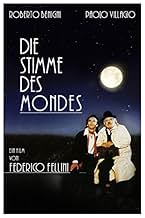




- Director
- Writers
- All cast & crew
- Production, box office & more at IMDbPro
6.33.5K
1
2
3
4
5
6
7
8
9
10
Featured reviews
Madness and Fellini
The amusing and entertaining adventures of a recently released mental patient (Roberto Benigni) and his band of misfits, discover conspiracies to concur while looking for love.
Acclaimed director Federico Fellini wrote a short treatment for this film in two weeks with his long-time scribe Tullio Pinelli as early as summer 1988. Returning to themes they first explored in "La strada" (1954), the duo crafted a parable on the whisperings of the soul that only madmen and vagabonds are capable of hearing.
The film screened out of competition at the 1990 Cannes Film Festival, where it was panned, misunderstood and/or ignored by the majority of North American critics. One critic boasted, "Absolutely ravishing. I've never been so bored in my life". Ultimately, Fellini's last film became his first never to find a North American distributor. At least until 2017 (more on that shortly).
One might think this is the sort of film that would grow in reputation over time. Those who saw it in 1990 likely did not know this was the final Fellini, and that alone should give it a special place in our hearts. Yet, critic Michael Scott pulls no punches when he calls the film "an unwanted, undercooked, post-meal main course, just as you are ready to slip into your pyjamas." He also says it is "the best example yet of the train wreck that can occur when you give a visionary unquestioned creative control but take away his glasses; it looks stunning but is nigh on incomprehensible."
He does concede however that the "visuals ... rank up there with the most impressive of Fellini's entire body of work." Herein lies what, I think, makes the film worth a second (or third) look. The color scheme is striking, especially on the new (2017) Arrow Films Blu-ray with a new scan. The blend of fantasy, madness and reality is cleverly blended, with one scene of lovemaking while a rumbling train passes quite memorable indeed.
The Arrow Blu-ray looks great, and does bring this Fellini to America for the first time ever. The special features are slim, but it does include an hour-long documentary on the film, which is really indispensable and perhaps would help change Mr. Scott's opinion? Certainly it puts the film in its proper place in the world of Fellini.
Acclaimed director Federico Fellini wrote a short treatment for this film in two weeks with his long-time scribe Tullio Pinelli as early as summer 1988. Returning to themes they first explored in "La strada" (1954), the duo crafted a parable on the whisperings of the soul that only madmen and vagabonds are capable of hearing.
The film screened out of competition at the 1990 Cannes Film Festival, where it was panned, misunderstood and/or ignored by the majority of North American critics. One critic boasted, "Absolutely ravishing. I've never been so bored in my life". Ultimately, Fellini's last film became his first never to find a North American distributor. At least until 2017 (more on that shortly).
One might think this is the sort of film that would grow in reputation over time. Those who saw it in 1990 likely did not know this was the final Fellini, and that alone should give it a special place in our hearts. Yet, critic Michael Scott pulls no punches when he calls the film "an unwanted, undercooked, post-meal main course, just as you are ready to slip into your pyjamas." He also says it is "the best example yet of the train wreck that can occur when you give a visionary unquestioned creative control but take away his glasses; it looks stunning but is nigh on incomprehensible."
He does concede however that the "visuals ... rank up there with the most impressive of Fellini's entire body of work." Herein lies what, I think, makes the film worth a second (or third) look. The color scheme is striking, especially on the new (2017) Arrow Films Blu-ray with a new scan. The blend of fantasy, madness and reality is cleverly blended, with one scene of lovemaking while a rumbling train passes quite memorable indeed.
The Arrow Blu-ray looks great, and does bring this Fellini to America for the first time ever. The special features are slim, but it does include an hour-long documentary on the film, which is really indispensable and perhaps would help change Mr. Scott's opinion? Certainly it puts the film in its proper place in the world of Fellini.
Weird and poetic
An astounding movie that left me behind with a smile on the face. Its ending reminded me of the annoying feeling when having woken up after a beautiful dream.
In fact, the movie has something of a dreamland, where almost everything seems possible and space and time have lost their limitations. In Salvini, plaid by Roberto Benigni, it is presenting a modern fool as its very likeable main protagonist, who on his ways around a small Italian town meets all kind of weird characters and hears voices from the ground of the wells. The movie could also be described as a modern fairy tale that in some parts becomes quite reflective when disclosing some absurdities of modern life. When seeing those it becomes in a way comprehensible that Gonella, the 2nd main protagonist, has developed a certain paranoia and believes in a big world conspiracy.
It is also true that the movie does not have a lot of thrill because it is lacking a real story line. This fact, however, kept alive my curiosity because it remains unclear throughout the movie where the film is heading at and what strange things are next to happen. This concept does not necessarily work out but grandmaster Fellini succeeds one more time in presenting us a stream of lively and fascinating images. Some typical Fellini ingredients like madonna statues and fairgrounds are part of them one more time.
Overall, a film like a poem, that certainly is not everyone's cup of tea.
In fact, the movie has something of a dreamland, where almost everything seems possible and space and time have lost their limitations. In Salvini, plaid by Roberto Benigni, it is presenting a modern fool as its very likeable main protagonist, who on his ways around a small Italian town meets all kind of weird characters and hears voices from the ground of the wells. The movie could also be described as a modern fairy tale that in some parts becomes quite reflective when disclosing some absurdities of modern life. When seeing those it becomes in a way comprehensible that Gonella, the 2nd main protagonist, has developed a certain paranoia and believes in a big world conspiracy.
It is also true that the movie does not have a lot of thrill because it is lacking a real story line. This fact, however, kept alive my curiosity because it remains unclear throughout the movie where the film is heading at and what strange things are next to happen. This concept does not necessarily work out but grandmaster Fellini succeeds one more time in presenting us a stream of lively and fascinating images. Some typical Fellini ingredients like madonna statues and fairgrounds are part of them one more time.
Overall, a film like a poem, that certainly is not everyone's cup of tea.
Fellini at his most poetic
Don't know why I'd never seen this one before, but I'm sure glad I've seen it now.
One of Fellini's most underrated films, and undeservedly so...
Is La Voce Della Luna one of Fellini's very best? Not for me, I consider the likes of Nights of Cabiria, La Dolce Vita, 8 1/2 and Amarcord better movies. But it is one of his most underrated movies. Some of the structure is a little dislocated, but even with that there is still much to like. Watching the visuals it is like visual lyric poetry, every frame is beautifully shot and the scenery is really stunning. The music is beautiful as well and Fellini's direction is superb with his themes of women and religious superstition on display and conveyed interestingly and intelligently. There is definitely his unique style, not just in the basic feel of the film but also in its themes. La Voce Della Luna is mostly very moving and haunting in feel as well. The acting is great, Roberto Benigni gives one of his most humanistic and understated performances and it is just wonderful and very natural, while Paolo Villaggio contrasts superbly with him. Overall, deserves to be better known as it is a very good movie. Not classic Fellini but should be more well known as just his last film. 8/10 Bethany Cox
"It seems my whole life is just this night" - Fellini still had it till the end, even if it wasn't his best
Probably the only time in cinema where Michael Jackson ("The Way You Make Me Feel" specifically and an inspired dancr sequence) gets a transition into the Blue Danube waltz, and rhsn back again so that's certainly something!
Plotless, rambling, and has more than a few moments where Fellini and his crew place actors and light and setting and music just so to make cinematic poetry: memories as stanzas broken up by the little bits where story appears to be taking place. It sounds contradictory, but what keeps it from being among the filmmaker's best is what is still very interesting about it: Benigni is s man who (after a little time to surmise) is out from a mental hospital and is wandering from town to town, looking for a woman that he adores from his past and interacts with other characters who have their own histories and mysteries and whatnot... And that's it, that's the movie - and all the while, to the director's credit, he gets a real performance out of his star and not merely circus shtick (which is what I assumed many years ago when I first heard of this that it would be).
As with many Fellini, it may just be too much to take in in one sitting, but on the other hand Im not sure I... Care that much about this character and his search for this woman who really doesn't want to see him. And yet, there are brilliant scenes and flashes of greatness through out, wild bits like the one man who gets married and when his wife has sex with him it becomes like being on an actual train that rocks and rolls and creates panedemonium and smoke, or the Blue Danube dance and everyone at the dance breaking out in applause, or that shot where all of those figures with big black garbage cans walk in formation into town. And other times, just as impressively, Fellini slows his usual madman roll snd lets Delli Colli keep the camera more still (or occasionally, something I don't remember from him before, handheld).
At its most enlightening and satisfying, it's a melancholy but entertaining journey through memory and not even desire so much as longing, like tbe ending with Benigni looking up at the moon. It's also about twenty minutes too long (that long sequence in the town square where, uh, suddenly there's a big screen up showing people crying and begging to a fake moon - it really dragged to nothing satisfying), and I wish there was a little more time to understand what the Prefect character was all about as a lost soul. But, even with its flaws, it's still a lovely experience because it's Fellini finding ways to rediscover his passions and interests in exploring memory, regret and the desire to want to fly in the sky, figuratively and literally.
Plotless, rambling, and has more than a few moments where Fellini and his crew place actors and light and setting and music just so to make cinematic poetry: memories as stanzas broken up by the little bits where story appears to be taking place. It sounds contradictory, but what keeps it from being among the filmmaker's best is what is still very interesting about it: Benigni is s man who (after a little time to surmise) is out from a mental hospital and is wandering from town to town, looking for a woman that he adores from his past and interacts with other characters who have their own histories and mysteries and whatnot... And that's it, that's the movie - and all the while, to the director's credit, he gets a real performance out of his star and not merely circus shtick (which is what I assumed many years ago when I first heard of this that it would be).
As with many Fellini, it may just be too much to take in in one sitting, but on the other hand Im not sure I... Care that much about this character and his search for this woman who really doesn't want to see him. And yet, there are brilliant scenes and flashes of greatness through out, wild bits like the one man who gets married and when his wife has sex with him it becomes like being on an actual train that rocks and rolls and creates panedemonium and smoke, or the Blue Danube dance and everyone at the dance breaking out in applause, or that shot where all of those figures with big black garbage cans walk in formation into town. And other times, just as impressively, Fellini slows his usual madman roll snd lets Delli Colli keep the camera more still (or occasionally, something I don't remember from him before, handheld).
At its most enlightening and satisfying, it's a melancholy but entertaining journey through memory and not even desire so much as longing, like tbe ending with Benigni looking up at the moon. It's also about twenty minutes too long (that long sequence in the town square where, uh, suddenly there's a big screen up showing people crying and begging to a fake moon - it really dragged to nothing satisfying), and I wish there was a little more time to understand what the Prefect character was all about as a lost soul. But, even with its flaws, it's still a lovely experience because it's Fellini finding ways to rediscover his passions and interests in exploring memory, regret and the desire to want to fly in the sky, figuratively and literally.


Did you know
- TriviaEven the original (Italian) dialogue was re-dubbed in order to increase the feeling of unreality. However, this is not a unique feature for this particular movie among Fellini's. On the contrary, it was very common for him to ask his performers to speak out loud randomly chosen numbers instead of the actual script text. Then the main cast would re-dub itself, the supporting cast being most of the time re-dubbed by a few specialized actors. It has to be said that in Italy direct sound wasn't much in use until the French 'Nouvelle Vague' made a massive use of it, in the name of realism, and thus became an example for the Italian film industry. Re-dubbing remained nonetheless a common practice, and an excellent one at that until the 1980s, and Fellini took advantage of its possibilities to increase the feeling of unreality in all of his movies by asking his dubbers (all of them) not to perfectly lip-sync. The only exceptions to this technique are his very early works, where the famous dreamlike world and sensitivity of the director aren't still outlined.
- ConnectionsFeatured in Towards the Moon with Fellini (1990)
- SoundtracksThe Way You Make Me Feel
Written & performed by Michael Jackson
- How long is The Voice of the Moon?Powered by Alexa
Details
- Release date
- Countries of origin
- Languages
- Also known as
- Die Stimme des Mondes
- Filming locations
- Production companies
- See more company credits at IMDbPro
Box office
- Gross worldwide
- $23,222
- Runtime
- 2h 6m(126 min)
- Color
- Aspect ratio
- 1.66 : 1
Contribute to this page
Suggest an edit or add missing content