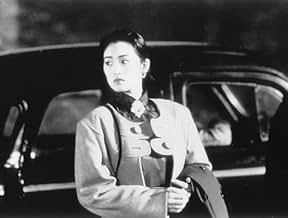
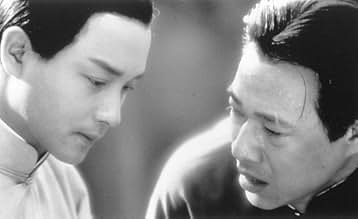
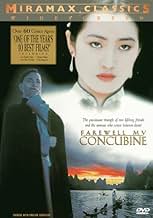
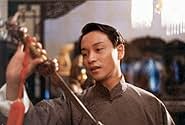
Two boys meet at an opera training school in Peking in 1924. Their resulting friendship will span nearly 70 years and endure some of the most troublesome times in China's history.Two boys meet at an opera training school in Peking in 1924. Their resulting friendship will span nearly 70 years and endure some of the most troublesome times in China's history.Two boys meet at an opera training school in Peking in 1924. Their resulting friendship will span nearly 70 years and endure some of the most troublesome times in China's history.
- Nominated for 2 Oscars
- 24 wins & 12 nominations total
Leslie Cheung
- Cheng Dieyi
- (segment "Douzi")
Fengyi Zhang
- Duan Xiaolou
- (segment "Shitou")
Zhenxiang Fei
- Shitou as a Child
- (as Yang Fei)
- Director
- Writers
- All cast & crew
- Production, box office & more at IMDbPro
8.136.1K
1
2
3
4
5
6
7
8
9
10
Featured reviews
A powerful film (and I do not give that out lightly)
I've seen this movie more times than I can count and I cry every time. I first saw it in the theater in 1993 and I was rooting for it to win Best Foreign Film Oscar, but it lost to the far inferior Belle Epoque (Spain). As to the person who wrote that this film made Cheng Dieyi seem like he was made to be gay because of abuse, I think you need to take another look. To my mind, Dieyi seemed to be infatuated with Shitzou as soon as he got there. However you look at it, this is a film that has great performances all around. I especially loved Leslie Cheung as the adult Cheng Dieyi (requiem eternem Leslie, 1956-2003), not to mention Gong Li. An excellent film, but be forewarned: it's almost three hours long. 10/10
One of the grandest epics of our time...
A masterpiece in every sense of the word, Chen Kaige's breath-stealing parable of China's multi-layered political revolution, is centred on two men. Chen presents us with an absorbing story of a 52 year-old relationship between two opera actors mounted upon an impossibly large canvas. But without sacrificing any intricate plot development or smudging over any delicate complexity in the relationship.
Considered by many to be one of the greatest epics of all time, this film rightly established Chen's reputation as one of the most brilliant narrative and artistic directors of our time, along with other such contemporary auteurs as Kieslowski, Bertolucci and Kurosawa.
You can not call yourself a film-buff if you haven't seen this movie. And film-students: you can witness the true art of filmmaking and story telling through the skilled hands of Chen Kaige's Farewell My Concubine.
Considered by many to be one of the greatest epics of all time, this film rightly established Chen's reputation as one of the most brilliant narrative and artistic directors of our time, along with other such contemporary auteurs as Kieslowski, Bertolucci and Kurosawa.
You can not call yourself a film-buff if you haven't seen this movie. And film-students: you can witness the true art of filmmaking and story telling through the skilled hands of Chen Kaige's Farewell My Concubine.
A fine movie, truly an epic.
I finally got a chance to see "Farewell my Concubine." I'd been anxious to see it since its initial release in 1993. It surprised me in its depth and technical skill.
Three points make this film outstanding. The first is the technical skill of the director and the luscious taste of the director of photography. The entire film is a feast for the eyes, taking full advantage of elaborate costumes and exotic locations. The second strength is in the actual storytelling. The plot is a fascinating tragedy, it feels almost Shakespearean. The acting is nothing short of incredible. Some of China's finest actors demonstrate their ability to carry a story that covers 52 years. Normally, these two strengths alone would be reason enough to see a film, but "Farewell my Concubine" succeeds in satisfying one more category (the bain of any epic): historical accuracy.
"Farewell my Concubine" is exceptionally accurate in portraying the monumental changes that were sweeping China at the time. The film doesn't just treat these events as background events, but drags them right into the plot and pins the characters into their surroundings. This is interesting when you consider that the story takes place in the Peking Opera, not the most likely place for these events to have effect. Instead, as we see the new China emerge, we watch these vestiges of old society fall, and the work of all involved make this transition an achievement to behold. The power of this film was not missed by Chinese censors who banned, removed, and then banned the film again several times over -debating whether or not its artistic brilliance was worth subversive portrayals of suicide and homosexuality. Unlike "The Last Emperor," this film was made by Chinese film makers and is in tune with its subject. I recommend this film highly!
As one last note, the version I saw was a DVD containing the original 170 minute version of the film, in its wide-screen splendor. From what I understand, the shorter versions released internationally deleted and shortened some opera scenes for fear that they would be lost on Western audiences. Having no prior experience with any Peking Opera, I found the scenes fascinating and integral to appreciating the entire story. Spend the extra time if you can.
Three points make this film outstanding. The first is the technical skill of the director and the luscious taste of the director of photography. The entire film is a feast for the eyes, taking full advantage of elaborate costumes and exotic locations. The second strength is in the actual storytelling. The plot is a fascinating tragedy, it feels almost Shakespearean. The acting is nothing short of incredible. Some of China's finest actors demonstrate their ability to carry a story that covers 52 years. Normally, these two strengths alone would be reason enough to see a film, but "Farewell my Concubine" succeeds in satisfying one more category (the bain of any epic): historical accuracy.
"Farewell my Concubine" is exceptionally accurate in portraying the monumental changes that were sweeping China at the time. The film doesn't just treat these events as background events, but drags them right into the plot and pins the characters into their surroundings. This is interesting when you consider that the story takes place in the Peking Opera, not the most likely place for these events to have effect. Instead, as we see the new China emerge, we watch these vestiges of old society fall, and the work of all involved make this transition an achievement to behold. The power of this film was not missed by Chinese censors who banned, removed, and then banned the film again several times over -debating whether or not its artistic brilliance was worth subversive portrayals of suicide and homosexuality. Unlike "The Last Emperor," this film was made by Chinese film makers and is in tune with its subject. I recommend this film highly!
As one last note, the version I saw was a DVD containing the original 170 minute version of the film, in its wide-screen splendor. From what I understand, the shorter versions released internationally deleted and shortened some opera scenes for fear that they would be lost on Western audiences. Having no prior experience with any Peking Opera, I found the scenes fascinating and integral to appreciating the entire story. Spend the extra time if you can.
Best Chinese movie ever
I don't know y'all but to everyone growing up in Taiwan or hongkong or China this is like The Godfather that kind of classic. This movie deserve at least a 9.0 for sure. Western people can not really understand this. But we Chinese people feel it with our heart.such an heartbreak and terrific film.best movie I've ever seen
10bluzman
A Tremendous Story on Many Levels
As an WASP American married a lady from Mainland China, I have a great interest in and curiosity about China. My wife's mother and father actually saw these men perform. I have discussed this movie with many Chinese friends, most of whom saw it before coming to this country. Some of them knew the story from real life as well as the movie. They are quick to point out the accuracy of the story in its detailing of Chinese history from the end of the last dynasty until its end during the Cultural Revolution. They also claim that the major happenings in the movie are real events, not the norm for most of Hollywood's "real life" stories. One point of conjecture in the movie is the sexually of Dieyi. It is presumed he is/becomes a homosexual. However, from what I have learned about the Peking/BeiJing Opera through reading and discussions, it is more likely that Dieyi was virtually unaware of his own sexuality. As opposed to being a hetero or homosexual, he was asexual in a way like it had be surgically removed from his being. It had been taken from him through the rigors of his training and years of performance. His love for Xiaolou is powerful, maybe even surpassing ordinary man/woman love, but platonic in as much as his mind is devoid of its sexuality. He suffers the same jealous anger and sense of betrayal as might be found when a wife discovers the cheatings of her husband, and reacts, unfortunately, accordingly (Heroin). His real, enduring love is performing. It is the one constant that has seen him through. He throws himself into it, being willing to perform for anyone, even as it drives the story to the end. The end of the movie is not satisfying to everyone. It was not a Hollywood ending. However, it was reality.
Did you know
- TriviaJackie Chan was originally offered the role of Duan Xiaolou due to his own childhood experience of training in the Peking Opera. But he turned it down, fearing that the film, which deals with themes of homosexuality, might tarnish his image.
- GoofsWhen Douzi is first examined by the owner of the opera troupe, his extra finger is on his right hand below the thumb. When he withdraws the hand from the opera troupe owner, he pulls back his left arm. When his mother cuts the extra finger off a few moments later, it is now on his left hand, next to his pinkie.
- Quotes
Master Yuan: A smile ushers in the spring.
Master Yuan: A tear does darken all the world.
Master Yuan: How truly does this befit you. To you... only you are possessed of such charm.
- Alternate versionsThe version presented in the U.S. is different from the original, longer cut, that was distributed internationally. The following differences exist in the U.S. version:
- The scene where Duan and Juxian are drinking after their wedding was originally directly after the wedding scene, rather than after the bloodletting at the Yuan-Cheng dinner.
- How long is Farewell My Concubine?Powered by Alexa
Details
Box office
- Budget
- $4,000,000 (estimated)
- Gross US & Canada
- $5,549,086
- Opening weekend US & Canada
- $69,408
- Oct 17, 1993
- Gross worldwide
- $8,442,285
- Runtime
- 2h 51m(171 min)
- Color
- Sound mix
- Aspect ratio
- 1.85 : 1
Contribute to this page
Suggest an edit or add missing content