IMDb RATING
6.8/10
9.6K
YOUR RATING


Two old pals reunite for a camping trip in Oregon's Cascade Mountains.Two old pals reunite for a camping trip in Oregon's Cascade Mountains.Two old pals reunite for a camping trip in Oregon's Cascade Mountains.
- Director
- Writers
- Stars
- Awards
- 5 wins & 5 nominations total


- Director
- Writers
- All cast & crew
- Production, box office & more at IMDbPro
6.89.5K
1
2
3
4
5
6
7
8
9
10
Featured reviews
The Big Chill Out
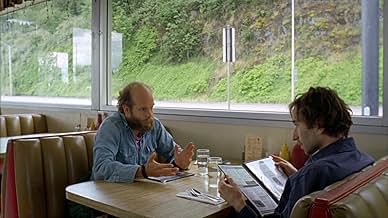
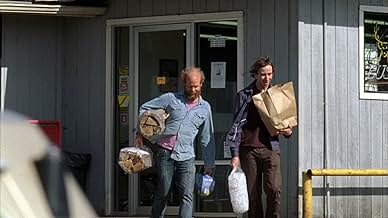
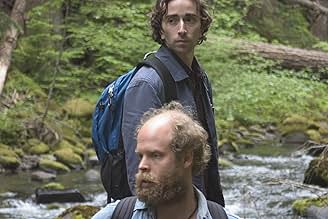
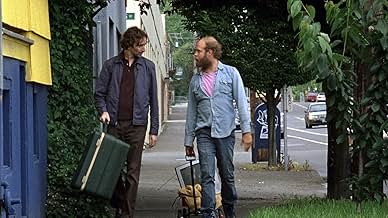
Two friends in their early thirties meet to renew their previous friendship on a camping trip in the gorgeous Cascade Mountains of Oregon. Kurt (Will Oldham) is a balding free spirit, while Mark (Daniel London) is a working man who is about to take on the responsibility of being a father. Both men seek to recreate the magic that once brought them together but their connection is now so tenuous and their worlds so divided that it seems as if there is no longer anything to hold onto, even memory.
Kelly Reichardt's superb Old Joy is a film of rare beauty unburdened by typical male-bonding clichés, more the "big chill out" than The Big Chill. While it is the story of male friendship, it is not about plot or even character but a film of mood and atmosphere that tells its story with gestures, expressions, and silences punctuated by the ambient sounds of nature. On their drive through pristine countryside to the music of Yo La Tengo, Mark listens to Air America talk radio bemoaning the state of the Democratic Party and talks about how his father decided to leave his mother when he turned seventy but nothing is said about what the two shared together in the past.
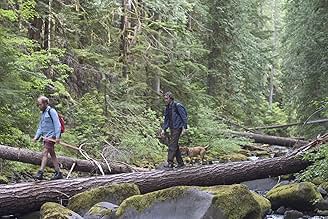
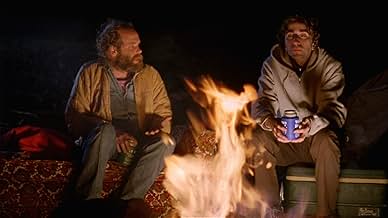
When Kurt fails to find the turnoff to the Bagby Hot Springs near Oregon's Mount Hood, the two (three if you include the dog) spend the night at an abandoned campsite, prompting Kurt to remark that "there are trees in the city, and garbage in the forest, so what is the difference?" At the campsite, Kurt relates his experiences of recent trips to Big Sur and Ashland which he calls "transcendent" and "life-changing" and about how he took a course in physics but knew more than the professor and volunteers his theory that the universe is enclosed in a tear that is falling and has been for millennia, but Mark seems to hardly notice.
He only perks up when he receives phone calls on his cell from his pregnant wife (Tanya Smith) who had only given grudging consent to the trip, sensing that the pot smoking Kurt was not a good influence. The next day they reach the springs and enjoy a moment of peace in the hot tub but it is interrupted by Kurt's telling Mark how much he misses him and how something is wrong with their relationship which Mark denies but the sense is that something has been lost forever.
Nothing really happens in Old Joy. There are almost no peak dramatic moments but almost every scene has subtle undertones of meaning. A sense of loss permeates the film, the loss perhaps of a time when people were connected and fighting for a cause meant human involvement rather than the distancing of today's radio talk shows or anonymous Internet message boards. When the aging hippie shares a Chinese proverb that "Sorrow is nothing but worn out joy", it feels as if the film becomes a metaphor for the joy that seems to be wearing out in an age approaching its zero point.
Kelly Reichardt's superb Old Joy is a film of rare beauty unburdened by typical male-bonding clichés, more the "big chill out" than The Big Chill. While it is the story of male friendship, it is not about plot or even character but a film of mood and atmosphere that tells its story with gestures, expressions, and silences punctuated by the ambient sounds of nature. On their drive through pristine countryside to the music of Yo La Tengo, Mark listens to Air America talk radio bemoaning the state of the Democratic Party and talks about how his father decided to leave his mother when he turned seventy but nothing is said about what the two shared together in the past.
When Kurt fails to find the turnoff to the Bagby Hot Springs near Oregon's Mount Hood, the two (three if you include the dog) spend the night at an abandoned campsite, prompting Kurt to remark that "there are trees in the city, and garbage in the forest, so what is the difference?" At the campsite, Kurt relates his experiences of recent trips to Big Sur and Ashland which he calls "transcendent" and "life-changing" and about how he took a course in physics but knew more than the professor and volunteers his theory that the universe is enclosed in a tear that is falling and has been for millennia, but Mark seems to hardly notice.
He only perks up when he receives phone calls on his cell from his pregnant wife (Tanya Smith) who had only given grudging consent to the trip, sensing that the pot smoking Kurt was not a good influence. The next day they reach the springs and enjoy a moment of peace in the hot tub but it is interrupted by Kurt's telling Mark how much he misses him and how something is wrong with their relationship which Mark denies but the sense is that something has been lost forever.
Nothing really happens in Old Joy. There are almost no peak dramatic moments but almost every scene has subtle undertones of meaning. A sense of loss permeates the film, the loss perhaps of a time when people were connected and fighting for a cause meant human involvement rather than the distancing of today's radio talk shows or anonymous Internet message boards. When the aging hippie shares a Chinese proverb that "Sorrow is nothing but worn out joy", it feels as if the film becomes a metaphor for the joy that seems to be wearing out in an age approaching its zero point.
Worthy of self-reflection...
In my mind, there are 2 ways to fully understand this film and it all depends which character relates to your own life the most. And that is as simple as it gets.
1. you're a "Mark". The friend that has matured, has a career & a family, left his carefree overindulgent days behind them and who doesn't have enough time for the friendships you once had.
2. you're a "Kurt". The friend who hasn't figured out what they want to do with their life just yet, living very sparsely, still doing the same irresponsible things they were in their twenties and really can't grasp that their friend they used to be really close to has other responsibilities.
On that basis alone, the "Marks" tend to appreciate the film more, while the "Kurts" tend to dismiss it rather quickly. Speaking from experience, the film hit a little too vlose to home. But as a "recovering Kurt", it was an absolute eye-opener. So I'm definitely in the minority by saying this film touched me in a profound way and made me really take a look at my own closest friendships. I can't think of another film that has made me do that. And all the while being the simplest of stories. Bravo.
1. you're a "Mark". The friend that has matured, has a career & a family, left his carefree overindulgent days behind them and who doesn't have enough time for the friendships you once had.
2. you're a "Kurt". The friend who hasn't figured out what they want to do with their life just yet, living very sparsely, still doing the same irresponsible things they were in their twenties and really can't grasp that their friend they used to be really close to has other responsibilities.
On that basis alone, the "Marks" tend to appreciate the film more, while the "Kurts" tend to dismiss it rather quickly. Speaking from experience, the film hit a little too vlose to home. But as a "recovering Kurt", it was an absolute eye-opener. So I'm definitely in the minority by saying this film touched me in a profound way and made me really take a look at my own closest friendships. I can't think of another film that has made me do that. And all the while being the simplest of stories. Bravo.
an excellent, quiet film....a nice change of pace
which is exactly what this film is supposed to be. Boring? Not a chance, unless of course you're a fan of what film has unfortunately become; chaotic cross cuts of meaningless images.
The soundtrack, the acting, the direction and scenery all add to this beautiful, intimate story about two friends trying to find solace in this chaos we call life.
Too many films today think high powered story lines, which generally equal meaningless dialogue make for an interesting film, which couldn't be farther from the truth.
It's about time we let film be film by allowing the images to tell the story.
Don't miss it. This is a nice, rare gem.
The soundtrack, the acting, the direction and scenery all add to this beautiful, intimate story about two friends trying to find solace in this chaos we call life.
Too many films today think high powered story lines, which generally equal meaningless dialogue make for an interesting film, which couldn't be farther from the truth.
It's about time we let film be film by allowing the images to tell the story.
Don't miss it. This is a nice, rare gem.
Surprisinlgy Not Boring
This is a movie where nothing at all happens. Surprisingly that's not a really bad thing. It is the story of a short dull road trip between two old friends. Two old friends that have nothing to say to each other.
Even though this movie is only about 70 minutes long, there is a still lot of filler. The filler is pretty and quiet in a mellow sort of way. Yo La Tengo's sparse soundtrack goes perfect with the lack of dialog and lack of action. Somehow it actually sort of works.
But I got a real sense of missed opportunity with this film. The filmmaker seems to have nothing to say. While amazingly well executed, there is no real depth to this film. Maybe that's the point. Even if, it felt like it needed more.
It is a nice film to watch if you find yourself in a mellow mood. It's like watching the scenery go by from a train. If you feel like a train ride, this is a pleasant one.
Even though this movie is only about 70 minutes long, there is a still lot of filler. The filler is pretty and quiet in a mellow sort of way. Yo La Tengo's sparse soundtrack goes perfect with the lack of dialog and lack of action. Somehow it actually sort of works.
But I got a real sense of missed opportunity with this film. The filmmaker seems to have nothing to say. While amazingly well executed, there is no real depth to this film. Maybe that's the point. Even if, it felt like it needed more.
It is a nice film to watch if you find yourself in a mellow mood. It's like watching the scenery go by from a train. If you feel like a train ride, this is a pleasant one.
Meticulous but slight American indie garners excessive praise
In Kelly Reichart's Old Joy, two thirty-something males who live in the Pacific Northwest reunite for a day-and-a-half trip by car and on foot to a hot spring in Oregon's Cascade Mountains and discover some hours of peace and mutual solitude. It seems that the years have separated them. Once great friends, they haven't been in touch for a while. They aren't the same guys they were and perhaps haven't much in common any more. The stocky, balding, bearded, single Kurt (Will Oldham) is a semi-hippie living marginally who smokes a lot of grass. Mark (Daniel London) is thin and married and both he and his pregnant wife work hard at their jobs. But Reichart is too unemphatic, and her understated dialogue is too naturalistic, for this implied discovery of lost friendship to have any drama, or for the differences between the two men to have any clear point. This is good film-making, but it seems almost at cross purposes with itself.
The colors are rich, the camera is precise, the sounds are finely recorded. The trip is meticulously observed. Reichart sees her little piece of ivory through a magnifying glass. The way Mark and Kurt talk seems authentic and true. They don't present back-stories, because it wouldn't be natural for them to do so -- though Kurt acknowledges Mark's daring in having a child; he says he's never done anything so "real." Mark's wife, glimpsed before the trip and overheard in cell phone conversations, seems neurotic, insecure about this dip back into Mark's pre-marital world. She may understandably feel jealous of the way, when Kurt calls and suggests the trip, Mark comes hopping.
They take Mark's better car, an old Volvo station wagon, and Kurt's directions lead them astray so at night they have to camp by what looks a bit like a dump, not really knowing exactly where they are. There's nothing to give away here. The two guys make the trip. They make it with Lucy, Mark's dog, up to the hot spring the next afternoon. And the rustic shelter set up there for bathing is as Kurt had promised, simple and lovely. Kurt has said there's not much difference between city and country now but this peaceful place belies that notion, except that when they return, their parting is quick, and Kurt is soon out and about by himself in a sleazy part of town and Mark is heading home with an Air America political talk show tuned in again just as it was when he headed out to get Kurt.
The irony is that all this meticulous observation reveals very little. When it's over, we don't know much about who these two men are. We don't know how they knew each other when younger or for how long; We don't know what Mark's job is. And it is not clear that they find each other boring, because they haven't said a lot to each other. Mark has talked a little about his father, and Kurt has told a long story at the hot spring about shopping for a notebook and a dream he just had that provides the title. In his dream a woman told Kurt that "sorrow is nothing but worn-out joy." Is the joy of Mark and Kurt's old friendship worn out and turned to sorrow? NYTimes critic Manohla Dargis, who wrote this week that this is "one of the finest American films of the year," says that at their parting, "from the way Kurt looks at Mark, it seems clear he knows there won't be another reunion." Seems, perhaps; but it isn't really clear. And this is the weakness of Reichart's understated method: it's so subtle, and in its construction so minimal, it risks not really saying anything. Nature and the urban world speak clearly in Reichart's film, but there's a substratum of feeling and experience that finds no voice.
Shown at various film festivals, including San Francisco, and released in Portland, Oregon in August and New York City (Film Forum) in September 2006.
The colors are rich, the camera is precise, the sounds are finely recorded. The trip is meticulously observed. Reichart sees her little piece of ivory through a magnifying glass. The way Mark and Kurt talk seems authentic and true. They don't present back-stories, because it wouldn't be natural for them to do so -- though Kurt acknowledges Mark's daring in having a child; he says he's never done anything so "real." Mark's wife, glimpsed before the trip and overheard in cell phone conversations, seems neurotic, insecure about this dip back into Mark's pre-marital world. She may understandably feel jealous of the way, when Kurt calls and suggests the trip, Mark comes hopping.
They take Mark's better car, an old Volvo station wagon, and Kurt's directions lead them astray so at night they have to camp by what looks a bit like a dump, not really knowing exactly where they are. There's nothing to give away here. The two guys make the trip. They make it with Lucy, Mark's dog, up to the hot spring the next afternoon. And the rustic shelter set up there for bathing is as Kurt had promised, simple and lovely. Kurt has said there's not much difference between city and country now but this peaceful place belies that notion, except that when they return, their parting is quick, and Kurt is soon out and about by himself in a sleazy part of town and Mark is heading home with an Air America political talk show tuned in again just as it was when he headed out to get Kurt.
The irony is that all this meticulous observation reveals very little. When it's over, we don't know much about who these two men are. We don't know how they knew each other when younger or for how long; We don't know what Mark's job is. And it is not clear that they find each other boring, because they haven't said a lot to each other. Mark has talked a little about his father, and Kurt has told a long story at the hot spring about shopping for a notebook and a dream he just had that provides the title. In his dream a woman told Kurt that "sorrow is nothing but worn-out joy." Is the joy of Mark and Kurt's old friendship worn out and turned to sorrow? NYTimes critic Manohla Dargis, who wrote this week that this is "one of the finest American films of the year," says that at their parting, "from the way Kurt looks at Mark, it seems clear he knows there won't be another reunion." Seems, perhaps; but it isn't really clear. And this is the weakness of Reichart's understated method: it's so subtle, and in its construction so minimal, it risks not really saying anything. Nature and the urban world speak clearly in Reichart's film, but there's a substratum of feeling and experience that finds no voice.
Shown at various film festivals, including San Francisco, and released in Portland, Oregon in August and New York City (Film Forum) in September 2006.


Did you know
- TriviaIn order to finance this film, Kelly Reichardt had to work on a full season of America's Next Top Model.
- GoofsThe birds singing at the hot springs are native to the Eastern U.S., not Oregon. According to Director Kelly Reichardt, she unknowingly mixed the audio for this scene with a stock recording of forest ambiance, and a birder pointed this error out to her at a Q&A for the film.
- Crazy creditsA disclaimer says that the Bagby Hot Springs does not allow nudity or the consumption of alcoholic beverages.
- ConnectionsFeatured in What Is Cinema? (2013)
- How long is Old Joy?Powered by Alexa
Details
- Release date
- Country of origin
- Official site
- Language
- Also known as
- Viejas alegrías
- Filming locations
- Production companies
- See more company credits at IMDbPro
Box office
- Budget
- $30,000 (estimated)
- Gross US & Canada
- $255,923
- Opening weekend US & Canada
- $3,310
- Aug 27, 2006
- Gross worldwide
- $301,633
Contribute to this page
Suggest an edit or add missing content