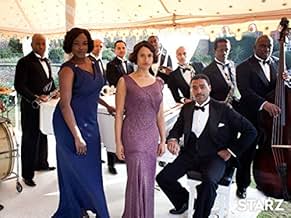
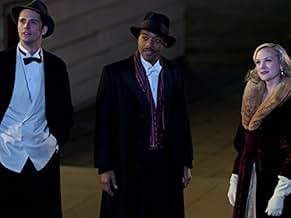
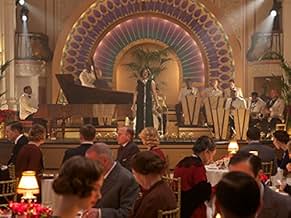
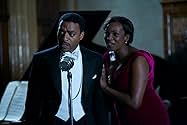
Set in the 1930s, a black Jazz band rises in fame and popularity while becoming entangled in an intricate web of intrigue, mystery and suspense with the elite of London society.Set in the 1930s, a black Jazz band rises in fame and popularity while becoming entangled in an intricate web of intrigue, mystery and suspense with the elite of London society.Set in the 1930s, a black Jazz band rises in fame and popularity while becoming entangled in an intricate web of intrigue, mystery and suspense with the elite of London society.
- Nominated for 1 Primetime Emmy
- 5 wins & 16 nominations total
Browse episodes
7.42.9K
1
2
3
4
5
6
7
8
9
10
Featured reviews
Vivid Evocation of a Hitherto Undiscovered Aspect of British History
Based on a hitherto undiscovered aspect of British history, DANCING ON THE EDGE tells of the fortunes of an African-Caribbean jazz band in 1930s upper-class British society. Louis Lester serves an apprenticeship in the United States, then takes London by storm with the help of talented singers Jessie and Carla. Initially managed by Wesley, who drives a hard bargain but manages to offend just about everyone, the band is eventually guided by white fixer Stanley, who just so happens to run one of London's leading music papers, a rival to the much better- known "Melody Maker." Poliakoff has a fascinating story to tell of a basically racist society that nonetheless embraces the Louis Lester jazz band, which provides the kind of music than no one has ever heard before. The band are so successful that they even attract the interest of the Prince of Wales (the future King Edward VIII). At the same time polite society has a seamy underbelly; if anyone dares to question the idea of white supremacy, then they are summarily dealt with. This rule applies to white and nonwhite people alike. The television series attracted mixed reviews on its premiere in February and March 2013; after having read Poliakoff's excellent screenplay, I am rather nonplussed as to why DANCING ON THE EDGE generated this kind of reaction.
Well done, fast paced, period drama 1933
A clever story with enough intrigue to keep it exciting. The characters are all very interesting and their chemistry works well together.
Stanley writes and edits a local music rag and hears Louis Lester's band in a local dive. He decides to help them become successful and succeeds.
I wouldn't read the blurbs here accompanying each episode because they describe exactly what happens in that particular episode.
The production values, camera work, sets, costumes, make-up and hair are all great and authentic. There is just the right balance between the drama and the music.
They don't get too bogged down with the politics of "negro" prejudice which is refreshing. Yet we are always aware of it in the background.
My only disappointment was I felt the ending of Episode 5 was extremely rushed with a lack of the usual explanation and depth.
I assumed it was the final episode until I saw Episode 6 listed in the TV guide for tonight.
The Interview was something Stanley always wanted but I found the episode boring and superfluous especially since it wasn't the interview I was expecting. We didn't need this companion piece. They would have been better spending more time on the the end of the series although I think Stanley left us with a wimpy cliffhanger for a potential Season 2.
It's almost as if they ran out of funding, time or backing and several of the main stars left before the end of Episode 5. Episode 6 was improvised and didn't make any sense because Stanley obviously had been gathering interview material from the start.
Stanley writes and edits a local music rag and hears Louis Lester's band in a local dive. He decides to help them become successful and succeeds.
I wouldn't read the blurbs here accompanying each episode because they describe exactly what happens in that particular episode.
The production values, camera work, sets, costumes, make-up and hair are all great and authentic. There is just the right balance between the drama and the music.
They don't get too bogged down with the politics of "negro" prejudice which is refreshing. Yet we are always aware of it in the background.
My only disappointment was I felt the ending of Episode 5 was extremely rushed with a lack of the usual explanation and depth.
I assumed it was the final episode until I saw Episode 6 listed in the TV guide for tonight.
The Interview was something Stanley always wanted but I found the episode boring and superfluous especially since it wasn't the interview I was expecting. We didn't need this companion piece. They would have been better spending more time on the the end of the series although I think Stanley left us with a wimpy cliffhanger for a potential Season 2.
It's almost as if they ran out of funding, time or backing and several of the main stars left before the end of Episode 5. Episode 6 was improvised and didn't make any sense because Stanley obviously had been gathering interview material from the start.
British miniseries about a black jazz group in 1930s London
For so many people not liking this, it has a high rating here on IMDb. I enjoyed it but see its flaws.
I am not familiar with the work of Stephen Poliakoff, so I can't comment on the criticisms of him.
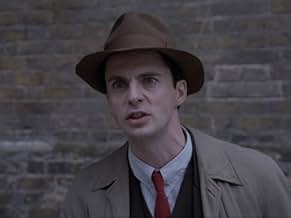
The series is about a black jazz band in the 1930s who is discovered by a music journalist, Stanley Mitchell (Matthew Goode). With Wesley's help, the group is booked at the upscale Imperial Hotel and even entertain Prince George (erroneously described during the program as the Prince of Wales, who was actually Edward, Prince of Wales).
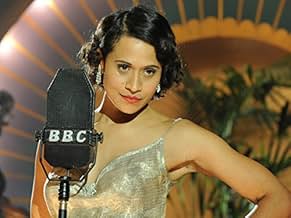
The band becomes successful and is written up often by Mitchell. With two talented singers (Wunmi Mosaku and Angel Coulby), they come to the attention of a record company and radio. But tragedy strikes, and the ensuing events threaten to ruin the band.
I'm at a disadvantage here because I'm not familiar with early '30s jazz music, but the critiques say the music presented is actually from a decade later. The songs are original to the production, which were also criticized. The producers certainly could have found actual songs, but I suppose they didn't want to pay for the rights. A couple of the songs weren't very good.
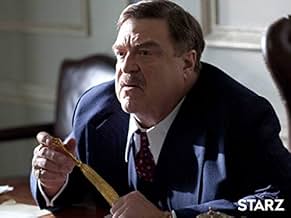
It's an expensive production with some excellent actors: Goode, who I've always loved, Chiwetel Ejiofor as Louis Lester, the leader of the band, Anthony Head, John Goodman, Tom Hughes, and Jacqueline Bisset. Very formidable.
There was also criticism that the series did not really evoke the '30s. I thought it looked wonderful, particularly the hotel scenes. But I agree, there was something missing in the period feel.
Fascinating to me was the statement in the series that the Brits didn't know what Americans sounded like until the advent of talking pictures, as well as the talk of the wireless. One really does get the feeling of limited communication and how far we've come.
Suspenseful, well-acted, this could have been more fascinating with some stronger writing, attention to period details, and maybe some cutting, perhaps to four episodes instead of six.
The research wasn't perfect -besides the Prince of Wales ID, there was also the reference to Clark Gable. In 1933, Clark Gable was just coming onto the radar in the U. S. Ronald Colman would have been much better. The devil is in the details.
I am not familiar with the work of Stephen Poliakoff, so I can't comment on the criticisms of him.
The series is about a black jazz band in the 1930s who is discovered by a music journalist, Stanley Mitchell (Matthew Goode). With Wesley's help, the group is booked at the upscale Imperial Hotel and even entertain Prince George (erroneously described during the program as the Prince of Wales, who was actually Edward, Prince of Wales).
The band becomes successful and is written up often by Mitchell. With two talented singers (Wunmi Mosaku and Angel Coulby), they come to the attention of a record company and radio. But tragedy strikes, and the ensuing events threaten to ruin the band.
I'm at a disadvantage here because I'm not familiar with early '30s jazz music, but the critiques say the music presented is actually from a decade later. The songs are original to the production, which were also criticized. The producers certainly could have found actual songs, but I suppose they didn't want to pay for the rights. A couple of the songs weren't very good.
It's an expensive production with some excellent actors: Goode, who I've always loved, Chiwetel Ejiofor as Louis Lester, the leader of the band, Anthony Head, John Goodman, Tom Hughes, and Jacqueline Bisset. Very formidable.
There was also criticism that the series did not really evoke the '30s. I thought it looked wonderful, particularly the hotel scenes. But I agree, there was something missing in the period feel.
Fascinating to me was the statement in the series that the Brits didn't know what Americans sounded like until the advent of talking pictures, as well as the talk of the wireless. One really does get the feeling of limited communication and how far we've come.
Suspenseful, well-acted, this could have been more fascinating with some stronger writing, attention to period details, and maybe some cutting, perhaps to four episodes instead of six.
The research wasn't perfect -besides the Prince of Wales ID, there was also the reference to Clark Gable. In 1933, Clark Gable was just coming onto the radar in the U. S. Ronald Colman would have been much better. The devil is in the details.
Really recommend it for Anglophiles
British acting royalty on full display here. Plus some welcome imports such as John Goodman. Jenna Colman and Tom Hughes before the mega-success that was Victoria. Jenna looking surprisingly unremarkable, but her voice is memorable. Before Doctor Who fame clearly.
I had this somewhere on the periphery for many, many years but since I couldn't find a version with decent subtitles I just left it there. I don't know what attracted me to it in the first place, whether it was Matthew Goode or the period aspect. Couldn't have been the topic itself I don't think.
Anyway, it starts as an underdog story and it morphs into an anatomy of the very upper class in Britain, up to the royals. Their vain, empty pursuits and lack of accountability. Up to an including the most heinous of acts.
In any case it was captivating for the most part, both the underdog stories and the upper crust slumming it and mixing with black jazz players. I thought they were dragging their feet and overdramatizing the last couple of episodes. Once you get a hint of what's really going on it really drags its feet to conclusion, but it still has some wonderfully tense moments.
I have about 20 minutes more of the last episode, the interview format, but basically you can do without that one, it does not add much.
Probably more of a 7 overall but I just love the genre. And the music slapped. Plus, if you love British shows and British actors you can't miss this one.
I had this somewhere on the periphery for many, many years but since I couldn't find a version with decent subtitles I just left it there. I don't know what attracted me to it in the first place, whether it was Matthew Goode or the period aspect. Couldn't have been the topic itself I don't think.
Anyway, it starts as an underdog story and it morphs into an anatomy of the very upper class in Britain, up to the royals. Their vain, empty pursuits and lack of accountability. Up to an including the most heinous of acts.
In any case it was captivating for the most part, both the underdog stories and the upper crust slumming it and mixing with black jazz players. I thought they were dragging their feet and overdramatizing the last couple of episodes. Once you get a hint of what's really going on it really drags its feet to conclusion, but it still has some wonderfully tense moments.
I have about 20 minutes more of the last episode, the interview format, but basically you can do without that one, it does not add much.
Probably more of a 7 overall but I just love the genre. And the music slapped. Plus, if you love British shows and British actors you can't miss this one.
All round excellent - and no spoilers here!
Firstly, at the time of writing (16 September 2013) the information for this on the main page is incorrect. It says this film/series is not yet released. However, I've just watched all 5 episodes on DVD (2 DVDs to be precise), plus the extra almost 1 hour "interview" between Stanley and Louis. The DVD release date was March 2013.
Like another reviewer I simply don't understand some of the poor ratings for this film. It was an immaculate production with an excellent cast for, I think, a cracking, well written story. It has style, suspense, humour, sensuality, good looks, great music and, as with so much of Stephen Poliakoff's work, a lot of intelligent dialogue and some fairly long scenes. But that's why I'm a fan of Poliakoff's work - it is literate, well researched and observed, and you have to pay attention. It rewards that attention many time over.
I must say there were some performances that were a revelation to me. Jacqueline Bisset for a start, and the late Mel Smith. But everyone was really outstanding in the parts they played. Joanna Vanderham is astonishingly mature well beyond her years (19 or 20 years old during the production) and is destined I feel to be a great actress. One cannot comment on this production without mentioning the singers - 2 established actresses who had never sung in public, in theatre, TV or on film before. They did their own singing and were amazingly good.
Like another reviewer I simply don't understand some of the poor ratings for this film. It was an immaculate production with an excellent cast for, I think, a cracking, well written story. It has style, suspense, humour, sensuality, good looks, great music and, as with so much of Stephen Poliakoff's work, a lot of intelligent dialogue and some fairly long scenes. But that's why I'm a fan of Poliakoff's work - it is literate, well researched and observed, and you have to pay attention. It rewards that attention many time over.
I must say there were some performances that were a revelation to me. Jacqueline Bisset for a start, and the late Mel Smith. But everyone was really outstanding in the parts they played. Joanna Vanderham is astonishingly mature well beyond her years (19 or 20 years old during the production) and is destined I feel to be a great actress. One cannot comment on this production without mentioning the singers - 2 established actresses who had never sung in public, in theatre, TV or on film before. They did their own singing and were amazingly good.
Did you know
- TriviaJenna Coleman and Tom Hughes would go on to star together as Queen Victoria and Prince Albert in the ITV period drama Victoria (2016).
- GoofsThe musical style of Louis Lester's band, and especially the vocal styles of his singers and the sorts of songs they perform, are typical of the 1950's, not the 1930's.
- ConnectionsFeatured in The Wright Stuff: Episode #18.20 (2013)
- How many seasons does Dancing on the Edge have?Powered by Alexa
Details
- Release date
- Country of origin
- Language
- Also known as
- 邊緣之舞
- Filming locations
- Severn Valley Railway, Shropshire, England, UK(Folkestone and South Bromley stations)
- Production companies
- See more company credits at IMDbPro
Contribute to this page
Suggest an edit or add missing content