

A writer encounters the owner of an aging high-class hotel, who tells him of his early years serving as a lobby boy in the hotel's glorious years under an exceptional concierge.A writer encounters the owner of an aging high-class hotel, who tells him of his early years serving as a lobby boy in the hotel's glorious years under an exceptional concierge.A writer encounters the owner of an aging high-class hotel, who tells him of his early years serving as a lobby boy in the hotel's glorious years under an exceptional concierge.
- Director
- Writers
- Stars
- Won 4 Oscars
- 136 wins & 227 nominations total






- Director
- Writers
- All cast & crew
- Production, box office & more at IMDbPro
Summary
Featured reviews
A cinematic chocolate box
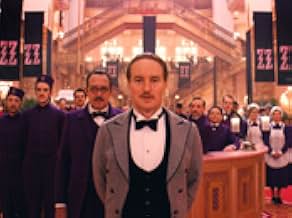
The structure is a story within a story within a story and at the heart of this Russian doll is a tale set in a mythical Middle European nation called Zubrowka between the two world wars and focused on Gustave H (Ralph Fiennes), the dedicated but eccentric concierge of the eponymous hotel, and his aspiring young bell boy Zero Mustapha (Tony Revolori). In a wonderful cast full of exquisite performances, Fiennes is a revelation. The man who chilled us in "Schindler's List" here shows a remarkable skill in comedic acting.
In a twisting plot of deceit and murder, above all this is a whimsical work from the opening views of the hotel to the final credits (when a little Russian character does a dance). Shot entirely in Germany, most of the scenes were filmed on the stages of the Babelsberg Studios.
Entertaining, slightly farcical, tale of dark deeds and friendship
"There are still faint glimmers of civilization left in this barbaric slaughterhouse that was once known as humanity... He was one of them. "
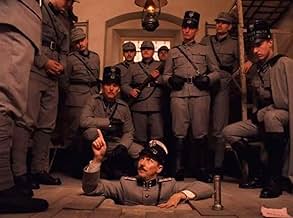
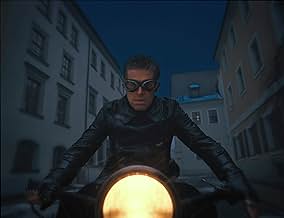
Through complex narrative framework, which itself is a mockery of all these films that are being narrated by someone and is also being an excuse for not being too realistic, we get to a story of a young lobby boy named Zero Moustafa and Gustave H. (Ralph Fiennes)the concierge of the Grandhotel Budapest. Many of the female guests of the hotel mainly come to enjoy Gustave's company. When one of these ladies passes away, Gustave grabs Zero and boards a train for her mansion. Soon he's blamed for her murder and hunted by police led by Edward Norton and a grim-faced assassin played by Willem Dafoe. There also is a love story between two young teens - Zero and Agatha (Saoirse Ronan) who has a birthmark in the shape of Mexico.
I frankly don't understand how can this film be successful in the USA. This film is just so typically European, that I guess some aspects of the film Americans just aren't familiar with. Some of the humor reminded of old French, Italian and Czech comedies.
Wes Anderson remains to be a stand-out filmmaker who never disappoints with any of his creations and is a safe bet to rely on his qualities. You won't want to return to the real world when the credits start to roll.
Wes Anderson's Best?
As I was hoping, the story to The Grand Budapest Hotel is very original and unique, some may even say strange. And as the movie goes on, the story only gets wilder and wilder. The film is often very hilarious, with some seriously funny dark humour thrown in there as well. Characters are extremely well written, with the bond between Gustave and Zero being the backbone of the whole movie as it's so well written. The Grand Budapest Hotel features an odd narrative structure that works very well for the film, again adding to the uniqueness and freshness of it. I wasn't exactly sure how the story would play out, as I purposely avoided all promotional materiel so I would know as little as possible before watching. This was a great benefit to my viewing experience as I loved everything I saw, and felt as though nothing was spoiled from watching too many trailers.
I haven't been a huge fan of most of Ralph Fiennes' work since his phenomenal performance in 1993′s "Schindler's List", but this is easily his best performance since then. He proves he can do comedy just as well as he can do drama, providing a perfect balance of both. Newcomer Tony Revolori is excellent as well. I won't get into the whole supporting cast because there's so many who were all so great, but I was particularly impressed by Willem Dafoe, Adrien Brody, Harvey Keitel, Jude Law and Saoirse Ronan.
The Grand Budapest Hotel is definitely a Wes Anderson film, down to its very core. If you know his style, then you known what to expect, as this movie is full of it. Thankfully though, it's not a case of style over substance, with a great story to accompany the gorgeous visuals. The colour palette is beautiful; it's nice to see lot's of bright colours when so many other films are so dark and dreary. The set design and costumes are perfect, and there's so much attention to detail within the sets. The cinematography is phenomenal, and I really like how the film was presented in different aspect ratios.
You really can't go wrong with this film. It's probably Wes Anderson's best film, it has gorgeous visuals, excellent acting and a wonderful story. If you're a fan of Wes Anderson's previous work, you cannot miss this, and even if you're not a fan you should go and see it anyway.
A brilliantly entertaining fantasy outing by Wes Anderson
In a complex serious of flashbacks, Tom Wilkinson plays an author remembering his younger self (Jude Law) being recounted, a number of years before, the life story of The Grand Budapest's mysterious elderly guest Zero Moustafa, played by Abraham. (Are you still with me?) Featuring strongly in this life story, Ralph Fiennes plays hotel concierge and lothario Gustave H., seducer of his elderly and wealthy guests. He is supported in this role – for everything outside the bedroom that is – by trainee Bellboy, and Gustave's protégé, Zero (in the younger form of Tony Revolori).
Following the murder of one such guest (Tilda Swinton), Gustave is not surprised to feature strongly in her will, awarded a priceless Renaissance painting – Boy with Apple. This is much to the displeasure of her son Dimitri (Adrien Brody) and his evil henchman Jopling (Willem Defoe). What follows is a madcap pursuit across snowy landscapes, various grisly murders, a couple of civil wars, some disconnected fingers, a prison break and a downhill ski chase.
All the cast seem to enjoy themselves immensely, but it is the production design and cinematography that really shines through: every single shot of the film is just a joy to look at, from the bright pastel colours of some scenes to the oak-panelled finery of the elderly lady's mansion. Beautifully crafted, beautifully lit,beautifully costumed, beautifully filmed. Bringing a film out so early in the new Oscar-year must be risky: but one can only hope that the voting members have a long enough memory to recognise this movie in these sorts of categories.
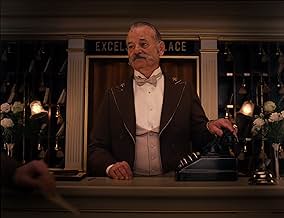
There are some interesting crossovers to recent films: both 'The Book Thief' and 'The Monuments Men' were filmed – as this was – in Studio Babelsberg in Potsdam. No coincidence then that the steam train chugging through the East European countryside looked startlingly similar to that in the opening scenes of 'The Book Thief'; and if you have Bill Murray and Bob Balaban in town for Monuments Men, then why not stick them together for this film too? Simples! Alexandre Desplat turns up AGAIN with another quirky and fitting score.
All in all, if you like the quirky style of films of the likes of Moulin Rouge then you'll love this. Highly recommended.
(If you enjoyed this review, please check out my archive of other reviews and while there sign up to "Follow the Fad"! Thanks!).
Wes Anderson Films as Ranked by IMDb Rating


Did you know
- TriviaThe scene in which Ludwig (Harvey Keitel) says "Good luck, kid!" before slapping Zero (Tony Revolori) across the face was shot forty-two times until Wes Anderson was satisfied. Keitel actually slapped Revolori each time.
- GoofsWhen Zero sits on top the haystacks waiting for the car from the Hotel Excelsior Palace, his pencil mustache is missing. It returns when he enters the car.
- Quotes
M. Gustave: You see, there are still faint glimmers of civilization left in this barbaric slaughterhouse that was once known as humanity. Indeed that's what we provide in our own modest, humble, insignificant... oh, fuck it.
- Crazy creditsNear the end of the closing credits, an animated Russian figure does a traditional dance.
- ConnectionsEdited into 365 Days, also Known as a Year (2019)
- SoundtracksThe Linden Tree
Written by Pavel Vasilevich Kulikov
Performed by Osipov State Russian Folk Orchestra, Vitaly Gnutov
Courtesy of Natalya Abramyan and National Music Publishers
Courtesy of Universal International Music B.V. Under license from Universal Music Enterprises
24 Frames From Wes Anderson Films
24 Frames From Wes Anderson Films

Details
- Release date
- Countries of origin
- Official site
- Languages
- Also known as
- El gran hotel Budapest
- Filming locations
- Görlitz, Saxony, Germany(Historical Art Nouveau Department store, formerly "Karstadt")
- Production companies
- See more company credits at IMDbPro
Box office
- Budget
- $25,000,000 (estimated)
- Gross US & Canada
- $59,301,324
- Opening weekend US & Canada
- $811,166
- Mar 9, 2014
- Gross worldwide
- $174,567,384
- Runtime
- 1h 39m(99 min)
- Color
- Sound mix