

A cattle herder and his family who reside in the dunes of Timbuktu find their quiet lives -- which are typically free of the Jihadists determined to control their faith -- abruptly disturbed... Read allA cattle herder and his family who reside in the dunes of Timbuktu find their quiet lives -- which are typically free of the Jihadists determined to control their faith -- abruptly disturbed.A cattle herder and his family who reside in the dunes of Timbuktu find their quiet lives -- which are typically free of the Jihadists determined to control their faith -- abruptly disturbed.
- Director
- Writers
- Stars
- Nominated for 1 Oscar
- 33 wins & 28 nominations total




Ibrahim Ahmed
- Kidane
- (as Ibrahim Ahmed dit Pino)


Yoro Diakité
- Djihadiste
- (as Yoro Diakite)
Weli Kleïb
- Juge
- (as Weli Cleib)
- Director
- Writers
- All cast & crew
- Production, box office & more at IMDbPro
7.118.8K
1
2
3
4
5
6
7
8
9
10
Featured reviews
A majestic work of art
One of the movies that's still in the running for a "Best Foreign Language Film" Oscar nomination, is Timbuktu. Together with the Estonian Mandariinid it's one of my favorites for this year's Academy Awards, but I'm afraid only one of them will make it to the shortlist and neither of them will eventually win the Oscar. Not while movies like Ida, Turist and Leviathan are their competitors (although I think Timbuktu and Mandariinid are better than those three). The thing about Timbuktu that makes it such a beautiful picture, is its, what I presume, authentic representation of Muslims and the different views on Islamic religion. Spoken in a number of languages, from French and English to Arabic and a wide diversity of African languages (Tamasheq, Bambara and Songhay), Timbuktu shows Westerners a part of the world we almost know nothing about. Apart from judgemental and arrogant claims about the (religious) backwardness of many people there, be they Berber or Bedouin, many people here just don't know what to say about the Northern part of Africa. Director Abderrahmane Sissako gives us lots of stuff to talk and think about (for example the use of "jihad" as on the one hand an inner struggle (the greater jihad) and on the other hand an external holy war which is fought by mujahideen - the second jihad being the one we fear and loathe so much in the West). Not only that, but together with his cinematographer Sofian El Fani (La Vie d'Adèle) he manages to provide us with wonderful visual poetry and exceptional sceneries of south-east Mauritania. While it took some getting used to the narrative and the editing, I was full of awe after enjoying this utterly majestic work of art. Highly recommended!
"Where is forgiveness? where is leniency?"
"Timbuktu" (2014 release from Mauritania; 99 min.) brings the story (fictional, by influenced by real events) of how the Mali town copes with the 'liberation' by jihadis. As the movie opens, we see the jihadis having a shooting practice by destroying the local wood statutes. The jihadis issue all kinds of rules ("smoking is forbidden! music is forbidden!"), much to the irritation of the local Mali population. We get to know one local family in particular, a husband and wife with their 12 yr. old daughter. They live a bit outside of the city center where the desert takes over, going about their daily business as best as possible. Then one day, one of the husband's cow accidentally destroys the fishing nets of the fisherman, who promptly kills the cow. The husband decides that he cannot tolerate this. To tell you more would spoil your viewing experience, you'll just have to see for yourself how it all plays out.
Couple of comments: first, it is a small miracle that a movie like "Timbuktu" could even have been made. Writer-director Abderrahmane Sissako shot the movie in Mauritania, which subs for Mali, but let's not kid ourselves. Mauritania is an "Islamic Republic", so it was no easy feat to shoot there either. Second, Sissako demonstrates again and again how much the local population resends the jihadis for uprooting their lives. There are several scenes in which a local man pleads with the jihadis ("where is forgiveness? where is leniency?"), to no avail of course. Playing soccer will cost you 20 leashes. Playing music comes at 40 lashes. Being in the room with someone from the opposite sex is another 40 lashes, and on and on. The fact that the neither side can understand the other (they speak Tamasheq in Timbuktu, the jihadis mostly speak Arabian, some also speak French or English) only makes the entire situation even more absurd. Second, while there are some shocking scenes in the movie, overall this is not a violent or graphic film. Almost on the contrary, in that the movie's editing and photography is done in such a way that it induces a false sense of peace and security. The photography in particular is pure eye-candy. Third, I have no idea where Sissako found these performers, but there are some wonderful performances, in particular from the wife and the 12 yr. old daughter. Bottom line: there is a good reason why this film is nominated for the Best Foreign Language Oscar, as it is a deeply moving film that will stay with you long after you have seen it.
The movie finally opened this weekend at my local art-house theater here in Cincinnati, and I went to see it right away. The matinée screening where I saw this at today was attended okay but not great, although I'm hoping that the bitter cold weather is a factor for that. If you like a top-notch foreign film that provides a glimpse of what real life under jihad is like, you cannot go wrong with this. "Timbuktu" is HIGHLY RECOMMENDED!
Couple of comments: first, it is a small miracle that a movie like "Timbuktu" could even have been made. Writer-director Abderrahmane Sissako shot the movie in Mauritania, which subs for Mali, but let's not kid ourselves. Mauritania is an "Islamic Republic", so it was no easy feat to shoot there either. Second, Sissako demonstrates again and again how much the local population resends the jihadis for uprooting their lives. There are several scenes in which a local man pleads with the jihadis ("where is forgiveness? where is leniency?"), to no avail of course. Playing soccer will cost you 20 leashes. Playing music comes at 40 lashes. Being in the room with someone from the opposite sex is another 40 lashes, and on and on. The fact that the neither side can understand the other (they speak Tamasheq in Timbuktu, the jihadis mostly speak Arabian, some also speak French or English) only makes the entire situation even more absurd. Second, while there are some shocking scenes in the movie, overall this is not a violent or graphic film. Almost on the contrary, in that the movie's editing and photography is done in such a way that it induces a false sense of peace and security. The photography in particular is pure eye-candy. Third, I have no idea where Sissako found these performers, but there are some wonderful performances, in particular from the wife and the 12 yr. old daughter. Bottom line: there is a good reason why this film is nominated for the Best Foreign Language Oscar, as it is a deeply moving film that will stay with you long after you have seen it.
The movie finally opened this weekend at my local art-house theater here in Cincinnati, and I went to see it right away. The matinée screening where I saw this at today was attended okay but not great, although I'm hoping that the bitter cold weather is a factor for that. If you like a top-notch foreign film that provides a glimpse of what real life under jihad is like, you cannot go wrong with this. "Timbuktu" is HIGHLY RECOMMENDED!
Definitely Worth It
At the end of Woody Allen's Bananas, the leader of the successful Latin American revolution starts making crazed pronouncements: "The official language of the country will be Swedish! Everyone must change their underwear every day, and wear it on the outside so we can check!" That's kind of what happens when the jihadists come to town in Timbuktu, only its tragic, not funny. A bunch of mostly foreigners with AK-47s show up in a Muslim community, tell all the locals they're not Muslim enough, and oh, by the way, use the Qaran to justify taking anything they feel like taking, including marriageable young women. You come away with a sense of what it feels like for ordinary people to live through this, and it's not pretty at all.
Complex and yet accessible
For someone raised in Mauritania as I was, it was quite something to watch the first Mauritanian movie nominated for a Foreign Film Oscar. I saw it in, of all places, in a movie theatre in Rio de Janeiro, the first week of its release in Brazil.
The language of cinema is truly universal as you see people who belong to an entirely different culture react in a similar way to someone from that culture. Of course there are some references not easy to get, such as the one to music lauding the Prophet by Mauritanian female artist Dimi mint Abba which is heard in a key scene showing how absurd these Islamists' prohibitions are.
Unsure, also, whether people can tell when different actors use different languages (Arabic, Tuareg, Bambara etc.).
The soccer game scene is one of the best I saw this year on the big screen, and the one with the killing of astounding beauty.
Definitely a great director at work here, despite obvious limited resources.
The language of cinema is truly universal as you see people who belong to an entirely different culture react in a similar way to someone from that culture. Of course there are some references not easy to get, such as the one to music lauding the Prophet by Mauritanian female artist Dimi mint Abba which is heard in a key scene showing how absurd these Islamists' prohibitions are.
Unsure, also, whether people can tell when different actors use different languages (Arabic, Tuareg, Bambara etc.).
The soccer game scene is one of the best I saw this year on the big screen, and the one with the killing of astounding beauty.
Definitely a great director at work here, despite obvious limited resources.
Hard to watch but a brilliant achievement
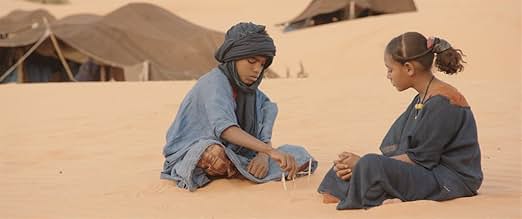
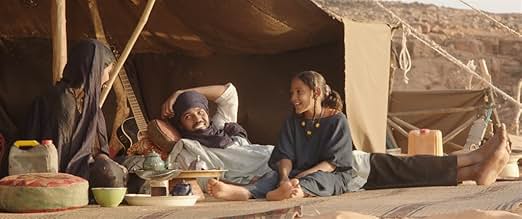
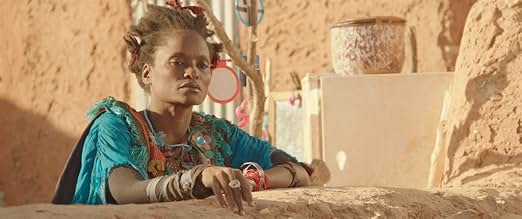
I don't believe there is one frame in this film that is not gorgeous, that couldn't be displayed as a photograph at a gallery. The muted colors of the desert, the medieval architecture of the town, the tragically expressive faces always glowing in a magical light--all of it is almost painfully beautiful. The story is beyond tragic. By seemingly digressing into numerous anecdotes illustrating the quirks of the population, the director allows us to appreciate deeply the texture and social fabric of the community that is being poisoned by madness. We see in particular its effect on an extremely appealing but by no means sanctified family. This is one of the film's extraordinary strengths as well. No character is oversimplified; even the appalling jihadists are granted their humanity. I've seen "Boyhood" and "Birdman", the apparent favorites for the Oscar. "Timbuktu" utterly blows both those fine movies out of the water.


Did you know
- TriviaIn 2015 Timbuktu became the first film shot in Mauritania by a Mauritanian director to win at the Cesar film awards. It won seven awards out of its eight nominations including Best Film, Best Director, Best Original Screenplay, Best Editing, Best Cinematography, Best Music and Best Sound, thus setting the record for being the African film with the most awards ever.
- GoofsIn the stoning scene, both man and woman are buried up to their necks. In a proper Islamic stoning (rajm), the woman should only be buried up to her waist.
- ConnectionsFeatured in The Oscars (2015)
- SoundtracksShooting The Statues
Composed, Arranged and Orchestrated By Amine Bouhafa
with The City of Prague Philharmonic Orchestra
© 2014 Universal Music France
- How long is Timbuktu?Powered by Alexa
Details
- Release date
- Countries of origin
- Official sites
- Languages
- Also known as
- Timbuktú
- Filming locations
- Oualata, Mauritania(as Timbuktu)
- Production companies
- See more company credits at IMDbPro
Box office
- Gross US & Canada
- $1,076,075
- Opening weekend US & Canada
- $45,110
- Feb 1, 2015
- Gross worldwide
- $7,179,391
- Runtime
- 1h 36m(96 min)
- Color
- Aspect ratio
- 2.35 : 1
Contribute to this page
Suggest an edit or add missing content