Read Tech News With Digest
Helps you quickly pick interesting articles to read.
 Lovable apps leaked passport numbers and 200,000 private messages
Researchers scanned 159,041 Lovable projects and found many built with Supabase left sensitive data readable without a login. Among the worst cases: a German forum exposing over 80,000 profiles and 200,000 chat messages, and a provider leaking more than 1,000 identity records with passport numbers and expiration dates. Lovable's terms put security responsibility on customers, yet its marketing suggests no technical skill is needed.
"An easy-to-use development platform does not remove the need for an expert review of access permissions before an application handles confidential data."
 SpaceX Catches Starship Again to Close Out Flight 15
SpaceX's Starship Flight 15 broadcast on X shows the company once more catching the Super Heavy booster with the launch tower's chopstick arms. The stream, scheduled for November 13 at 9:58 PM, follows a test campaign in which the booster returns to the pad instead of splashing down, while the upper stage continues its own flight. The catch remains the headline moment of the mission.
"SpaceX Catches the Starship to end Flight 15"
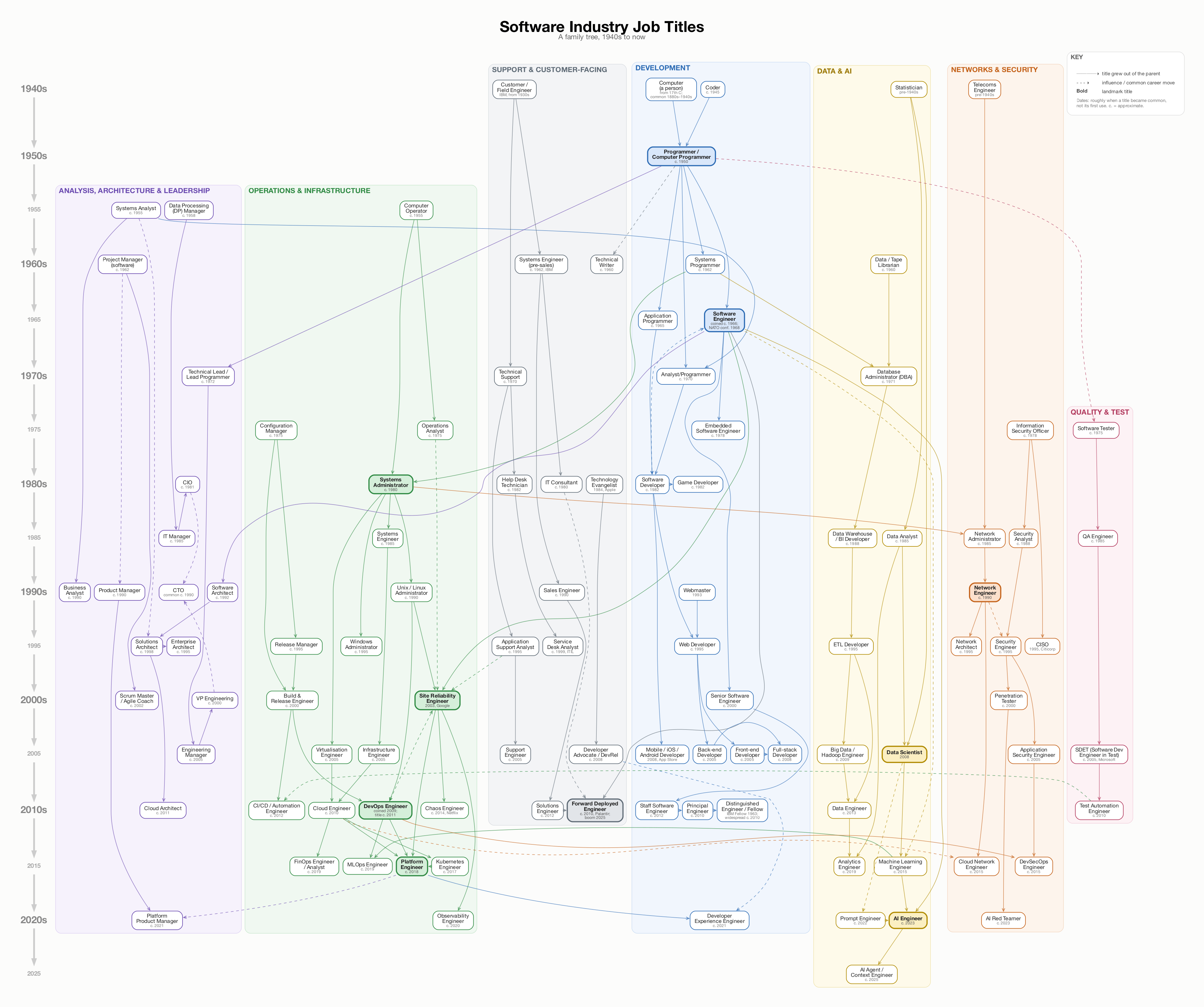 From "Computer" to "AI Agent": an 80-year family tree of software job titles
Ian Miell, who once worked as "Head of DevOps" under several other names, traced 104 software job titles from 1947 to today in a Graphviz family tree. Coding began as low-status clerical work done largely by women, the webmaster fragmented into specialists and recombined as full-stack, and the prompt engineer was absorbed almost as soon as it appeared. The forward deployed engineer, he notes, is IBM's 1960s systems engineer under a new name.
"The Dev/Ops divide has never been resolved. It just keeps getting new names."
 PyPI now warns you when a package's origin can't be verified
PyPI has finished its UI overhaul, adding a dedicated security tab that shows each release's provenance state and per-file attestations. Releases with full provenance have every file backed by PyPI Publish or SLSA Build Provenance attestations; those without get a clear notice that file origin can't be cryptographically verified. New warnings flag incomplete, inconsistent, changed, or lost provenance, and the project page, release files, and release history tabs were redesigned around them.
""No provenance" simply means that no file in the release has an attestation. This is typical for older releases or projects that have not yet configured Trusted Publishing."
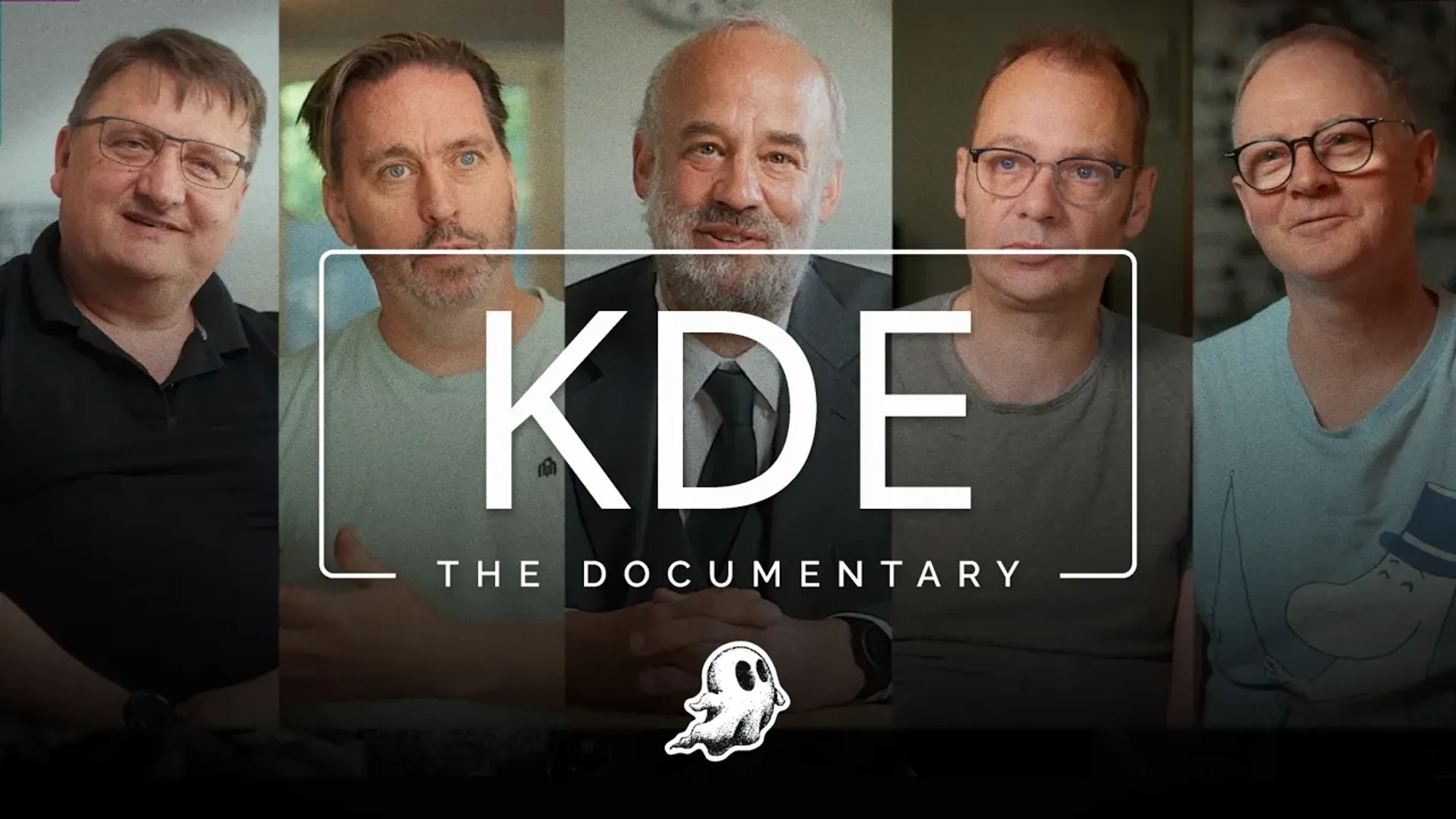 A Student's 1996 Usenet Post Grew Into KDE, the Desktop That Made Linux Usable
This documentary traces KDE from Matthias Ettrich's 1996 Usenet call for help building a Linux desktop to its place as the default on major distributions and the Steam Deck. It covers the Qt licensing fight, the rivalry with GNOME, KHTML becoming the basis of WebKit and Chrome, the rocky KDE 4 release, and how KDE e.V. became a model for open source governance.
"Above all, the film is about the people who built KDE, the friendships that formed, and why generations of developers have given their free time to it."
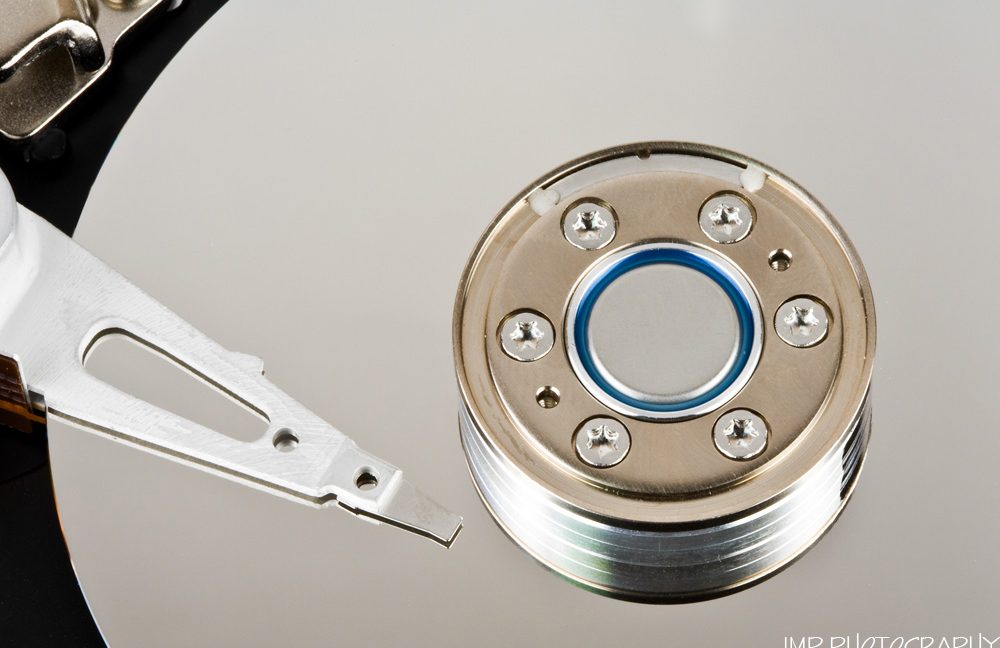 Seagate revives the SSD-HDD hybrid drive as storage prices soar
Seagate's FireCuda Forge pairs a 8TB or 20TB hard drive with a user-supplied M.2 NVMe SSD, managed by its new Alkemi platform, starting at $699 without the SSD. With NAND and mechanical drive prices climbing amid the AI boom, the hybrid math from Apple's 2012 Fusion Drive era works again. But Seagate won't say how Alkemi tiers data or what happens when one drive dies.
"Fast-forward to our current storage cost predicament in 2026, and Seagate's line of thinking that everything old is new again starts to hold water."
 Grey Rocking: How Being Deliberately Boring Can Improve Your Life
The grey rock technique, coined in 2012 by mental-health blogger Skylar after she left a 25-year relationship with a man she came to see as a psychopath, means becoming so unremarkable that drama-hungry people lose interest and drift away. It works on stalkers and narcissists, but also on the family WhatsApp group. One writer tries it and finds it defuses old arguments — while wondering whether he still has any opinions of his own.
"You don't just practise grey rock, you become a grey rock. There are grey rocks and pebbles everywhere you go, but you never notice them. None of them attract your attention. You don't remember any specific rock you saw today because they blend with the scenery."
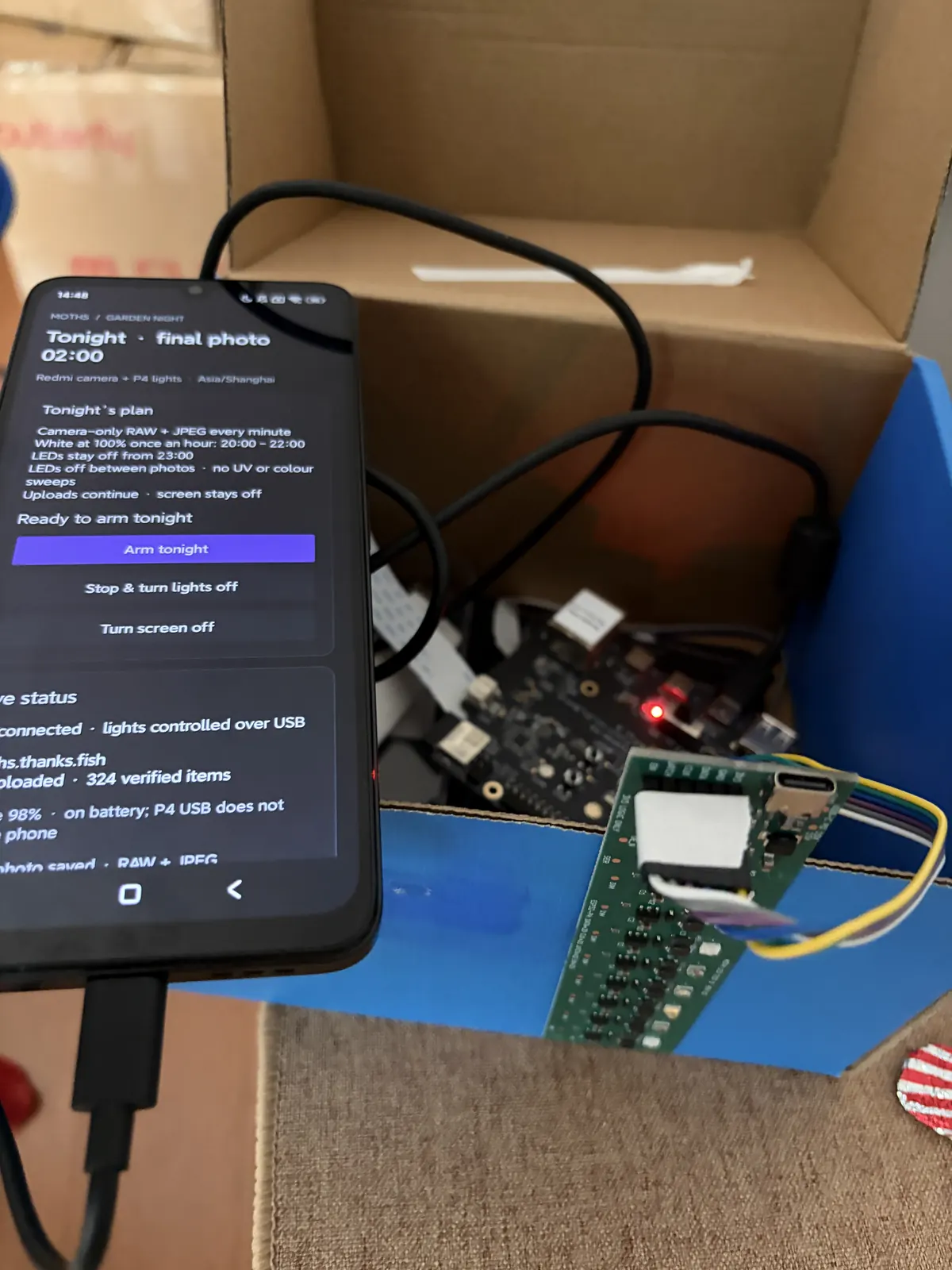 Why buy a Raspberry Pi when a $50 used phone already has the camera, GPS, and battery?
A maker pricing out a camera-and-lights project found that a used Redmi 13C 5G or Huawei Mate 30 5G costs roughly $45–75 on Taobao and already packs a 40–50MP camera, GPS, storage, a clock, a battery, a touchscreen, and cellular. A comparably equipped Raspberry Pi 4 build runs about $222–347. The Redmi is rooted and running scheduled wake-and-sleep tasks; the open question is sourcing hundreds of matching phones with healthy batteries.
"There's something fun about taking a device made in enormous numbers, giving it a second life, and finding that most of the hardware I was about to assemble is already inside it."
 Google's Antigravity agents proved a 2013 information theory conjecture and formalized the Weil conjectures in Lean
Google researchers paired Gemini 4 models with Antigravity's /teamwork multi-agent harness to attack problems open for decades. The system proved the 2013 Courtade–Kumar conjecture in full generality with a 50-million-line Lean 4 formalization, and autonomously produced a 1.8-million-line machine-checked formalization of the Weil conjectures. Other results settled open questions in quantum query complexity, matrix multiplication, streaming algorithms, and splay-tree performance, while a 30-agent chemistry loop hit 95% top-1 accuracy on NMR structure elucidation.
"Gemini first found counterexamples to a generalized conjecture from the CUHK team's earlier paper."
 LinkedIn and Monster pull 1,500 fake job ads that funneled applicants into an MLM
After a CBC visual investigation, LinkedIn removed nearly 900 postings and Monster took down 600 — all advertising remote travel jobs paying up to $75,000 with no experience required. Applicants who applied with blank résumés were directed to virtual sessions run by people tied to Evolution Travel, a U.S. multi-level marketing company that charges hundreds upfront and a monthly fee. The ads never mentioned the MLM or the costs.
"They catch you with the lure of the fake job. The money is great, [successful applicants] get to stay at home. You have to pay to get work — that's not how work works."
 DeepSeek V3 JAX - Full architecture in 190 lines of pure JAX
DeepSeek V3 JAX is a minimalist implementation of the DeepSeek V3 architecture—including Multi-head Latent Attention, DeepSeekMoE, auxiliary-loss-free balancing, and multi-token prediction—in just 190 lines of pure JAX. No Flax, no Equinox, no PyTorch. It was pretrained from scratch on a MacBook Air using public-domain detective fiction, achieving a validation loss drop from 5.02 to 3.51 in about 2.6 hours. The code is readable top to bottom, with plain dicts of arrays and every component as a function. Perfect for learning, experimentation, and understanding modern LLM internals without heavy frameworks.
"The bias evens out the experts without costing anything, which is the paper's claim."
 SpaceX's Starship Is the Only Way to Put Data Centers in Orbit
Google, SpaceX, Blue Origin, and China's Three-Body Computing Constellation are all betting on orbital data centers, and Elon Musk claims space will be the cheapest place for AI within a few years. A sober cost model finds the economics hinge almost entirely on Starship reaching Falcon-like reusability: space solar matches off-grid terrestrial power near $250/kg to orbit and beats every current energy source near $50/kg, down from roughly $1,500/kg today. Cooling turns out manageable; dead chips and bandwidth limits are the real drags.
"The inability to do maintenance would be a large cost: a dead chip in an orbital data center would remain dead, wasting the supporting power and cooling infrastructure and diminishing overall compute."
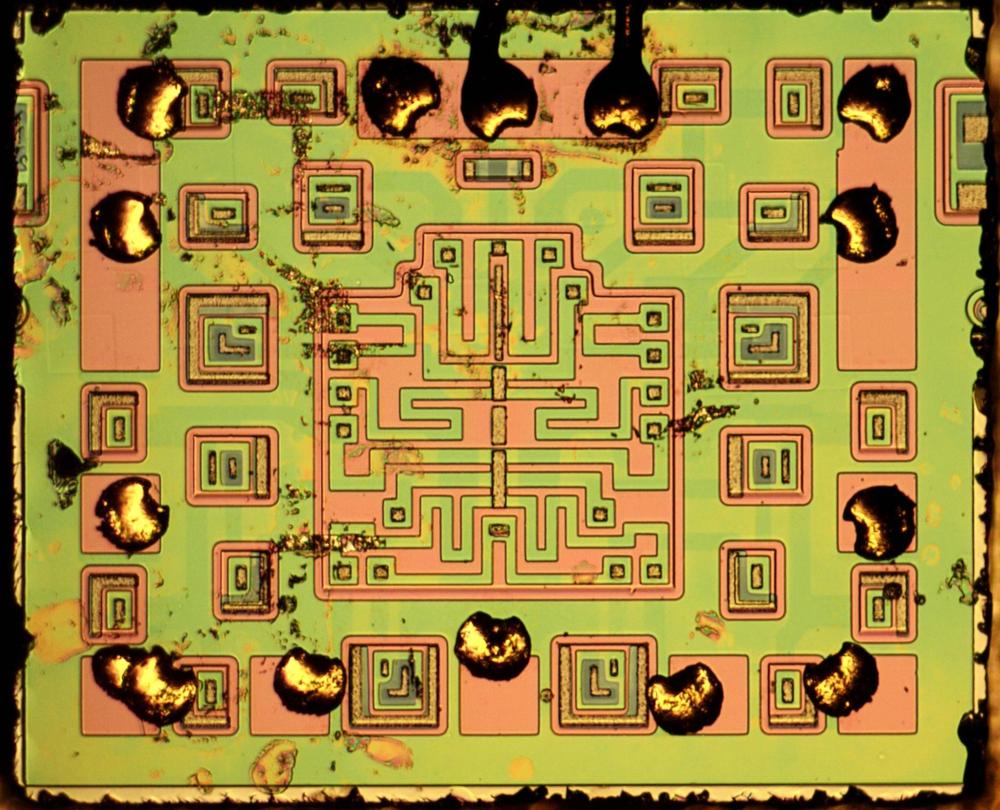 Signetics' 1965 chip hid three different ICs on one die
CuriousMarc found some unidentifiable chips in an old parts bin, and after decapping one with hot air and cleaning the die with a few drops of boiling sulfuric acid, Ken Shirriff reverse engineered it as the Signetics ST680A — four NAND gates in diode-transistor logic from 1965, part of the first IC family sold in a plastic DIP. Two stray diodes on the die revealed that Signetics reused the same silicon for at least three chips, swapping only the metal layer.
"Much to my surprise, I found that the Signetics chips predate this standard and have ground on pin 1 and power on pin 8: still diagonal, but the wrong diagonal!"
 AI Burns Up to 180 Times More Energy on Non-English Text
University of Michigan researchers measured three open-source models—Alibaba's Qwen 3, Google's Gemma 3, and Meta's Llama 3.1—and found non-English prompts cost 1.4 to 180 times more energy, with Hindi at 7.9x and Bengali at 15.3x English. The cause: non-Latin scripts need more tokens, and accuracy often drops too. Roughly 5.2 billion people face this double penalty, which could price them out of AI.
"The languages that typically consume more energy also tend to have lower accuracy in the model output."
 Terminactory - Cozy terminal-native idle factory game in Rust
Terminactory (tfac) is a cozy factory-building idle game that lives entirely in your terminal, built in Rust with ratatui. Dig copper, coal and iron, melt and press them, sell goods, and research your way up to computers and oil. There's nothing to fight and nothing breaks at random — the factory keeps earning while you're away. It's designed to sit in a split next to your AI agents, which can send you short Markdown messages that appear in-game via a simple `tfac msg` command or a Claude Code hook, so you can play while they work. It even ships with its own in-game browser, termweb, holding the wiki, research tree and production stats. Install with Cargo and try `tfac --demo`.
"It is made to sit in a split next to your AI agents. They can send you short messages that show up in the game, so you can play while they work."
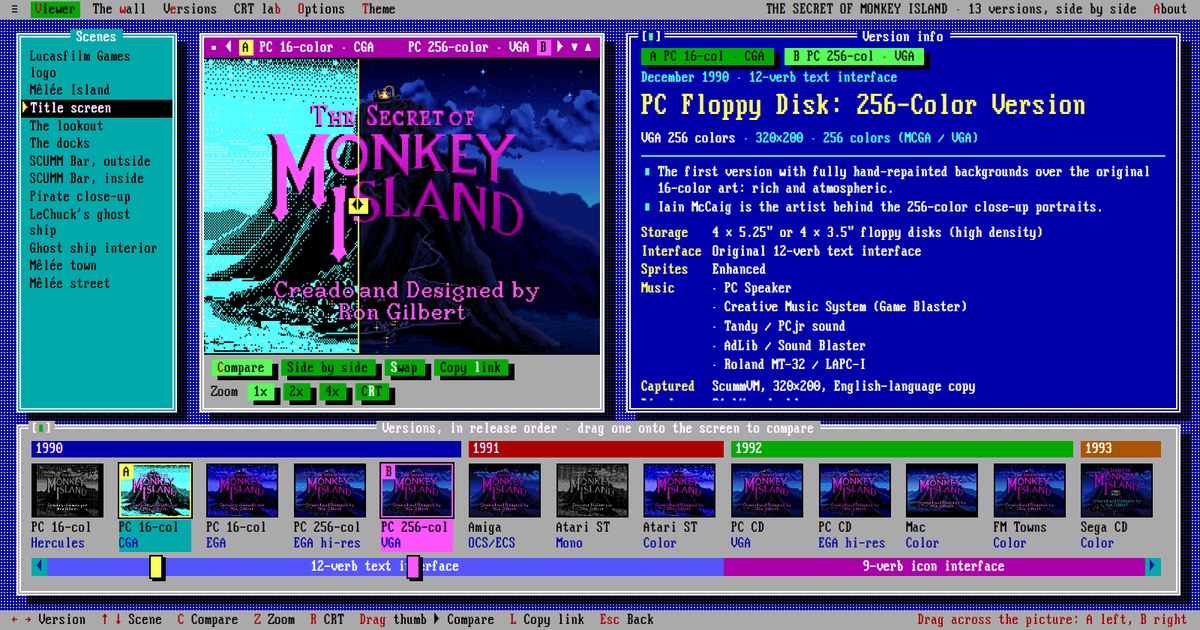 Two brothers put all 13 versions of Monkey Island side by side
A fan-made interactive archive lines up 156 screenshots from The Secret of Monkey Island — 12 scenes across 13 releases, from the 1990 16-color PC floppy to the 1993 Sega CD. Every capture was taken in ScummVM (Hatari for Atari ST mono), scaled with nearest-neighbour pixels and 4:3 correction, and rendered through WebGL2 CRT shaders so each version appears on the monitor it was made for.
"The twelve moments are the same in every version, with the same framing, so switching versions changes the machine, not the moment."
 Dartmouth Halts Math PhD Admissions, Leaving Applicants and Students Reeling
Guarini School of Graduate and Advanced Studies has paused admissions to Dartmouth's math PhD program for the 2027-2028 cycle, citing a departmental review. Current students' funding and status remain unchanged, but applicants who already submitted materials will not be reviewed. The move follows a national 15% drop in PhD acceptances and raises concerns about undergraduate course offerings and research culture.
"The idea of being a research university and a liberal arts college doesn't work if you don't have graduate students."
Commercial phone unlocking tools don't invent new attacks; they industrialize known ones. This technical overview walks through Android's hardware security architecture — TrustZone's Normal and Secure Worlds, Gatekeeper and Keymaster, the boot chain — and explains why a Secure Element like Google's Titan M is the single biggest factor in resisting forensic unlocking. It also details how File-Based Encryption derives keys from user credentials and how BFU attacks break the boot chain to brute-force PINs offline.
"Commercial phone unlocking tools are not magic. They exploit the same classes of vulnerabilities that security researchers publish about at conferences and in academic papers."
 Google's Project Zero will disclose bugs 90 days after reporting, then cut to 30
Project Zero is replacing its "90+30" policy with a "Full X" model: vulnerabilities are disclosed X days after being reported to the vendor. Starting today, that's 90 days; on February 2, 2027, it drops to 60, and on January 3, 2028, to 30. Most special cases, including grace periods and variant policy, are gone. The reason: LLMs have accelerated vulnerability discovery and exploitation, making patch soak time meaningless and increasing the volume of bugs Project Zero finds.
"Patch soak time is no longer meaningful in a world where attackers can almost immediately determine bug details from a patch, and can put users at risk by creating a false sense of secrecy."
Fursoy Slice-1 is a clean-slate 64-bit out-of-order superscalar RISC-V processor written in SystemVerilog. It implements RV64IMAFDV with Zba/Zbb extensions, Sv39 virtual memory, and privilege separation, and successfully boots mainline Linux 6.6.50 with BusyBox userspace. The core features a 2-wide superscalar pipeline, 128-entry reorder buffer, 160-entry physical register file, and non-blocking caches. It meets 500 MHz timing in Nangate 45nm synthesis across 8 functional blocks, with cycle-exact CPI telemetry showing zero conservation errors over 89 million cycles. This project provides a verified, high-performance RISC-V core for research and development.
"Every cycle is mutually exclusively owned by one architectural bucket asserted continuously in hardware, with zero CPI conservation errors across 89,861,075 simulated cycles."
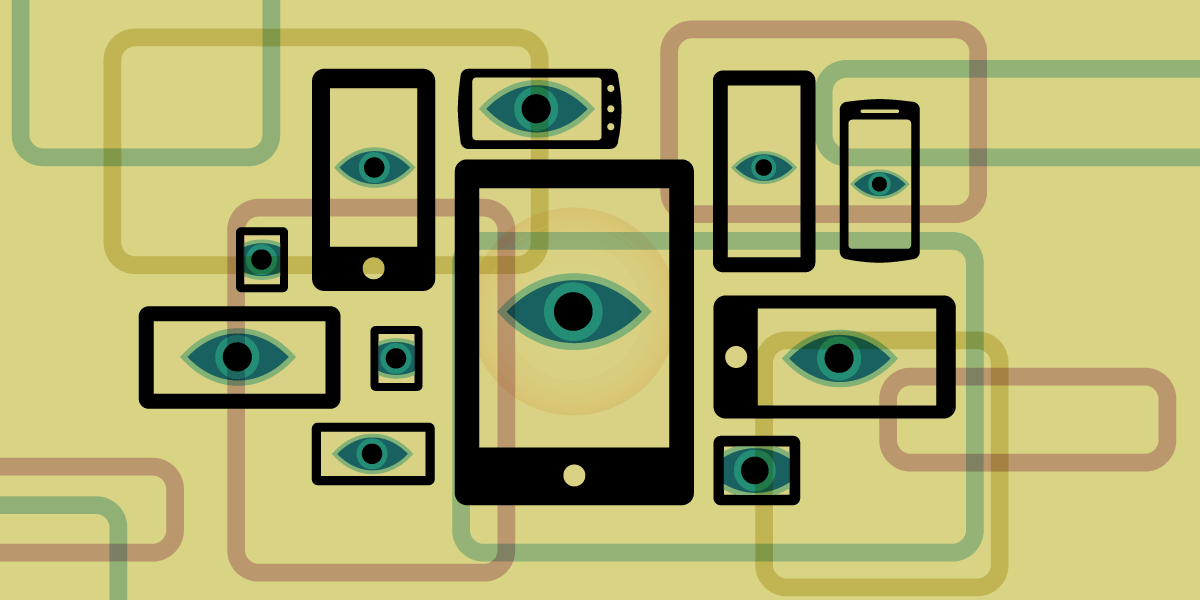 EFF Warns Smart Glasses and AI Wearables Make Privacy a Burden on Everyone Around You
Meta and Google's camera-equipped glasses, Apple's Audio Intelligence, and Amazon's Bee devices record and transcribe daily life, but their privacy promises only protect the buyer. EFF argues bystanders can't opt out, consent becomes meaningless, and constant monitoring erodes the spontaneity of private conversation. Technical fixes and laws won't solve the social damage, so the group urges users to push back through feedback and direct engagement.
"And just alerting bystanders doesn't do much to help. It can actually be weirdly disempowering to you in that you're like, 'What am I meant to do now?'"
 Build Your Own Federated Messenger Protocol, Email-Style
A hands-on walkthrough for building a federated chat protocol called lnchat, modeled on how SMTP servers discover and talk to each other. It covers email-shaped identities like [email protected], discovery through a .well-known JSON file, server-to-server endpoints for resolving and publishing public keys, and end-to-end encryption using HPKE-style encapsulation. The author is candid about the limits: a compromised server can lie about keys, so real E2E needs fingerprints, TOFU, or key transparency.
"If a server is responsible for publishing users' public keys, a malicious or compromised server could lie about a key."
Italy's data protection regulator hit Meta with an $887 million penalty over how its app accessed Android users' photo galleries, ruling that the consent flow never clearly explained what people were agreeing to. Hacker News commenters were less focused on the fine than on the tally: one user added up Meta's prior EU penalties to roughly €5.2 billion, bringing the total past €6 billion — and still called it a slap on the wrist.
"Wait, they could see what we were doing inside our bedrooms, and they got away with a fine?"
A brisk, hands-on walkthrough of implementing a working subset of PostScript in concise, Forth-inspired JavaScript. It covers tokenizing programs, mapping PostScript types onto JavaScript values, and driving an operand stack and dictionary stack with a small set of primitive operators. The result runs as a REPL and handles examples like `[10 20 30] {2 mul} forall` identically to Ghostscript, with exercises for extending the operator set.
"I think the most trustworthy programming languages are those which are human-scale: languages which a single user could reasonably write from scratch on some readily-available computational substrate."
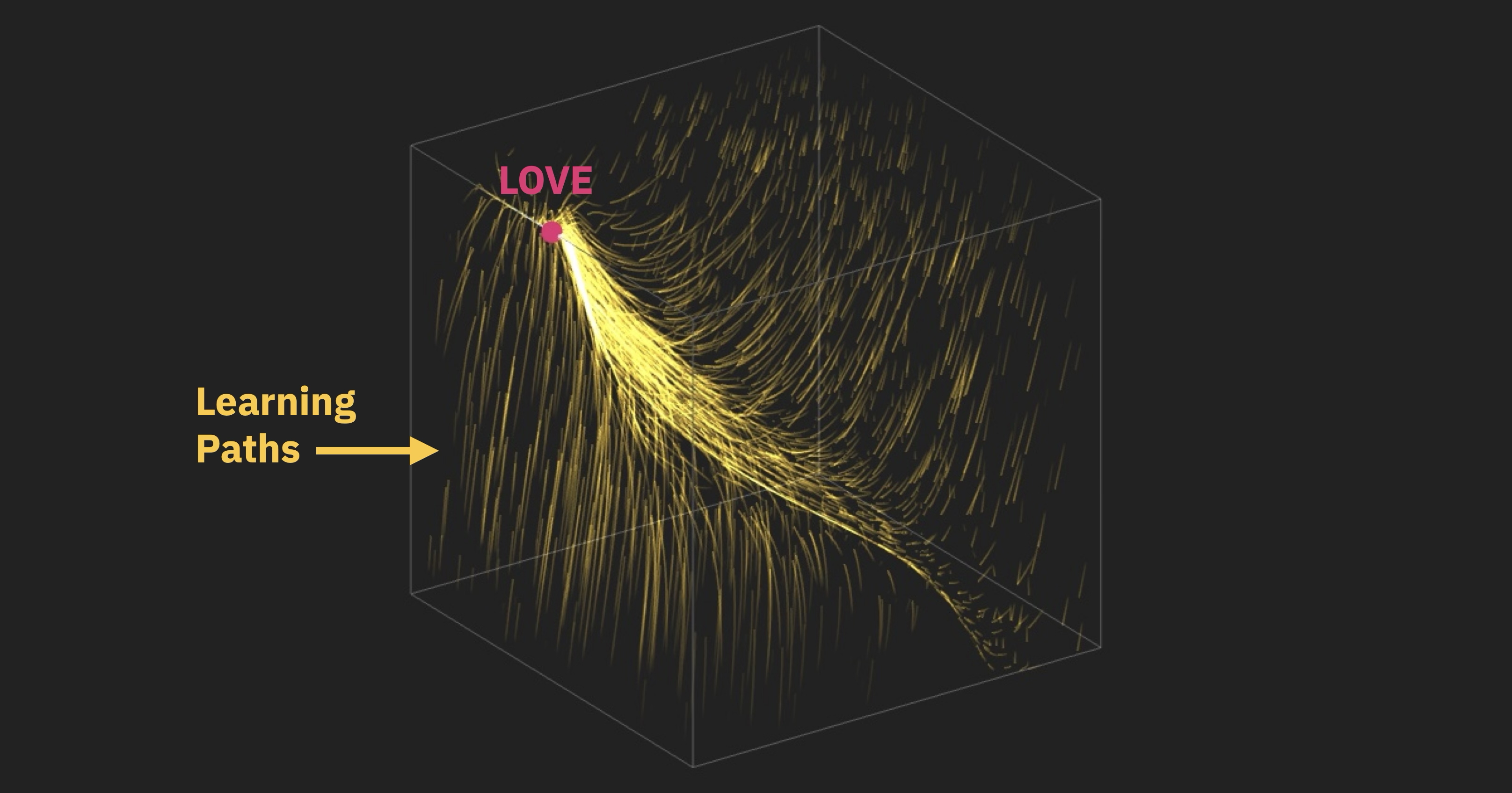 Watch a four-neuron brain teach itself to love the light
Aatish Bhatia and neuroscientist Arkarup Banerjee build a simple digital creature called a spark with just four neurons and three adjustable parameters, then let it learn by trial and error. Through thousands of attempts, guided only by reward and punishment, the spark goes from spinning in place to expertly tracking light. The piece visualizes learning as a path through the space of possible brains, and shows how the same algorithm can produce fleeing, freezing, or fighting depending on the reward.
"Learning is how you navigate this vast internal space. And feedback is the compass that points the way."
The IRS has published the source code for Direct File, its free, interview-based federal tax filing service, on GitHub. The repository includes the Scala-based Fact Graph for reasoning about incomplete returns and test cases for interpreting the 2024 tax code. However, the code is archived, unmaintained, and may contain unpatched vulnerabilities, so the IRS explicitly warns against using it in production. Certain sensitive code was removed.
"This repository has been archived and is no longer maintained. The code is provided for historical reference and may contain unpatched or unknown vulnerabilities. It should not be used in production systems."
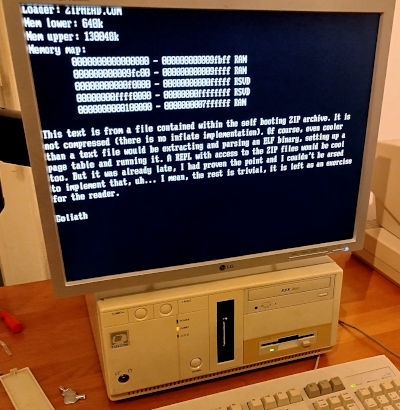 This ZIP Archive Boots Itself on a Bare PC
A developer built a ZIP archive that is also a bootable disk image. The first bytes form a valid ZIP local file header whose filename field doubles as a jump instruction, and the Multiboot magic 0x1BADB002 hides in the header bytes. It boots under QEMU direct kernel boot, from a floppy image, or on real hardware including a Pentium MMX, i486 DX2, and Am386DX-40. The archive even contains the source code to rebuild itself.
"Luckily, Phil Katz' initials are valid opcodes."
 A Taped Trash Can Blocks Nearly All Radio Signals, Test Shows
Worried about EMPs, Jeff Kaufman tested a galvanized trash can as a Faraday cage. Using a broadband noise generator and a radio receiver, he found the bare lid leaked at the seam, but taping it eliminated detectable signal across 24 MHz to 1.7 GHz. While unplugging electronics is probably enough, a taped trash can offers strong protection if you want it.
"Overall, while I'm still not sure a Faraday cage is needed, if you do want one a taped trash can should work very well."
 Lean proof checker finds 138 drafting errors in the US tax code
Lexifina turned Title 26 into structured data and pointed Lean at every cross-reference, flagging 138 real faults — dead citations, typos, duplicated paragraph numbers, unclosed parentheses — each backed by a machine-checked certificate. They then modeled the 2025 income tax in Lean, validated it against PolicyEngine-US, Tax-Calculator and UsTaxes, and ran a loophole search that rediscovered known strategies and surfaced a few results they could not find documented anywhere.
"One dollar can cost $8,046. The EITC's investment-income limit at $11,950 is a cliff, and the saver's credit tiers are cliffs: a couple at $47,500 gets $2,000, at $47,501 they get $800."
 Agweb - Non-intrusive browser for coding agents
Agweb is a macOS browser built on WebKit specifically for coding agents. It solves the common pain points of focus stealing and resource-heavy headless browsers by providing a single window that never takes focus, letting agents drive it via a playwright-cli-style command while you monitor all tabs live. With features like idle tab suspension, shared login profiles, and secret handling, it's designed to make multi-agent workflows efficient and unobtrusive. Perfect for developers running multiple coding agents who need a lightweight, always-visible browser that acts like a human without the overhead.
"agweb is one window that never takes focus: agents drive it from the shell with `agweb`, a playwright-cli-style command, and you watch them all live."