Enterprise Architecture advice for SMEs navigating AI adoption. Grounded in TOGAF, free of hype.
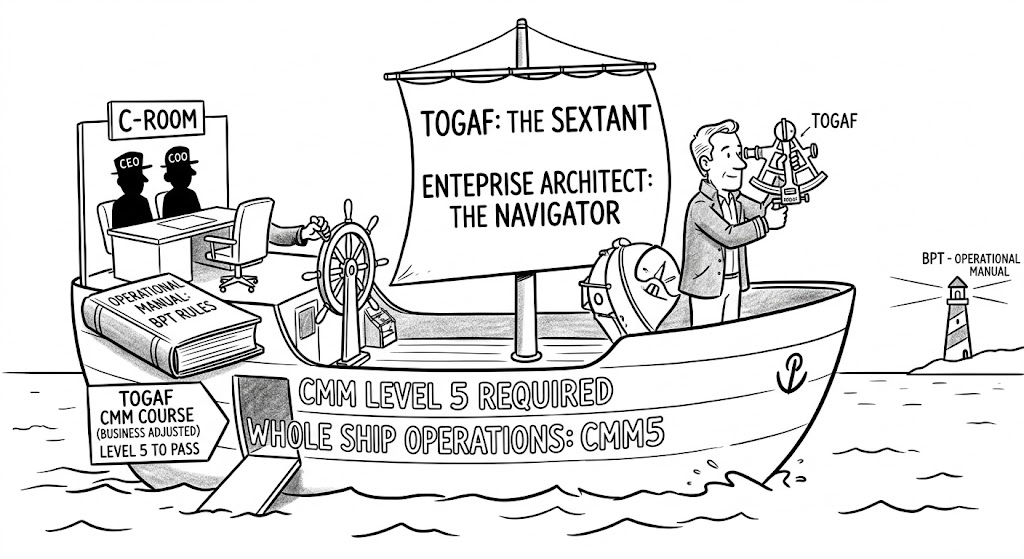
BPT Is Not a Workflow — And Why That Word Has Been Hijacked
“Workflow” is one word doing three jobs, and the collision is costing organizations clarity about what they actually own. Here’s the untangling. Three things, one word WORKFLOW 20206 aka WFL2026 — the implementation artifact. This is Dapr and Temporal, and their relatives: code-first, durable orchestration for distributed systems. It persists state, survives crashes, manages retries. It exists because modern applications are constellations of microservices and AI agents landing as containers, and someone has to keep track of where each one is in its execution. It lives entirely in Technology (T), and it’s optional — a system can be built without it. ...
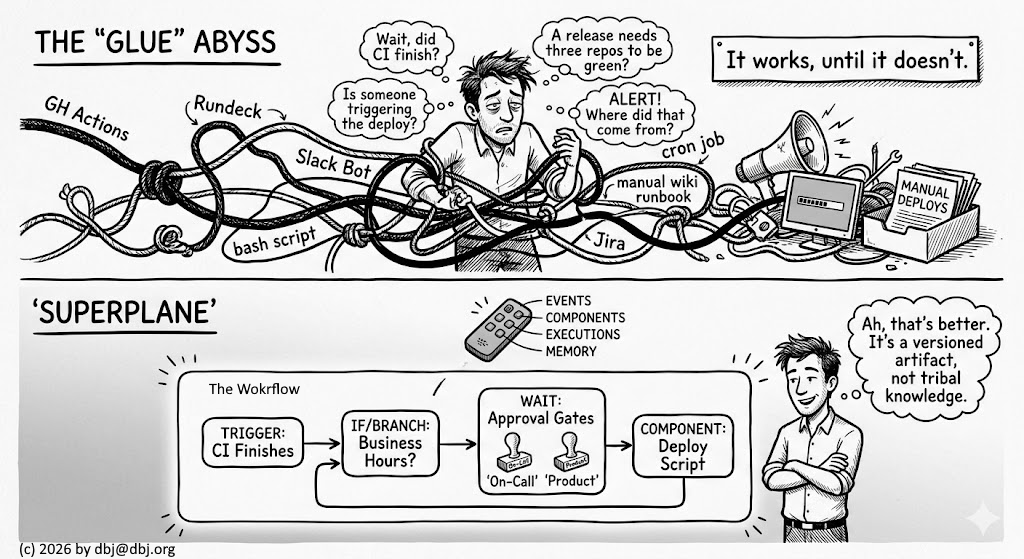
SuperPlane: The Bridge Over the "Glue Abyss"
The Control Plane Your Platform Team Has Been Gluing Together Manually Platform engineering teams write a lot of glue. CI finishes — someone triggers a deploy script. An alert fires — someone pings Slack, opens a Jira, checks the last five deployments manually. A release train needs three repos to be green before the coordinated push — someone watches dashboards and hits the button when the moment looks right. This glue lives in a dozen places: GitHub Actions, bash scripts, cron jobs, Slack bots, Rundeck, internal wikis with “runbook” in the title. It works, until it doesn’t — and when it doesn’t, nobody knows which piece failed or why. ...
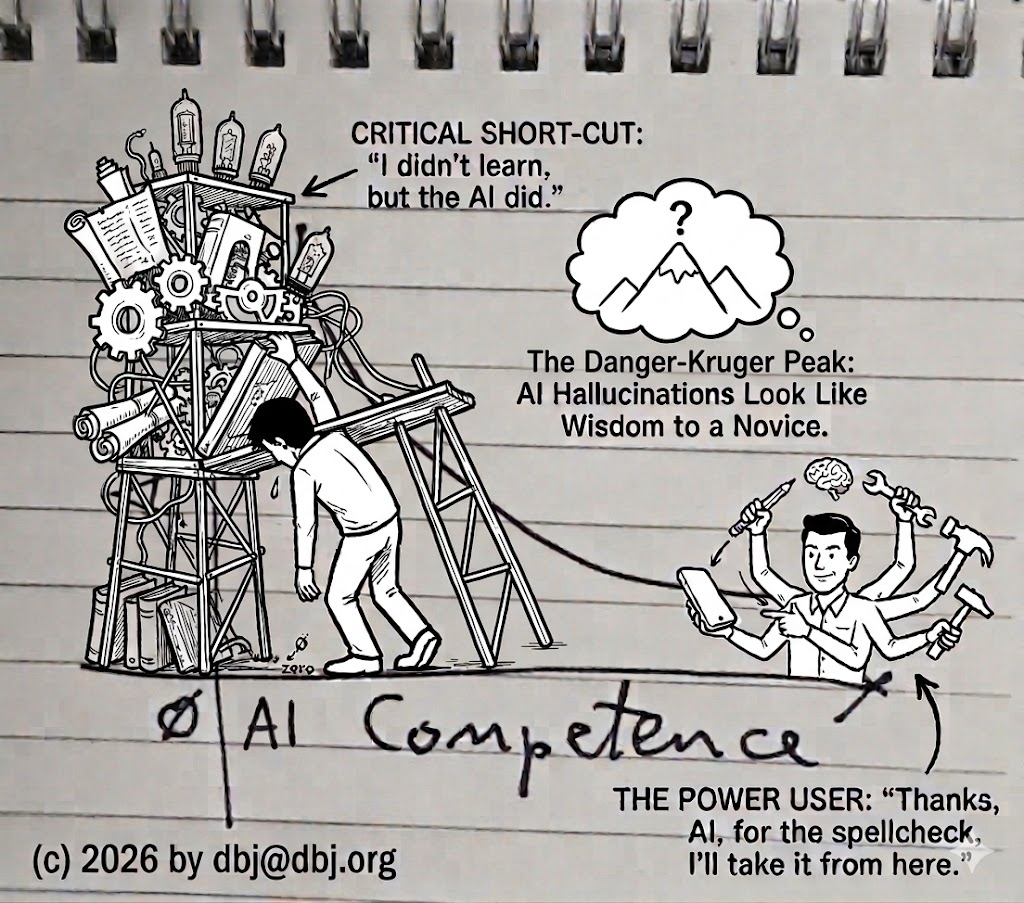
The Danger-Kruger Peak
There’s a ladder. The rungs are labeled “AI Competence.” A novice climbs it, rung by rung, using a critical shortcut: “I didn’t learn, but the AI did.” It works. For a while it works great. The climb is fast, the view improves with every step, and the effort-to-altitude ratio feels like magic. Then the ladder ends. Not because the climber ran out of energy — because the ladder did. That point is the Danger-Kruger Peak: the spot where AI hallucinations start looking exactly like wisdom, because the climber has no competence of their own left to tell the difference. ...
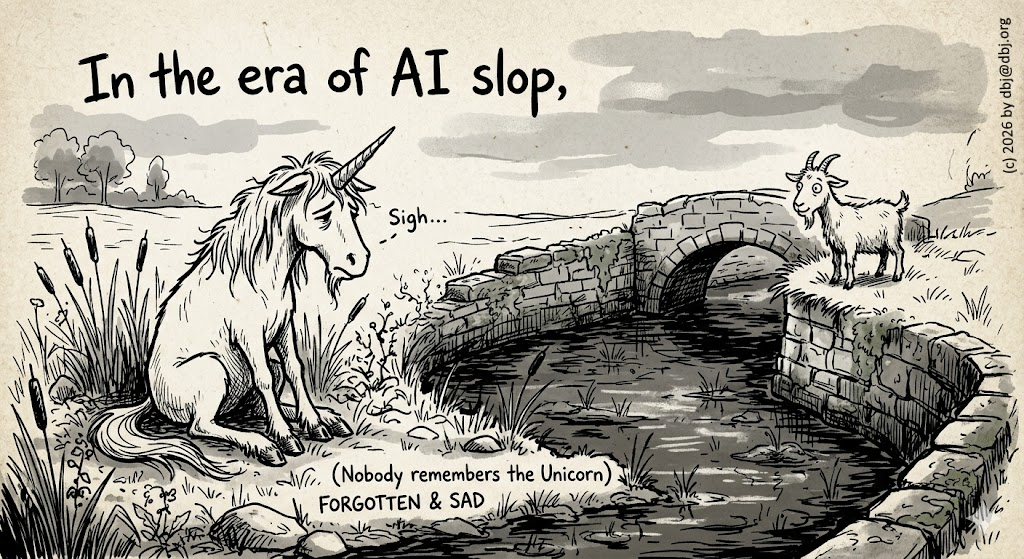
In the Era of AI Slop
The unicorn is still there. Exactly where it always was. But. Nobody is looking. A goat walked to the side of the moat and it’s fine up there — visible, unremarkable, good enough. The goat didn’t defeat the unicorn. It is just vibed up in greater numbers, at lower cost, faster than anyone could count. That might be the epitome of the AI slop. Not malicious. Not even bad. Just sufficient — produced at a volume and velocity that makes discernment feel like an unaffordable luxury. (yes I used that word) ...
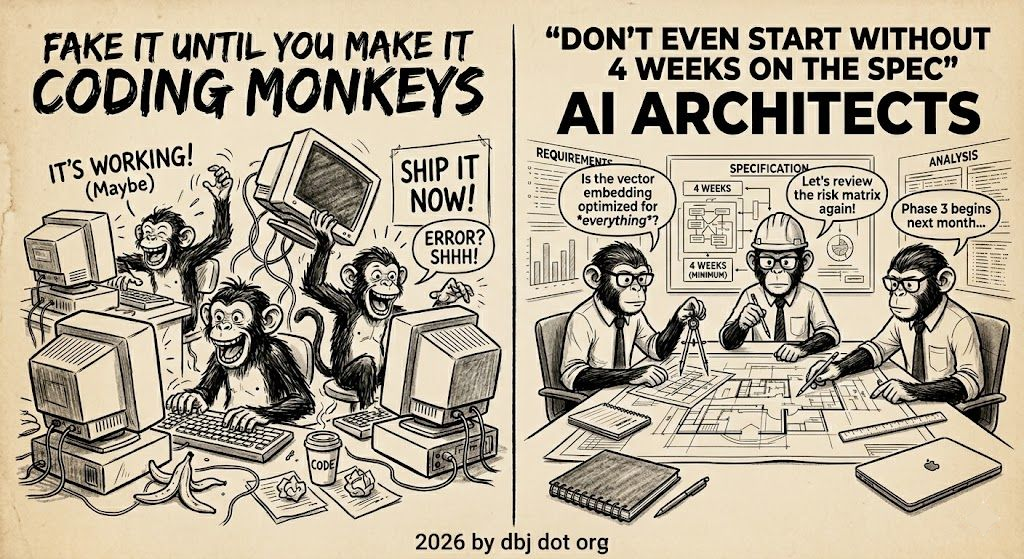
Fake It Until You Make It: Coding Monkeys vs. AI Architects
Two teams. Same deadline. Different disasters. On the left: the coding monkeys. Keyboards rattling, errors scrolling, “It’s working! Maybe—” before the SHIP IT NOW and the inevitable ERROR. Fast. Confident. Wrong. On the right: the AI architects. Whiteboards full, meetings scheduled, not a single line written yet. “Don’t even start without four weeks on the spec.” Safe. Thorough. Also wrong. The cartoon is funny because both rooms exist in every organization that has ever touched software. ...
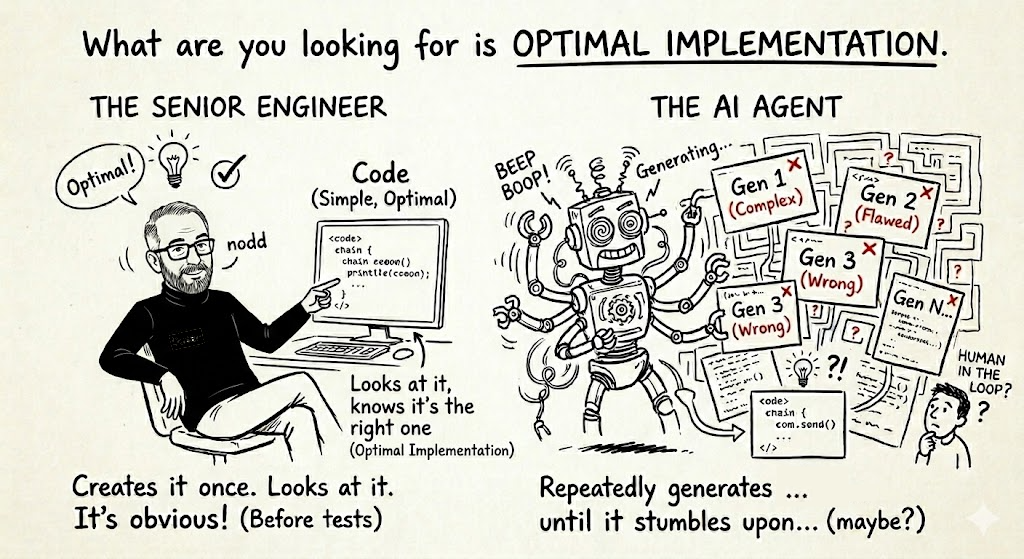
What You Are Looking For Is Optimal Implementation
The senior engineer looks at the problem. Builds a mental model. Writes code that is simple and correct. Looks at it again, knows it’s right, moves on. The AI agent generates. Evaluates. Regenerates. Evaluates again. Tries a variation. Stumbles into something that passes the tests. Maybe. Same output, different paths. And the path matters — not for sentimental reasons, but for practical ones. What optimal actually means Optimal implementation is not the cleverest solution. It’s not the most elegant one. It’s the one that is correctly scoped to the problem, legible to the next person who touches it, and arrived at deliberately rather than by exhaustion of alternatives. ...
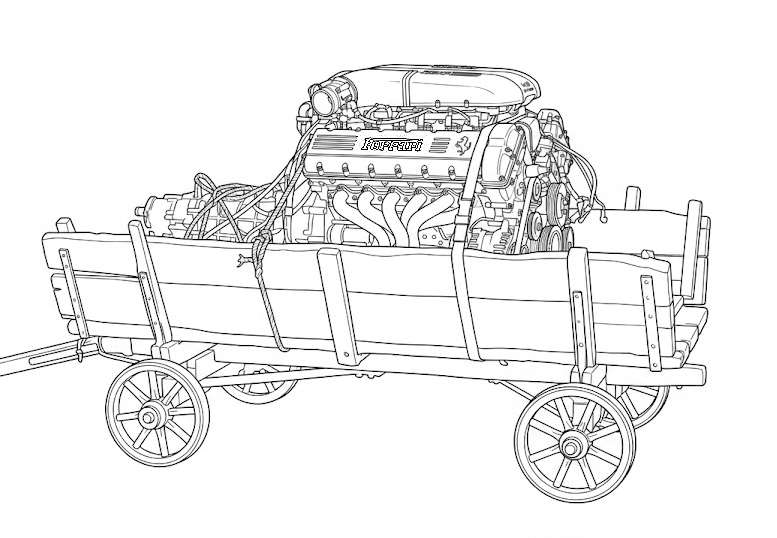
AI on an Old Operating Model
A Ferrari V12 engine dropped into a wooden farm cart. That is not satire. That is the exact situation most organizations are in right now. The engine is state-of-the-art. The cart is nineteenth century. The wheels are wooden. There is no drivetrain, no chassis rated for the load, and nowhere to sit. The moment you open the throttle, the cart disintegrates. What “AI Ready” Actually Means AI-readiness is not a technology procurement question. It is not about which model you license, which cloud you use, or how many GPU hours you can afford. Those are secondary. ...
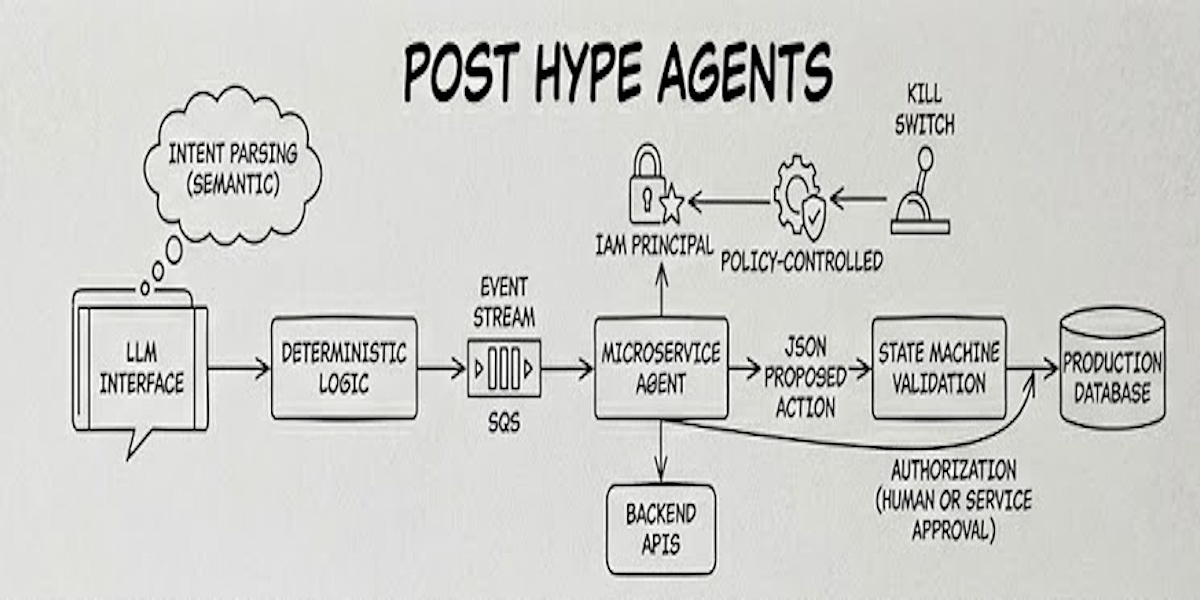
Post-Hype Agents
Post Hype Agents This document defines a pragmatic, engineering-first approach to “Agentic” architectures, aligning them with the rigorous standards of the DBJ Method as established at DBJ.ORG. To move beyond current industry hysteria, we define the “Agent” not as an autonomous entity, but as a Policy-Controlled, Deterministic-Adjacent Task Handler. 1. Core Architectural Principles The Agent is a Consumer: Agents are treated as standard microservices. They pull from event streams (e.g., SQS) and execute strictly defined calls to backend APIs. Semantic Adaptation: The LLM is strictly used as a semantic bridge—translating unstructured input (text, legacy formats) into structured data—not as a substitute for business logic. Determinism First: All logic remains in compiled, testable code. The LLM handles the “intent parsing,” while the DBJ Method dictates the “transactional execution.” 2. Governance and Safety (The “Kill Switch” Model) Following the principles of identity-centric security, an Agent is a first-class identity entity: ...
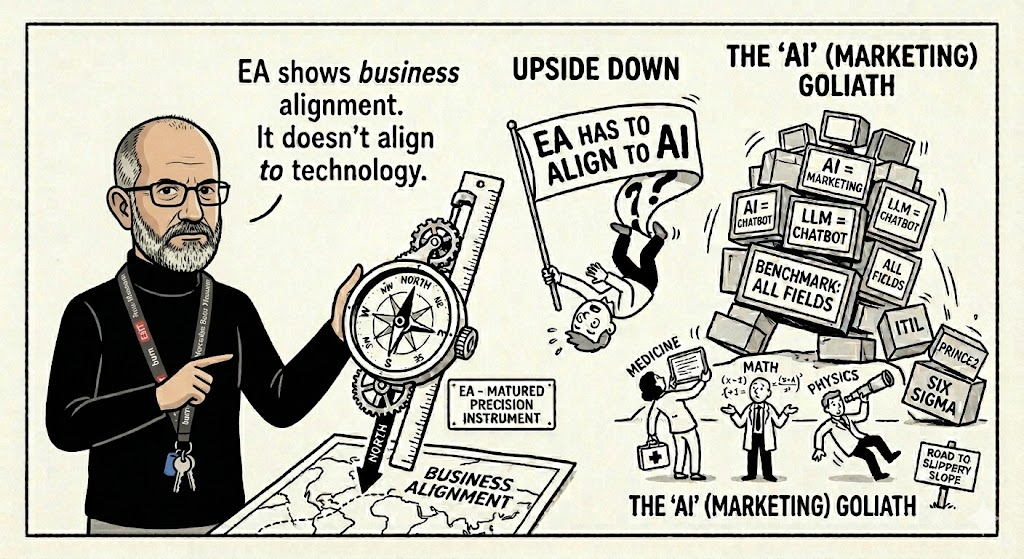
EA Is an Instrument
Regarding the phrase “EA has to align with AI” — a revolutionary flag being waved high. This time by Gartner: https://lnkd.in/d9F9_QZZ This is completely upside down. EA will not change because of AI; to suggest otherwise misses the point of EA entirely. For 50 years, EA has matured into a vital tool. EA is a precision instrument that tells you, me, and all of us whether a business is truly aligned with its technology. ...
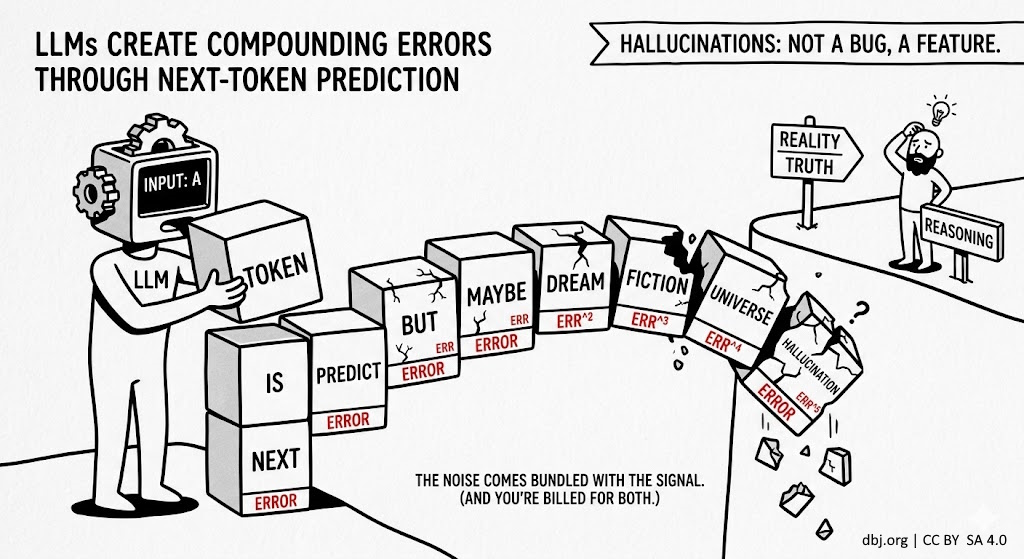
Feature, Not a Bug
© Dusan B. Jovanovic — image generated with Gemini under author’s direction Nobody told you this when you readily signed up for the API key. Every LLM has the same training objective: predict the next token. Not the next true thing. Not the next logical step. The next token — one symbol, conditioned on all the symbols before it. That’s it. That’s the whole game. IMPORTANT It produces text that reads beautifully. It reasons the way a drunk navigates by streetlights — confident, directional, and increasingly wrong. Here is the mechanical problem. Each generated token feeds back into the context as input for the next prediction. So when the model makes a small error at step one, that error is now part of the premises at step two. The mistake doesn’t stay put. It becomes ground truth. The next token is predicted on top of a lie, and the one after that on top of a slightly larger lie, and so on down the chain until you’ve arrived somewhere that sounds perfectly coherent and has nothing to do with reality. ...