Featured Post

SIX KEYS TO A LITERARY GENETIC CODE

In essays on the subject of centricity, I've most often used the image of a geometrical circle, which, as I explained here,  owes someth...

Showing posts with label denny o'neil. Show all posts

Thursday, July 3, 2025

HOSTS, HEAVENLY AND OTHERWISE PT. 3


I started thinking once more about the topic of "story-hosts" after re-reading Batman's visit to "The House of Mystery" in BRAVE AND BOLD #93, courtesy of Denny O'Neil and Neal Adams. In a previous installment of this essay-series, I had talked about how certain issues of that rotating team-up title, because those stories paired Batman, a superordinate icon, with such subordinate icons as The Joker, the Riddler and Ra's Al Ghul, none of whom have ever progressed beyond the subordinate level (in contrast, say, to a rare character like The Catwoman, who made her superordinate mark in the 1990s and who has kept that stature thereafter). 


But at least all of the villains so featured were actual icons. In the story "Red Water, Crimson Death," the two "headliners" are Batman and Cain from DC's "House of Mystery" title-- but not only do they not interact with one another, the latter character has, as far as this story is concerned, no power to interact with Batman or anyone else. He might best be termed a "null-icon" here, as he is in most if not all of the horror-stories he hosted. Thus, in contrast to what I wrote in COSMIC ALIGNMENT PT. 6, in all such narratives Cain would be neither Prime nor Sub. I'm aware that he becomes a Sub in the SANDMAN comic, which parallels what I also wrote in the above essay about the EC story "Horror Beneath the Streets." In that tale the three EC horror-hosts come into "reality" to berate the comic-book makers-- but only to make the humans assign the hosts to their already established venues. Technically they are Primes and the comic-book authors are Subs-- though the categorization is made more difficult in that story-hosts are essentially identical with their authors. They serve the same purpose as omniscient narrators, but as "null-icons," they convey a sense of personality absent in such narrators.


So in my book, "Crimson" is essentially a Batman story, concerning his adventure when he tries to take a vacation from being Batman. He meets a young Irish boy, Sean, during an ocean voyage , and though Bruce Wayne has no idea that Sean is involved in a criminal case, he ends up accompanying the boy back to his small fishing-isle, and thus, getting some necessary exposition-- and an introduction to a supernatural manifestation.          


I won't recount the whole story here, but suffice to say that there's a human agency behind the so-called "red tides" and the never-specified deaths of Sean's parents. However, there's also a superhuman agency that manipulates the Gotham Guardian into intervening to capture the criminals and save Sean's life. And yet, though as scripted this is a Batman story, with no crossover elements, O'Neil and Adams structured the tale as the sort of thing that could have run in HOUSE OF MYSTERY. And suppose that it had been reworked to be just such a story, with Batman ejected and replaced by just some basic one-shot viewpoint character? Then the centricity would have shifted from that POV type to either King Hugh, the ghost that renders aid to the boy's protector-- or even to Sean, since O'Neil's backstory slightly suggests that the boy, still grieving for his lost parents, may have subconsciously summoned the spirit of his dead relative to enact vengeance.


Sunday, May 25, 2025

WEIRDIES AND WORLDIES PT. 3

 I would say, then, that all mysteries after Poe tend to follow either the rational model of the Dupin stories, where the detective's acumen resolves all the problems, and or the irrational model of "The Oblong Box," where even the solution of a given problem merely generates a sense of greater mystery, often of some mystery that remains insoluble.-- RATIONAL AND IRRATIONAL PROBLEMS, 2019.

In Part 2 of this series, I mentioned that Infantino's investment in infusing "Rational DC" with the irrationality of the Gothic was signified by (1) the "spookification" of HOUSE OF MYSTERY and the debut of DEADMAN, both in 1967, and (2) the reinvention of the 1950s character The Phantom Stranger in SHOWCASE #80, in 1969. But in between those two, another DC stalwart showed similar changes in 1968, a little before the Bat-books went full-bore Gothic. I have no direct testimony that Infantino intervened to alter the direction of DC's CHALLENGERS OF THE UNKNOWN, which had dealt with rationalized versions of the metaphenomenal since its genesis under Jack Kirby and Dave Wood.


For roughly six years Arnold Drake had been writing the CHALLENGERS title, often with art by Bob Brown, and all of their contributions had fallen into the rational model. By some odd chance, their last two issues on the title effectively launched the irrational, Gothic direction for the remainder of the series' original run. In issue 62 (June-July 1968), Drake introduced a new set of villains for the heroes, The Legion of the Weird, which comprised five villainous wizards from different cultures: the vaguely East European Count Karnak. the Egyptian Kaftu, the possibly American Mistress Wycker, the archaic Brit druid Hordred, and the unspecifically Indian medicine man Madoga. Drake had used this multicultural approach to sorcerous evildoers before in a 1964 Mark Merlin story, which took much the same rational approach as everything else DC published in that year. 


The Legion "weirdies," as one panel calls them, uses various mystic forces against the Challengers, not least with a gigantic mummy named Tukamenon. However, for whatever reason Drake and Brown were unable to finish the Legion's battle with the "Challs."  


Though #63 ended in a cliffhanger, the next two issues of CHALLENGERS were fill-in stories written by Robert Kanigher and drawn by Jack Sparling, who would be the closest thing the title had to a regular penciler. Though many of the stories that followed involved mad science as much as mysticism, Sparling, whatever his limitations, was much better than Brown at rendering freaky-deaky visuals, so it's not unlikely he was selected for just that purpose.


Issue #66 finishes up the Legion of the Weird story with Sparling and a Mike Friedrich script. The villains are defeated but escape, never (as far as I know) to return. Denny O'Neil then took over the series for the remainder of its original run, and he certainly showed even more penchant for supernatural mystery-stories than anyone previous. O'Neil's stories for the title were as pedestrian as those of Drake and Kanigher. but there are a couple of minor landmarks in his run. In #69 O'Neil finds a reason to get charter Challenger Prof Haley out of the way so that he can bring in the Challengers' first regular female member, Corrinna Stark, to take Prof's place. In the early sixties the Challs had a recurring "irregular female member"    named June Robbins, but Corrinna was the first regular female Challenger. 

O'Neil didn't really think that much about the character, though. She starts out helping the Challs because her mad-scientist father half-killed Prof, but though she offered to take Prof's place, she didn't really have any skill except that of being a hot girl, depending on whether she was drawn by Sparling, Dick Dillin or George Tuska. Three or four issues into O'Neil's run, Corrinna suddenly gets psychic medium-powers for the sake of some more spooky stories, and there's a moderately entertaining story in #74 that guest-stars both Deadman and O'Neil's private dick Jonny Double. Then in #75, Corrinna and the four guys finish the last of the mag's new material with a one-page introduction to a Kirby reprint, and such reprints take up the rest of the issues until cancellation with #80. (Technically the book on its bimonthly schedule ended in #77 and the last three Kirby reprint-issues appeared about two years later, in 1973.) There's a mention of Jack Kirby's new works for DC in the lettercol to issue #76 (1970), and that's probably the only reason the dying book went reprint at all. Someone, maybe Infantino, thought that Kirby fans might desert Marvel to pick up anything the King did at DC, even old work that was largely out of fashion. 

So the CHALLENGERS title spent most of its life as Rational Fantasy, detoured into Irrational Fantasy for its last two years, and then went back to its origins for its unspectacular finish. Infantino's Gothic preoccupations had some great results for the Bat-titles and tapped a market for horror-tales that Marvel never quite accessed. But despite preceding PHANTOM STRANGER into the new Weirdie terrain, "Gothic Challengers" is a mostly forgotten chapter in DC history.

Saturday, August 3, 2024

COSMIC ALIGNMENT PT. 3

 In the first COSMIC ALIGNMENT essay I cited a few exceptions to my general rule that every time a given Sub-icon appears within the cosmos of a particular Prime icon, that Sub is aligned with that Prime. The most relevant exception was this one:

... in comic books Thanos first appeared in an IRON MAN story, but he was never established, via escalated appearances, as an Iron Man villain. Instead, his creator Starlin aligned Thanos first with the third Captain Marvel and then with Warlock, and given the demise of the former, I would tend to think that he aligns most strongly with Warlock.

Probably as a result of seeing DEADPOOL VS WOLVERINE, I gave some thought to the way various X-MEN characters had been mixed and matched with respect to alignment in their media-history, and I settled on illustrating my thoughts with the example of Lady Deathstrike. All of the stories I study herein also count as near-myths in my system.


Strangely, Lady Deathstrike starts as a side-character in a five-part DAREDEVIL story by Denny O'Neil. She isn't even in the first part of that story, but Wolverine is. I haven't troubled to check exactly what the status was re: the origin of Wolverine's adamantium skeleton, but O'Neil's story came out in 1983, eight years before Barry Smith produced the "Weapon X" continuity. In DAREDEVIL #196, both Wolverine and Daredevil learn of a plot by Japanese criminals to ship the bedridden hitman Bullseye-- reduced to a paraplegic toward the end of Frank Miller's run on DAREDEVIL-- in order to restore the villain to health by duplicating aspects of the bone-reinforcement operation used on Wolverine. Now, O'Neil had the unenviable task of keeping up the sales of the DAREDEVIL title after Miller's departure, and plainly one of his strategies was to bring back Bullseye. O'Neil had no involvement in the X-titles, so patently he must have got editorial approval to forge a link in the "Wolverine's origin" chain. But though one might think in 1983 Wolverine would be extremely curious about Bullseye's benefactors-- or anyone who had any information on the process of making an adamantium skeleton-- the X-Man quickly loses interest in the case so that the Man Without Fear is free to journey to Japan alone. Incidentally, though O'Neil isn't very good with Wolverine's dialogue, he does seek to play the X-Man's disregard for "playing for keeps" against Daredevil's compunctions against killing.


In Japan Daredevil rescues a young woman, Yuriko Oyama, from her father, the man responsible for seeking to remake Bullseye into his own private assassin. Said father runs his own private island full of mercenaries, and he has assumed the sobriquet "Dark Wind" to indicate his passion for taking Japan back to its warlike past. As an indicator of his monomania, he has inflicted facial scars on all of his adult children, including Yuriko, because he himself suffered scarring in his war years. Yuriko helps Daredevil infiltrate Dark Wind's island, but the two of them are too late to prevent both the operation on Bullseye and his subsequent escape back to America. (Daredevil concludes the sequence by following him back for a confrontation in issue #200.) All the Japanese issues, then, deal with Daredevil getting involved in Yuriko's quarrel with her father. There's a frustrated romantic arc involved as well, just as there was in O'Neil's previous father-daughter meditation, the alliance of Ra's Al Ghul and Talia in Bronze Age BATMAN. Yuriko has fallen in love with one of Dark Wind's retainers, and she wants to free her lover Kira from her father's influence. Her part in the story concludes when she saves Daredevil by stabbing her evil dad from behind.

In all likelihood O'Neil deemed Yuriko a minor support character, and since he concluded issue #199 (poetically entitled "Daughter of a Dark Wind") by giving her a romantic reunion with her lover Kira, he probably would never have revived her in another story. Since Dark Wind scarred Yuriko's late brothers the same way he scarred her, one can't argue a straightforward Oedipal complex-- though it's still mildly significant that Yuriko has to kill her dad to get access to her young lover. Had Yuriko been left alone, she would have remained a subordinate icon with very minor charisma.

But she wasn't left alone, as I'll address in Part 4.

Friday, April 26, 2024

THE I CHING DYNASTY

This post at CRIVENS COMICS AND STUFF led me to ruminate a bit on the character of "the Incredible I Ching" as portrayed in his sole venue, as the teacher of "the Mod Wonder Woman" of the late sixties and early seventies. I won't discuss that phase of the Amazing Amazon's history overall, except with respect to what it means psychologically for DC's character of Wonder Woman/Diana Prince to have a father.

First off, it's necessary to state that the basic schtick behind the character's name-- where he would introduce himself by saying "I Ching"-- wasn't particularly racist or chauvinist. However, it was so lame that even the primary creators of this arc, Denny O'Neil and Mike Sekowsky, dropped it quickly.

Second, although Wonder Woman's creator William Marston was himself a father in real life, it was apparently important to him that his heroine should be fatherless; molded out of clay by her figurative mother, the Amazon Hippolyta, and then brought to life by a Greek goddess. Wonder Woman, raised in an all-female society, never evinced any sign under Marston that she felt the lack of a paternal figure in her life. After Marston's passing, Robert Kanigher was for the most part the person most in control of the WONDER WOMAN franchise for the next twenty years, and for all the divergences Kanigher took from Marston's template, I'd say that on balance his heroine too was just fine without ever having had paternity in her life.


The character's first appearance, like his last, is defined by "comic book coincidence." At the start of the "Mod" arc, the superheroine Wonder Woman has to give up her powers for contrived reasons. Almost immediately, an old blind Chinese man with peerless martial arts skills accosts Diana Prince and talks her into training with him, so that she can fight evil with her purely mortal abilities.

Though I don't believe the arc ever uses the term "sensei," the initial relationship between Diana and I Ching is purely that of student and sensei. The two of them also become a crimefighting team, particularly against a mastermind named Doctor Cyber, but it was initially a very formal relationship, not showing the parental warmth seen, say, in the Golden Age Batman/Robin interactions.


Then, toward the end of his first run on the Mod Arc, Denny O'Neil scripted a big, teary emotional outburst for Diana in WW #182. Diana has been romanced by a handsome swain, only to find out that he's an agent of Cyber. She loses control and slams him around with forceful karate punches. When Ching stops her, she rejects his fortune-cookie homilies, telling him to shut up as she runs away.

Now, I should point out that although this was meant to be a more "realistic" reaction than what passed for drama in any of the earlier Kanigher WONDER WOMAN stories, Mike Sekowsky, taking over both writing and artistic duties in the next issue, never comes back to this moment of drama, as contemporary Marvel writers like Roy Thomas or Archie Goodwin might have. This would prove to be a repeating pattern in Mod Wonder Woman.


Issues 183 and 184 take the now mortal Diana back into Amazon territory, and Ching goes along for the ride. The Amazons are now being menaced by Ares, God of War, whom Sekowsky capriciously imagines to be Hippolyta's father and thus Diana's figurative grandfather. While the Amazons are besieged, Diana voyages to a dimension where many of the Earth's heroes dwell apart from humankind, all in a quasi-Arthurian setting, despite the presence of non-Arthurian types like Siegfried, Roland, and (possibly as a sop to feminism) Brunhild, leader of the Valkyries. The heroes make a show of indifference but end up helping to defeat Ares, after which Diana and Ching go back to Earth.


The next emotional moment, from #186, shows a bit more of Sekowsky's humor about the interactions of Diana and Ching. Diana spends most of the story trying to rein in the rampage of a psychologically unstable witch named Morgana-- a "yo yo," as Ching calls her. Sekowsky's big joke is that Diana keeps trying to fight the witch with her mortal skills, and won't listen when Ching tries to tell her he just happens to know magic and can overpower the witch in that manner. And on top of that, Diana and Morgana go toe-to-toe on a purely physical plane, and Diana loses, much to her chagrin.


Issue #187 and 188 introduce a new parental wrinkle. Through a set of seeming coincidences, Ching is reunited with Lu Shan, his long lost daughter. But "seeming" is the operative word, for Lu Shan is an agent of Cyber, and she shoots Ching in the belief that he's responsible for killing her mother.


Now, one would think that even a rather erratic writer like Sekowsky would want to follow through on this big revelation, even if it was just to invalidate Lu Shan's claim as false. But nope, we don't get it from Sekowsky, and we don't get it from O'Neil in his last few scripts for the Mod Arc. But for some reason, even before the decision had been made to end the Mod Phase, in issue #188 Sekowsky delivered a two-page in-joke in which Diana clobbers two petty thieves in a department store. The in-joke is that one of the thugs is named "Creepy Caniguh," which presumably expresses Sekowsky's opinion of the former WONDER WOMAN scribe.
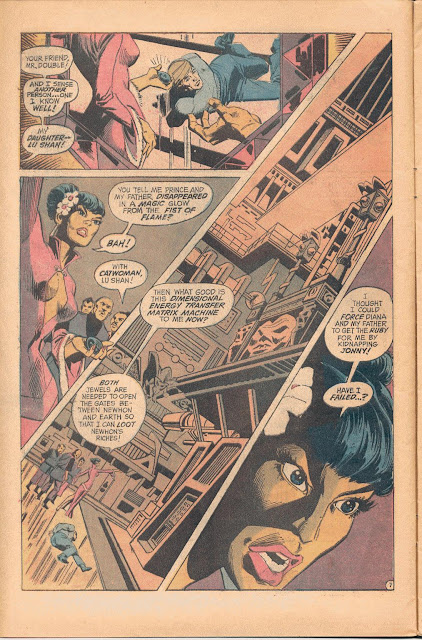


In the ensuing issues Ching presumably has lots of opportunities to hold forth on what caused his natural daughter's grudge, but if he expounds anything to Diana, there's no evidence on any of the pages. Then Lu Shan, last seen escaping Cyber's HQ after shooting her dad in #187, makes her bid to become a super-villain. In this O'Neil script, she kidnaps Jonny Double, potential boyfriend material for Diana, as part of a scheme to get hold of a magical jewel to power a big dimension-crossing machine for purposes of pillage. 


Diana and Ching learn about these plans, promoting what I believe is the first time Ching expresses parental affection for Diana. But of explanations about the death of Ching's wife-- nada.

The next issue, #203, is essentially the last adventure for Mod Wonder Woman. scripted by Samuel Delany as one part of a projected new story-line that never came to pass-- one in which Ching is not even mentioned. But DC Editorial had already decided to bring back the Amazon Princess, and Robert Kanigher, as if summoned from the vasty deep by Sekowsky's jibe, was tapped to return Diana to her roots.


I'm not sure I could survive revisiting the extreme stupidity of Kanigher's hackwork in this period, and in any case the only relevant part of #204 consists of seven pages in which Kanigher kills off Ching and has Diana forget her whole "mod phase" before transitioning back to her Amazon status, and to whatever plotlines mattered to Kanigher.

Now, one might view this summary execution as "tit for tat." When O'Neil and Sekowsky took over the title, they certainly didn't make a smooth transition from whatever Kanigher's last scripts had been. In fact, they showed extreme disinterest in the old WONDER WOMAN mythos by killing off Steve Trevor, just so he wouldn't get in the way of whatever romances they wanted to give Diana. Compared to Trevor's unceremonious demise, Ching's is not that bad, if one grants that, in that era, no one but hardcore fans expected seamless continuity from comic books. 

Also, it's not impossible that someone above Kanigher-- hypothetically, Dick Giordano-- might have advised Kanigher to give Ching a decent send-off, not unlike a much later incident in which Giordano *allegedly * warned Keith Giffen not to kill off Aquaman's wife. In the absence of any testimony about outside influences, though, I have to say that I like the line Kanigher writes for Diana, calling Ching the father she never had. I'm sure Kanigher cared absolutely nothing about anything that had happened during Mod Wonder Woman, just as it would be hard to argue that the author even cared about his own WW stories, beyond putting money in his wallet. But a good line is a good line, whether its author cared about the story or not.

Much later, Brian Azzarello undid the whole "virgin birth" of Princess Diana by claiming that she was the daughter of Zeus. I've read none of these. But even with all the narrative problems of the Mod phase, I Ching still holds the honor of "first father."

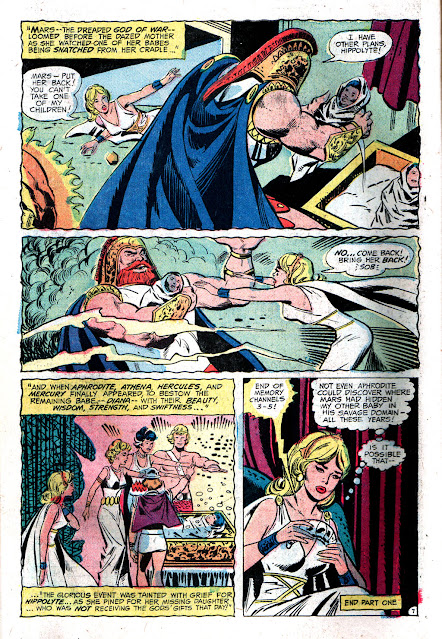


SIDE-NOTE: Because #204 introduces Diana's Black Amazon sister Nubia, I did force myself to revisit Kanigher's "Origin of Nubia" story in #206. It's like a lot of Kanigher's WW stories from the pre-Mod era, where events often unfold with only the thinnest justifications. Here, instead of Hippolyta praying to have a child who's like her, Aphrodite rather randomly instructs the Amazon queen to make two clay kids, one light skinned and one dark skinned-- apparently for no reason but so that Evil Ares will have the chance to steal the dark one and try to mold her into his perfect warrior. This scenario did have some mythopoeic potential, but Kanigher pretty much blows it from start to finish. But again, I have to admit that Kanigher's basic concept had some validity, since a lot of later creators took pleasure in doing their versions of "Black Wonder Woman."

Wednesday, August 17, 2022

COORDINATING INTERORDINATION PT. 2

In Part 1, I emphasized that when I spoke of my newly christened category of "interordination," I conceived it to be a subset of all those narrative strategies that Julie Kristaeva designated as "intertextuality," stating at the essay's conclusion: 

I don't expect to use interordination on a regular basis, except as a means to clarify the ways in which crossovers belong more properly to this specific type of "quotation" rather than to the more generalized category of intertextuality.

Upon exploring even the basic Wiki writeup of intertextuality, I find that other critics have attempted to make distinctions between different forms of the concept:

Intertextuality has been differentiated into referential and typological categories. Referential intertextuality refers to the use of fragments in texts and the typological intertextuality refers to the use of pattern and structure in typical texts

The term "typological" has some appeal to me because in INTERORDINATION PT. 1, I devoted particular attention to the example of the Moore-Gibbons WATCHMEN as comprising several forms of intertextuality, none of which relate to the subcategory of interordination as I've conceived it. But even "typological" needs some finessing. What is Alan Moore doing when he bases his WATCHMEN-heroes upon the Charlton heroes? He is *emulating* certain *tropes* that he observed in the earlier stories of the heroes, after which he then crossbreeds those tropes with other tropes. Of course, all of these were borrowed from other sources as well.


In fact, all literature as we have it now is founded in "trope emulation." From caveman times on, one author puts forth an icon of some sort (not necessarily an original one) that his auditors find pleasing, so the next author tries to emulate something about the icon in order to enjoy similar popularity. In Classical times, one can observe this process in Athens' belated attempts to formulate a city-hero, their Theseus, in loose emulation of Thebes' protector Herakles.


Now, going back to Wiki: what does the essay's author mean by "referential intertextuality?" Without going into this too much, the basic contrast is that this form directly borrows from passages in earlier works. Though this concept is not a direct parallel to my line of thought, it's close enough to suggest a contrast to "trope emulation," and that is "icon emulation." In the latter formulation, a derivative author does not choose to create a new character, but attempts to tell a new story with an old character. To be sure, "newness" is difficult to ascertain with archaic figures, given that it's impossible to be 100% sure when a given Herakles story originated. At best, archaeology can tell us the earliest known record of a given story. However, we can be relatively sure that even the earliest Herakles stories were not all devised by one writer, but by innumerable authors-- some of whose stories may have simply fallen off the cultural map. 


Returning to the importance of names outlined in I THINK ICON, I THINK ICON, Moore took all of the tropes he borrowed from Steve Ditko's hero The Question, plus all those he took from other sources, and thus forged a new character, Rorschach. No matter how many fan-readers know about the influence of The Question, the name of Rorschach keeps him distinct from the Ditko character, far more than any of the formal differences between the characters.


Such formal differences are of lesser importance because in many cases an author utilizing "icon emulation" may deviate from the original model just as much as does the one utilizing "trope emulation." 

Steve Ditko's character of The Question appeared in about half a dozen stories for Charlton Comics, and since these were produced under an implicit work-for-hire contract, the stories and the character both belonged to Charlton. When DC bought up all or most of the Charlton superheroes, DC then produced several new "icon emulation" variations on those characters-- and of these variants, none diverged quite as far from the original model as the 1987 Question first produced by writer Denny O"Neil and artist Denys Cowan. Ditko supplied nearly no character traits or back history for "Vic Sage," the secret identity of his crusader, and only a very marginal rationale for the hero's blank-masked appearance, since Ditko was principally concerned with using the hero as a spokesman for philosophical belief. O'Neil not only paid zero attention to any of the philosophies exposed by the Ditko character, he formulated a detailed back history for Sage-- even to the extent of stating that his name was a revision of an Eastern European cognomen-- and gave the New Question all sorts of "film noir" adventures in which the nature of good and evil was never as distinct as it was in Ditko.

Yet, by keeping the name of the character and a few choice bits of his mythology, O'Neil's Question is an icon derived from an icon, rather than being an icon created from some of the tropes that constituted the original icon.

It's because of this "crypto-continuity," as I dubbed it earlier, that it's possible to view derivative icons as being coterminous with their original models. Thus, despite all the dissimilarities between the Kong of the 1933 film and the Kong who fights Godzilla, the two Kongs are coterminous because the second icon was grounded in the identity of the first one. The same applies to all of the various icons based on non-fictional originals like Billy the Kid and Jack the Ripper. I've pointed out that such characters are based on what I term "innominate texts," meaning that the models are not purely fictional, but there's still a icon-to-icon derivation, rather than a trope-to-icon derivation.

In closing, I devoted some space in I THINK ICON to the fact that "icons" included countless entities that are not characters as such, but only cited a couple of examples. Another noteworthy example is Edgar Rice Burroughs' land of Pellucidar, an environment characterized by its assorted flora and fauna as well as its unique location at the center of the Earth. In the formal "Earth's Core" series, the entire environment of Pellucidar is simply a subordinate icon to whatever hero is the star of the story. However, in 1929 Burroughs produced his most distinctive crossover of two franchises, by having Tarzan, superordinate icon of his own series, have adventures within the environment of Pellucidar. Because Pellucidar is not normally aligned to Tarzan's adventures, this interaction rates as a "charisma-crossover."

ADDENDUM: Since I've previously made some remarks on spoof-versions of established figures, the sort I'm now calling "icons," I feel I should expand on these remarks. Spoofs are for the most part "trope emulations" because the artists simply borrow tropes from the originals, frequently (though not always) distancing the spoof-characters from the originals with goofy names like "Batboy and Rubin." But it's possible for an author to produce an "icon emulation" that is loosely coterminous with the original, even if said author decides to alter the myth-radical that dominates the established icon. Such icons as Superman, Modesty Blaise, and The Lone Ranger all belong to the mythos of adventure. However, the filmed stage play of SUPERMAN-- THE MUSICAL is a full icon emulation of Superman, but in the mode of comedy, while both Modesty Blaise and The Lone Ranger got redone into modes of irony for the big screen.

Friday, July 22, 2022

MYTHCOMICS: BIRTH OF THE DEMON (1992)

 I posted two essays about Denny O'Neil the week after he passed in 2020. One was a mythcomics appreciation of one of his QUESTION stories. In the other essay, I wrote the following:

When considering my favored subject, that of “myth in literature,” O’Neil certainly doesn’t rank alongside the creators who tally up the greatest quantity of mythcomics, such as Fox, Broome, and Kirby. Of course, even the best myth-makers, in order to stay gainfully employed, had to craft many, many stories that appealed to the reader’s desire for easily comprehensible lateral meaning, whereas the more difficult vertical meaning proved hit and miss. Indeed, a lot of the stories in which I’ve observed a high symbolic discourse seem to have done so without much conscious intention. I would’ve thought that, given his considerable investment in the Caped Crusader, there might’ve been a fair sampling of myth-tales during O’Neil’s various outings with the character. But even the stories with O’Neil’s most celebrated creation, Ra’s Al Ghul, only rate as near-myths.

Happily, I recently learned that this was inaccurate. Though I tried to keep abreast of most major developments of commercial comics in the 1990s, I've missed some things without intending to do so. Just as I never heard anything about the WOLVERINE: ORIGIN series of 2001, I entirely overlooked BIRTH OF THE DEMON, a stand-alone graphic novel in which O'Neil related the origin-story of Ra's Al Ghul, aided by Norm Breyfogle. Breyfogle's selection for this project  was almost certainly predicated on his professional inspiration by Neal Adams, with whom O'Neil co-created Ra's Al Ghul in BATMAN #232 (1971). The selection of an Adams-like artist suggests to me that O'Neil aspired to recapture the elan that he and Adams captured in their attempt to move Batman away from the gimmicky stories that had dominated the character for many years-- not only in the tales of raconteurs like Fox and Robbins, but even from co-creator Bill Finger-- and back to his earliest roots in pulpish thrills.

Though BIRTH is devoted to the story of Ra's Al Ghul, it's framed as a Batman story. The crusader becomes obsessed with the possibility of finally ending the villain's menace by finding and destroying all of the Lazarus Pits scattered around the world. By so doing, Batman can at last prevent his enemy from being able to continually resuscitate himself-- which Ra's has done for many centuries, giving the immortal evildoer resources beyond any of the other criminals in the hero's rogues' gallery. In a non-diegetic sense the famous Bat-villains are of course as immortal as Ra's, as is Batman, but within the diegesis, an ever-recrudescent villain suggests the futility of the hero's war against crime. Additionally, Batman is emotionally entwined with Talia, "the daughter of the demon," whose off-again, on-again loyalty to her father further compromises the crusader's dedication to his crimefighting cause.


The main part of the story is a chronicle of the early life of Ra's Al Ghul, recited by both Talia and Batman as she tries to keep the hero from destroying another Lazarus Pit. The chronicle was compiled by Huwe, one of the future villain's few comrades in medieval Arabia, though in the sequence above Huwe relates a scene at the birth of the man who would be Ra's-- whom I will henceforth call "the doctor," since he's given no proper name and does not take the demonic cognomen in his early years.


O'Neil does not devote any time to the doctor's childhood, and only says that at some point in his studies, the doctor formed a preternatural aversion to the fact of Death. He becomes so skilled that he rises to the position of royal physician to a prestigious ruler, the Salimb. However, the king's son heedlessly injures an infirm townswoman, and though the doctor is not at fault, he offers himself as a sacrifice to the old woman's son. The young fellow, Huwe by name, almost accepts the sacrifice, but later becomes the doctor's companion throughout the majority of his ancient exploits.


The Salimb's unnamed son falls ill, and even though the doctor has only contempt for the prince, he journeys to the place where he the doctor was born. There he goes into a trance, and beholds a bat-like demon whom he associates with Death. He imagines himself being immerses and strengthened by a pit of liquid, though he has yet to actually experience a Lazarus Pit.


Using this visionary experience as a guide, the doctor revives the moribund prince by uncovering a real Lazarus Pit. The doctor pays dearly for this hubris, for upon rising the prince goes berserk, as do all such reborn individuals-- and the mindless royal slays the doctor's wife. The Salimb cares no more for the deceased doctor's wife than his son did for the old woman, and in fact he condemns the doctor for the act of murder. The prince provides the icing on the cake, ghoulishly confining the doctor in a cage with the dead body of his beloved.


Huwe saves the doctor and the two flee into the desert. The doctor guides them to the camp of his uncle, and despite initial resistance, the uncle makes it possible for the doctor to achieve vengeance-- the first time the reader sees evidence of the doctor's uncanny ability to plan the doom of his enemies. This time the physician imagines the bat-demon of his previous dream helping him slay the corrupt prince, though the full scheme-- once more depending on the use of the Lazarus Pits-- also brings doom to the Salimb as well.


Following the overthrow of the city's rulers, the formerly merciful physician leads his uncle's raiders against the city, slaughtering dozens of innocents. The doctor himself is wounded, and for the first time he uses a Pit to save himself from Death's grasp. Now that he feels himself the very incarnation of the power of the Pits, he overthrows the idol of the demon Bisu, whom the locals venerate as the representation of the desert's unforgiving cruelty. There are some intimations that the bat-demon seen in the doctor's visions may be covalent with Bisu rather than with Death, but O'Neil does not commit himself one way or the other.


Though the doctor uses the Pits to keep Huwe and his uncle as immortal as he is, the association goes sour after several centuries, when the doctor catches Huwe recording his chronicle. He ends up slaying Huwe, but the uncle preserves the chronicle so that it can fall into the hands of the Batman. Returning to modern times, the hero and the daughter of the demon discuss the similarity of Ra's obsessions and those of Batman himself. But in the end, Talia has to step back from the confrontation-- for Ra's himself has been listening to the conversation, and he demands access to the Pit being blocked by the Caped Crusader.


There is, inevitably, yet another climactic battle between the adversaries, and it ends with the mysterious maybe-death of Ra's, though of course no reader believes him truly destroyed. Batman survives as well, apparently having been succored by none other than the demon Bisu-- though of course only the readers, not the hero himself, may choose to believe that. 


I'll conclude by noting that not only does O'Neil provide a full-blown mythic origin for the best-known character of his creation, he also revises the origin of the second-best known O'Neil character, the demon's daughter. In the 1987 graphic novel SON OF THE DEMON, Mike Barr and Jerry Bingham purveyed a rather mundane backstory for Talia's mother Melisande. The O'Neil-Breyfogle narrative rewrites that as seen above, asserting that Ra's met Talia's mother at Woodstock. In his massive Bat-saga, part of which I reviewed here, Grant Morrison shows his respect for O'Neil by endorsing O'Neil's version of Talia's genesis, though Morrison does keep Barr's name for the mother, Melisande. I don't know what O'Neil thought of other writers' elaborations of his most famous characters. But I'm happy to see that, just as Morrison gave life to a full-blown myth for Talia Al Ghul, the Demon himself got his finest myth-narrative from the man who conceived him.


Sunday, June 28, 2020

MYTHCOMICS: “SAVING FACE” (THE QUESTION #13-14, 1987)


One of the aspects O’Neil frequently touched on in his Bronze Age Batman stories was the notion of the hero as a master martial artist. Prior to O’Neil, Batman fought like a boxer most of the time, with occasional touches of judo or wrestling. But even though the author imported into the Batman mythos many tropes of the martial arts genre, one particular trope—that of the use of martial arts as a means of personal growth—made no appearances in O’Neil’s Batman-tales, or, for that matter, in anyone else’s Bat-tales. The Cowled Crusader needed no personal growth; being Batman was his entire raison d’etre.

O’Neil did use the "spiritual growth" trope somewhat in the largely forgettable RICHARD DRAGON title, but not until the late 1980s did he find the proper vehicle to merge his interest in hardboiled crime with that of Oriental esotericism. Indeed, the foremost work to spring from DC Comics’s acquisition of Charlton Comics’ superhero characters was the first run of THE QUESTION, originated by O’Neil and artist Denys Cowan. To fans of Steve Ditko’s original blank-visaged crusader, this version must have seemed a travesty, foregoing Ditko’s trademark moral sbsolutism in favor of a hero who constantly had to “question” everything—culture, society, and his own inner nature. Indeed, the original hero, as presented in the first issue, literally “dies” before he receives tutelage by none other than O’Neil’s previous kung-fu stalwart, Richard Dragon.

I’ve already praised the metaphysical questions posed in issue #11, but the two-parter that I entitle “Saving Face” orients more on the sociological end of things. Following a “grabber” scene in which an army recruiter is killed while giving his enlistment pitch, Vic Sage, a.k.a. the new improved Question, converses with Doctor Rodor, his sometime mentor. Their short dialogue gives Sage just enough time to make a distinction between the tortures of coercion and the ordeals of discipline by stating that “discipline comes from inside.” Then Sage is called away to the scene of a disaster, where, all unknowing, he has a near-encounter with his next opponent.


Said adversary is Colonel DeBeck, an ex-military man full of the desire to castigate the armed forces of the United States for weakness and lack of discipline. To graphically illustrate this vulnerability, DeBeck and a small squad of other disaffected men attack a small detachment of soldiers giving a public demonstration of their training. Sage can’t reach the soldiers before DeBeck’s men slaughter them. Later Sage expresses a muted admiration for the sheer nerve behind the assault. In the guise of the Question, Sage tracks down DeBeck, but the former colonel summons his squad, and the hero is captured.


Rather than simply killing the vigilante, DeBeck tests the resolve of his opponent, burying him in the earth up to his neck, so that the hero can breathe and speak but nothing else. Yet DeBeck also claims that he withstood this same torture in Cambodia, and so promises that if the Question will go free if he surpasses DeBeck’s record for withstanding the torture.


O’Neil plays fair throughout the ordeal: the Question gets no lucky breaks or last-minute rescues from allies. To survive, the hero must use his Oriental meditative techniques to sink into himself, to escape the torment of being unable to move while exposed to the elements. He does receive a little imaginary help from a scorpion, on whom Sage projects the persona of his teacher Richard. Of course it’s really Sage giving himself “sage” advice: “accept the discomfort and pain and fear and cherish it. It’ll only leave when you invite it to stay.”


Without giving away the well-orchestrated ending, the Question does indeed survive his encounter with the honor-obsessed murderers, and goes on to continue his inquiries into other aspects of existence. In an interesting subplot, Sage’s girlfriend Myra runs for office, and the constant hectoring of the publicity machine causes her to dream of herself stripping on a stage before a crowd of horny gawkers.


NEAR-MYTHS: “CARNIVAL OF THE CURSED” (BATMAN #224, 1970)


It’s been roughly a week since the announcement of Denny O’Neil’s passing. I’m sure there have been any number of essays devoted to his contributions, and without looking I’m reasonably sure that most fans will mention most fondly his work on various Batman stories, while placing less emphasis on his contributions to such franchises as Superman, Wonder Woman, Spider-Man and Iron Man. Were I writing a standard obituary, I would certainly write something similar. O’Neil wasn’t the first writer to steer the Batman away from gimmickry and toward Gothicism and gloominess, but he maintained a consistency of tone and an emphasis upon downtrodden humanity that redeemed even the most hackneyed plots.

When considering my favored subject, that of “myth in literature,” O’Neil certainly doesn’t rank alongside the creators who tally up the greatest quantity of mythcomics, such as Fox, Broome, and Kirby. Of course, even the best myth-makers, in order to stay gainfully employed, had to craft many, many stories that appealed to the reader’s desire for easily comprehensible lateral meaning, whereas the more difficult vertical meaning proved hit and miss. Indeed, a lot of the stories in which I’ve observed a high symbolic discourse seem to have done so without much conscious intention. I would’ve thought that, given his considerable investment in the Caped Crusader, there might’ve been a fair sampling of myth-tales during O’Neil’s various outings with the character. But even the stories with O’Neil’s most celebrated creation, Ra’s Al Ghul, only rate as near-myths.


“Carnival of the Cursed” also comes damn close to the mark. Batman learns of the murder of a jazz musician, Blind Buddy Holden, and jets down to New Orleans to find the culprits, simply because the crusader was a fan of the man’s music. Providentially, the hero arrives during Mardi Gras, so that the exoticism of the city’s Catholicism-driven holiday is on full display. Batman finds the murderers quickly enough, but he also finds that they have a powerful ally, an apish brute named Moloch. Without going into the specific reasons for the jazz-man’s murder, it’s not surprising that money is at the root of it all, so that I found myself wondering if the name “Mammon” might’ve been a more appropriate name for the villain. But the act of giving the grotesque evildoer the name of a pagan god certainly contributes, as much as jazz music and Mardi Gras costumes, to the impact of the story, ending with this page, certainly one of the most perfect denouements in commercial comics.