<?xml version="1.0" encoding="utf-8"?>
<feed xmlns="http://www.w3.org/2005/Atom">
    <title>Valhalla's things</title>
    <link href="https://blog.trueelena.org/atom.xml" rel="self" />
    <link href="https://blog.trueelena.org" />
    <id>https://blog.trueelena.org/atom.xml</id>
    <author>
        <name>Elena “of Valhalla”</name>
        <email>blog@trueelena.org</email>
    </author>
    <updated>2026-04-18T00:00:00Z</updated>
    <entry>
    <title>Pizza!</title>
    <link href="https://blog.trueelena.org/blog/2026/04/18-pizza/index.html" />
    <id>https://blog.trueelena.org/blog/2026/04/18-pizza/index.html</id>
    <published>2026-04-18T00:00:00Z</published>
    <updated>2026-04-18T00:00:00Z</updated>
    <summary type="html"><![CDATA[<article>
    <section class="header">
        Posted on April 18, 2026
        <br />
        
        Tags: <a title="All pages tagged 'madeof:atoms'." href="https://blog.trueelena.org/tags/madeof%3Aatoms.html">madeof:atoms</a>, <a title="All pages tagged 'craft:cooking'." href="https://blog.trueelena.org/tags/craft%3Acooking.html">craft:cooking</a>
        
    </section>
    <section>
        <p>This post contains a bit of consumerism and is full of references to
commercial products, none of which caused me to receive any money nor
non-monetary compensation.</p>
<p>This post has also been written after eating in one meal the amount of
bread-like stuff that we usually have in more than 24 hours.</p>
<p>I’ve been baking bread since a long time ago. I don’t know exactly when,
but probably it was the early 2000s or so, and remained a regular-ish
thing until 2020, when it became an <em>extremely</em> regular thing, as in I
believe I bake bread on average every other day.</p>
<p>In the before times, I’ve had a chance to bake pizza in a wood fired
oven a few times: a friend had one and would offer the house, my partner
would mind the fire, and I would get there with the dough and prepare
the pizza.</p>
<p>Now that we have moved to a new house, we don’t have a good and
convenient place for a proper wood fired oven in masonry, but we can use
one of the portable ones, and having dealt with more urgent expenses, I
decided that just before the potential collapse of the global economy
was a good time as any to buy the oven I had been looking at since we
found this house.</p>
<p>I decided to get an Ooni Karu 2, having heard good things about the
brand, and since it looked like a good balance between size and
portability. I also didn’t consider their gas fired ovens (nor did I buy
the gas burner) because I’m trying to get rid of gas, not add stuff that
uses it, and I didn’t get an electric one because I’m not at all unhappy
with the bakery-style pizza we make in our regular oven, and I have to
admit we also wanted to play with fire<a href="https://blog.trueelena.org#fn1" class="footnote-ref" id="fnref1" role="doc-noteref"><sup>1</sup></a>.</p>
<p>We also needed an outdoor table suitable to use the oven on and store
it. Here I looked for inspiration at the Ooni tables (and for cheaper
alternatives in the same style), but my mother who shares the outdoor
area with us wasn’t happy with the idea of steel<a href="https://blog.trueelena.org#fn2" class="footnote-ref" id="fnref2" role="doc-noteref"><sup>2</sup></a>.
And then I was browsing the modern viking shores, and found that there
was a new piece in the NÄMMARÖ series my mother likes (and of which we
already have some reclining chairs): a kitchen unit in wood with a steel
top.</p>
<p>At first I expected to just skip the back panel, since it would be in
the way when using the oven, but then I realized that it could probably
be assembled upside down, down from the top between the table legs, and
we decided to try that option.</p>
<p>This week everything had arrived, and we could try it.</p>
<p>Yesterday evening, after dinner (around 21, I think) I prepared the
dough with the flour I usually use for bakery-style pizza: <a href="https://www.biscotticavanna.com/collections/farine/products/farina-di-grano-tenero-tipo-0">Farina di
Grano Tenero Tipo 0 PANE</a> (320 - 340 W);
since I wanted to make things easier for myself I only used 55%
hydration, so the recipe was:</p>
<ul>
<li>1 kg flour</li>
<li>550 g water</li>
<li>2 g dry yeast</li>
<li>12 g salt</li>
</ul>
<p>The next time I think I’ll try with one of my other staples: <a href="https://molinobogetto.it/products/etichetta-blu">Molino
Bogetto etichetta blu</a> (260/280 W)</p>
<p>Then this morning we assembled the NÄMMARÖ, then I divided the dough in
eight balls, put them in a covered — but not sealed — container
<a href="https://blog.trueelena.org#fn3" class="footnote-ref" id="fnref3" role="doc-noteref"><sup>3</sup></a>, well floured with rice flour and then we fired the oven
(as in: my partner did, I looked for a short while and then set the
table and stuff), using charcoal, because we already had some, and could
conveniently get more at the supermarket.</p>
<p>When the oven had reached temperatures in the orange range<a href="https://blog.trueelena.org#fn4" class="footnote-ref" id="fnref4" role="doc-noteref"><sup>4</sup></a> I
stretched the smallest ball out, working on my wooden peel, sprayed it
with water<a href="https://blog.trueelena.org#fn5" class="footnote-ref" id="fnref5" role="doc-noteref"><sup>5</sup></a>, sprinkled it with coarse salt and put it in the
oven.</p>
<p>After 30 seconds I turned it around with the new metal peel, then again
after 30 seconds, and then I lost count of how many times I repeated
this<a href="https://blog.trueelena.org#fn6" class="footnote-ref" id="fnref6" role="doc-noteref"><sup>6</sup></a>, but it was probably 2 or 3 minutes until it looked
good.</p>
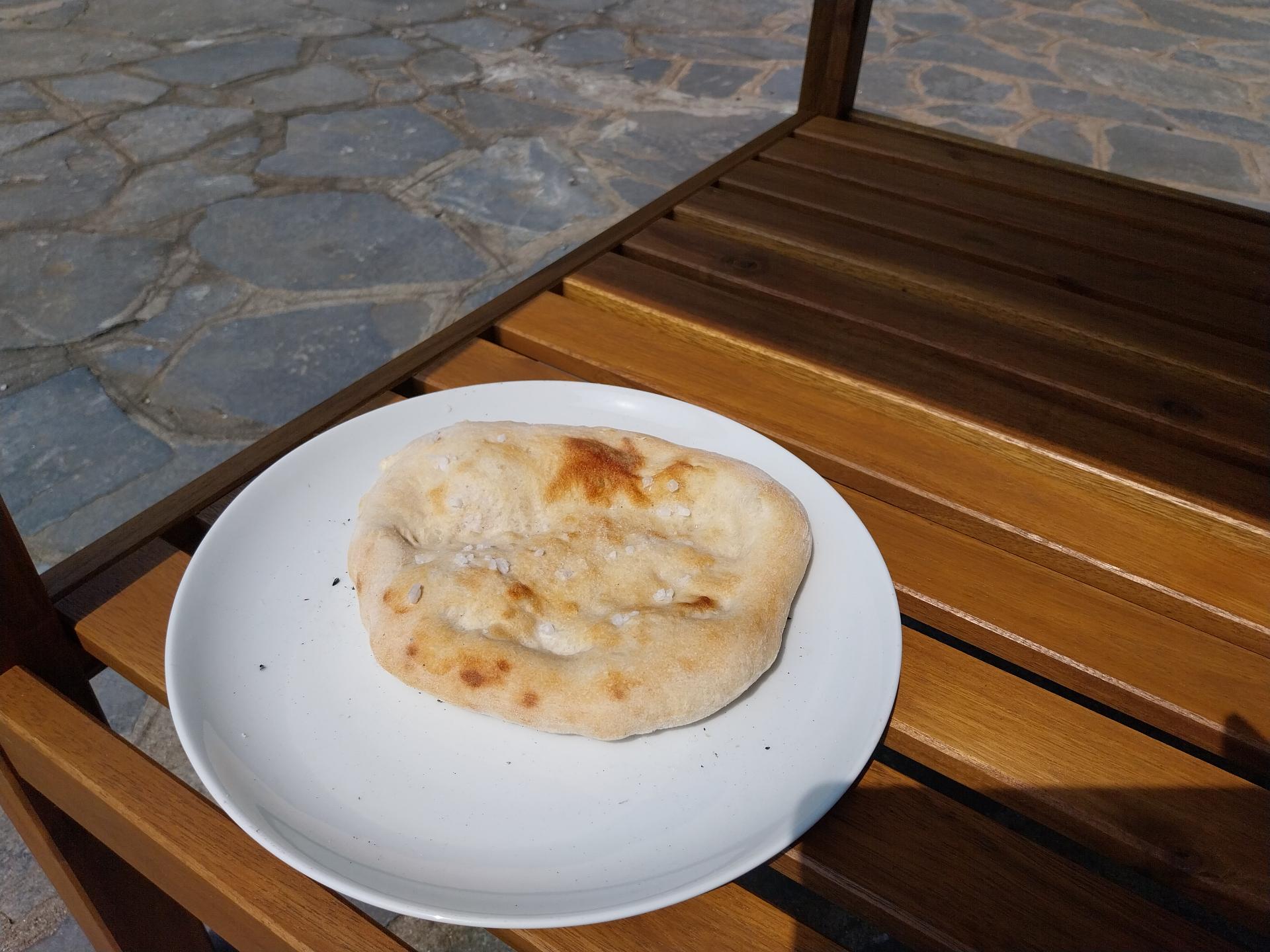
<p><img src="https://blog.trueelena.org/blog/2026/04/18-pizza/focaccia.jpg" class="align-center" style="width:80.0%" alt="A flatbread on a regular plate: it's only a bit more than half
the plate in diameter, puffed up near the borders and thin in the
middle, and only lightly browned in places, not burnt.
It's sitting on the lower shelf of a wooden table." /></p>
<p>And it was good. The kind of pizza that is quite soft, especially near
the borders.</p>
<p>We ate it with fresh mozzarella and tomatoes, and then made another one
the same way, to finish the mozzarella.</p>
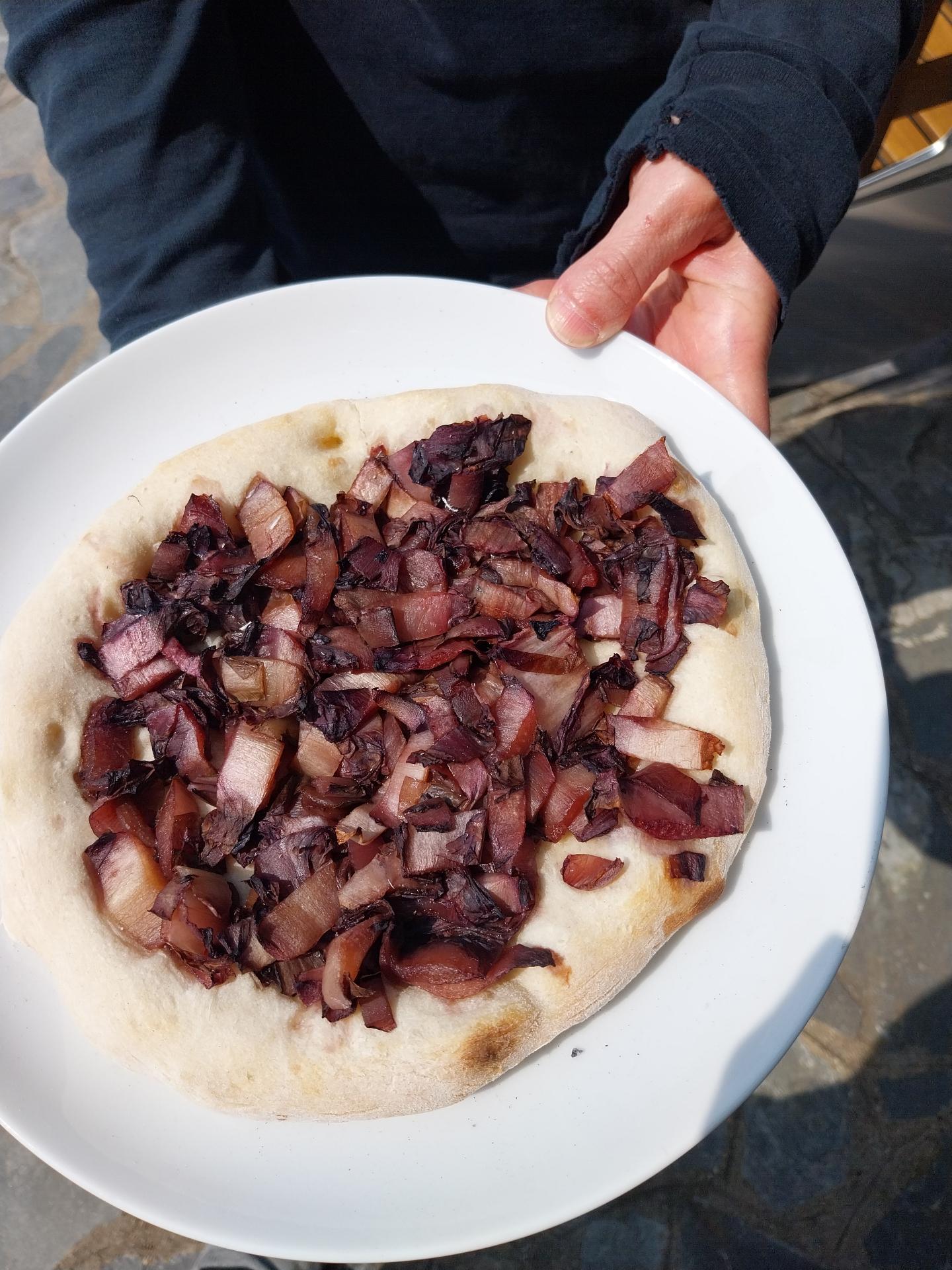
<p><img src="https://blog.trueelena.org/blog/2026/04/18-pizza/radicchio.jpg" class="align-center" style="width:80.0%" alt="Another flatbread on the same plate, this time it's about 4 cm
smaller than the plate on all sides, and it's covered with
brownish-red chopped up vegetables." /></p>
<p>This was supposed to be our lunch, but we decided to try one with some
leftover cooked radicchio, and that also worked quite nicely.</p>
<p>And finally, we decided we needed to try a more classical pizza, with
tomato sauce and cured meat, of which we forgot to take pictures.</p>
<p>Up to here we had eaten about half of the dough, and we were getting
full: I had prepared significantly more than what I expected to eat, to
be able to accidentally burn some, but also with the idea to bake
something else to be eaten later.</p>
<p>So I made two more focaccias with just water and salt, and then I tried
to cook some bread with what I expected to be residual heat.</p>
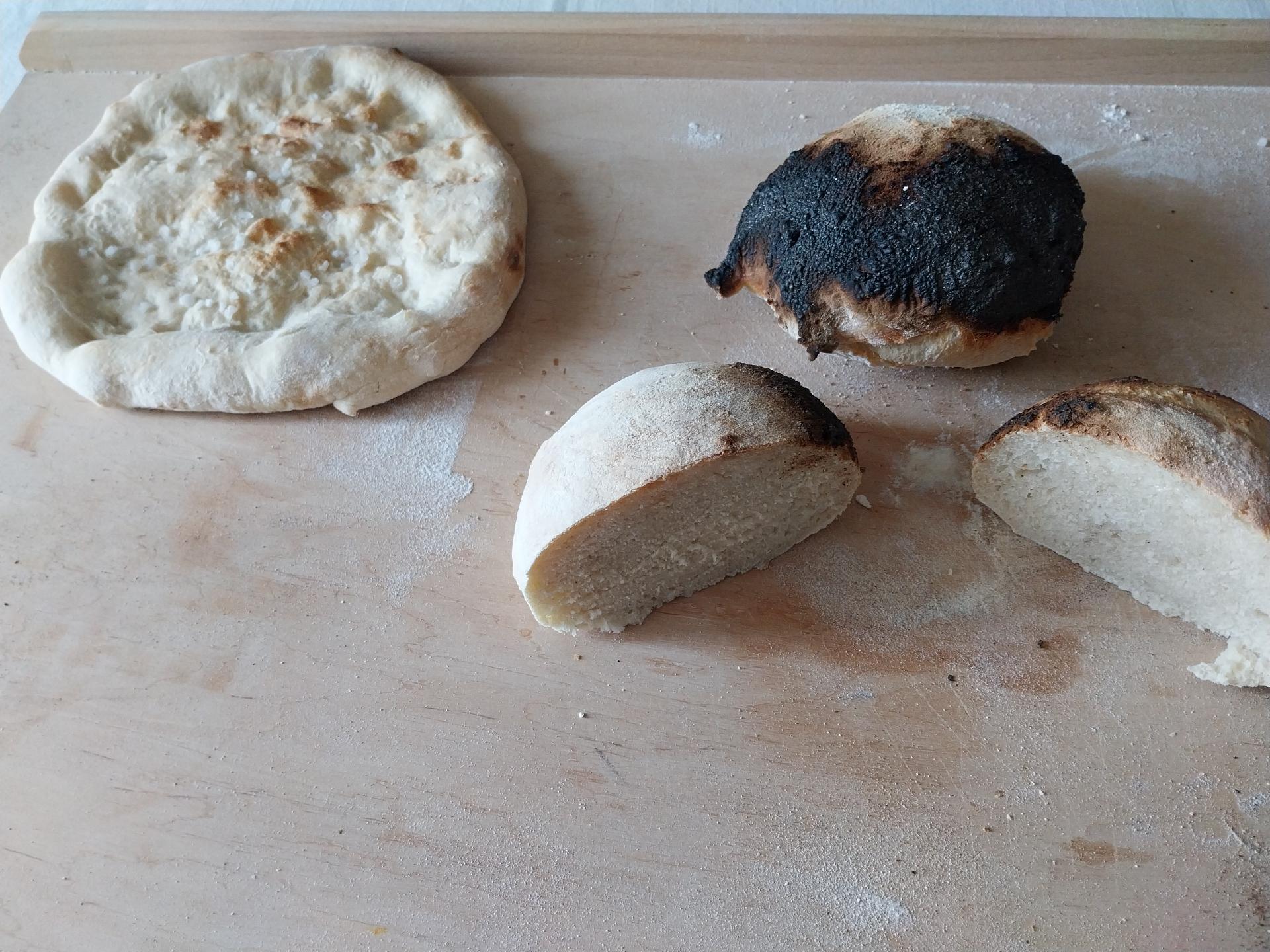
<p><img src="https://blog.trueelena.org/blog/2026/04/18-pizza/bread.jpg" class="align-center" style="width:80.0%" alt="Another flatbread with coarse salt and two bread rolls, one of
which is completely carbonized on one side. The other one has been
cut, and while it has a carbonized spot, it is also well cooked in
the middle, and perfectly edible." /></p>
<p>Except that the oven was getting a bit too cold, so my partner added
some charcoal, and when I put the last two unflattened balls right at
the back of the oven where it was still warmer, that side carbonized.
After 5 minutes I moved them to the middle of the oven, and turned them,
and then after another turn and 5 more minutes they were ready. And
other than the burnt crust, they were pretty edible.</p>
<p>So, the thoughts after our first experience.
Everybody around the table (my SO, my mother and me) was quite happy
with the results, and they are different enough from the ones I could
get with the regular oven.</p>
<p>As I should have expected, it’s much faster than a masonry oven, both in
getting to temperature and in cooling down: my plan for residual heat
bread cooking will have to be adjusted with experience.</p>
<p>We were able to get it hot enough, but not as hot as it’s supposed to be
able to get: we suspect that using just charcoal may have influenced it,
and next week we’ll try to get some wood, and try with a mix.</p>
<p>As for the recipe, dividing the dough in eight parts worked quite well:
maybe the pizzas are a bit on the smaller side, but since they come one
at a time it’s more convenient to cut and share them, and maybe make a
couple more at the end.</p>
<p>Of course, I’ll want to try different recipes, for different styles of
pizzas (including some almost-trademark-violating ones) and for other
types of flatbread.</p>
<p>I expect it won’t be hard to find volunteers to help us with the
experiments. :D</p>
<section class="footnotes footnotes-end-of-document" role="doc-endnotes">
<hr />
<ol>
<li id="fn1" role="doc-endnote"><p>any insinuation that there may have been considerations of
having a way to have freshly baked bread in case of a prolonged
blackout may or may not be based on reality.
But it wasn’t <em>the only</em> — or even the main — reason.<a href="https://blog.trueelena.org#fnref1" class="footnote-back" role="doc-backlink">↩︎</a></p></li>
<li id="fn2" role="doc-endnote"><p>come on! it’s made of STEEL. how can it be not good? :D<a href="https://blog.trueelena.org#fnref2" class="footnote-back" role="doc-backlink">↩︎</a></p></li>
<li id="fn3" role="doc-endnote"><p>IKEA 365+ 3.1 glass, the one that is 32 cm × 21 cm × 9
cm; it was just big enough for the amount of dough, and then I
covered it with a lid that is missing the seal.<a href="https://blog.trueelena.org#fnref3" class="footnote-back" role="doc-backlink">↩︎</a></p></li>
<li id="fn4" role="doc-endnote"><p>why did they put a thermometer on it, and not add <em>labels</em>
with the actual temperature? WHY???<a href="https://blog.trueelena.org#fnref4" class="footnote-back" role="doc-backlink">↩︎</a></p></li>
<li id="fn5" role="doc-endnote"><p>if you don’t have dietary restrictions a bit of olive oil
would taste even better.<a href="https://blog.trueelena.org#fnref5" class="footnote-back" role="doc-backlink">↩︎</a></p></li>
<li id="fn6" role="doc-endnote"><p>numbers above 2 are all basically the same, right?<a href="https://blog.trueelena.org#fnref6" class="footnote-back" role="doc-backlink">↩︎</a></p></li>
</ol>
</section>
    </section>
</article>
]]></summary>
</entry>
<entry>
    <title>Ink Lightfastness Tests 2026</title>
    <link href="https://blog.trueelena.org/blog/2026/03/28-ink_lightfastness_tests_2026/index.html" />
    <id>https://blog.trueelena.org/blog/2026/03/28-ink_lightfastness_tests_2026/index.html</id>
    <published>2026-03-28T00:00:00Z</published>
    <updated>2026-03-28T00:00:00Z</updated>
    <summary type="html"><![CDATA[<article>
    <section class="header">
        Posted on March 28, 2026
        <br />
        
        Tags: <a title="All pages tagged 'madeof:atoms'." href="https://blog.trueelena.org/tags/madeof%3Aatoms.html">madeof:atoms</a>, <a title="All pages tagged 'topic:inks'." href="https://blog.trueelena.org/tags/topic%3Ainks.html">topic:inks</a>
        
    </section>
    <section>
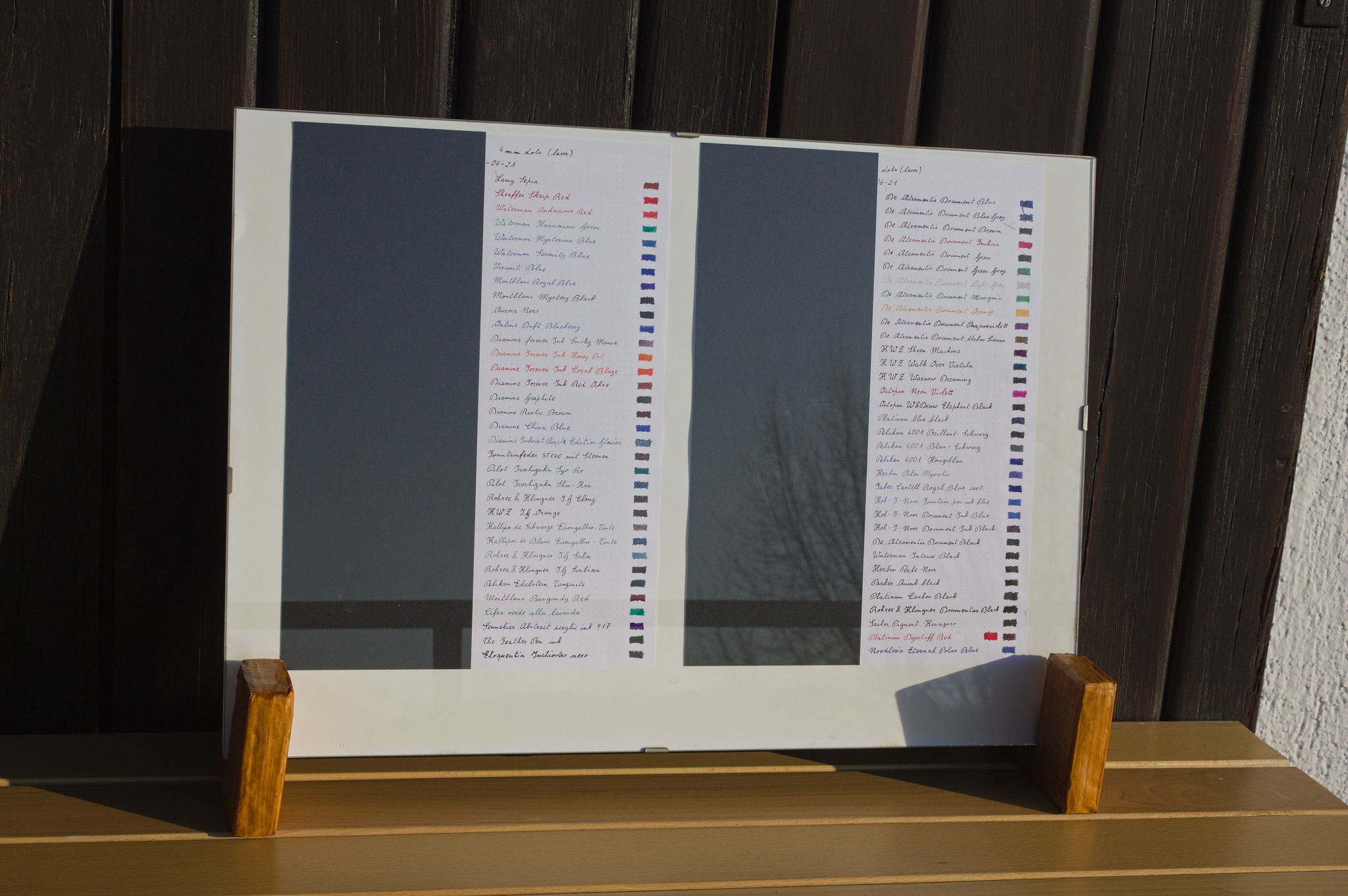
        <p><img src="https://blog.trueelena.org/blog/2026/03/28-ink_lightfastness_tests_2026/test_setup.jpg" class="align-center" style="width:80.0%" alt="A borderless frame set on a table outdoors, with two sheets of
paper a vertical half of which is covered by black paper, while
the other half has lines with an ink name and a small filled
rectangle, all in the ink itself." /></p>
<div class="note">
<div class="title">
<p>Note</p>
</div>
<p>This post will be updated in the next weeks with the test results as
they become available.</p>
</div>
<div class="note">
<div class="title">
<p>Note</p>
</div>
<p>Most of the images in this post have no real alt-text: they are all
scans of the test sheet at various stages through the test, and the
results visible on them are described in detail at the end of the
post.</p>
</div>
<p>Most of the time, what people write by hand will either end up inside a
notebook in a drawer or cupboard where it’s well protected, or thrown in
the recycling where it doesn’t matter.
There are times, however, when things will be exposed to light: it
doesn’t matter whether it’s a work of artistic calligraphy that you want
to frame or a passive-aggressive notice left in the atrium of a
building; it is useful to know whether the work will remain legible or
it will fade into nothing in a short time.</p>
<p>A few inks are tested by the producers for lightfastness according to
some established standard, a few others are declared lightfast in a
generic way, but a lot come with no indication at all.
Proper testing according to the <a href="https://en.wikipedia.org/wiki/Lightfastness#Standards_and_measure_scales">standard scales</a> requires significant
equipment to precisely control the exposure, but it’s significantly
easier — and fun — to do a simple test to divide the inks into three
categories:</p>
<ul>
<li>suitable for framed calligraphy, i.e. it looks the same after 3 months
of direct sun exposure;</li>
<li>suitable for complaining about the way your neighbours deal with the
trash, i.e. still readable after 3 months of exposure;</li>
<li>not suitable for either, i.e. has faded significantly in the same time.</li>
</ul>
<p>In the past I’ve done some such tests by taping some sheets to a
south-east facing window, and I’ve noticed that most of the results were
already apparent after a month, and there was basically no difference
between two and three months of exposure, but spring equinox to summer
solstice is a nice timeframe to use for such a test (and it leaves time
for a second test of different materials from summer solstice to autumn
equinox), so this is what I’ve chosen to do this year.</p>
<p>Rather than a window, now I have access to a south-facing covered
balcony that is protected from rain but receives quite a bit of direct
sun, so instead of taping sheets to the windows<a href="https://blog.trueelena.org#fn1" class="footnote-ref" id="fnref1" role="doc-noteref"><sup>1</sup></a> I’ve prepared a
sturdy cardboard panel that I can leave on a table on the balcony,
hopefully safe from the rain, but well exposed to the sun.</p>
<p>And then made a quick test, and realized that without the window glass
in front, the black strip used to cover the unexposed half of the sample
doesn’t lay flat and lets some sun in, so I used an old cheap<a href="https://blog.trueelena.org#fn2" class="footnote-ref" id="fnref2" role="doc-noteref"><sup>2</sup></a>
glass frame instead of the panel.</p>
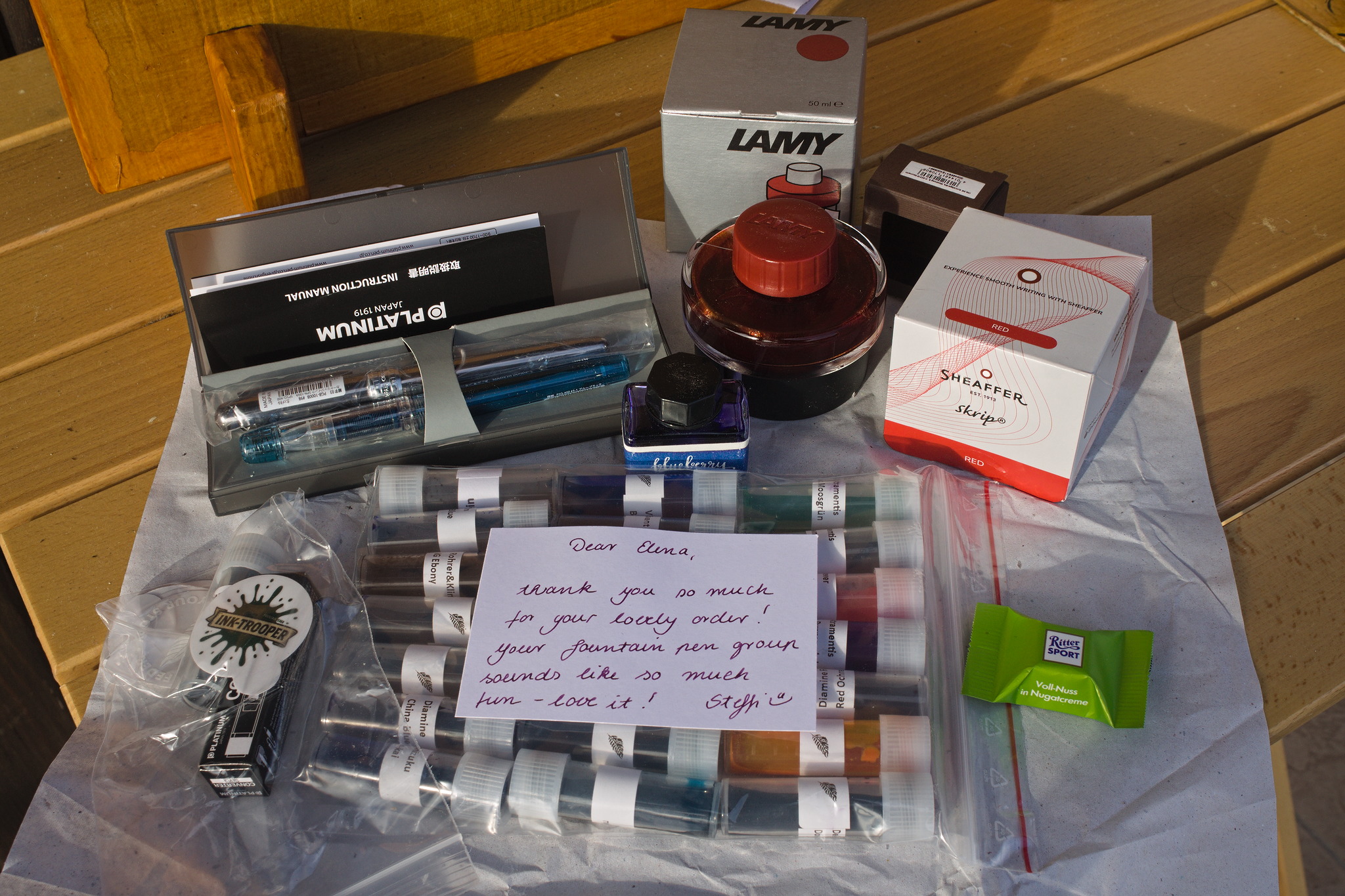
<p><img src="https://blog.trueelena.org/blog/2026/03/28-ink_lightfastness_tests_2026/loot.jpg" class="align-center" style="width:80.0%" alt="The contents of an order from a fountain pen shop, spread out
on a table: a couple of cheap pens, a couple bottles of ink, a
converter, a small ritter sport chocolate and a bag full of 5
ml vials with 2 ml of ink each, and a thank-you note from the
seller (Steffi)." /></p>
<p>The next step, already in January, was mentioning in a fountain-pen
enthusiasts forum that I planned such a test, and asking if people were
interested in having me buy a few samples of more inks when I was
buying my next pen.
The word “enthusiasts” is probably a hint of the reason why soon
afterwards I received a package with the pen I had planned to buy, its
converter, and a <em>couple dozens</em> ink samples.
And then a couple envelopes with additional samples of inks that weren’t
available on the shops, from said enthusiasts.</p>
<p>Added to the inks I already had acquired since the last lightfastness
test, it meant that they couldn’t all fit in one single page, and thus I
had some room to add some inks I had already tested: some were requests,
and for others I tried to select ones that felt relevant.
Since I’m changing the test setup, I’ve decided I should probably keep
doing this until I’ve tested again all of the inks I still have
available.</p>
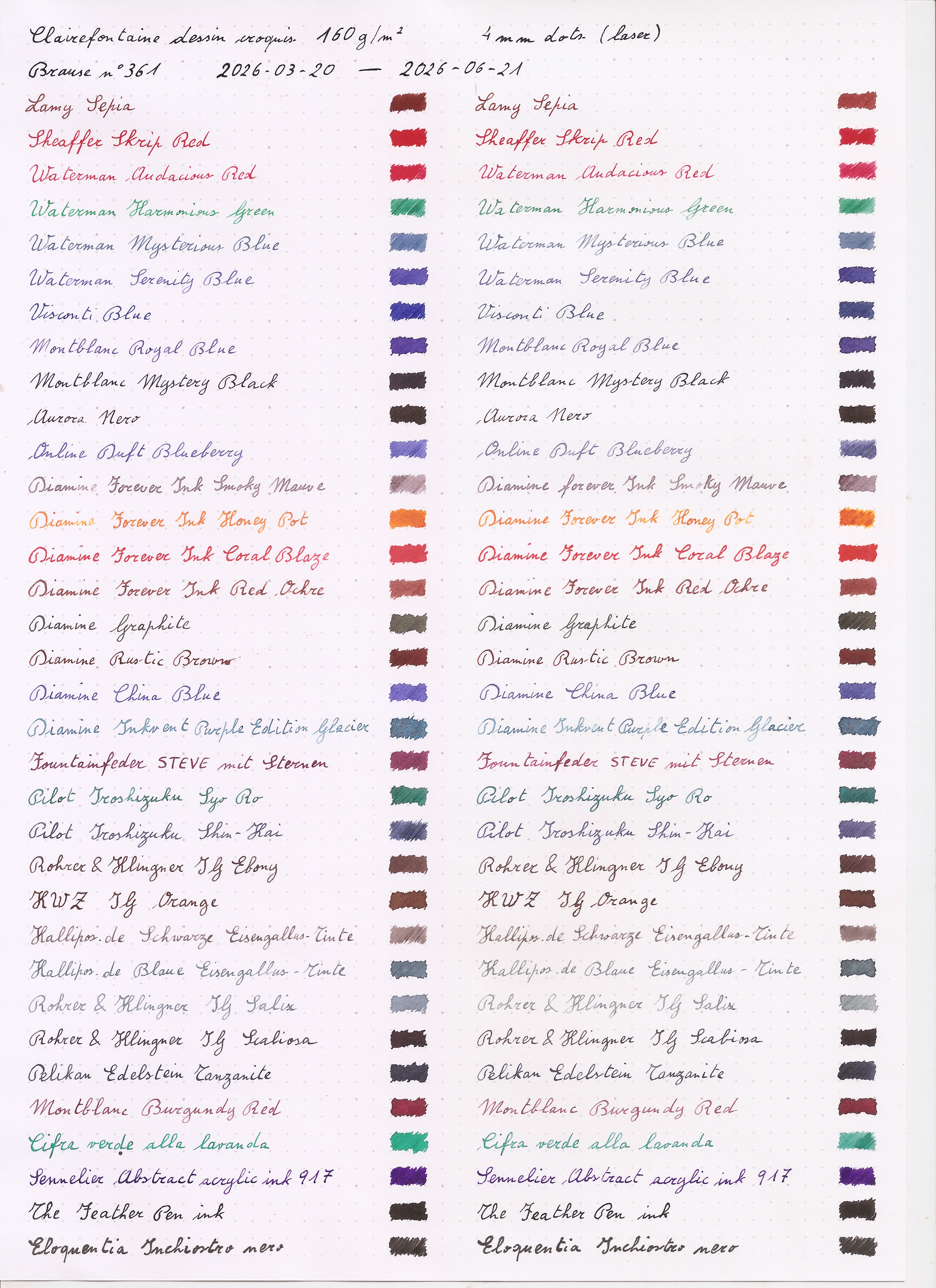
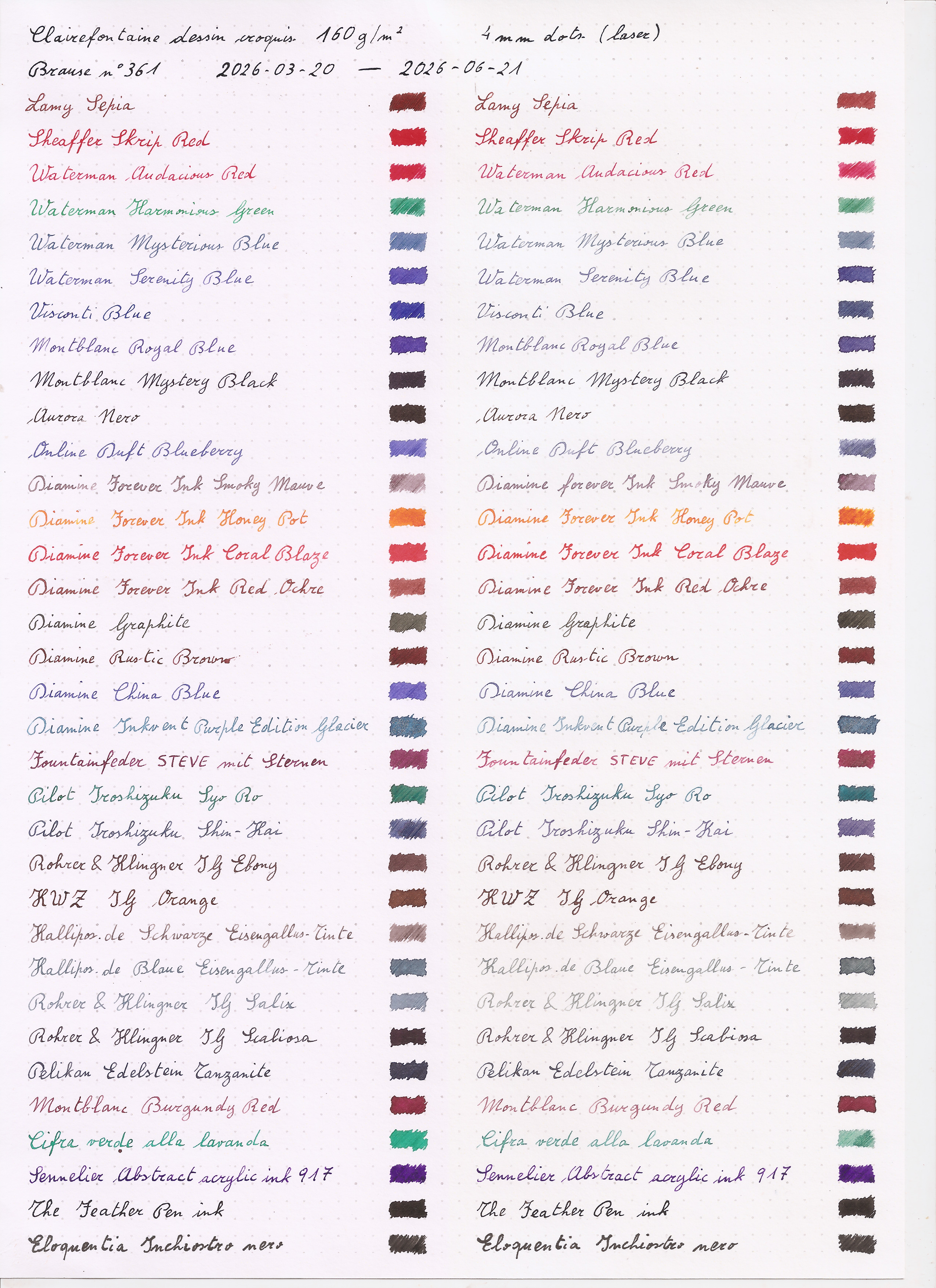
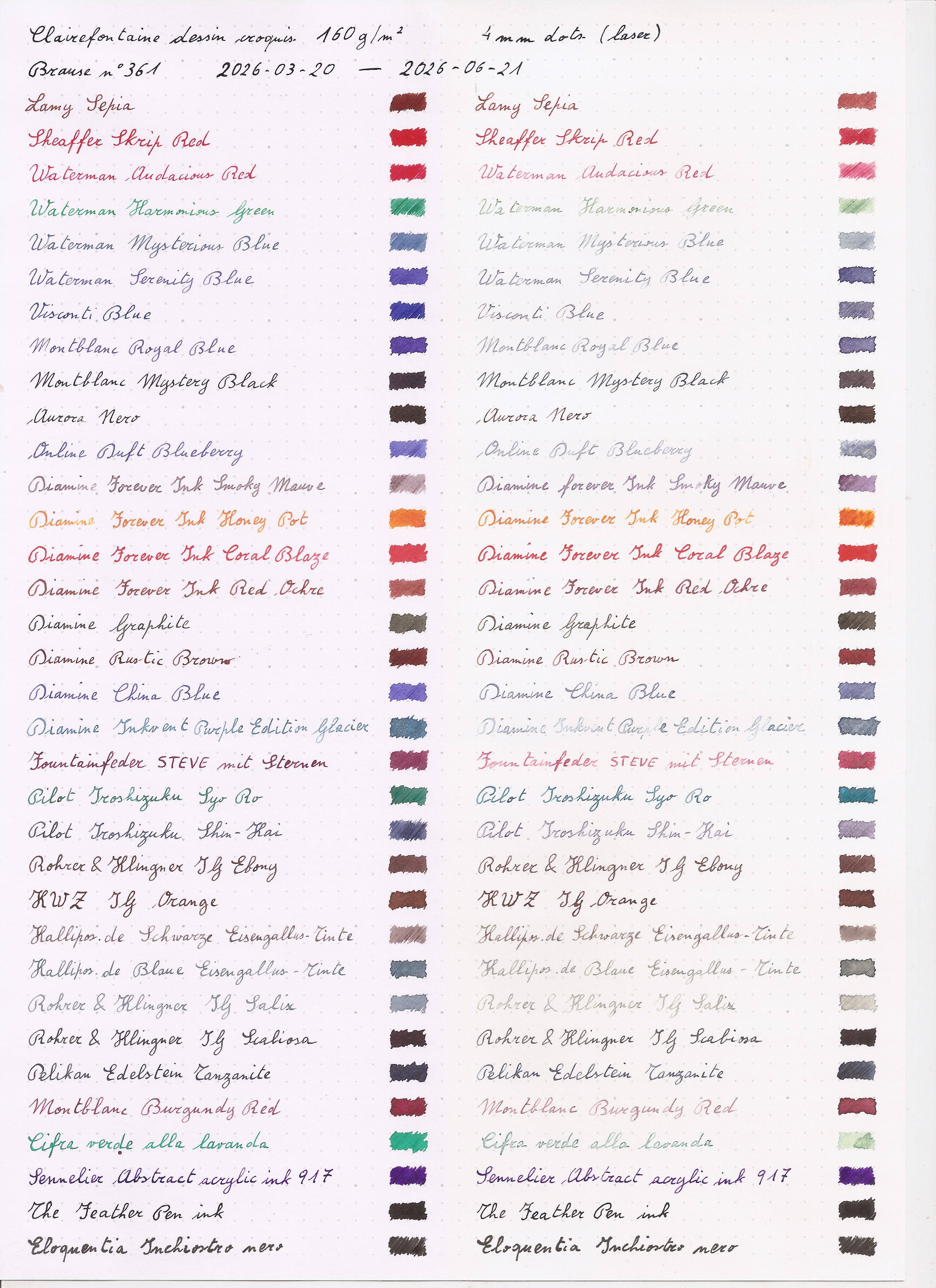
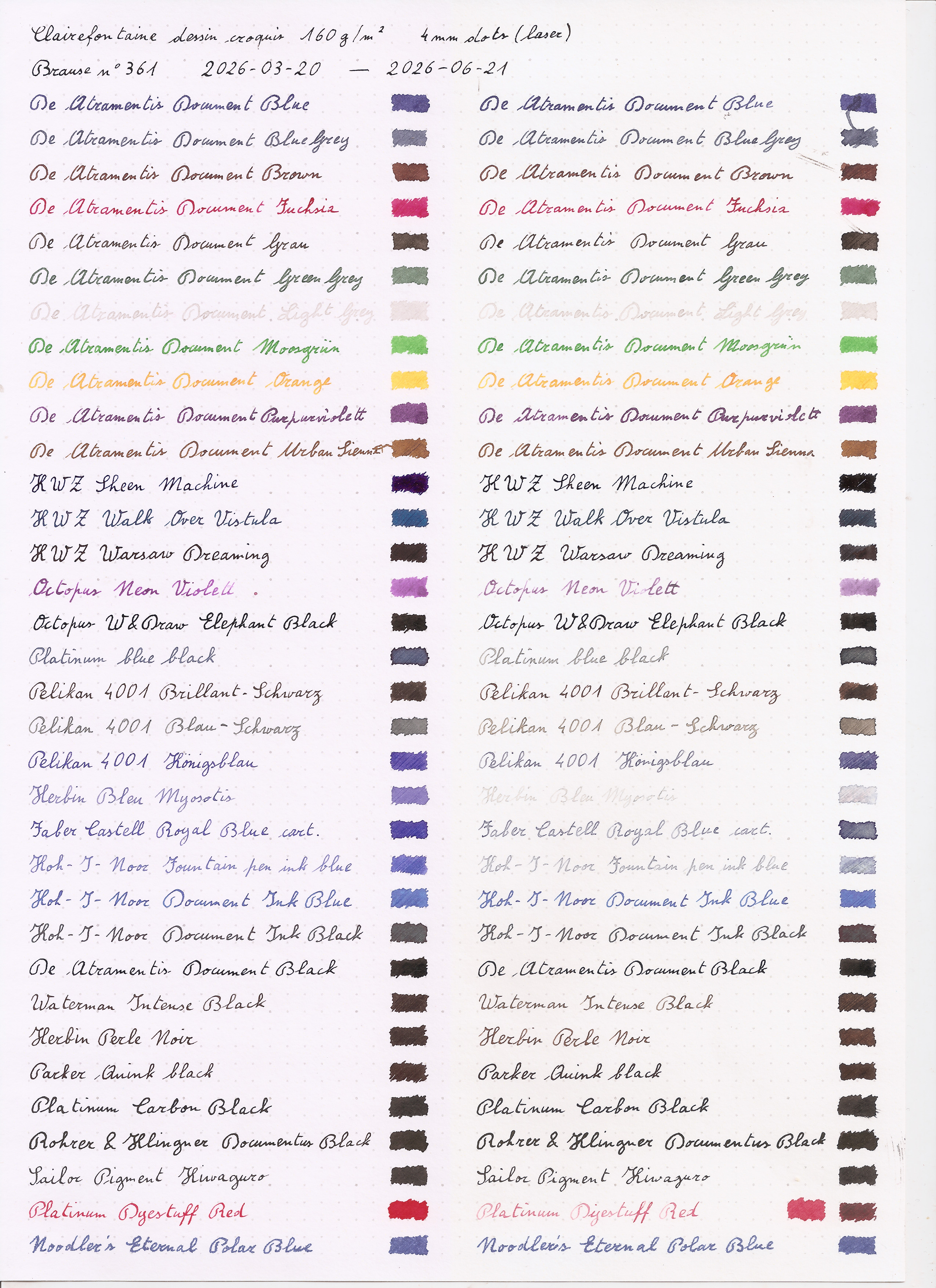
<p><img src="https://blog.trueelena.org/blog/2026/03/28-ink_lightfastness_tests_2026/lightfastness_a_03-15.jpg" class="align-center" style="width:80.0%" alt="see below" /></p>
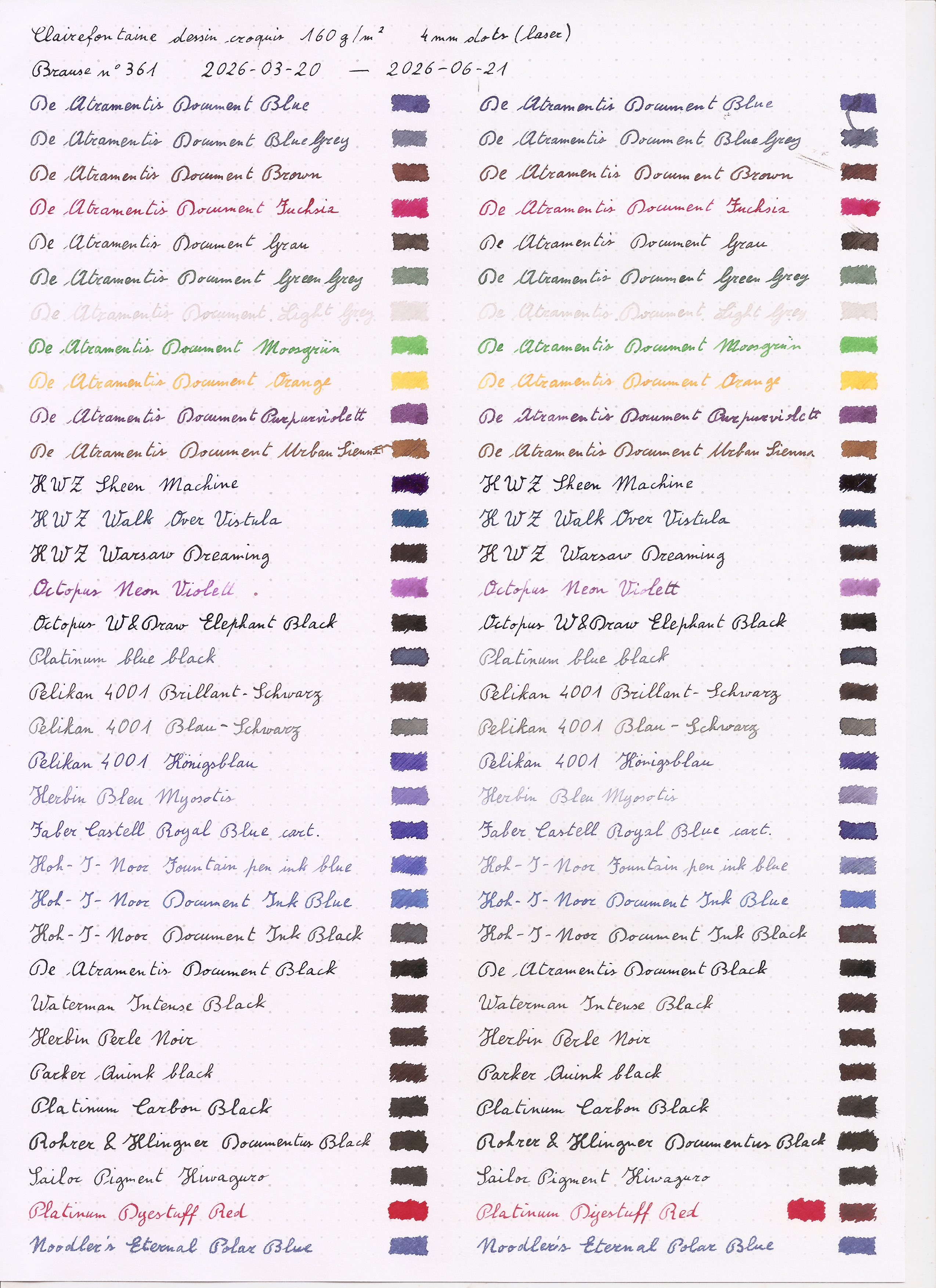
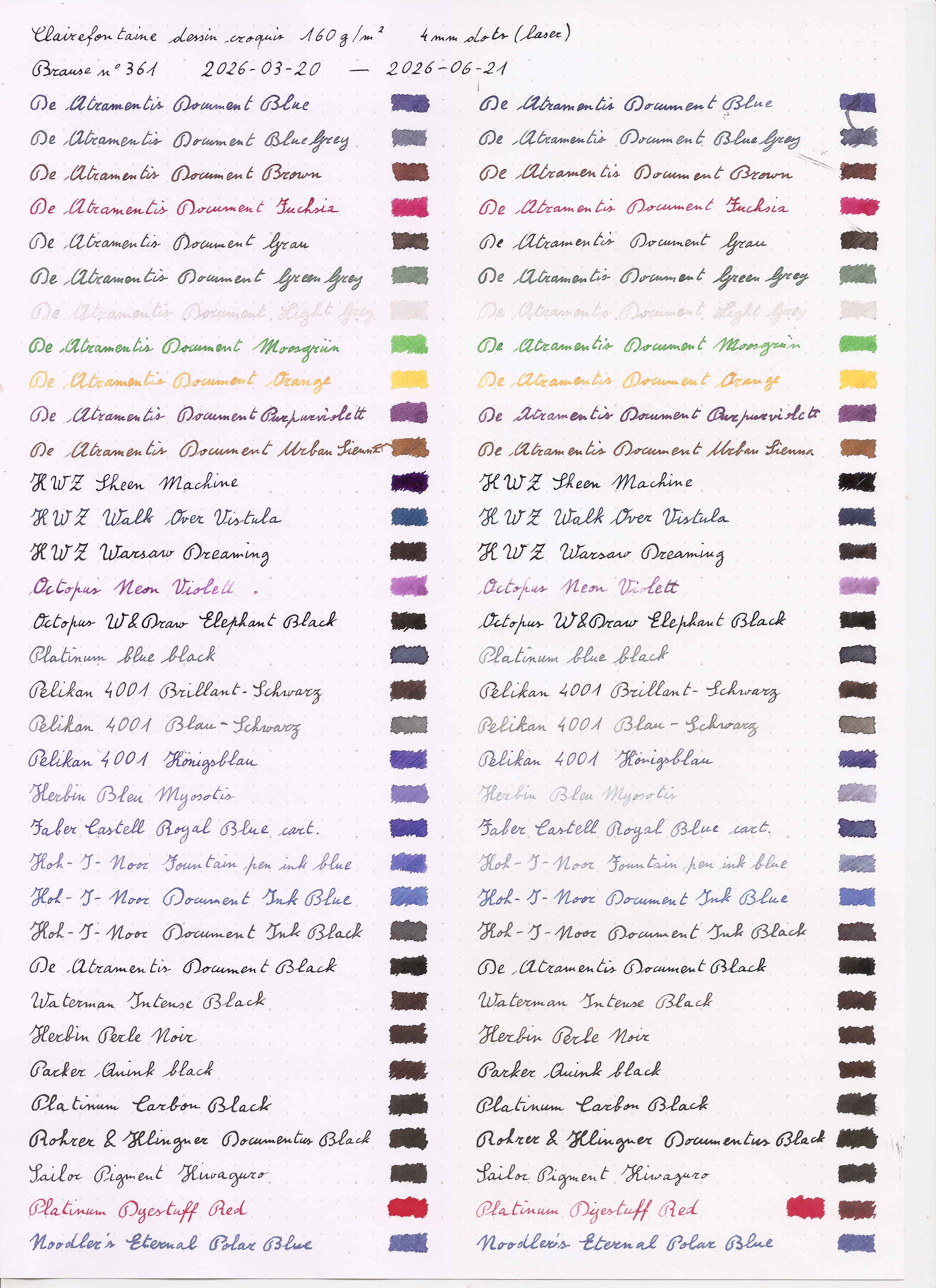
<p><img src="https://blog.trueelena.org/blog/2026/03/28-ink_lightfastness_tests_2026/lightfastness_b_03-15.jpg" class="align-center" style="width:80.0%" alt="see below" /></p>
<p>For the paper, I’ve used A4 sheets of <a href="https://www.clairefontaine.com/gb/4350-papier-dessin-croquis-160g-1685c.html">Clairefontaine Dessin Croquis
160 g/m²</a>,
one of my staples that I’m sure I will have available in the next years,
printed with a dot pattern with a laser printer, using <a href="https://blog.trueelena.orgpointed-paper-4mm-a4.pdf">this pdf</a>.
And as for the pen I’ve used a fresh Brause n°361 nib: loading a fountain pen
with all of these inks wouldn’t be a reasonable effort, and the 361 is
one of the writing implements I use most anyway. I also used a glass pen
to fill a couple of squares on the paper with more ink.
One side of each sheet was then covered with a strip of 300 g/m² black
paper (also from Clairefontaine), kept in place with three dots of
non-permanent two sided tape, put in the frame and set out in the sun on
the morning of 2026-03-20, the day of the spring equinox.</p>
<hr />
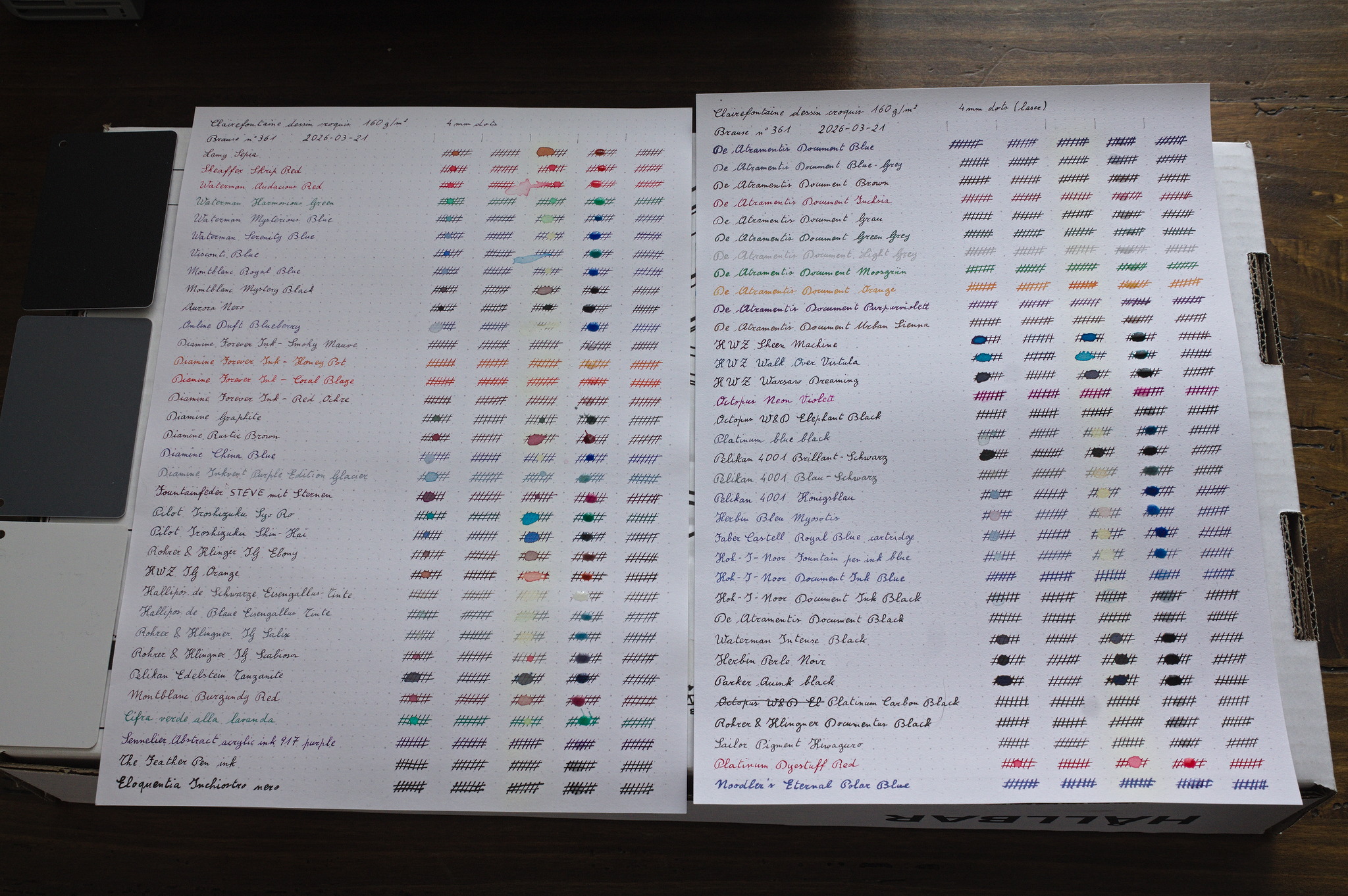
<p><img src="https://blog.trueelena.org/blog/2026/03/28-ink_lightfastness_tests_2026/liquid_resistance_tests.jpg" class="align-center" style="width:80.0%" alt="see below" /></p>
<p>While I was filling the sheet for the lightfastness tests, I decided to
also prepare a second set of sheet, for a liquid resistance drop test.</p>
<p>On each line, beside the name of the ink, I added five sets of crossing
parallel lines, and let everything dry for a few days.</p>
<p>Then I used a syringe to put a drop of a liquid on each set of lines,
waited for it to be absorbed into the paper and to dry, at least
overnight, but sometimes also for a day or two (life happened), and then
looked at the results and did the next test.</p>
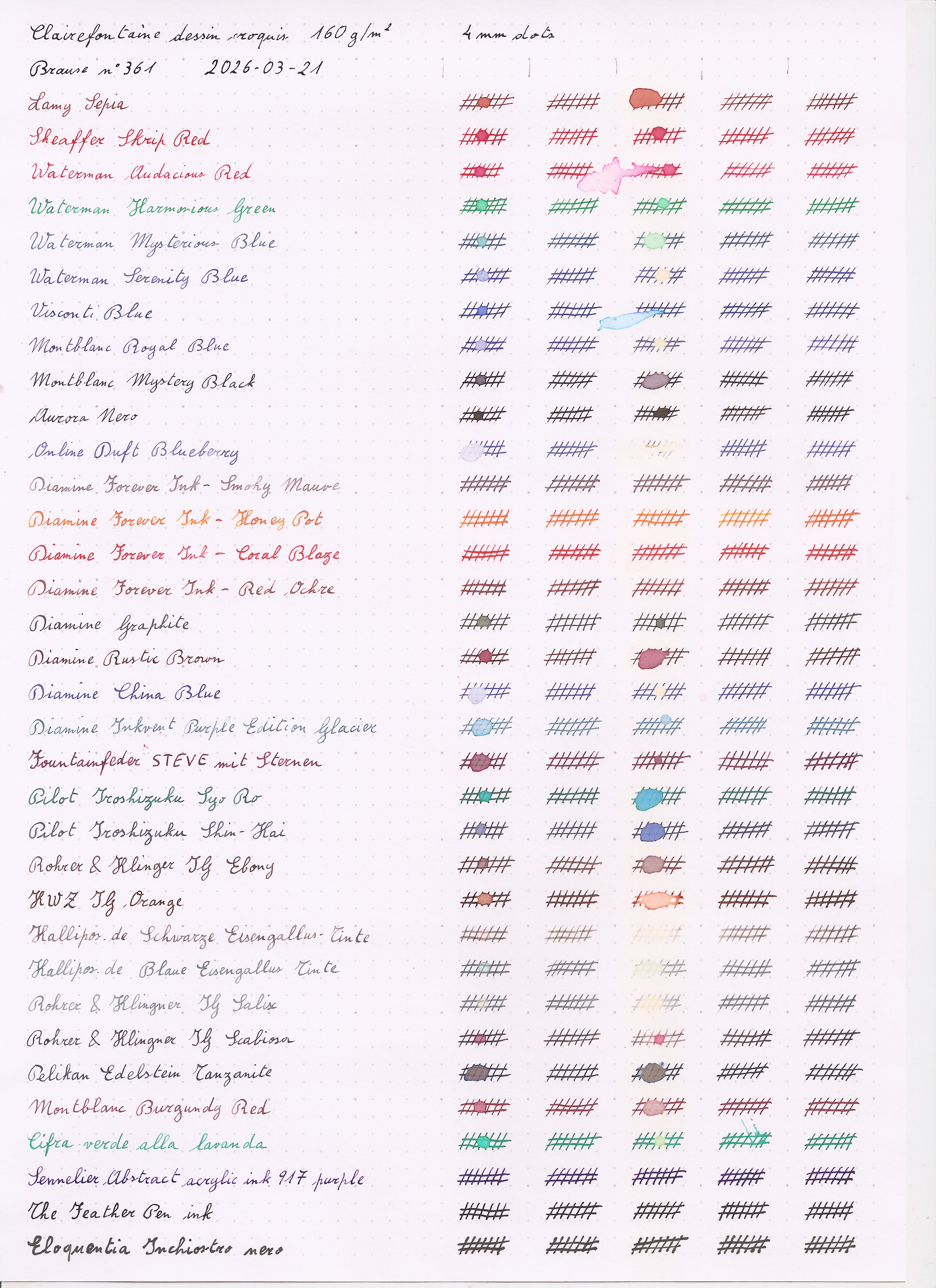
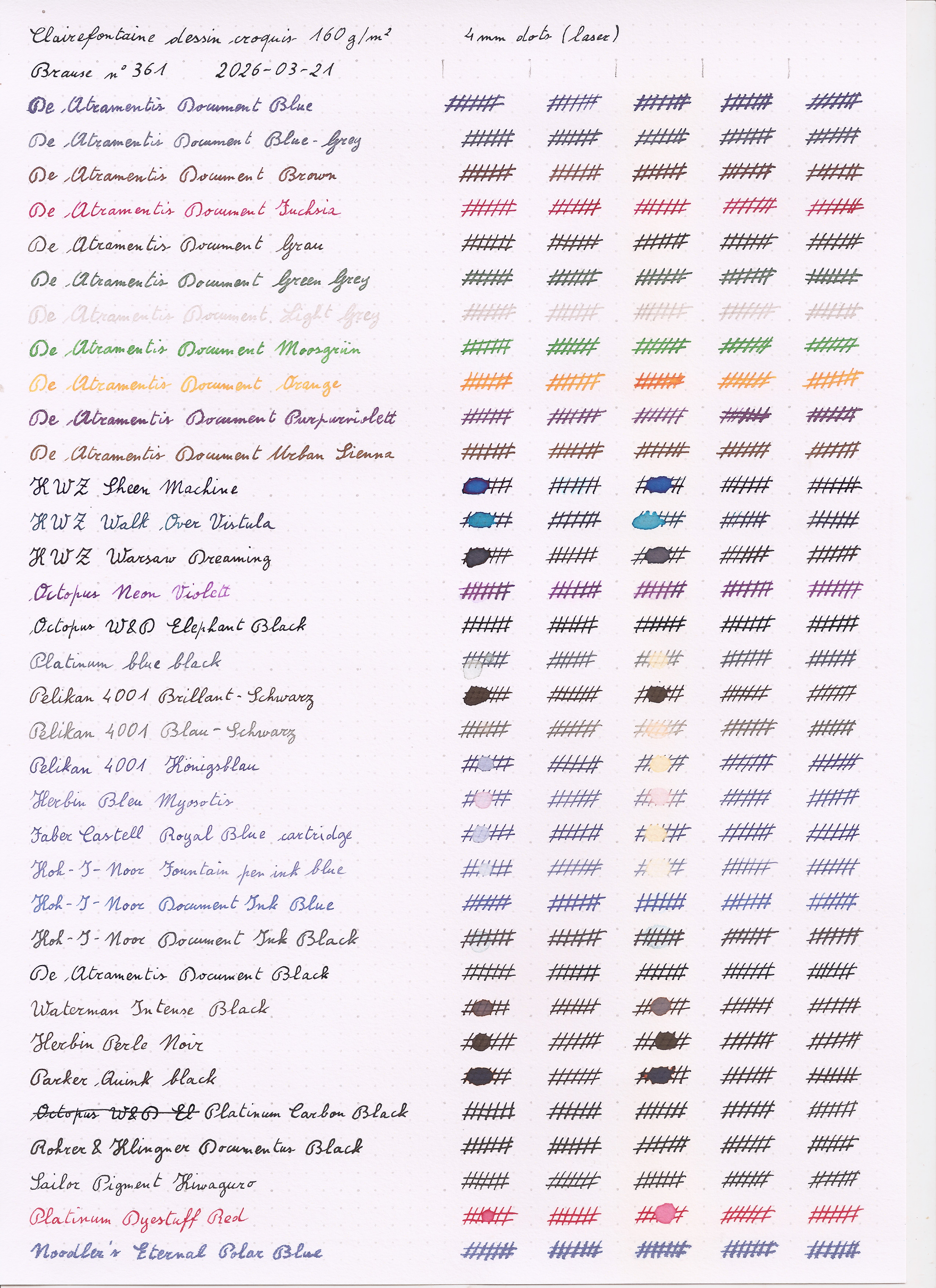
<p>The first liquid was water, with the usual wild difference between
washable and permanent inks, and all of the intermediate possibilities.</p>
<p>The second liquid was isopropyl alcohol, and I was surprised to see
that, with very few exceptions, most inks didn’t change at all. I
wonder whether that’s related to the fact that instead of forming a drop
it was absorbed almost immediately into the paper, and dried in a very
short time.</p>
<p>The third liquid was hydrogen peroxide: beside the individual results I
noticed that its column yellowed visibly; I wonder whether that means
that the paper I used has optical brighteners, and it will also yellow
under the sun: that wouldn’t be ideal, but it would also be a surprise,
for paper that is acid free and sold for arts.</p>
<p>The fourth liquid was citric acid, by mixing a bit less than a teaspoon
of citric acid granules in just enough very warm water (heated to 70°C,
i.e. the lowest temperature available on my kettle) to dissolve most of
the acid. I forgot that I had some old PH strips until one hour after
I’ve put the drop on the paper, and I don’t know whether something had
changed, but when I did remember about them it showed a deep red between
1 and 2. I don’t think I can <em>trust</em> those strips too much, however.</p>
<p>This backfired badly: the drop of citric acid never dried out, but
formed a sticky paste that prevented me from scanning the results,
and I’m not sure whether I’ll do the last test, which was supposed to be
household bleach.</p>
<p><img src="https://blog.trueelena.org/blog/2026/03/28-ink_lightfastness_tests_2026/liquids_a_3.jpg" class="align-center" style="width:80.0%" alt="see below" /></p>
<p><img src="https://blog.trueelena.org/blog/2026/03/28-ink_lightfastness_tests_2026/liquids_b_3.jpg" class="align-center" style="width:80.0%" alt="see below" /></p>
<p>Luckily I had scanned the partial results, and they are shown here.</p>
<hr />
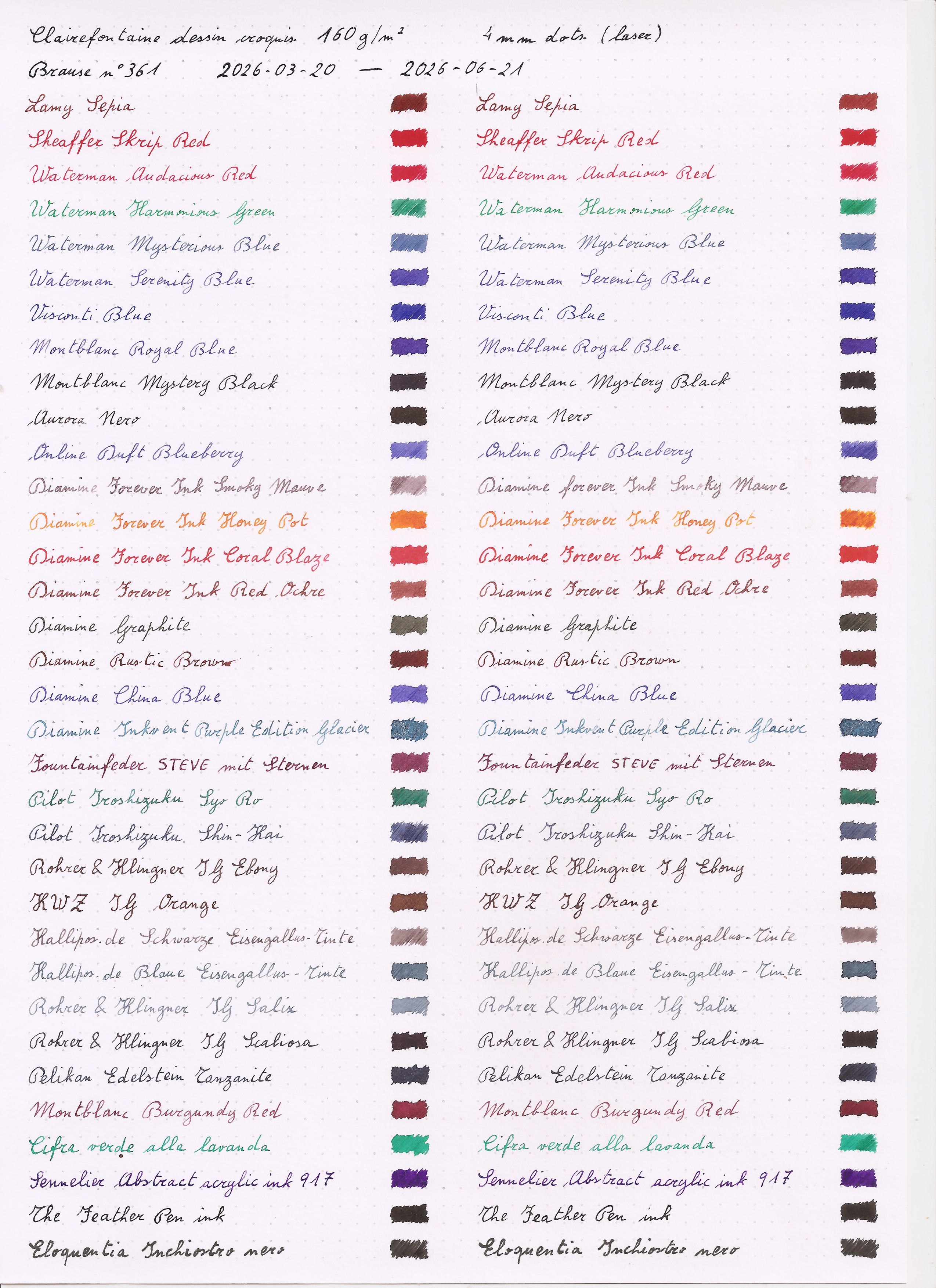
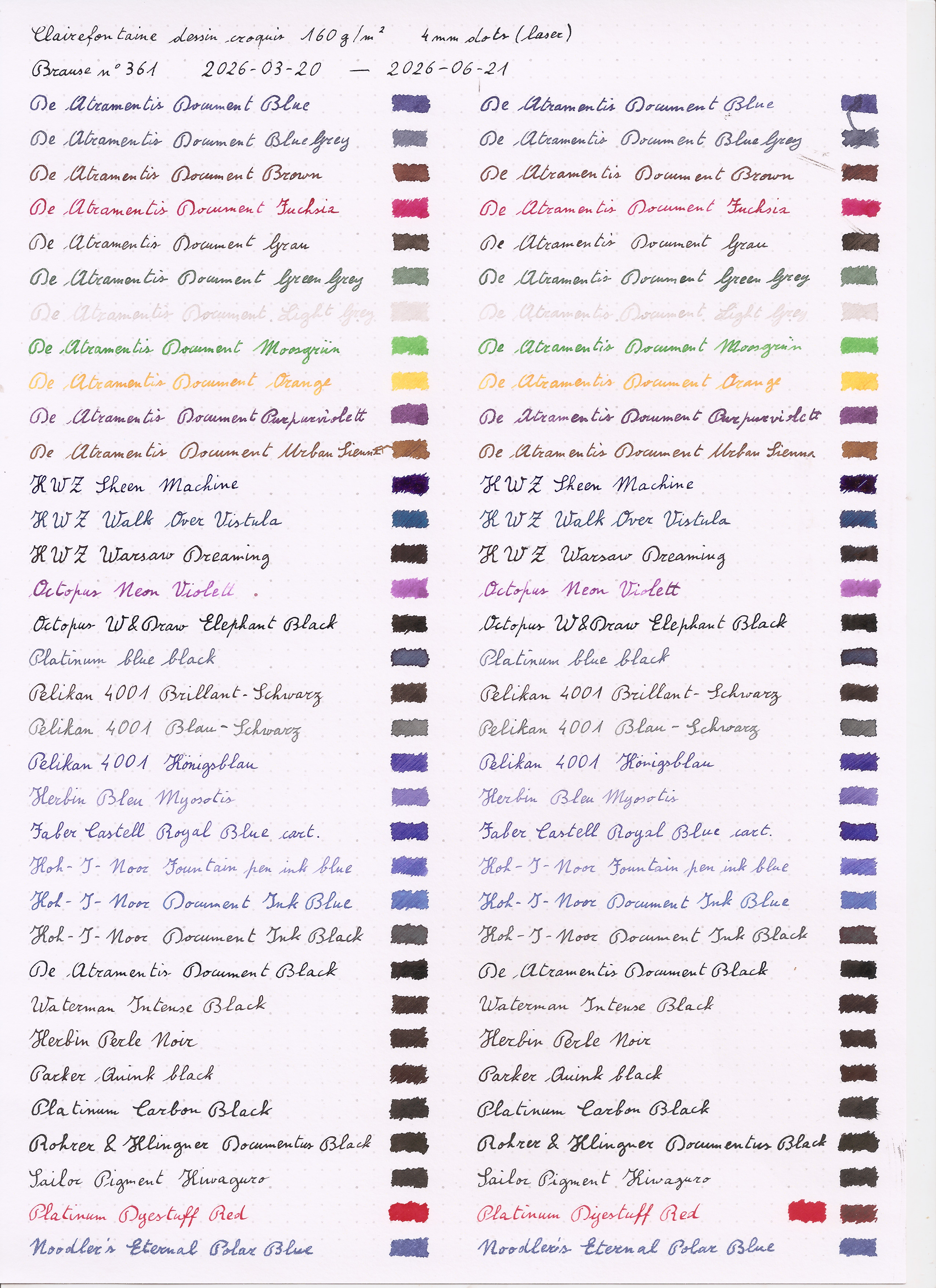
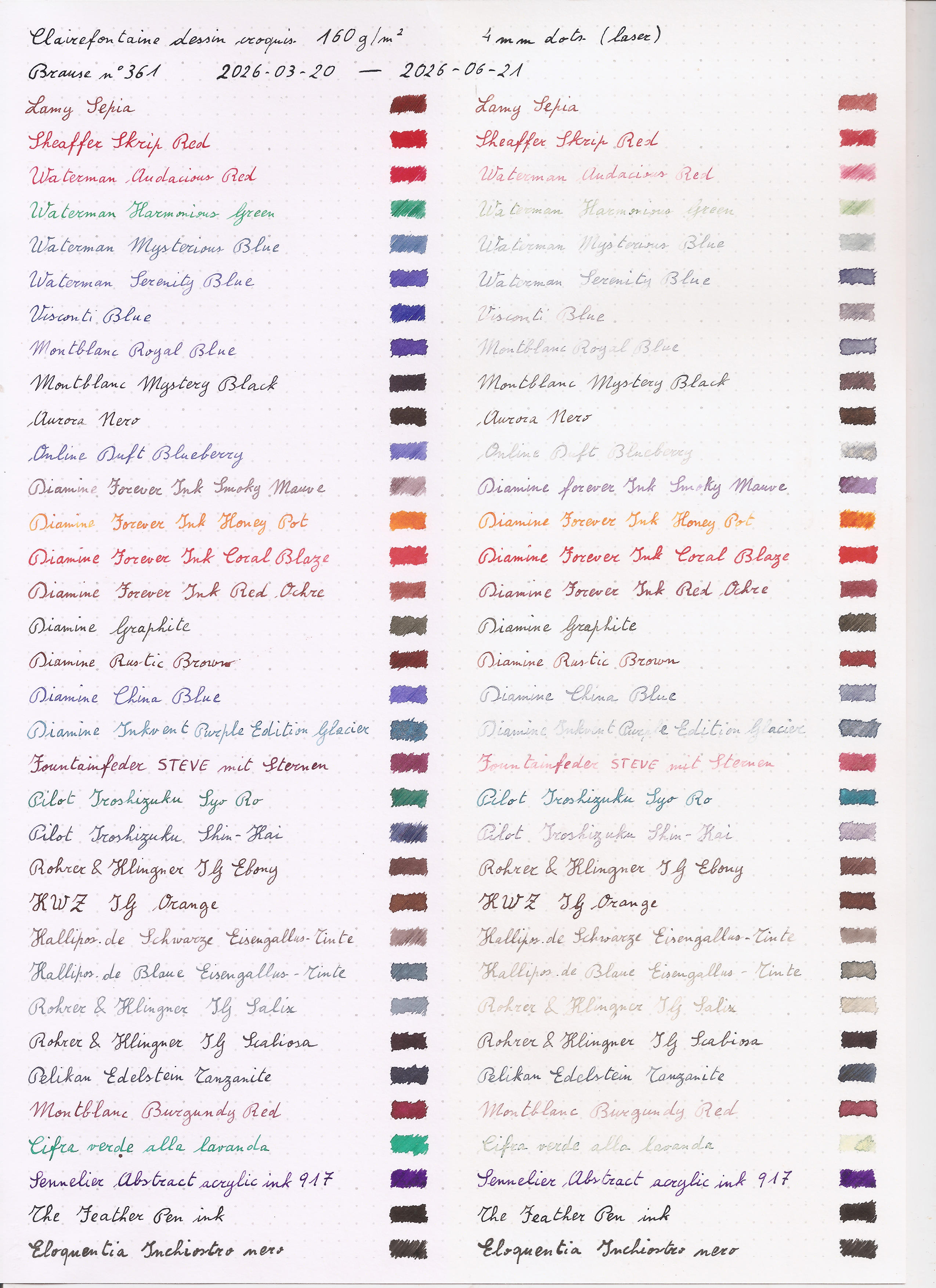
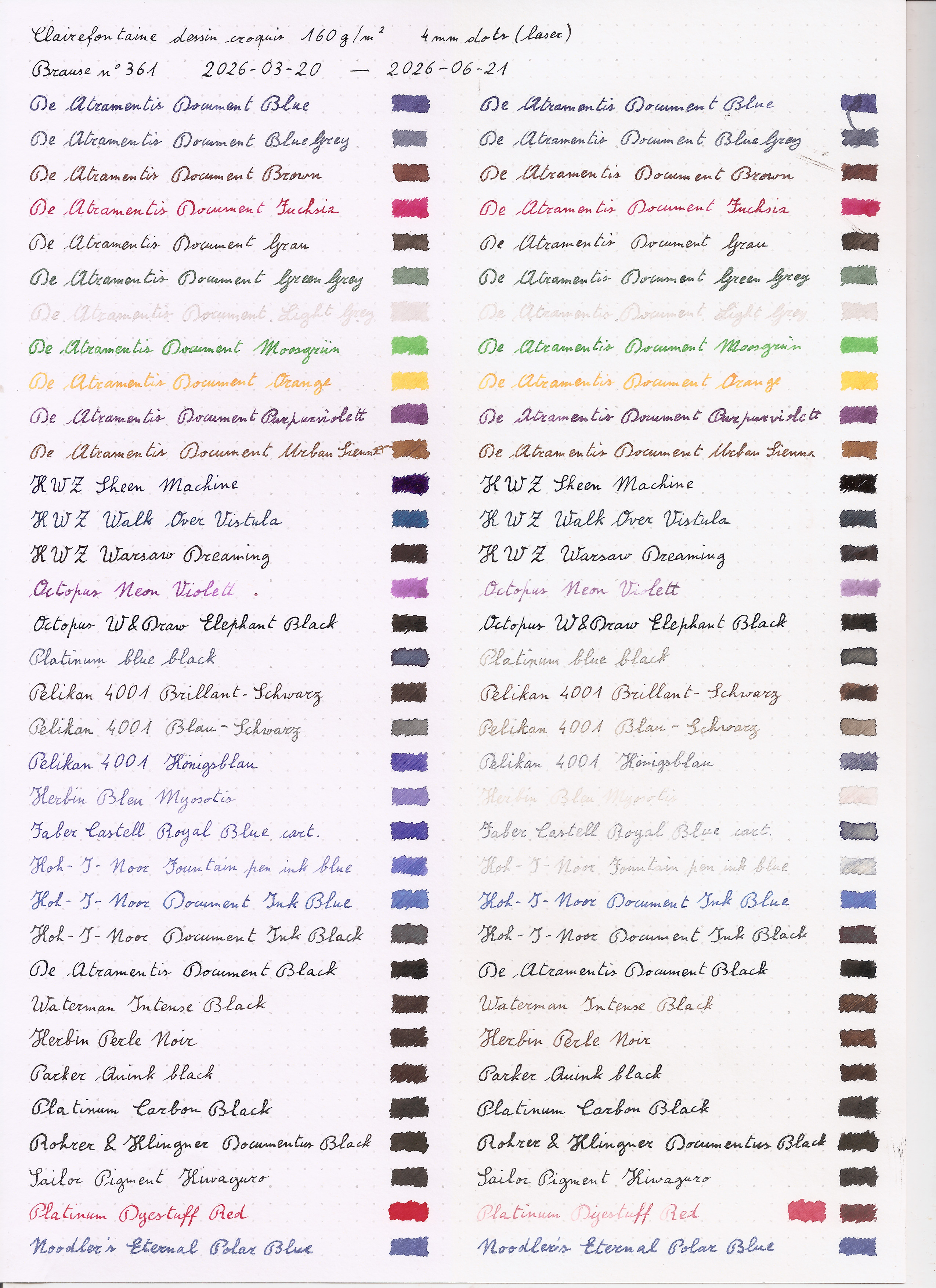
<p><img src="https://blog.trueelena.org/blog/2026/03/28-ink_lightfastness_tests_2026/lightfastness_a_03-20.jpg" class="align-center" style="width:80.0%" alt="see below" /></p>
<p><img src="https://blog.trueelena.org/blog/2026/03/28-ink_lightfastness_tests_2026/lightfastness_b_03-20.jpg" class="align-center" style="width:80.0%" alt="see below" /></p>
<p>After one full day with plenty of sun, nothing really had changed,
except possibly for a vague hint that the Herbin Bleu Myosotis may have
have been a bit lighter than it started, but it may also have been a
suggestion.</p>
<hr />
<p><img src="https://blog.trueelena.org/blog/2026/03/28-ink_lightfastness_tests_2026/lightfastness_a_03-23.jpg" class="align-center" style="width:80.0%" alt="see below" /></p>
<p><img src="https://blog.trueelena.org/blog/2026/03/28-ink_lightfastness_tests_2026/lightfastness_b_03-23.jpg" class="align-center" style="width:80.0%" alt="see below" /></p>
<p>After three days, however, some results started to show, with the most
fugitive inks starting to be visibly changed, becoming either paler or
in some case duller.</p>
<hr />
<p><img src="https://blog.trueelena.org/blog/2026/03/28-ink_lightfastness_tests_2026/lightfastness_a_03-27.jpg" class="align-center" style="width:80.0%" alt="see below" /></p>
<p><img src="https://blog.trueelena.org/blog/2026/03/28-ink_lightfastness_tests_2026/lightfastness_b_03-27.jpg" class="align-center" style="width:80.0%" alt="see below" /></p>
<p>And the full week showed more of that, with a few more inks starting to
show visible change.</p>
<hr />
<p><img src="https://blog.trueelena.org/blog/2026/03/28-ink_lightfastness_tests_2026/lightfastness_a_04-04.jpg" class="align-center" style="width:80.0%" alt="see below" /></p>
<p><img src="https://blog.trueelena.org/blog/2026/03/28-ink_lightfastness_tests_2026/lightfastness_b_04-04.jpg" class="align-center" style="width:80.0%" alt="see below" /></p>
<p>After two weeks the paper had significantly yellowed, something I did
not expect from drawing paper (and which means that I will probably use
a different paper when making similar tests in the future).</p>
<p>As for the inks, there were a couple more inks with visible changes, but
mostly it was more of the same as seen in the previous week.</p>
<hr />
<p><img src="https://blog.trueelena.org/blog/2026/03/28-ink_lightfastness_tests_2026/lightfastness_a_04-10.jpg" class="align-center" style="width:80.0%" alt="see below" /></p>
<p><img src="https://blog.trueelena.org/blog/2026/03/28-ink_lightfastness_tests_2026/lightfastness_b_04-10.jpg" class="align-center" style="width:80.0%" alt="see below" /></p>
<p>Three weeks started to show changes in the black and most irongall inks, and of course more changes in the even less resistant inks.</p>
<hr />
<p><img src="https://blog.trueelena.org/blog/2026/03/28-ink_lightfastness_tests_2026/lightfastness_a_04-17.jpg" class="align-center" style="width:80.0%" alt="see below" /></p>
<p><img src="https://blog.trueelena.org/blog/2026/03/28-ink_lightfastness_tests_2026/lightfastness_b_04-17.jpg" class="align-center" style="width:80.0%" alt="see below" /></p>
<p>Week four saw a bit more clouds and rain than the first few weeks, and
there weren’t big changes, but mostly more of what had already started
to happen earlier.</p>
<hr />
<p><img src="https://blog.trueelena.org/blog/2026/03/28-ink_lightfastness_tests_2026/lightfastness_a_04-21.jpg" class="align-center" style="width:80.0%" alt="see below" /></p>
<p><img src="https://blog.trueelena.org/blog/2026/03/28-ink_lightfastness_tests_2026/lightfastness_b_04-21.jpg" class="align-center" style="width:80.0%" alt="see below" /></p>
<p>A month didn’t change much compared to the four weeks, but I did the
scans for completeness, and from now on I’m going to update monthly.</p>
<hr />
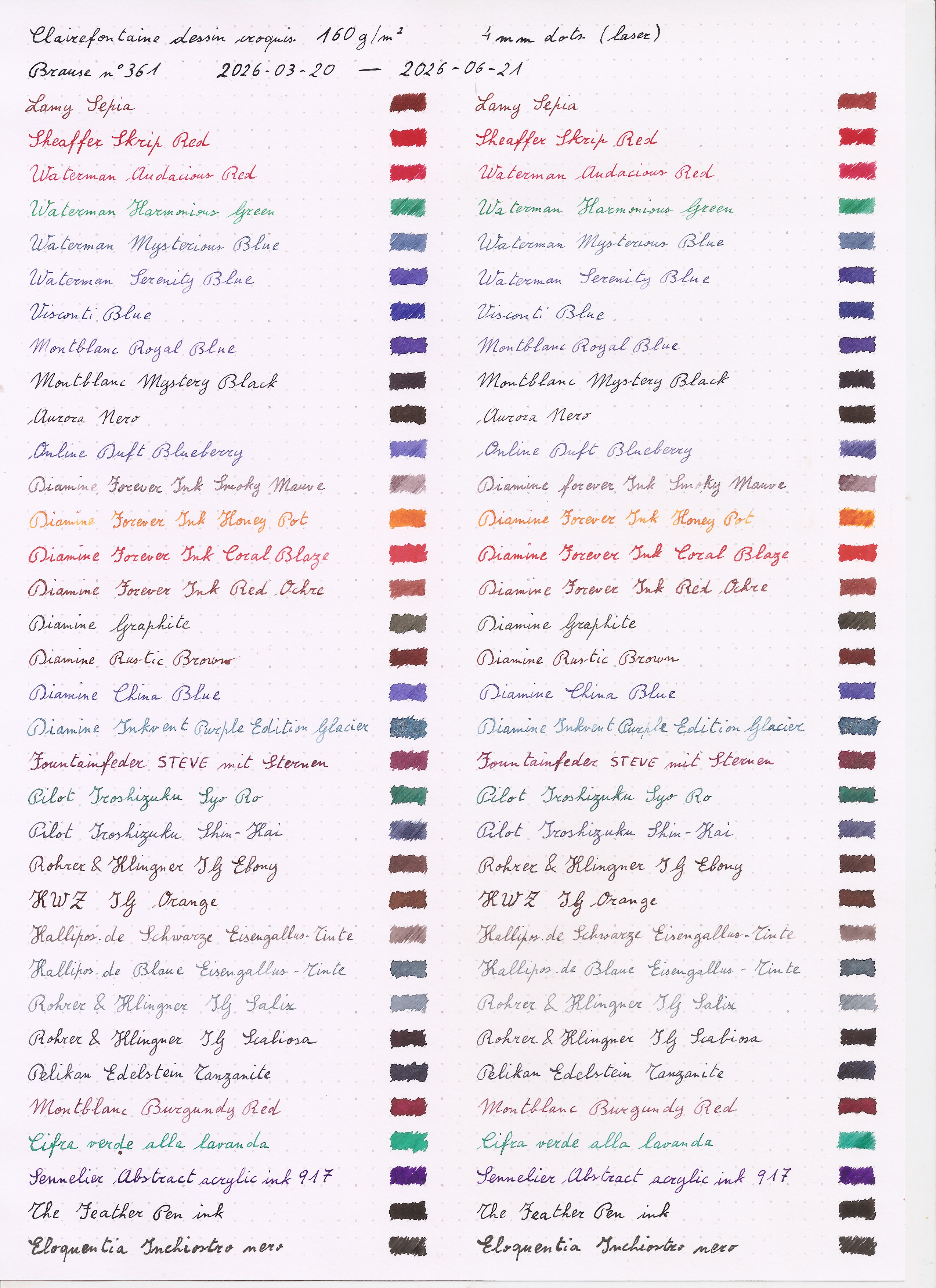
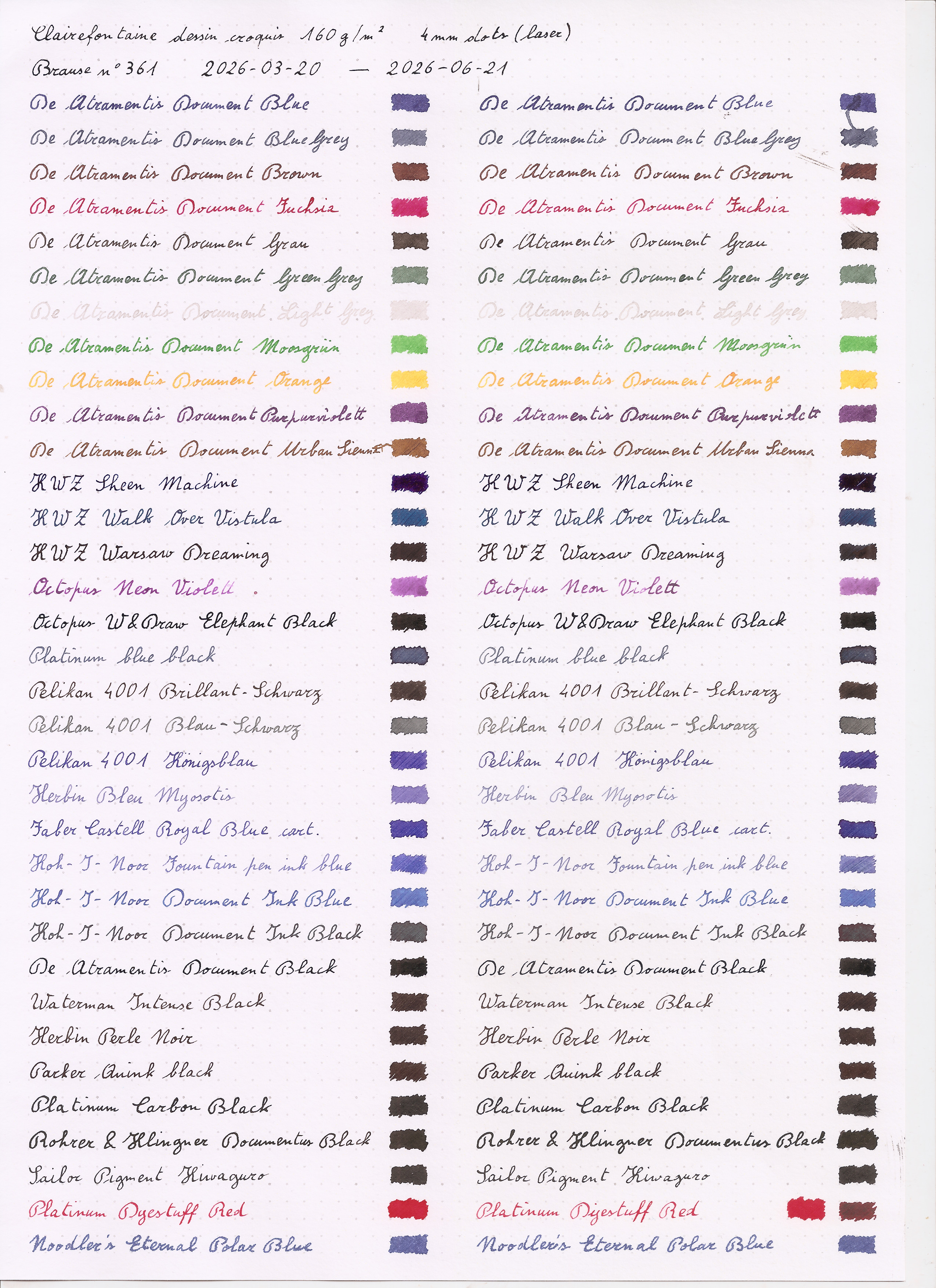
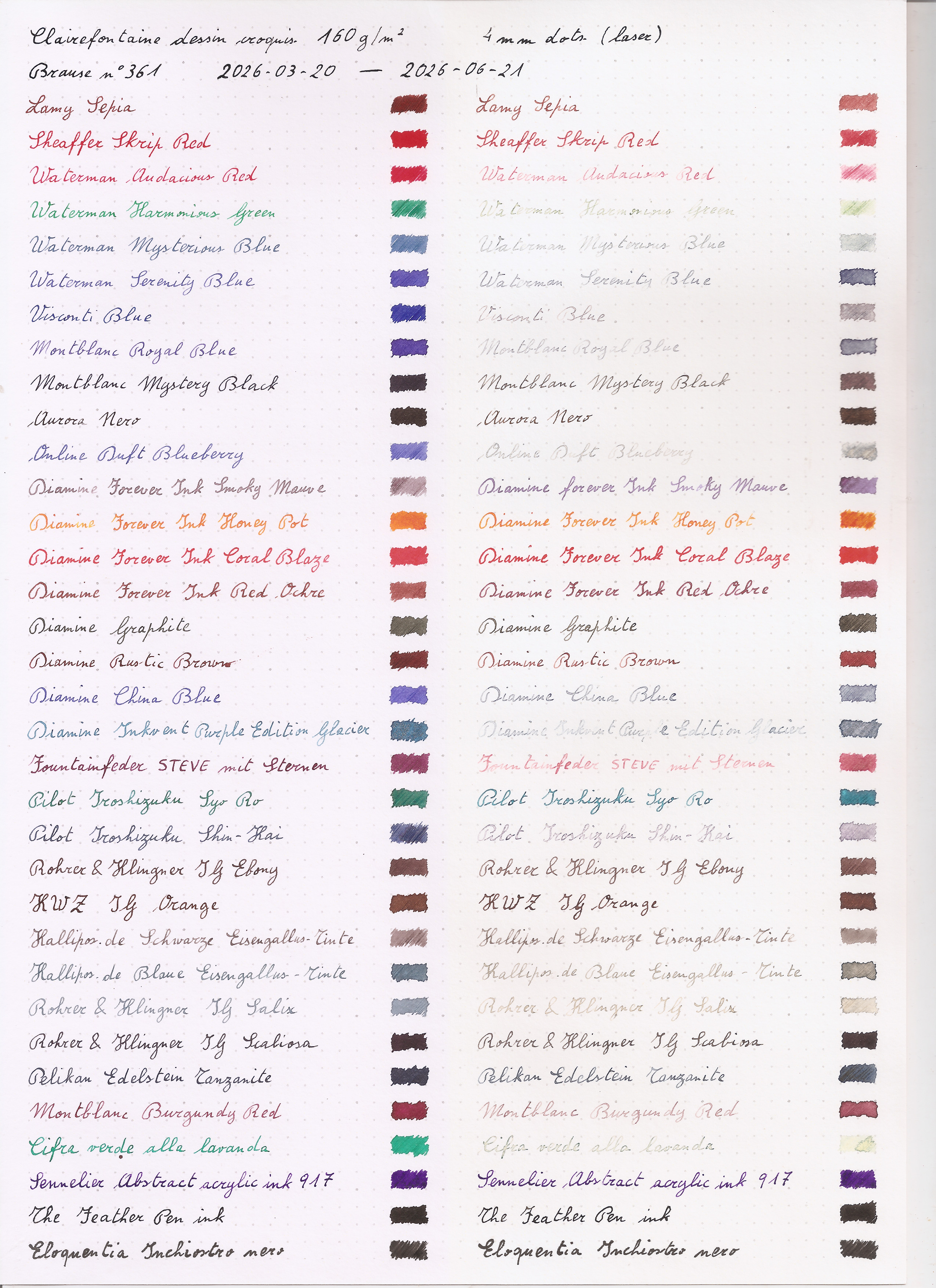
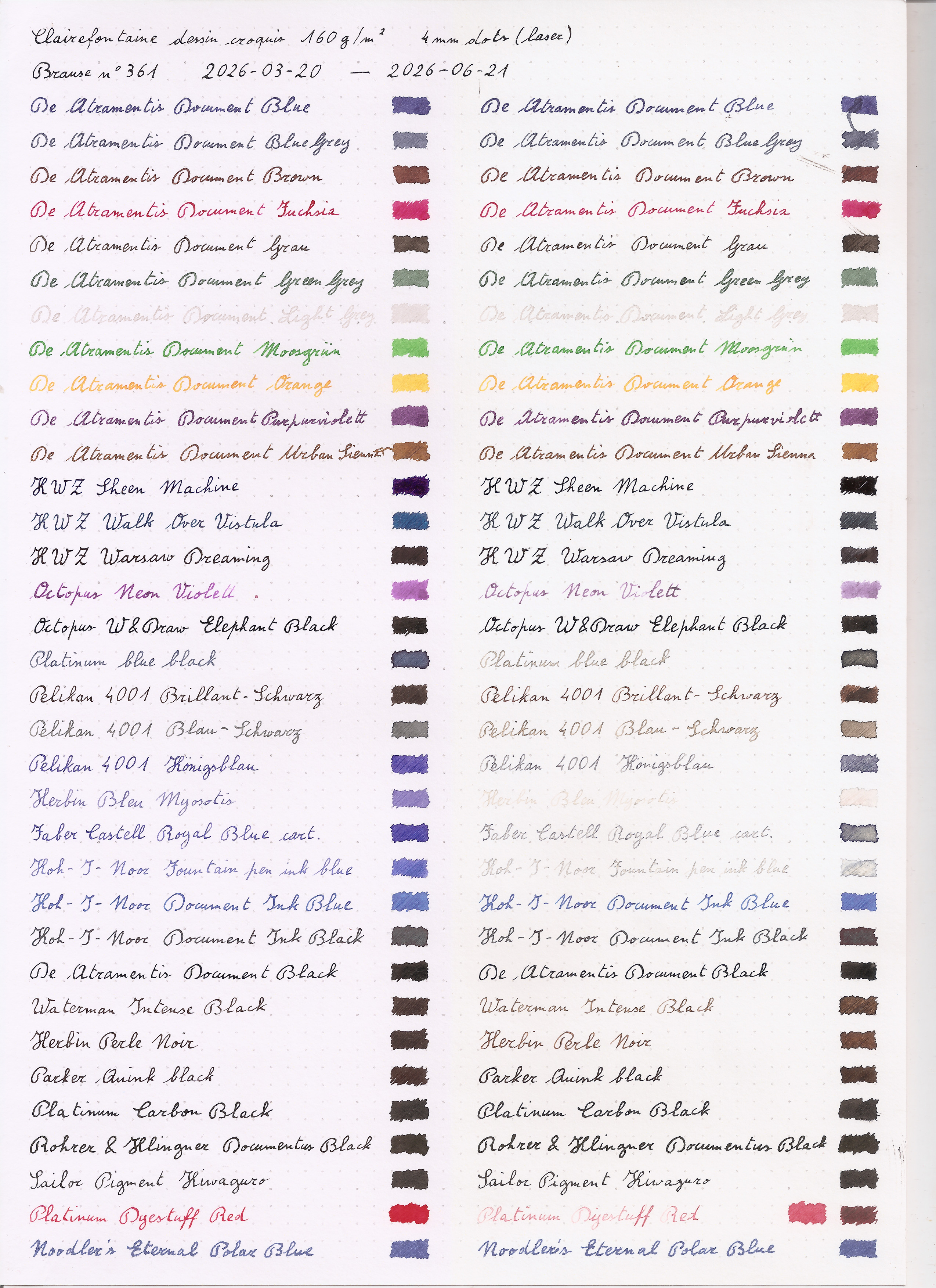
<p>These are the inks I’ve tested, and here I’ll add notes on the results,
as soon as they will be available, keeping this section updated.</p>
<p>When nothing is mentioned, it means that there were no changes, either
under the light or under the various liquids.</p>
<dl>
<dt>Lamy Sepia</dt>
<dd>
<p>Not resistant to water, the drop becomes an uniform colour spot.</p>
<p>After one week it started to be just slightly paler, more so after
three weeks.</p>
</dd>
<dt>Sheaffer Skrip Red</dt>
<dd>
<p>Not resistant to water, the drop becomes an uniform colour spot.</p>
<p>After one week it started to be just slightly paler, more so after
three weeks.</p>
</dd>
<dt>Waterman Audacious Red</dt>
<dd>
<p>Not resistant to water, the drop becomes an uniform colour spot.</p>
<p>After three days it started to be just slightly paler, after a week
visibly so. After four weeks it was very pale.</p>
</dd>
<dt>Waterman Harmonious Green</dt>
<dd>
<p>Not resistant to water, the drop becomes an uniform colour spot; the
hydrogen peroxide drop looks a bit lighter than the one with just
water.</p>
<p>After one week it started to be just slightly paler, more so after
three weeks. After four weeks it was very pale.</p>
</dd>
<dt>Waterman Mysterious Blue</dt>
<dd>
<p>Not resistant to water, the drop becomes an uniform colour spot; the
hydrogen peroxide drop is significantly lighter and tends towards
green.</p>
<p>After two weeks it started to be just slightly paler, after three
weeks it was more gray. After four weeks it was very pale.</p>
</dd>
<dt>Waterman Serenity Blue</dt>
<dd>
<p>Not resistant to water, the drop becomes an uniform colour spot; the
hydrogen peroxide drop is almost completely bleached to a light yellow.</p>
<p>After one week it started to be a bit duller. After four weeks it was
paler and duller.</p>
</dd>
<dt>Visconti Blue</dt>
<dd>
<p>Not resistant to water, the drop becomes an uniform colour spot.</p>
<p>After one week it was visibly duller, looking darker than the
original. After three weeks it was duller, and lighter. After a month
it was just a pale gray.</p>
</dd>
<dt>Montblanc Royal Blue</dt>
<dd>
<p>Not resistant to water, the drop becomes an uniform colour spot; the
hydrogen peroxide drop is almost completely bleached to a light
yellow.</p>
<p>After one week it started to be just slightly duller, more so after
two weeks. After three weeks it was also paler. After a month it was
just a pale gray.</p>
</dd>
<dt>Montblanc Mystery Black</dt>
<dd>
<p>Not resistant to water, the drop becomes an uniform colour spot.</p>
<p>After three weeks it started to be a bit paler.</p>
</dd>
<dt>Aurora Nero</dt>
<dd>
<p>Not resistant to water, the drop becomes an uniform colour spot.</p>
<p>After three weeks it started to be a bit more brown.</p>
</dd>
<dt>Online Duft Blueberry</dt>
<dd>
<p>Not resistant to water, the drop looks very washed out, although a
hint of the original shape can be guessed; the hydrogen peroxide drop
is almost completely bleached to a light yellow.</p>
<p>After one week it was visibly paler and duller. After three weeks
significantly so. After a month it was a pale grey.</p>
</dd>
<dt>Diamine Forever Ink - Smoky Mauve</dt>
<dd>
<p>After a month it looked a bit more purple.</p>
</dd>
<dt>Diamine Forever Ink - Honey Pot</dt>
<dd>
<p>.</p>
</dd>
<dt>Diamine Forever Ink - Coral Blaze</dt>
<dd>
<p>.</p>
</dd>
<dt>Diamine Forever Ink - Red Ochre</dt>
<dd>
<p>.</p>
</dd>
<dt>Diamine Graphite</dt>
<dd>
<p>Not resistant to water, the drop becomes an uniform colour spot.</p>
</dd>
<dt>Diamine Rustic Brown</dt>
<dd>
<p>Not resistant to water, the drop becomes an uniform colour spot.</p>
<p>After three weeks it started to be very slightely paler.</p>
</dd>
<dt>Diamine China Blue</dt>
<dd>
<p>Not resistant to water, the drop becomes an uniform colour spot; the
hydrogen peroxide drop is almost completely bleached to a light
yellow.</p>
<p>After three weeks it started to be paler and duller.</p>
</dd>
<dt>Diamine Inkvent Purple Edition - Glacier</dt>
<dd>
<p>Not resistant to water, there is a drop of uniform colour, but it
maintains a somewhat recognisable shade of the original shape.</p>
<p>After three weeks it started to be lighter.</p>
</dd>
<dt>Fountainfeder STEVE</dt>
<dd>
<p>Not resistant to water, there is a drop of uniform colour, but it
maintains a somewhat recognisable shade of the original shape.</p>
<p>After two weeks the base colour had changed to a pink rather than
purple.</p>
</dd>
<dt>Pilot Iroshizuku Syo Ro</dt>
<dd>
<p>Not resistant to water, there is a drop of uniform colour, but it
maintains a somewhat recognisable shade of the original shape.</p>
<p>After four weeks it was very slightely paler.</p>
</dd>
<dt>Pilot Iroshizuku Shin-Kai</dt>
<dd>
<p>Not resistant to water, there is a drop of uniform colour, but it
maintains a somewhat recognisable shade of the original shape.</p>
<p>After two weeks it had become lighter and more purple. After four
weeks it was a purple gray.</p>
</dd>
<dt>Rohrer &amp; Klingner IG Ebony</dt>
<dd>
<p>Not resistant to water, there is a drop of uniform colour, but it
maintains a recognisable shade of the original shape; under
hydrogen peroxide the shade is significantly lighter.</p>
<p>After four weeks it was a bit lighter</p>
</dd>
<dt>KWZ IG Orange</dt>
<dd>
<p>Not resistant to water, the drop becomes an uniform colour spot; the
hydrogen peroxide drop is significantly bleached to a light orange.</p>
</dd>
<dt>Kallipos.de Schwarze Eisengallus-Tinte</dt>
<dd>
<p>Water stains the paper, leaving however the original shape quite
visible; is it almost completely bleached by hydrogen peroxide.</p>
<p>After three weeks it started to be very slightely lighter.</p>
</dd>
<dt>Kallipos.de Blaue Eisengallus-Tinte</dt>
<dd>
<p>Water stains the paper, leaving however the original shape quite
visible; is it almost completely bleached by hydrogen peroxide.</p>
<p>After two weeks it had started to become lighter and more gray.</p>
</dd>
<dt>Rohrer &amp; Klingner IG Salix</dt>
<dd>
<p>Water stains the paper, leaving however the original shape quite
visible; is it almost completely bleached by hydrogen peroxide.</p>
<p>After two weeks it had become lighter and significantly more gray.
After a month it was a yellowish gray.</p>
</dd>
<dt>Rohrer &amp; Klingner IG Scabiosa</dt>
<dd>
<p>Water stains the paper with a significant purple spot, leaving
however the original shape quite visible; is is a bit bleached by
hydrogen peroxide, but still quite readable.</p>
</dd>
<dt>Pelikan Edelstein Tanzanite</dt>
<dd>
<p>Not resistant to water, the drop becomes an uniform colour spot, but
there is a visible trace of the original shape.</p>
<p>After three weeks it started to be slightly paler.</p>
</dd>
<dt>Montblanc Burgundy Red</dt>
<dd>
<p>Not resistant to water, the drop becomes an uniform colour spot, with
just a hint of the original shape; slightly bleached by hydrogen
peroxide.</p>
<p>After three weeks it started to be paler.</p>
</dd>
<dt>Cifra inchiostro finissimo verde alla lavanda</dt>
<dd>
<p>Not resistant to water, the drop becomes an uniform colour spot;
quite bleached to a light yellowish green by hydrogen peroxide.</p>
<p>After one week it was visibly paler. After a month it was a still
readable pale trace.</p>
</dd>
<dt>Sennelier Abstract acrylic ink 917 purple</dt>
<dd>
<p>.</p>
</dd>
<dt>The Feather Pen Ink</dt>
<dd>
<p>.</p>
</dd>
<dt>Eloquentia Inchiostro nero</dt>
<dd>
<p>.</p>
</dd>
<dt>DeAtramentis Document Blue</dt>
<dd>
<p>.</p>
</dd>
<dt>DeAtramentis Document BlueGrey</dt>
<dd>
<p>.</p>
</dd>
<dt>DeAtramentis Document Brown</dt>
<dd>
<p>.</p>
</dd>
<dt>DeAtramentis Document Fuchsia</dt>
<dd>
<p>.</p>
</dd>
<dt>DeAtramentis Document Grau</dt>
<dd>
<p>.</p>
</dd>
<dt>DeAtramentis Document Green Grey</dt>
<dd>
<p>.</p>
</dd>
<dt>DeAtramentis Document Light Grey</dt>
<dd>
<p>.</p>
</dd>
<dt>DeAtramentis Document Moosgrün</dt>
<dd>
<p>.</p>
</dd>
<dt>DeAtramentis Document Orange</dt>
<dd>
<p>.</p>
</dd>
<dt>DeAtramentis Document Purpurviolett</dt>
<dd>
<p>.</p>
</dd>
<dt>DeAtramentis Document Urban Sienna</dt>
<dd>
<p>.</p>
</dd>
<dt>KWZ Sheen Machine</dt>
<dd>
<p>Not resistant to water, the drop becomes an uniform colour spot; the
hydrogen peroxide bleached away the red sheen. This was one of the
only two inks to react to isopropyl alcohol, which caused a pale cyan
halo around the lines.</p>
<p>After three days it was still perfectly readable, but had visibly
lost some red sheen, after one week the red had completely gone and
it looked very dark blue (but still shiny)</p>
</dd>
<dt>KWZ Walk over Vistula</dt>
<dd>
<p>Not resistant to water, the drop becomes an uniform colour spot.</p>
<p>After four weeks it looked a bit <em>darker</em> and duller.</p>
</dd>
<dt>KWZ Warsaw Dreaming</dt>
<dd>
<p>Not resistant to water, the drop becomes an uniform colour spot.</p>
<p>After a month it started to be a bit lighter.</p>
</dd>
<dt>Octopus Neon Violett</dt>
<dd>
<p>Water very lightly stains the paper, leaving however the original
shape quite visible. The other ink that reacted to isopropyl alcohol,
with a pale purple halo around the lines.</p>
<p>After two weeks it was paler, more pink.</p>
</dd>
<dt>Octopus Write &amp; Draw Elephant Black</dt>
<dd>
<p>.</p>
</dd>
<dt>Platinum blue black</dt>
<dd>
<p>Water stains the paper, leaving however the original shape quite
visible; it is significantly bleached by hydrogen peroxide.</p>
<p>After three weeks it started to become gray.</p>
</dd>
<dt>Pelikan 4001 Brillant-Schwarz</dt>
<dd>
<p>Not resistant to water, the drop becomes an uniform colour spot.</p>
<p>After three weeks it was a bit more brown than black, after a month
noticeably so.</p>
</dd>
<dt>Pelikan 4001 Blau-Schwarz</dt>
<dd>
<p>Water stains the paper, leaving however the original shape quite
visible; it is significantly bleached by hydrogen peroxide.</p>
<p>After three weeks it started to become gray.</p>
</dd>
<dt>Pelikan 4001 Königsblau</dt>
<dd>
<p>Not resistant to water, the drop becomes an uniform colour spot, with
just a hint of the original shape; significantly bleached by hydrogen
peroxide.</p>
<p>After three days it had started to be slightly paler.
After three weeks it was significantly desaturated.</p>
</dd>
<dt>Herbin Bleu Myosotis</dt>
<dd>
<p>Not resistant to water, the drop becomes an uniform pink spot,
significantly bleached by hydrogen peroxide.</p>
<p>After three days it was already visibly paler, after one week it was
a pale grey. After a month it was still somehow readable, but as a
trace.</p>
</dd>
<dt>Faber Castell Royal Blue</dt>
<dd>
<p>Not resistant to water, the drop becomes an uniform colour spot, with
just a hint of the original shape; significantly bleached by hydrogen
peroxide.</p>
<p>After three days it was slightly duller, after two weeks definitely
so. After a month it was also quite paler.</p>
</dd>
<dt>Koh-I-Noor Fountain pen ink blue</dt>
<dd>
<p>Not resistant to water, the drop becomes an uniform colour spot, with
just a hint of the original shape; significantly bleached by hydrogen
peroxide.</p>
<p>After three days it had started to be slightly paler, more so after
one week when it had also turned grey. After four weeks it was very
pale.</p>
</dd>
<dt>Koh-I-Noor Document Ink Blue</dt>
<dd>
<p>.</p>
</dd>
<dt>Koh-I-Noor Document Ink Black</dt>
<dd>
<p>Water leaves a very light stain, but the original shape doesn’t look
changed.</p>
</dd>
<dt>DeAtramentis Document Black</dt>
<dd>
<p>.</p>
</dd>
<dt>Waterman Intense Black</dt>
<dd>
<p>Not resistant to water, the drop becomes an uniform colour spot, with
a trace of the original shape still visible; very lightly bleached by
hydrogen peroxide.</p>
<p>After three weeks it started to look a bit more brown, noticeably so
after a month.</p>
</dd>
<dt>Herbin Perle Noir</dt>
<dd>
<p>Not resistant to water, the drop becomes an uniform colour spot, with
a trace of the original shape still visible.</p>
<p>After three weeks it started to look a bit more brown, noticeably so
after a month.</p>
</dd>
<dt>Parker Quink black</dt>
<dd>
<p>Not resistant to water, the drop becomes an uniform colour spot.</p>
</dd>
<dt>Platinum Carbon black</dt>
<dd>
<p>.</p>
</dd>
<dt>Rohrer &amp; Klingner Documentus Black</dt>
<dd>
<p>.</p>
</dd>
<dt>Sailor Pigment Kiwaguro</dt>
<dd>
<p>.</p>
</dd>
<dt>Platinum Dyestuff Red</dt>
<dd>
<p>Not resistant to water, the drop becomes an uniform colour spot; very
lightly bleached by hydrogen peroxide.</p>
<p>After three weeks it was a bit paler.</p>
</dd>
<dt>Noodler’s Eternal Polar Blue</dt>
<dd>
<p>.</p>
</dd>
</dl>
<section class="footnotes footnotes-end-of-document" role="doc-endnotes">
<hr />
<ol>
<li id="fn1" role="doc-endnote"><p>which would be spend the day covered by mostly closed
shutters anyway, because they receive quite a bit of direct sun, and
we don’t want that to enter the house during the summer.<a href="https://blog.trueelena.org#fnref1" class="footnote-back" role="doc-backlink">↩︎</a></p></li>
<li id="fn2" role="doc-endnote"><p>and thus, I hope, not especially UV-filtering.<a href="https://blog.trueelena.org#fnref2" class="footnote-back" role="doc-backlink">↩︎</a></p></li>
</ol>
</section>
    </section>
</article>
]]></summary>
</entry>
<entry>
    <title>A Pen Case (or a Few)</title>
    <link href="https://blog.trueelena.org/blog/2026/03/02-a_pen_case_or_a_few/index.html" />
    <id>https://blog.trueelena.org/blog/2026/03/02-a_pen_case_or_a_few/index.html</id>
    <published>2026-03-02T00:00:00Z</published>
    <updated>2026-03-02T00:00:00Z</updated>
    <summary type="html"><![CDATA[<article>
    <section class="header">
        Posted on March  2, 2026
        <br />
        
        Tags: <a title="All pages tagged 'madeof:atoms'." href="https://blog.trueelena.org/tags/madeof%3Aatoms.html">madeof:atoms</a>, <a title="All pages tagged 'FreeSoftWear'." href="https://blog.trueelena.org/tags/FreeSoftWear.html">FreeSoftWear</a>, <a title="All pages tagged 'craft:sewing'." href="https://blog.trueelena.org/tags/craft%3Asewing.html">craft:sewing</a>
        
    </section>
    <section>
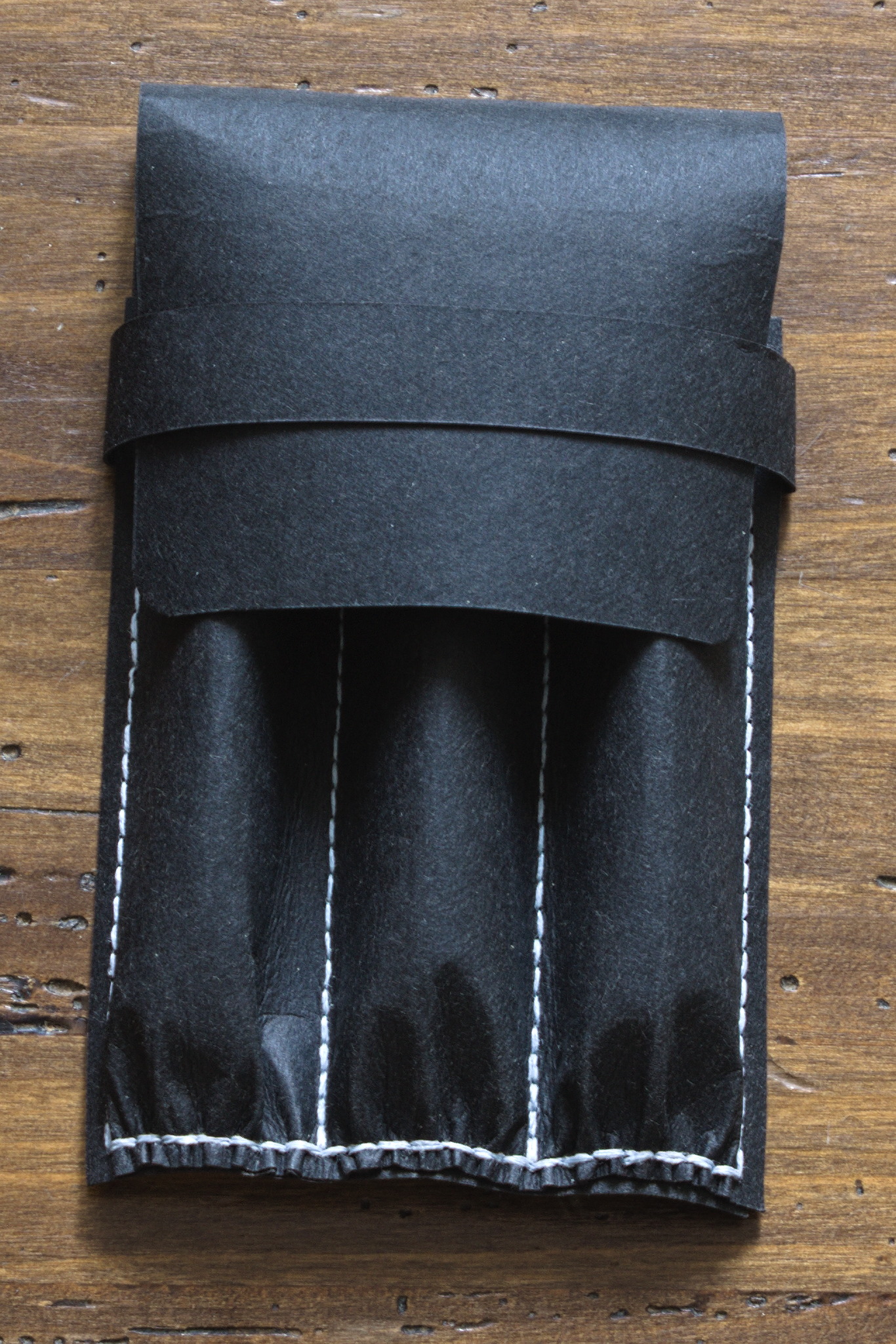
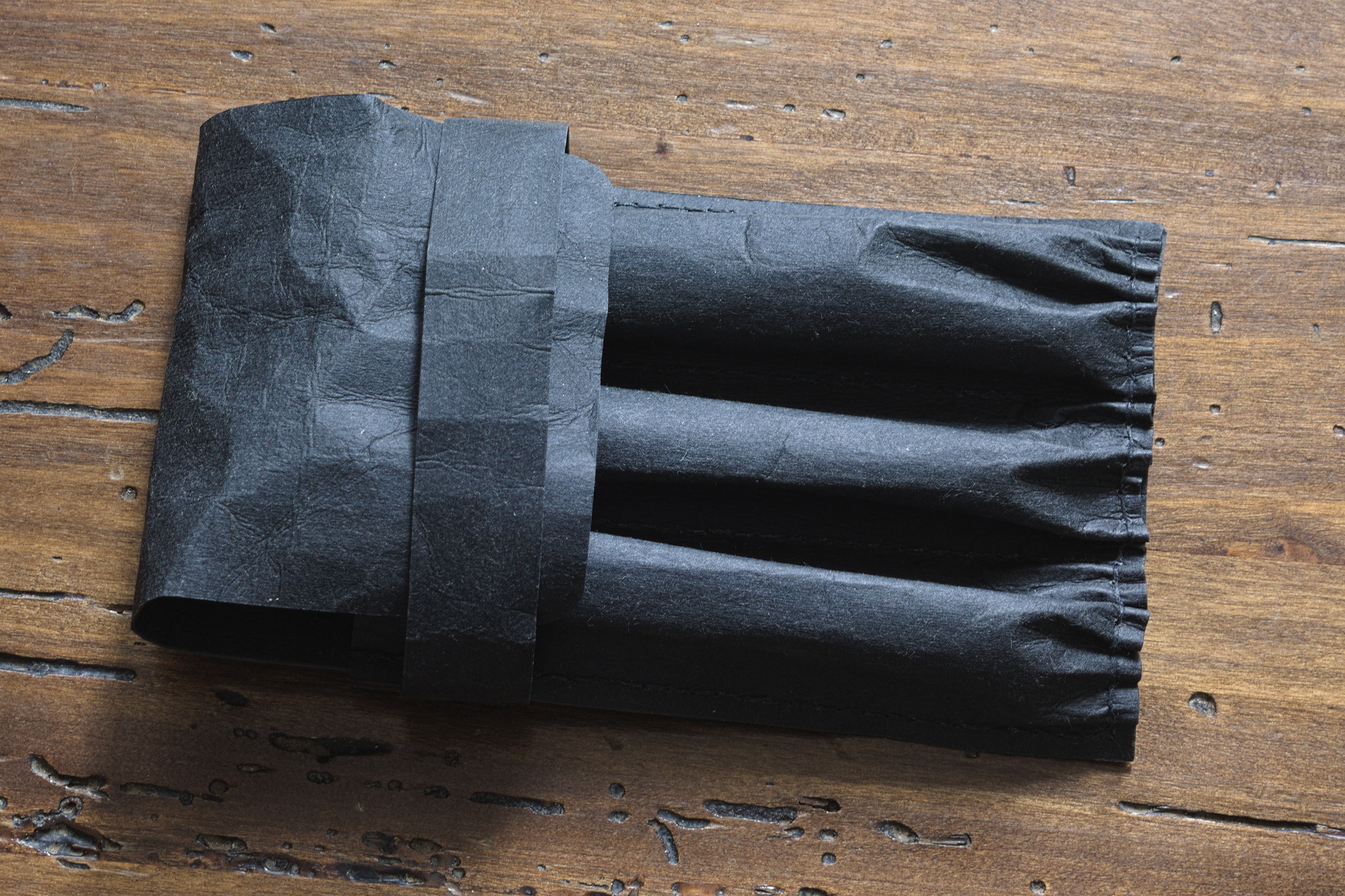
        <p><img src="https://blog.trueelena.org/blog/2026/03/02-a_pen_case_or_a_few/pen_case.jpg" class="align-center" style="width:80.0%" alt="A pen case made of two pieces of a relatively stiff black material
with a flat base and three separate channels on top, plus a flap
covering everything and a band to keep the flap closed; there is
visible light blue stitching all around the channels." /></p>
<p>For my birthday, I’ve bought myself a fancy new expensive<a href="https://blog.trueelena.org#fn1" class="footnote-ref" id="fnref1" role="doc-noteref"><sup>1</sup></a>
fountain pen.</p>
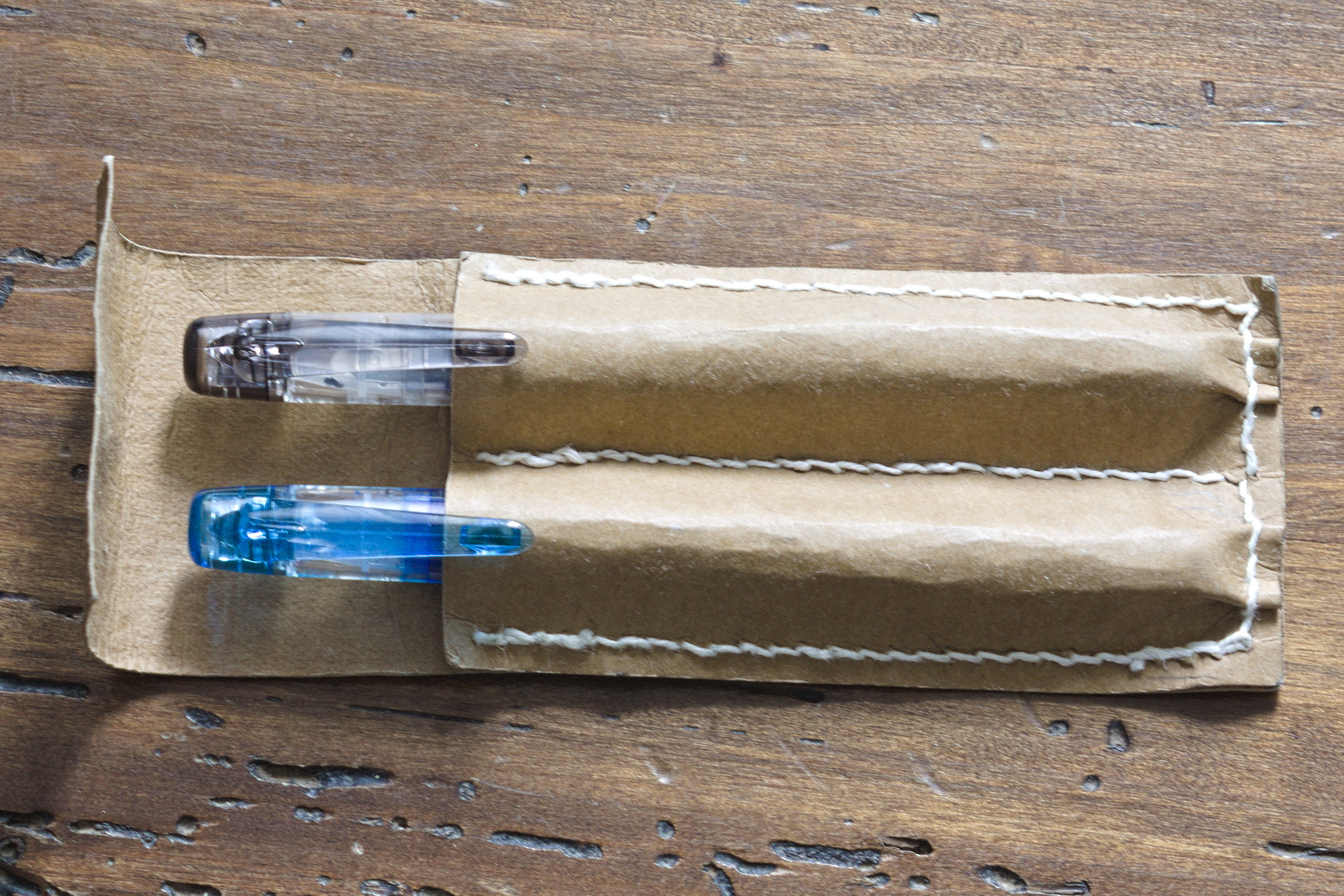
<p><img src="https://blog.trueelena.org/blog/2026/03/02-a_pen_case_or_a_few/failed_prototype.jpg" class="align-center" style="width:80.0%" alt="A two slot pen case in the same material as above, but brown:
the flap is too short to cover the pens, and there isn't a band to
keep it closed." /></p>
<p>Such a fancy pen, of course requires a suitable case: I couldn’t use the
failed prototype of a case I’ve been keeping my Preppys in, so I had to
get out the nice vegetable tanned leather… Yeah, nope, I don’t have that
(yet). I got out the latex and cardboard material that is sold as a
(cheaper) leather substitute, doesn’t look like leather at all, but is
quite nice (and easy) to work with. The project is not vegan anyway,
because I used waxed linen thread, waxing it myself with a lot of very
nicely smelling beeswax.</p>
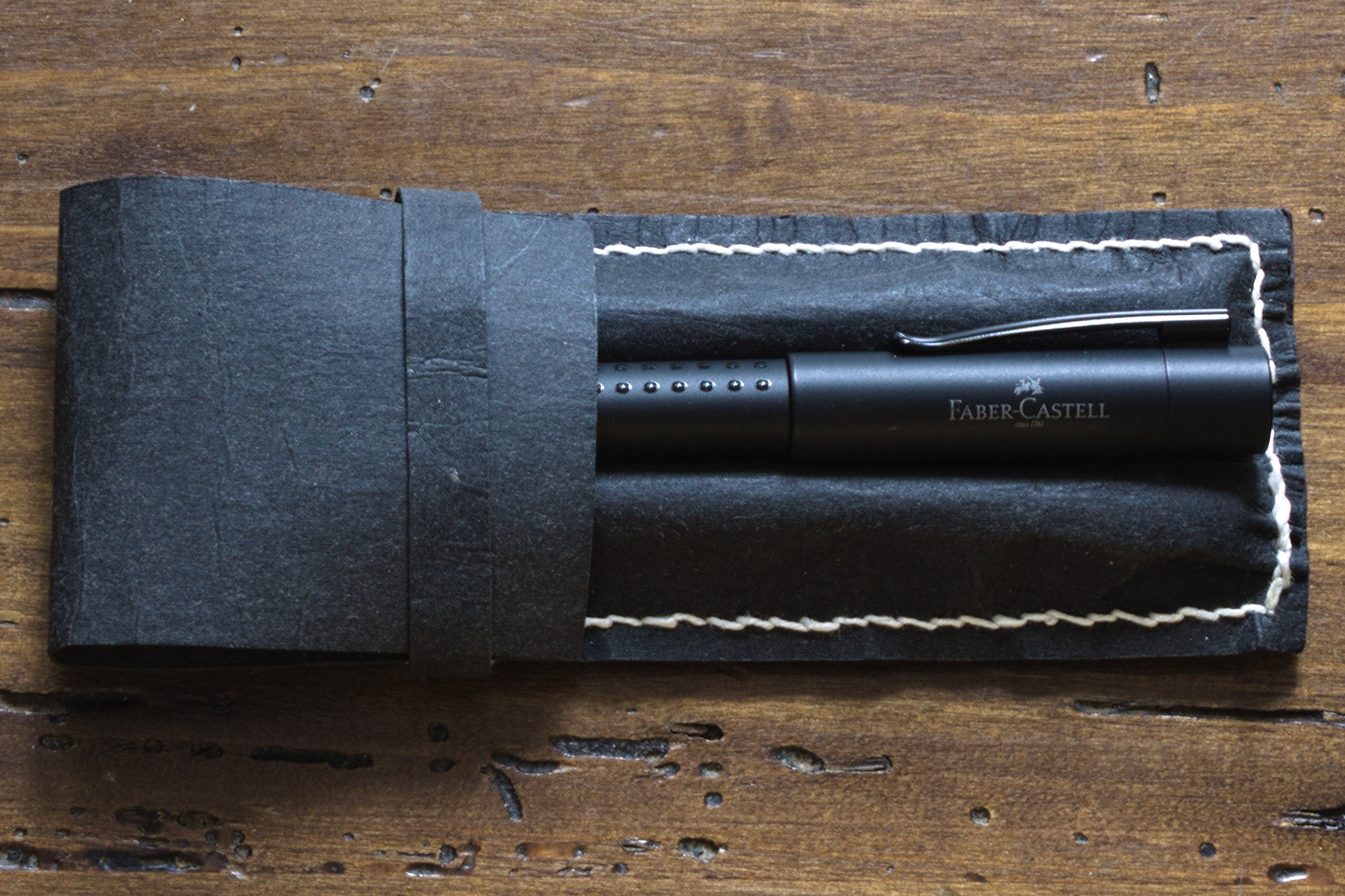
<p><img src="https://blog.trueelena.org/blog/2026/03/02-a_pen_case_or_a_few/2_pen_case.jpg" class="align-center" style="width:80.0%" alt="a case similar to the one above, but this one only has two
slots, and there is a a Faber Castell pen nested on top of the
case between the two slots.
Here the stitches are white, and in a coarser thread." /></p>
<p>I got the measurements<a href="https://blog.trueelena.org#fn2" class="footnote-ref" id="fnref2" role="doc-noteref"><sup>2</sup></a> from the less failed prototype
where I keep my desktop pens, and this time I made a <a href="https://sewing-patterns.trueelena.org/accessories/cases/pen_case/index.html">proper pattern I
could share online</a>,
under the usual Free Culture license.</p>
<p><img src="https://blog.trueelena.org/blog/2026/03/02-a_pen_case_or_a_few/second_case.jpg" class="align-center" style="width:80.0%" alt="A case like the one above, except that the stitches are in
black, and not as regular. This one has also been scrunched up a
bit for a different look, and now the band is a bit too wide." /></p>
<p>From the width of the material I could conveniently cut two cases, so
that’s what I did, started sewing the first one, realized that I got the
order of stitching wrong, and also that if I used light blue thread
instead of the black one it would look nice, and be easier to see in the
pictures for the published pattern, started sewing the second one, and
kept alternating between the two, depending on the availability of light
for taking pictures.</p>
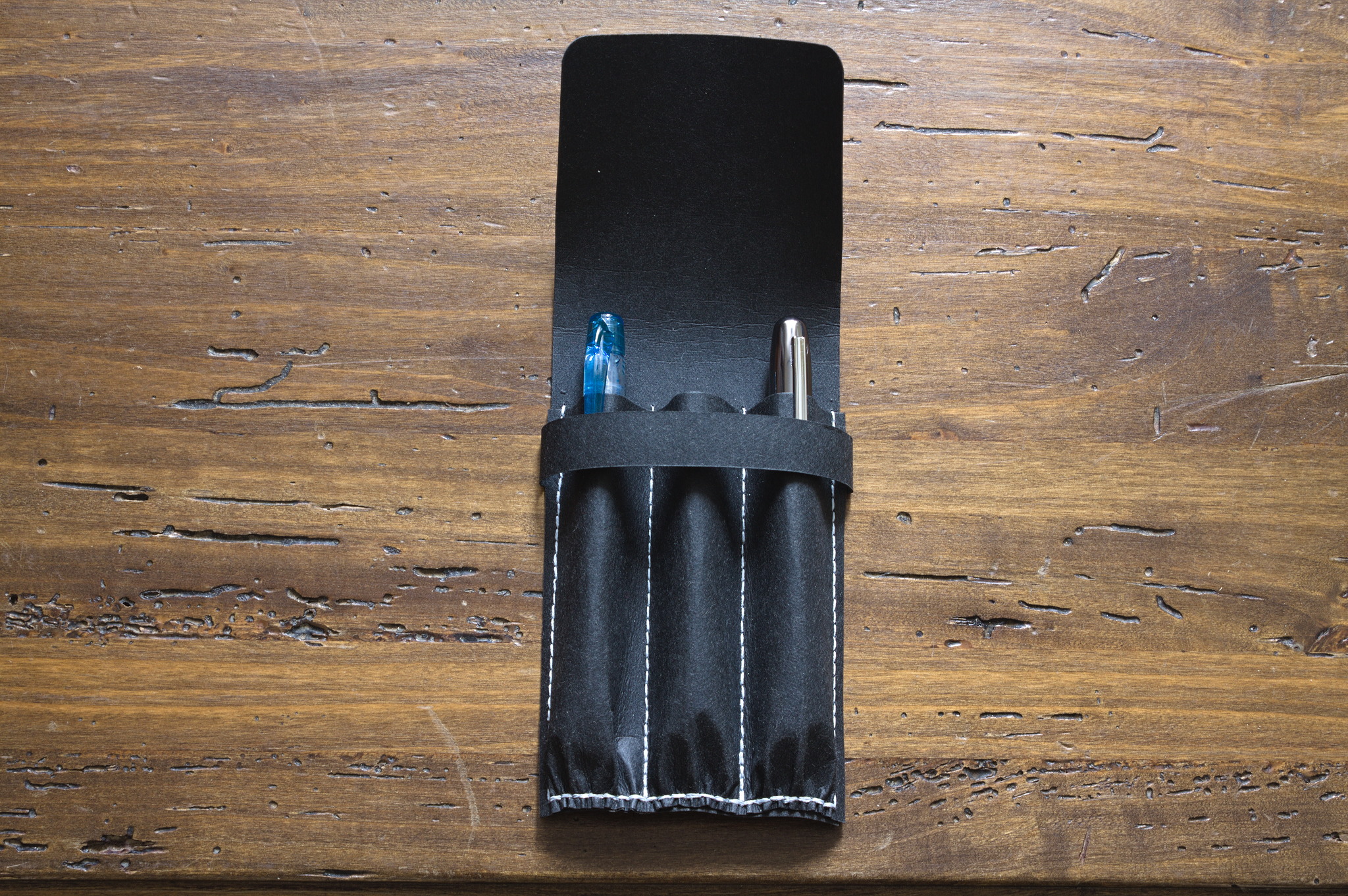
<p><img src="https://blog.trueelena.org/blog/2026/03/02-a_pen_case_or_a_few/case_with_a_missing_pen.jpg" class="align-center" style="width:80.0%" alt="The open pen case, showing two pens, a blue Preppy and a
gunmetal Plaisir cosily nested in the two outer slots, while the
middle slot is ominously empty." /></p>
<p>One of the two took the place of my desktop one, where I had one more
pen than slots, and one of the old prototypes was moved to keep my
bedside pen, and the other new case was used for the new pen in my
handbag, together with a Preppy, and now I have a free slot and you can
see how this is going to go wrong, right? :D</p>
<section class="footnotes footnotes-end-of-document" role="doc-endnotes">
<hr />
<ol>
<li id="fn1" role="doc-endnote"><p>16€. plus a 9€ converter, and another 6€ pen to get the
EF nib from, since it wasn’t available for the expensive pen.<a href="https://blog.trueelena.org#fnref1" class="footnote-back" role="doc-backlink">↩︎</a></p></li>
<li id="fn2" role="doc-endnote"><p>I have them written down somewhere. I couldn’t find
them. So I measured the real thing, with some approximation.<a href="https://blog.trueelena.org#fnref2" class="footnote-back" role="doc-backlink">↩︎</a></p></li>
</ol>
</section>
    </section>
</article>
]]></summary>
</entry>
<entry>
    <title>A Day Off</title>
    <link href="https://blog.trueelena.org/blog/2026/02/03-a_day_off/index.html" />
    <id>https://blog.trueelena.org/blog/2026/02/03-a_day_off/index.html</id>
    <published>2026-02-03T00:00:00Z</published>
    <updated>2026-02-03T00:00:00Z</updated>
    <summary type="html"><![CDATA[<article>
    <section class="header">
        Posted on February  3, 2026
        <br />
        
        Tags: <a title="All pages tagged 'madeof:atoms'." href="https://blog.trueelena.org/tags/madeof%3Aatoms.html">madeof:atoms</a>, <a title="All pages tagged 'madeof:bits'." href="https://blog.trueelena.org/tags/madeof%3Abits.html">madeof:bits</a>
        
    </section>
    <section>
        <p>Today I had a day off. Some of it went great. Some less so.</p>
<p>I woke up, went out to pay our tribute to NotOurCat, and it was snowing!
yay! And I had a day off, so if it had snowed enough that shovelling was
needed, I had time to do it (it didn’t, it started to rain soon
afterwards, but still, YAY snow!).</p>
<p>Then I had breakfast, with the fruit rye bread I had baked yesterday,
and I treated myself to some of the strong Irish tea I have left,
instead of the milder ones I want to finish before buying more of the
Irish.</p>
<p>And then, I bought myself a fancy new <em>expensive</em> fountain pen. One that
costs 16€! more than three times as much as my usual ones! I hope it
will work as well, but I’m quite confident it should. I’ll find out when
it arrives from Germany (together with a <em>few</em> ink samples that will
result in a future blog post with some SCIENCE).</p>
<p>I decided to try and use bank transfers instead of my visa debit card
when buying from online shops that give the option to do so: it’s a tiny
bit more effort, but it means I’m paying 0.25€ to my bank<a href="https://blog.trueelena.org#fn1" class="footnote-ref" id="fnref1" role="doc-noteref"><sup>1</sup></a>
rather than the seller having to pay some unknown amount to an US based
payment provider. Unluckily, the fountain pen website offered a huge
number of payment methods, but not bank transfers. sigh.</p>
<p>And then, I could start working a bit on the connecting wires for the
LED strips for our living room: I soldered two pieces, six wires each
(it’s one RGB strip, 4 pins, and a warm white one requiring two more),
then did a bit of tests, including writing some micropython code to add
a test mode that lights up each colour in sequence, and the morning was
almost gone. For some reason this project, as simple as it is, is taking
forever. But it is showing progress.</p>
<p>There was a break, when the postman delivered a package of <em>chemicals</em>
<a href="https://blog.trueelena.org#fn2" class="footnote-ref" id="fnref2" role="doc-noteref"><sup>2</sup></a> for a future project or two. There will be blog posts!</p>
<p>After lunch I spent some time finishing eyelets on the outfit I wanted
to wear this evening, as I had not been able to finish it during fosdem.
This one will result in <em>two</em> blog posts!</p>
<p>Meanwhile, in the morning I didn’t remember the name of the program I
used to load software on micropython boards such as the one that will
control the LED strips (that’s <a href="https://thonny.org">thonny</a>), and while searching for it in
the documentation, I found that there is also a command line program I
can use, <a href="https://docs.micropython.org/en/latest/reference/mpremote.html">mpremote</a>, and that’s a much better fit for my preferences!</p>
<p>I mentioned it in an xmpp room full of nerds, and one of them mentioned
that he could try it on his <a href="https://soldered.com/collections/inkplate-e-paper-displays/">Inkplate</a>, when he had time, and I was
nerd-sniped into trying it on mine, which had been sitting unused
showing the temperatures in our old house on the last day it spent there
and needs to be updated for the sensors in the new house.</p>
<p>And that lead to the writing of <a href="https://docs.trueelena.org/microcontrollers/inkplate/index.html">some notes on how to set it up from the
command line</a>
(good), and to the opening on one <a href="https://github.com/SolderedElectronics/Inkplate-micropython/issues/47">upstream issue</a>
(bad), because I have an old model, and the board-specific library isn’t
working. at all.</p>
<p>And that’s when I realized that it was 17:00, I still had to cook the
bread I had been working on since yesterday evening (ciabatta, one of my
favourites, but it needs almost one hour in the oven), the outfit I
wanted to wear in the evening was still not wearable, the table needed
cleaning and some panicking was due. Thankfully, my mother was cooking
dinner, so I didn’t have to do that too.</p>
<p>I turned the oven on, sewed the shoulder seams of the bodice while
spraying water on the bread every 5 minutes, and then while it was
cooking on its own, started to attach a closure to the skirt, decided
that a safety pin was a perfectly reasonable closure for the first day
an outfit is worn, took care of the table, took care of the bread, used
some twine to close the bodice, because I still haven’t worked out what
to use for laces, realized my bodkin is still misplaced, used a <em>long</em>
and <em>sharp</em> and <em>big</em> needle meant for sewing mattresses instead of a
bodkin, managed not to stab myself, and less than half an hour late we
could have dinner.</p>
<p>There was bread, there was Swedish crispbread, there were spreads (tuna,
and beans), and vegetables, and then there was the cake that caused my
mother to panic when she added her last honey to the milk and it curdled
(my SO and I tried it, it had no odd taste, we decided it could be used)
and it was good, although I had to get a second slice just to be 100%
sure of it.</p>
<p>And now I’m exhausted, and I’ve only done half of the things I had
planned to do, but I’d still say I’ve had quite a good day.</p>
<section class="footnotes footnotes-end-of-document" role="doc-endnotes">
<hr />
<ol>
<li id="fn1" role="doc-endnote"><p>Banca Etica, so one that avoids any investment in weapons and
a number of other problematic things.<a href="https://blog.trueelena.org#fnref1" class="footnote-back" role="doc-backlink">↩︎</a></p></li>
<li id="fn2" role="doc-endnote"><p>not food grade, except for one, but kitchen-safe.<a href="https://blog.trueelena.org#fnref2" class="footnote-back" role="doc-backlink">↩︎</a></p></li>
</ol>
</section>
    </section>
</article>
]]></summary>
</entry>
<entry>
    <title>And now for something completely different</title>
    <link href="https://blog.trueelena.org/blog/2026/01/04-and_now_for_something_completely_different/index.html" />
    <id>https://blog.trueelena.org/blog/2026/01/04-and_now_for_something_completely_different/index.html</id>
    <published>2026-01-04T00:00:00Z</published>
    <updated>2026-01-04T00:00:00Z</updated>
    <summary type="html"><![CDATA[<article>
    <section class="header">
        Posted on January  4, 2026
        <br />
        
        Tags: <a title="All pages tagged 'topic:walking'." href="https://blog.trueelena.org/tags/topic%3Awalking.html">topic:walking</a>
        
    </section>
    <section>
        <div class="warning">
<div class="title">
<p>Warning</p>
</div>
<p>mention of bodies being bodies and minds being minds, and
not in the perfectly working sense.</p>
</div>
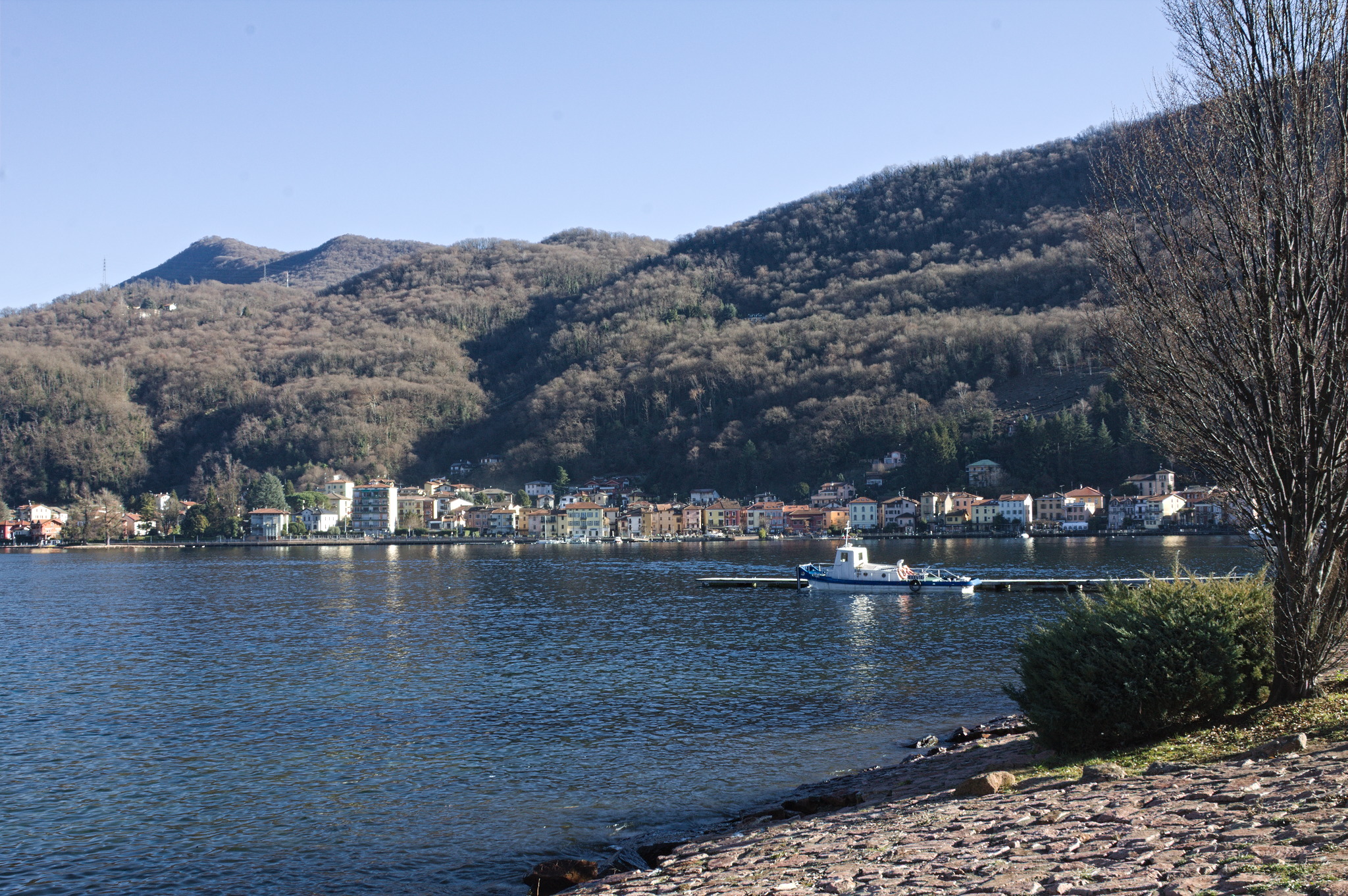
<p><img src="https://blog.trueelena.org/blog/2026/01/04-and_now_for_something_completely_different/lake_side.jpg" class="align-center" style="width:80.0%" alt="One side of Porto Ceresio along the lake: there is a small
strip of houses, and the hills behind them are covered in woods.
A boat is parked around the middle of the picture." /></p>
<p>A lot of the youtube channels I follow tend to involve somebody making
<em>things</em>, so of course one of the videos my SO and I watched a few days
ago was about <a href="https://www.youtube.com/watch?v=1MUSqkcd7n8">walking around San Francisco Bay</a>, and that recalled my
desire to go to places by foot. Now, for health-related reasons doing it
properly would be problematic, and thus I’ve never trained for that, but
during this Christmas holiday-heavy time I suggested my very patient
SO the next best thing: instead of our usual 1.5 hours uphill walk in
the woods, a 2 hours and a bit mostly flat walk on paved streets, plus
some train, to a nearby town: Porto Ceresio, on the Italian side of Lake
Lugano.</p>
<p>I started to prepare for it on the day before, by deciding it was a good
time to upgrade my <a href="https://blog.trueelena.org/blog/2023/02/15-my-experience-with-a-pinephone/index.html">PinePhone</a>, and wait, I’m still on Trixie? I could
try Forky, what could possibly go wrong? And well, the phone was no
longer able to boot, and reinstalling from the latest weekly had a
system where the on-screen keyboard didn’t appear, and I didn’t want to
bother finding out why, so re-installed another time from the 13.0
image, and between that, and distracting myself with <a href="http://www.widelands.org/">widelands</a> while
waiting for the downloads and uploads and reboots etc., well, all of the
afternoon and the best part of the evening disappeared.</p>
<p>So, in a hurry, between the evening and the next morning I prepared a
nice healthy lunch, full of all the important nutrients such as sugar,
salt, mercury and arsenic. Tuna (mercury) soboro (sugar and salt) on
rice and since I was in a hurry I didn’t prepare any vegetables, but
used pickles (more salt) and shio kombu (arsenic and various heavy
metals, sugar <em>and</em> salt). Plus a green tea mochi for dessert, in case
we felt low on sugar. :D</p>
<p>Then on the day of the walk we woke up a bit later than usual, and then
my body decided it was a good day for my belly to not exactly hurt, but
not not-hurt either, and there I took an executive decision to wear a
corset, because if something feels like it wants to burst open, wrapping
it in a steel reinforced cage will make it stop. (I’m not joking. It
does. At least in those specific circumstances.)</p>
<p>This was followed by hurrying through the things I had to do before
leaving the house, having a brief anxiety attack and feeling feverish
(it wasn’t fever), and finally being able to leave the house just half
an hour late.</p>
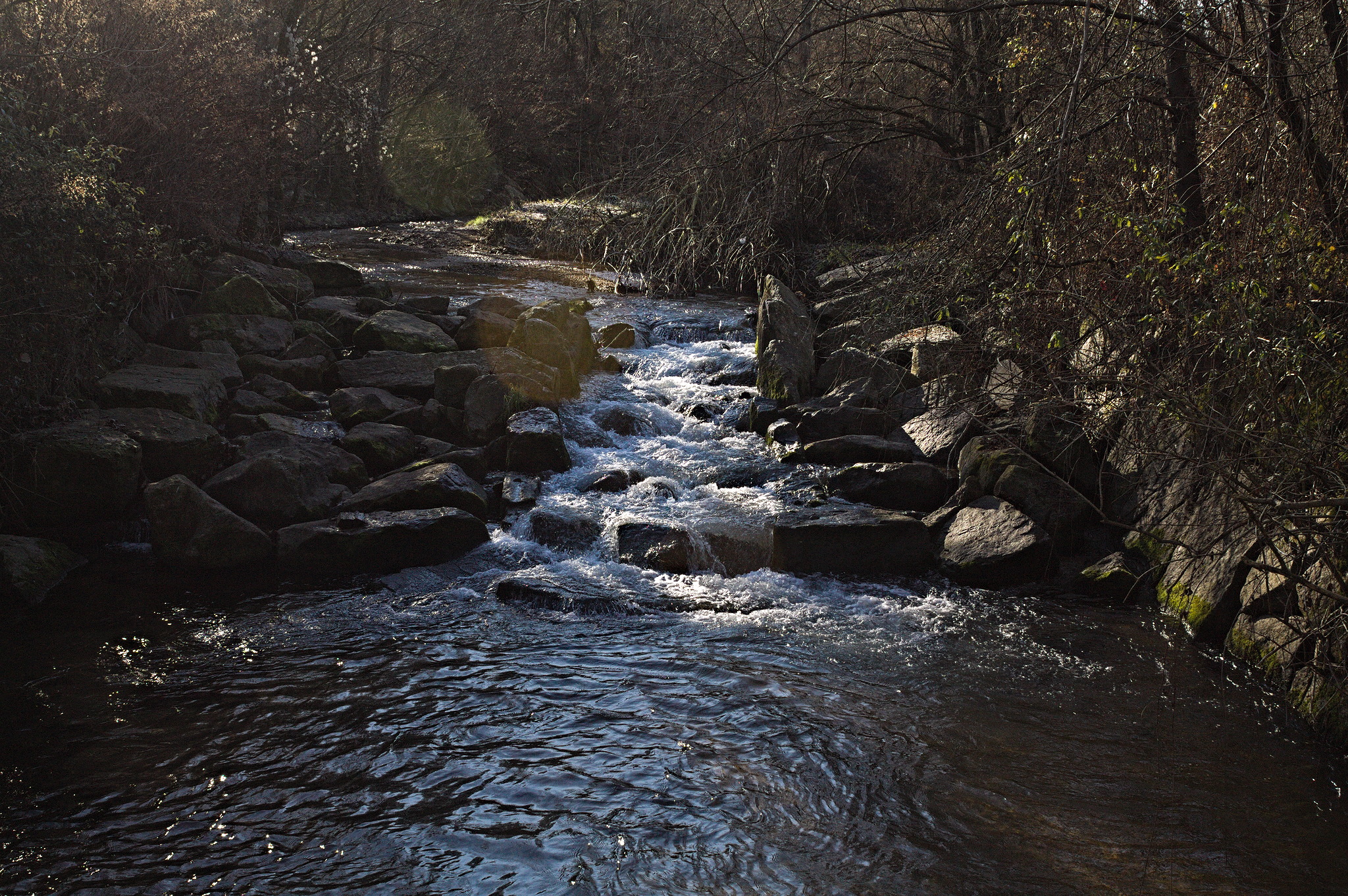
<p><img src="https://blog.trueelena.org/blog/2026/01/04-and_now_for_something_completely_different/stream.jpg" class="align-center" style="width:80.0%" alt="A stream running on rocks with the woods to both sides." /></p>
<p>And then, 10 minutes after we had left, realizing that I had written
down the password for the train website, since it was no longer saved on
the phone, but i had forgotten the bit of paper at home. We could have
gone back to take it, but decided not to bother, as we could also
hopefully buy paper-ish tickets at the train station (we could).</p>
<p>Later on, I also realized I had also forgotten my GPS tracker, so I have
no record of where we went exactly (but it’s not hard to recognize it on
a map) nor on what the temperature was. It’s a shame, but by that point
it was way too late to go back.</p>
<p>Anyway, that probably was when Murphy felt we had paid our respects, and
from then on everything went lovingly well!</p>
<p>Routing had been done on the <a href="https://www.openstreetmap.org/">OpenStreetMap</a> website, with OSRM, and it
looked pretty easy to follow, but we also had access to an Android
phone, so we used OSMAnd to check that we were still on track. It tried
to lead us to the Statale (i.e. most important and most trafficked road)
a few times, but we ignored it, and after a few turns and a few changes
of the precise destination point we managed to get it to cooperate.</p>
<p>At one point a helpful person asked us if we needed help, having seen us
looking at the phone, and gave us indication for the next fork (that way
to Cuasso al Piano, that way to Porto Ceresio), but it was pretty easy,
since the way was clearly marked also for cars.</p>
<p>Then we started to notice red and white markings on poles and other
places, and on the next fork there was a signpost for hiking routes with
our destination and we decided to follow it instead of the sign for
cars. I knew that from our starting point to or destination there was
also a hiking route, uphill both ways :) , through the hills, about 5 or 6
hours instead of two, but the sign was pointing downhill and we were
past the point where we would expect too long of a detour.</p>
<p><img src="https://blog.trueelena.org/blog/2026/01/04-and_now_for_something_completely_different/offroad.jpg" class="align-center" style="width:80.0%" alt="A wide and flat unpaved track passing through a flat grassy
area with trees to the sides and rolling hills in the background." /></p>
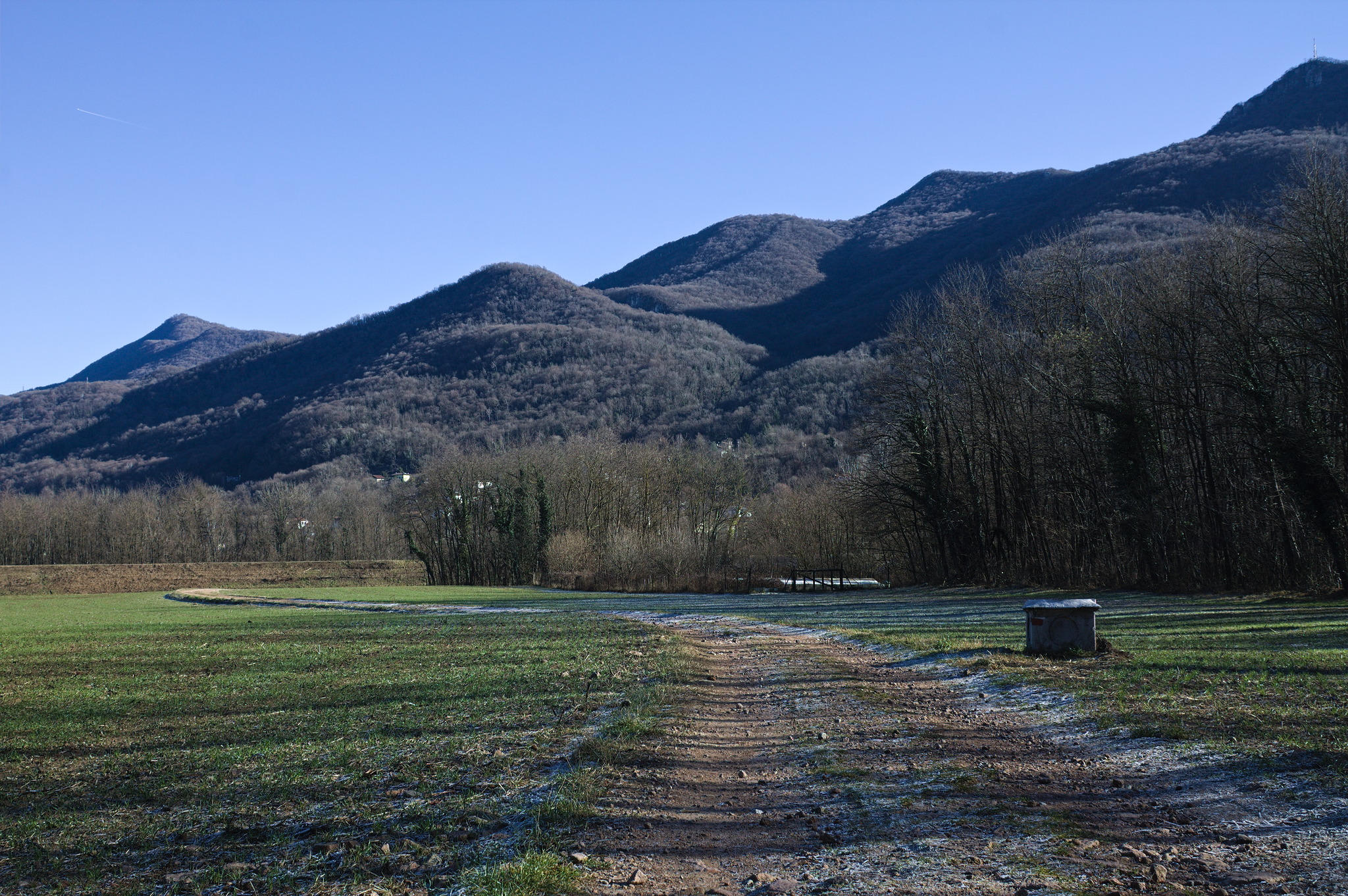
<p>And indeed, after a short while the paved road ended, but the path
continued on a wide and flat track, and was a welcome detour through
what looked like water works to prevent flood damage from a stream.
In a warmer season, with longer grass and ticks maybe the fact that I
was wearing a long skirt may have been an issue, but in winter it was
just fine.</p>
<p>And soon afterwards, we were in Porto Ceresio. I think I have been there
as a child, but I had no memory of it. On the other hand, it was about
as I expected: a tiny town with a lakeside street full of houses built
in the early 1900s when the area was an important tourism destination,
with older buildings a bit higher up on the hills (because streams
in this area <em>will</em> flood). And of course, getting there by foot rather
than by train we also saw the parts where real people live (but not
work: that’s cross-border commuters country).</p>
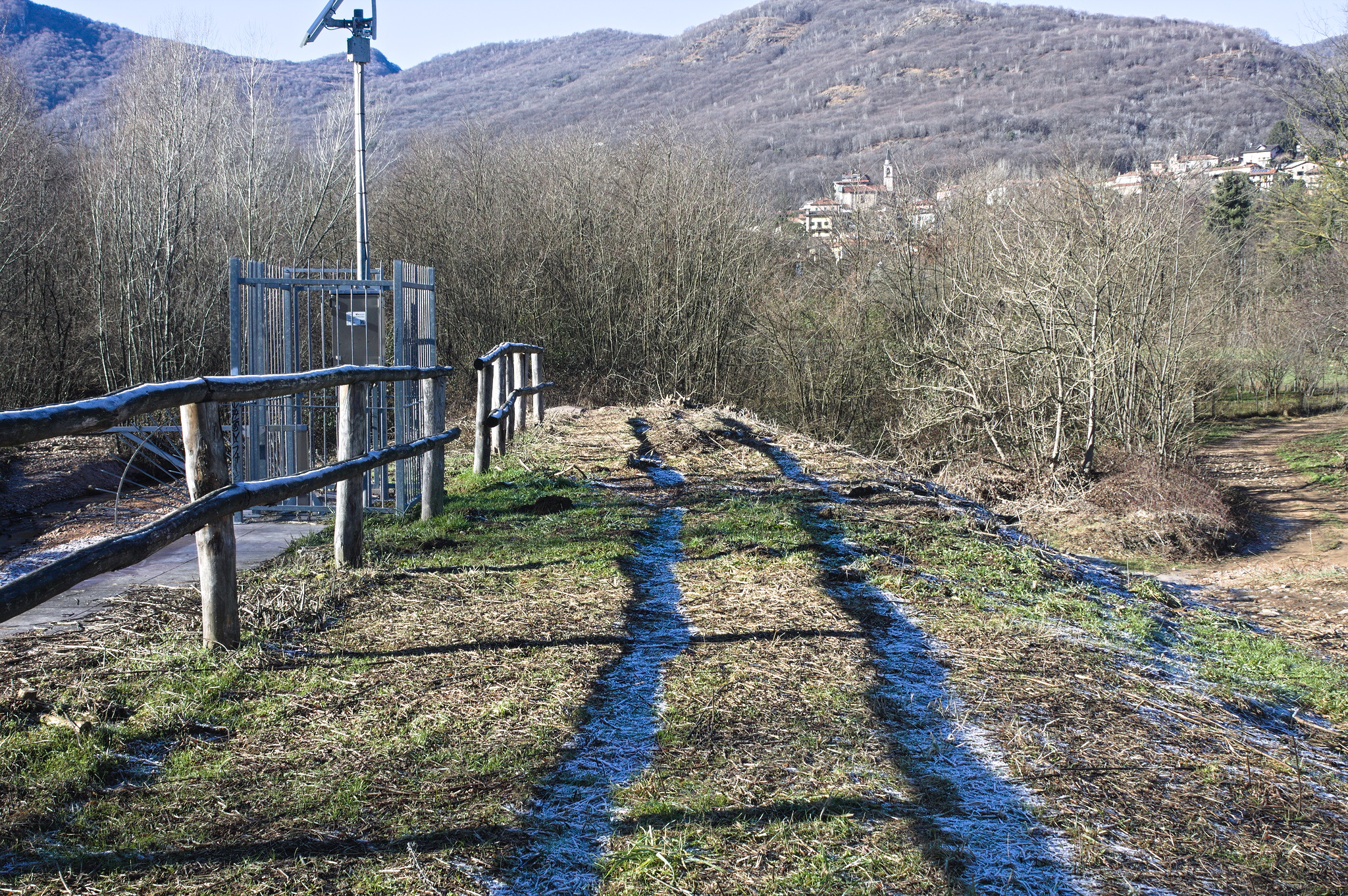
<p><img src="https://blog.trueelena.org/blog/2026/01/04-and_now_for_something_completely_different/frost.jpg" class="align-center" style="width:80.0%" alt="Dried winter grass with two strips of frost, exactly under the
shade of a fence." /></p>
<p>Soon after arriving in Porto Ceresio we stopped to eat our lunch on a
bench at the lakeside; up to then we had been pretty comfortable in the
clothing we had decided to wear: there was plenty of frost on the
ground, in the shade, but the sun was warm and the temperatures were
cleanly above freezing. Removing the gloves to eat, however, resulted in
quite cold hands, and we didn’t want to stay still for longer than
strictly necessary.</p>
<p>So we spent another hour and a bit walking around Porto Ceresio like
proper tourists and taking pictures. There was an exhibition of nativity
scenes all around the streets, but to get a map one had to go to either
facebook or instagram, or wait for the opening hours of an office that
were later than the train we planned to get to go back home, so we only
saw maybe half of them, as we walked around: some were quite nice, some
were nativity scenes, and some showed that the school children must have
had some fun making them.</p>
<p><img src="https://blog.trueelena.org/blog/2026/01/04-and_now_for_something_completely_different/tree_gnomes.jpg" class="align-center" style="width:80.0%" alt="three gnome adjacent creatures made of branches of evergreen
trees, with a pointy hat made of moss, big white moustaches and
red Christmas tree balls at the end of the hat and as a nose.
They are wrapped in LED strings, and the lake can be seen in the
background." /></p>
<p>Another Christmas decoration were groups of creatures made of evergreen
branches that dotted the sidewalks around the lake: I took pictures of
the first couple of groups, and then after seeing a few more something
clicked in my brain, and I noticed that they were wrapped in green LED
strings, like chains, and they had a red ball that was supposed to be
the nose, but could just be around the mouth area, and suddenly I felt
the need to play <a href="https://brutallegend.fandom.com/wiki/Bound_Serpent">a certain chord</a> to release them,
but sadly I didn’t have a weaponized guitar on me :D</p>
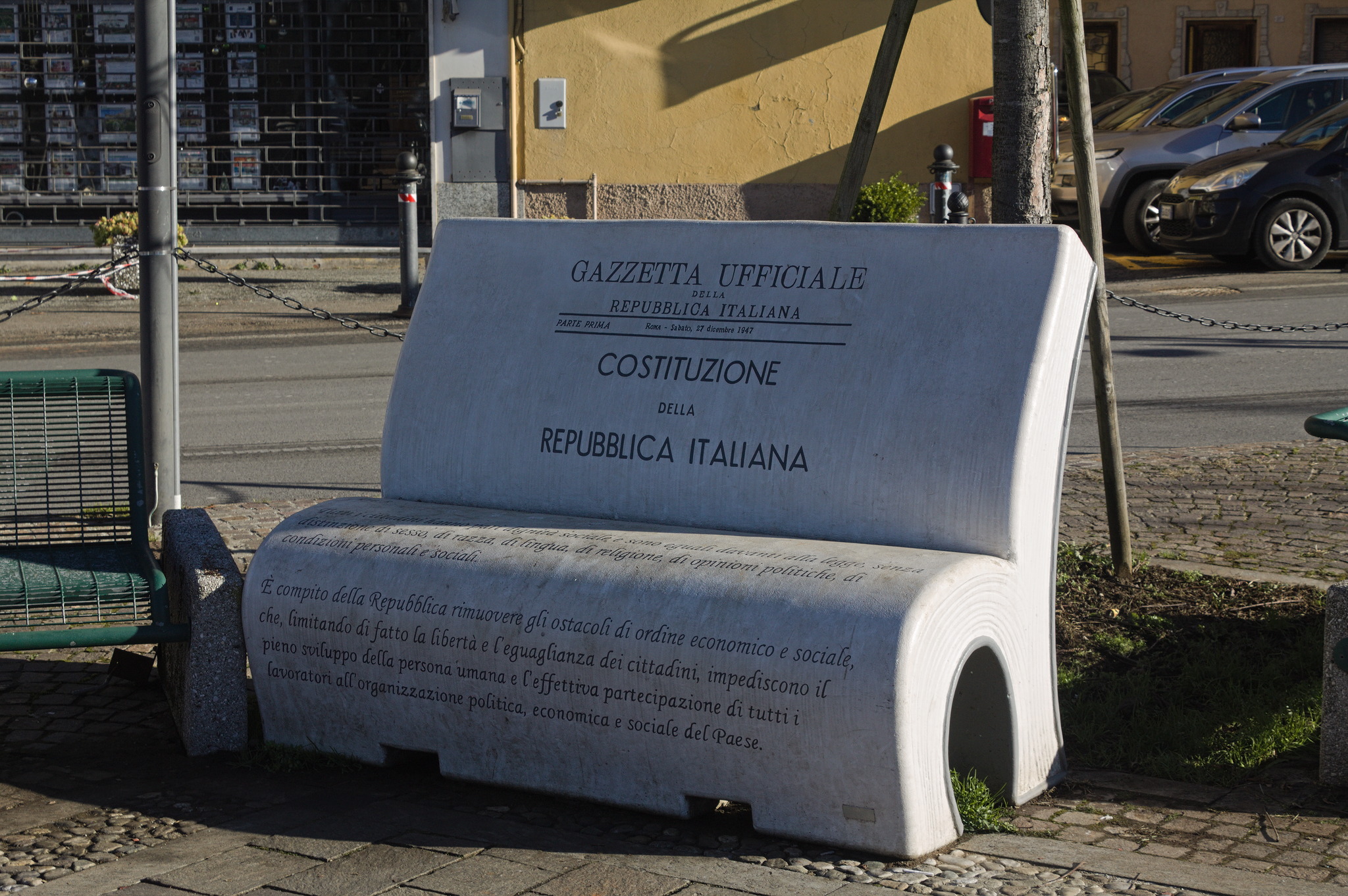
<p><img src="https://blog.trueelena.org/blog/2026/01/04-and_now_for_something_completely_different/constitution_bench.jpg" class="align-center" style="width:80.0%" alt="A bench in the shape of an open book, half of the pages folded
in a reversed U to make the seat and half of the pages standing
straight to form the backrest. It has the title page and beginning
of the Constitution of the Italian Republic." /></p>
<p>Another thing that we noticed were some benches in the shape of books,
with book quotations on them; most were on reading-related topics, but
the one with the Constitution felt worth taking a picture of, especially
these days.</p>
<p>And then, our train was waiting at the station, and we had to go back
home for the afternoon; it was a nice outing, if a bit brief, and we
agreed to do it again, possibly with a bit of a detour to make the walk
a bit longer. And then maybe one day we’ll train to do the whole 5-6
hour thing through the hills.</p>
    </section>
</article>
]]></summary>
</entry>
<entry>
    <title>PDF Planners 2026</title>
    <link href="https://blog.trueelena.org/blog/2025/11/27-pdf_planners_2026/index.html" />
    <id>https://blog.trueelena.org/blog/2025/11/27-pdf_planners_2026/index.html</id>
    <published>2025-11-27T00:00:00Z</published>
    <updated>2025-11-27T00:00:00Z</updated>
    <summary type="html"><![CDATA[<article>
    <section class="header">
        Posted on November 27, 2025
        <br />
        
        Tags: <a title="All pages tagged 'madeof:atoms'." href="https://blog.trueelena.org/tags/madeof%3Aatoms.html">madeof:atoms</a>, <a title="All pages tagged 'madeof:bits'." href="https://blog.trueelena.org/tags/madeof%3Abits.html">madeof:bits</a>, <a title="All pages tagged 'craft:bookbinding'." href="https://blog.trueelena.org/tags/craft%3Abookbinding.html">craft:bookbinding</a>
        
    </section>
    <section>
        <p>A few years ago I wrote some <a href="https://git.trueelena.org/software/pdfscripts/tree/planner">planner generating code</a> to make myself a
custom planner; in <a href="https://blog.trueelena.org/blog/2023/11/22-pdf_planners_2024/index.html">November 2023</a> I generated a few, and posted them
here on the blog, in case somebody was interested in using them.</p>
<p>In 2024 I tried to do the same, and ended up being even more late, to
the point where I didn’t generate any (uooops).</p>
<p>I did, however, start to write a Makefile to automate the generation
(and got stuck on the fact that there wasn’t an easy way to deduce the
correct options needed from just the template name); this year, with the
same promptness as in 2023 I got back to the Makefile and finished it, so
maybe next year I will be able to post them early enough for people to
print and bind them? maybe :)</p>
<p>Anyway, these are all of the variants I currently generate, for 2026.</p>
<p>The files with <code>-book</code> in the name have been imposed on A4 paper for a
16 pages signature. All of the fonts have been converted to paths, for
ease of printing (yes, this means that customizing the font requires
running the script, but the alternative also had its drawbacks).</p>
<p>In English:</p>
<dl>
<dt><a href="https://blog.trueelena.org/blog/2025/11/27-pdf_planners_2026/daily-95×186-en.pdf">daily-95×186-en.pdf</a></dt>
<dd>
<p>blank daily pages, 95 mm × 186 mm;</p>
</dd>
<dt><a href="https://blog.trueelena.org/blog/2025/11/27-pdf_planners_2026/daily-A5-en.pdf">daily-A5-en.pdf</a> <a href="https://blog.trueelena.org/blog/2025/11/27-pdf_planners_2026/daily-A5-en-book.pdf">daily-A5-en-book.pdf</a></dt>
<dd>
<p>blank daily pages, A5;</p>
</dd>
<dt><a href="https://blog.trueelena.org/blog/2025/11/27-pdf_planners_2026/daily-A6-en.pdf">daily-A6-en.pdf</a> <a href="https://blog.trueelena.org/blog/2025/11/27-pdf_planners_2026/daily-A6-en-book.pdf">daily-A6-en-book.pdf</a></dt>
<dd>
<p>blank daily pages, A6;</p>
</dd>
<dt><a href="https://blog.trueelena.org/blog/2025/11/27-pdf_planners_2026/daily-graph-A5-en.pdf">daily-graph-A5-en.pdf</a> <a href="https://blog.trueelena.org/blog/2025/11/27-pdf_planners_2026/daily-graph-A5-en-book.pdf">daily-graph-A5-en-book.pdf</a></dt>
<dd>
<p>graph paper (4 mm) daily pages, A5;</p>
</dd>
<dt><a href="https://blog.trueelena.org/blog/2025/11/27-pdf_planners_2026/daily-points4mm-A5-en.pdf">daily-points4mm-A5-en.pdf</a> <a href="https://blog.trueelena.org/blog/2025/11/27-pdf_planners_2026/daily-points4mm-A5-en-book.pdf">daily-points4mm-A5-en-book.pdf</a></dt>
<dd>
<p>pointed paper (4 mm), A5;</p>
</dd>
<dt><a href="https://blog.trueelena.org/blog/2025/11/27-pdf_planners_2026/daily-ruled-A5-en.pdf">daily-ruled-A5-en.pdf</a> <a href="https://blog.trueelena.org/blog/2025/11/27-pdf_planners_2026/daily-ruled-A5-en-book.pdf">daily-ruled-A5-en-book.pdf</a></dt>
<dd>
<p>ruled paper daily pages, A5;</p>
</dd>
<dt><a href="https://blog.trueelena.org/blog/2025/11/27-pdf_planners_2026/week_on_two_pages-A6-en.pdf">week_on_two_pages-A6-en.pdf</a> <a href="https://blog.trueelena.org/blog/2025/11/27-pdf_planners_2026/week_on_two_pages-A6-en-book.pdf">week_on_two_pages-A6-en-book.pdf</a></dt>
<dd>
<p>weekly planner, one week on two pages, A6;</p>
</dd>
<dt><a href="https://blog.trueelena.org/blog/2025/11/27-pdf_planners_2026/week_on_one_page-A6-en.pdf">week_on_one_page-A6-en.pdf</a> <a href="https://blog.trueelena.org/blog/2025/11/27-pdf_planners_2026/week_on_one_page-A6-en-book.pdf">week_on_one_page-A6-en-book.pdf</a></dt>
<dd>
<p>weekly planner, one week per page, A6;</p>
</dd>
<dt><a href="https://blog.trueelena.org/blog/2025/11/27-pdf_planners_2026/week_on_one_page_dots-A6-en.pdf">week_on_one_page_dots-A6-en.pdf</a> <a href="https://blog.trueelena.org/blog/2025/11/27-pdf_planners_2026/week_on_one_page_dots-A6-en-book.pdf">week_on_one_page_dots-A6-en-book.pdf</a></dt>
<dd>
<p>weekly planner, one week per page with 4 mm dots, A6;</p>
</dd>
<dt><a href="https://blog.trueelena.org/blog/2025/11/27-pdf_planners_2026/week_health-A6-en.pdf">week_health-A6-en.pdf</a> <a href="https://blog.trueelena.org/blog/2025/11/27-pdf_planners_2026/week_health-A6-en-book.pdf">week_health-A6-en-book.pdf</a></dt>
<dd>
<p>weekly health tracker, one week per page with 4 mm dots, A6;</p>
</dd>
<dt><a href="https://blog.trueelena.org/blog/2025/11/27-pdf_planners_2026/month-A6-en.pdf">month-A6-en.pdf</a> <a href="https://blog.trueelena.org/blog/2025/11/27-pdf_planners_2026/month-A6-en-book.pdf">month-A6-en-book.pdf</a></dt>
<dd>
<p>monthly planner, A6;</p>
</dd>
</dl>
<p>And the same planners, in Italian:</p>
<dl>
<dt><a href="https://blog.trueelena.org/blog/2025/11/27-pdf_planners_2026/daily-95×186-it.pdf">daily-95×186-it.pdf</a></dt>
<dd>
<p>blank daily pages, 95 mm × 186 mm;</p>
</dd>
<dt><a href="https://blog.trueelena.org/blog/2025/11/27-pdf_planners_2026/daily-A5-it.pdf">daily-A5-it.pdf</a> <a href="https://blog.trueelena.org/blog/2025/11/27-pdf_planners_2026/daily-A5-it-book.pdf">daily-A5-it-book.pdf</a></dt>
<dd>
<p>blank daily pages, A5;</p>
</dd>
<dt><a href="https://blog.trueelena.org/blog/2025/11/27-pdf_planners_2026/daily-A6-it.pdf">daily-A6-it.pdf</a> <a href="https://blog.trueelena.org/blog/2025/11/27-pdf_planners_2026/daily-A6-it-book.pdf">daily-A6-it-book.pdf</a></dt>
<dd>
<p>blank daily pages, A6;</p>
</dd>
<dt><a href="https://blog.trueelena.org/blog/2025/11/27-pdf_planners_2026/daily-graph-A5-it.pdf">daily-graph-A5-it.pdf</a> <a href="https://blog.trueelena.org/blog/2025/11/27-pdf_planners_2026/daily-graph-A5-it-book.pdf">daily-graph-A5-it-book.pdf</a></dt>
<dd>
<p>graph paper (4 mm) daily pages, A5;</p>
</dd>
<dt><a href="https://blog.trueelena.org/blog/2025/11/27-pdf_planners_2026/daily-points4mm-A5-it.pdf">daily-points4mm-A5-it.pdf</a> <a href="https://blog.trueelena.org/blog/2025/11/27-pdf_planners_2026/daily-points4mm-A5-it-book.pdf">daily-points4mm-A5-it-book.pdf</a></dt>
<dd>
<p>pointed paper (4 mm), A5;</p>
</dd>
<dt><a href="https://blog.trueelena.org/blog/2025/11/27-pdf_planners_2026/daily-ruled-A5-it.pdf">daily-ruled-A5-it.pdf</a> <a href="https://blog.trueelena.org/blog/2025/11/27-pdf_planners_2026/daily-ruled-A5-it-book.pdf">daily-ruled-A5-it-book.pdf</a></dt>
<dd>
<p>ruled paper daily pages, A5;</p>
</dd>
<dt><a href="https://blog.trueelena.org/blog/2025/11/27-pdf_planners_2026/week_on_two_pages-A6-it.pdf">week_on_two_pages-A6-it.pdf</a> <a href="https://blog.trueelena.org/blog/2025/11/27-pdf_planners_2026/week_on_two_pages-A6-it-book.pdf">week_on_two_pages-A6-it-book.pdf</a></dt>
<dd>
<p>weekly planner, one week on two pages, A6;</p>
</dd>
<dt><a href="https://blog.trueelena.org/blog/2025/11/27-pdf_planners_2026/week_on_one_page-A6-it.pdf">week_on_one_page-A6-it.pdf</a> <a href="https://blog.trueelena.org/blog/2025/11/27-pdf_planners_2026/week_on_one_page-A6-it-book.pdf">week_on_one_page-A6-it-book.pdf</a></dt>
<dd>
<p>weekly planner, one week per page, A6;</p>
</dd>
<dt><a href="https://blog.trueelena.org/blog/2025/11/27-pdf_planners_2026/week_on_one_page_dots-A6-it.pdf">week_on_one_page_dots-A6-it.pdf</a> <a href="https://blog.trueelena.org/blog/2025/11/27-pdf_planners_2026/week_on_one_page_dots-A6-it-book.pdf">week_on_one_page_dots-A6-it-book.pdf</a></dt>
<dd>
<p>weekly planner, one week per page with 4 mm dots, A6;</p>
</dd>
<dt><a href="https://blog.trueelena.org/blog/2025/11/27-pdf_planners_2026/week_health-A6-it.pdf">week_health-A6-it.pdf</a> <a href="https://blog.trueelena.org/blog/2025/11/27-pdf_planners_2026/week_health-A6-it-book.pdf">week_health-A6-it-book.pdf</a></dt>
<dd>
<p>weekly health tracker, one week per page with 4 mm dots, A6;</p>
</dd>
<dt><a href="https://blog.trueelena.org/blog/2025/11/27-pdf_planners_2026/month-A6-it.pdf">month-A6-it.pdf</a> <a href="https://blog.trueelena.org/blog/2025/11/27-pdf_planners_2026/month-A6-it-book.pdf">month-A6-it-book.pdf</a></dt>
<dd>
<p>monthly planner, A6;</p>
</dd>
</dl>
<p>Some of the planners include ephemerids and moon phase data: these have
been calculated for the town of Como, and specifically for
<a href="https://blog.trueelena.orggeo:45.81478,9.07522?z=17">geo:45.81478,9.07522?z=17</a>, because that’s what <em>everybody</em> needs, right?</p>
<p>If you need the ephemerids for a different location and can’t run the
script yourself (it depends on pdfjam, i.e. various GB of LaTeX, and a
few python modules such as dateutil, pypdf and jinja2), feel free to
ask: unless I receive too many requests to make this sustainable I’ll
generate them and add them to this post.</p>
<p>I hereby release all the PDFs linked in this blog post under the <a href="https://blog.trueelena.org">CC0
license</a>.</p>
<p>You may notice that I haven’t decided on a license for the code dump
repository; again if you need it for something (that is compatible with
its unsupported status) other than running it for personal use (for
which afaik there is an implicit license) let me know and I’ll push
“decide on a license” higher on the stack of things to do :D</p>
<p>Finishing the Makefile meant that I had to add a tiny feature to one of
the scripts involved, which required me to add a dependency to <a href="https://pypdf.readthedocs.io/en/latest/">pypdf</a>:
up to now I have been doing the page manipulations with <a href="https://github.com/pdfjam/pdfjam">pdfjam</a>, which
is pretty convenient to use, but also uses LaTeX, and apparently not
every computer comes with texlive installed (shocking, I know).</p>
<p>If I’m not mistaken, pypdf can do all of the things I’m doing with
pdfjam, so maybe for the next year I could convert my script to use that
one instead.</p>
<p>But then the planners 2027 will be quick and easy, and I will be able to
publish them <em>promptly</em>, right?</p>
    </section>
</article>
]]></summary>
</entry>
<entry>
    <title>Historically Inaccurate Hemd</title>
    <link href="https://blog.trueelena.org/blog/2025/11/17-historically_inaccurate_hemd/index.html" />
    <id>https://blog.trueelena.org/blog/2025/11/17-historically_inaccurate_hemd/index.html</id>
    <published>2025-11-17T00:00:00Z</published>
    <updated>2025-11-17T00:00:00Z</updated>
    <summary type="html"><![CDATA[<article>
    <section class="header">
        Posted on November 17, 2025
        <br />
        
        Tags: <a title="All pages tagged 'madeof:atoms'." href="https://blog.trueelena.org/tags/madeof%3Aatoms.html">madeof:atoms</a>, <a title="All pages tagged 'craft:sewing'." href="https://blog.trueelena.org/tags/craft%3Asewing.html">craft:sewing</a>
        
    </section>
    <section>
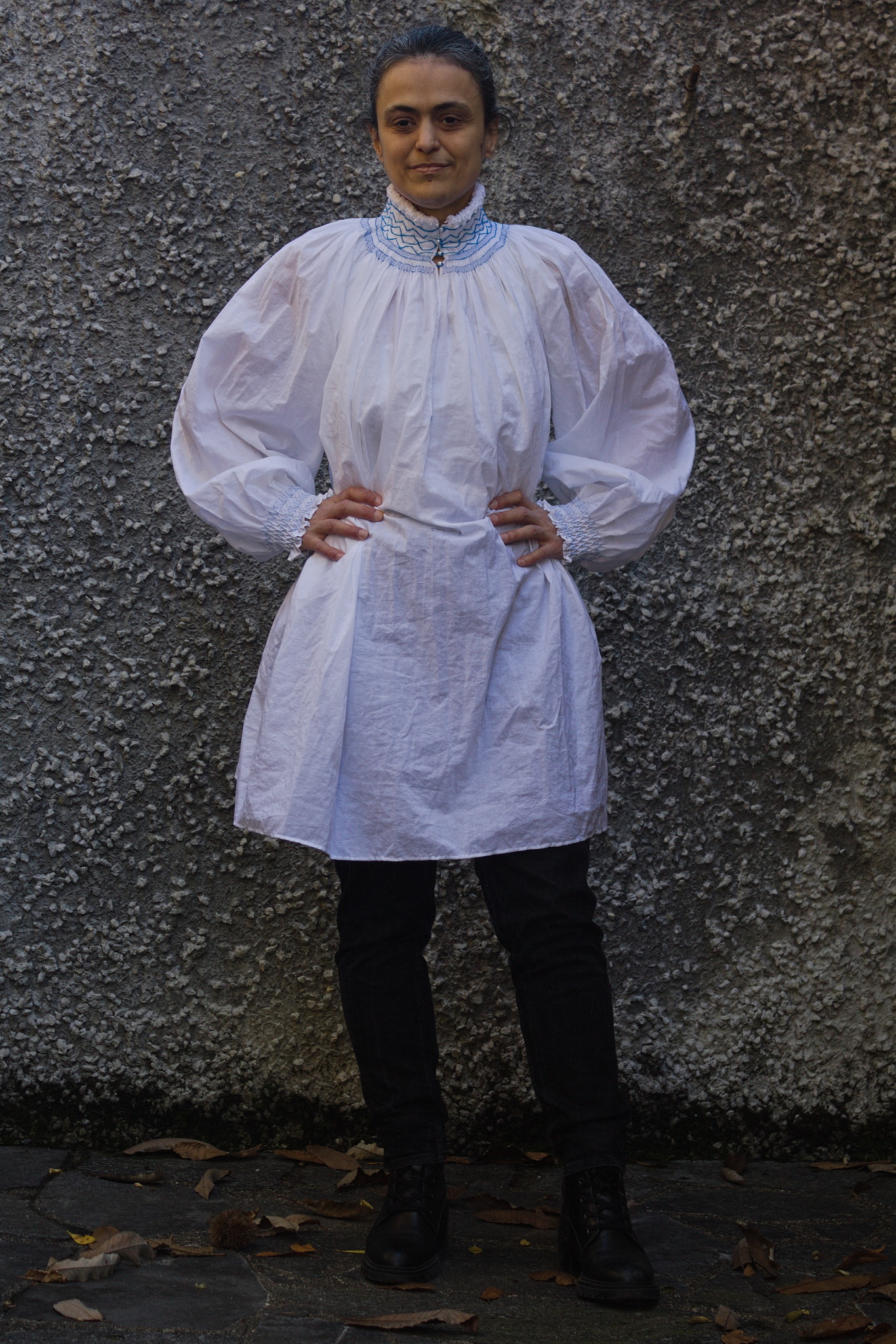
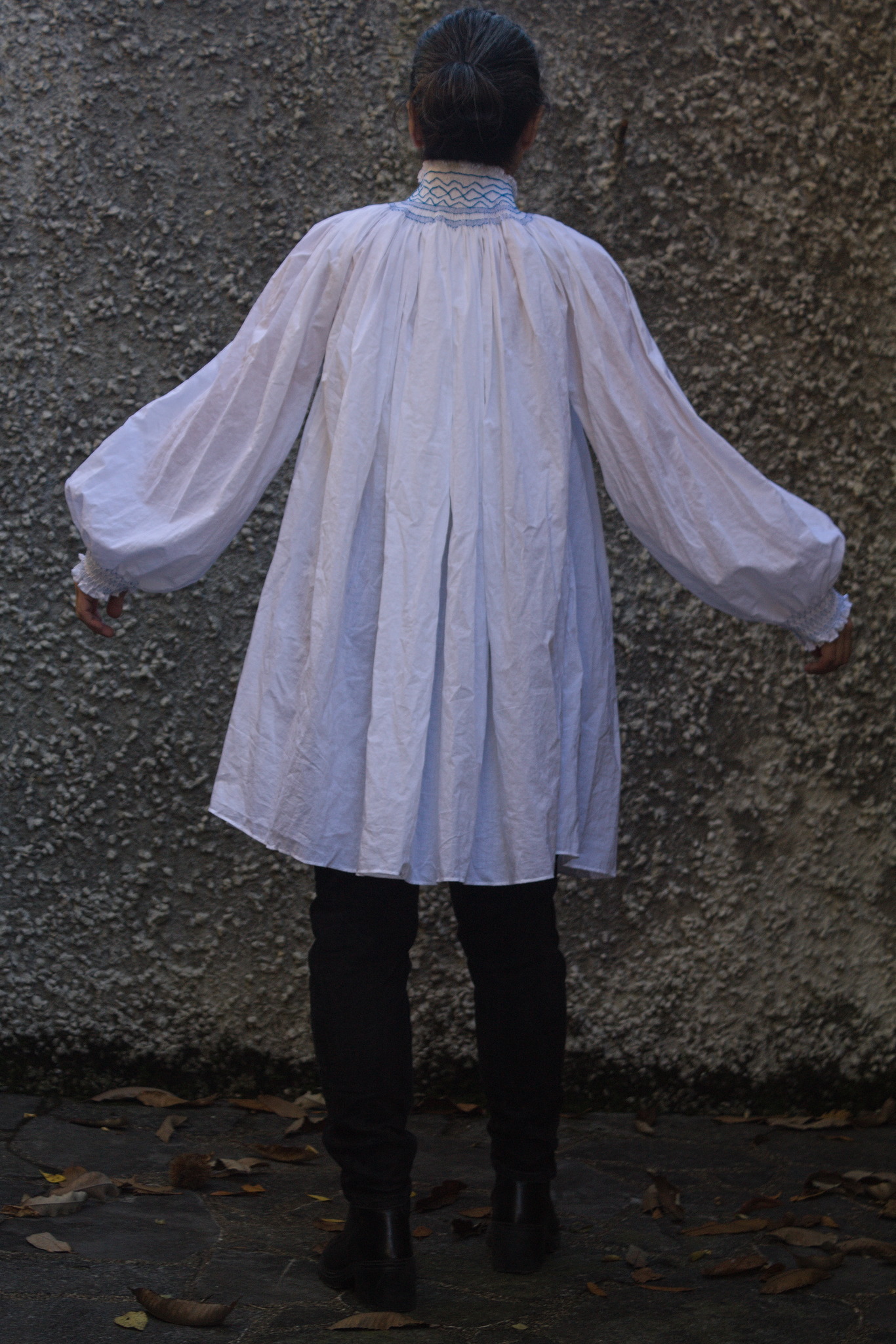
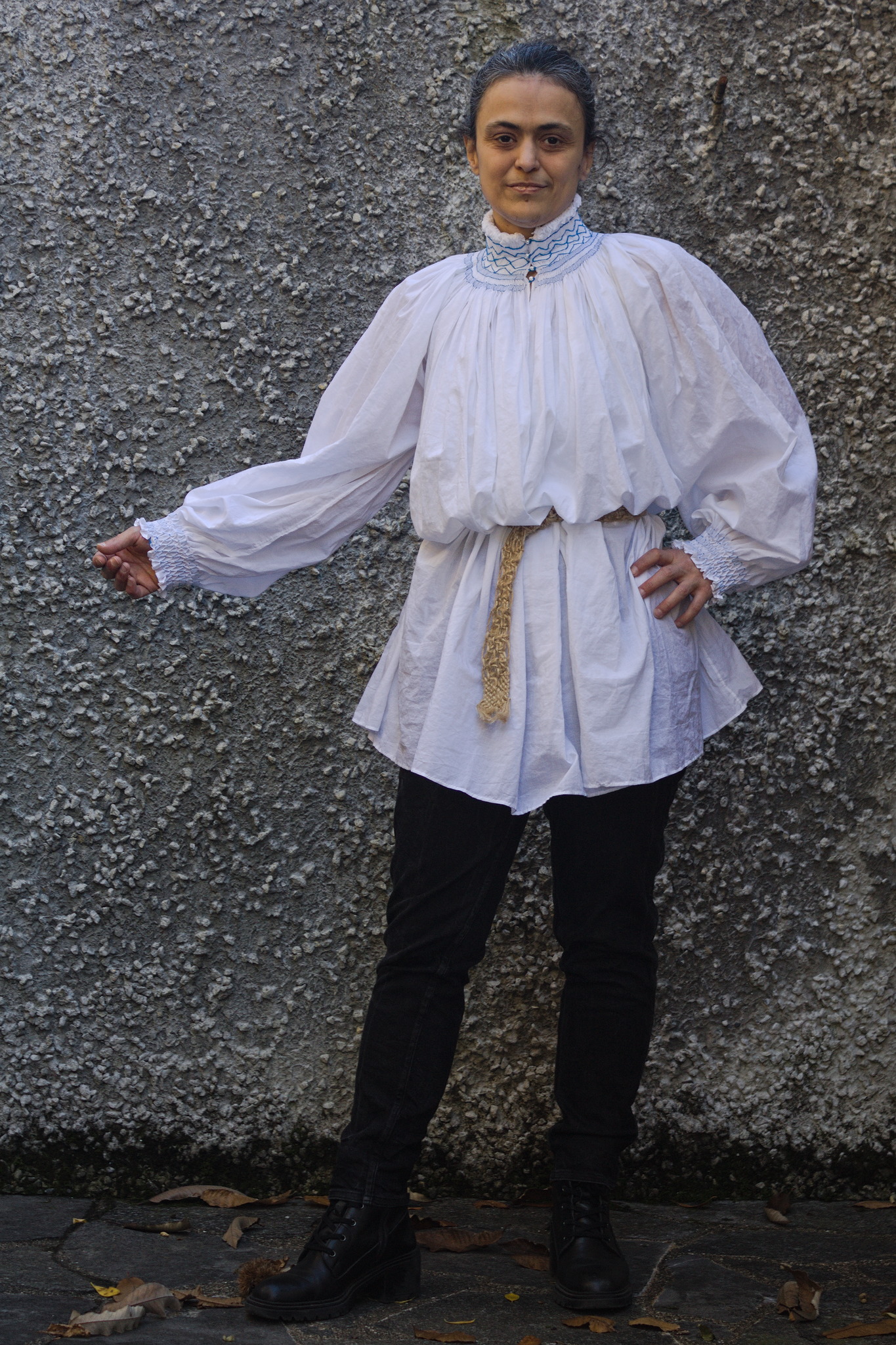
        <p><img src="https://blog.trueelena.org/blog/2025/11/17-historically_inaccurate_hemd/hemd_front.jpg" class="align-center" style="width:80.0%" alt="A woman wearing a white shirt with a tall, thick collar with
lines of blue embroidery, closed in the front with small buttons;
the sleeves are wide and billowing, gathered at the cuffs with
more blue embroidery. She's keeping her hands at the waist so that
the shirt, which reaches to mid thigh, doesn't look like a
shapeless tent from the neck down." /></p>
<p>After cartridge pleating and honeycombing, I was still somewhat in the
mood for that kind of fabric manipulation, and directing my internet
searches in that vague direction, and I stumbled on this:
<a href="https://katafalk.wordpress.com/2012/06/26/patternmaking-for-the-kampfrau-hemd-chemise/">https://katafalk.wordpress.com/2012/06/26/patternmaking-for-the-kampfrau-hemd-chemise/</a></p>
<p>Now, do I want to ever make myself a 16th century German costume,
especially a kampfrau one? No! I’m from lake Como! Those are the
enemies who come down the Alps pillaging and bringing the Black Death
with them!</p>
<p>Although I have to admit that at times during my day job I have found the
idea of leaving everything to go march with the <a href="https://girlgenius.fandom.com/wiki/J%C3%A4germonster">Jägermonsters</a>
attractive. You know, the exciting prospective of long days of march
spent knitting sturdy socks, punctuated by the excitement of settling
down in camp and having a chance of doing lots of laundry. Or something.
Sometimes being a programmer will make you think odd things.</p>
<p>Anyway, going back to the topic, no, I didn’t need an historically
accurate hemd. But I did need a couple more shirts for daily wear, I did
want to try my hand at smocking, and this looked nice, and I was
intrigued by the way the shaping of the neck and shoulder worked, and
wondered how comfortable it would be.</p>
<p>And so, it had to be done.</p>
<p>I didn’t have any suitable linen, but I did have quite a bit of cotton
voile, and since I wasn’t aiming at historical accuracy it looked like a
good option for something where <em>a lot</em> of fabric had to go in a small
space.</p>
<p>At first I considered making it with a bit less fabric than the one in
the blog, but then the voile was quite thin, so I kept the original
measurement as is, only adapting the sleeve / sides seams to my size.</p>
<p><img src="https://blog.trueelena.org/blog/2025/11/17-historically_inaccurate_hemd/hemd_back.jpg" class="align-center" style="width:80.0%" alt="The same woman, from the back. This time the arms are out, so
that the big sleeves show better, but the body does look like a
tent." /></p>
<p>With the pieces being rectangles the width of the fabric, I was able to
have at least one side of selvedge on all seams, and took advantage of it
by finishing the seams by simply folding the allowances to one sides so
that the selvedge was on top, and hemstitching them down as I would have
done with a folded edge when felling.</p>
<p>Also, at first I wanted to make the smocking in white on white, but then
I thought about a few hanks of electric blue floss I had in my stash,
and decided to just go with it.</p>
<p>The initial seams were quickly made, then I started the smocking at the
neck, and at that time the project went on hold while I got ready to go
to DebConf. Then I came back and took some time to get back into a
sewing mood, but finally the smocking on the next was finished, and I
could go on with the main sewing, which, as I expected, went decently
fast for a handsewing project.</p>
<p><img src="https://blog.trueelena.org/blog/2025/11/17-historically_inaccurate_hemd/smocking_collar.jpg" class="align-center" style="width:80.0%" alt="detail of the smocking in progress on the collar, showing the
lines of basting thread I used as a reference, and the two in
progress zig-zag lines being worked from each side." /></p>
<p>While doing the diagonal smocking on the collar I counted the stitches
to make each side the same length, which didn’t completely work because
the gathers weren’t that regular to start with, and started each line
from the two front opening going towards the center back, leaving a
triangle with a different size right in the middle. I think overall it
worked well enough.</p>
<p>Then there were a few more interruptions, but at last it was ready! just
as the weather turned cold-ish and puffy shirts were no longer in
season, but it will be there for me next spring.</p>
<p>I did manage to wear it a few times and I have to say that the neck
shaping is quite comfortable indeed: it doesn’t pull in odd ways like
the classical historically accurate pirate shirt sometimes does, and the
heavy gathering at the neck makes it feel padded and soft.</p>
<p><img src="https://blog.trueelena.org/blog/2025/11/17-historically_inaccurate_hemd/hemd_belted.jpg" class="align-center" style="width:80.0%" alt="The same shirt belted (which looks nicer); one hand is held out
to show that the cuff is a bit too wide and falls down over the
hand." /></p>
<p>I’m not as happy with the cuffs: the way I did them with just
honeycombing means that they don’t need a closure, and after washing and
a bit of steaming they lie nicely, but then they tend to relax in a
wider shape. The next time I think I’ll leave a slit in the sleeves,
possibly make a different type of smocking (depending on whether I have
enough fabric) and then line them like the neck so that they are stable.</p>
<p>Because, yes, I think that there will be another time: I have a few more
project before that, and I want to spend maybe another year working from
my stash, but then I think I’ll buy some soft linen and make at least
another one, maybe with white-on-white smocking so that it will be
easier to match with different garments.</p>
    </section>
</article>
]]></summary>
</entry>
<entry>
    <title>English Paper Piecing, Done Wrong</title>
    <link href="https://blog.trueelena.org/blog/2025/09/03-english_paper_piecing_done_wrong/index.html" />
    <id>https://blog.trueelena.org/blog/2025/09/03-english_paper_piecing_done_wrong/index.html</id>
    <published>2025-09-03T00:00:00Z</published>
    <updated>2025-09-03T00:00:00Z</updated>
    <summary type="html"><![CDATA[<article>
    <section class="header">
        Posted on September  3, 2025
        <br />
        
        Tags: <a title="All pages tagged 'madeof:bits'." href="https://blog.trueelena.org/tags/madeof%3Abits.html">madeof:bits</a>
        
    </section>
    <section>
        <p><img src="https://blog.trueelena.org/blog/2025/09/03-english_paper_piecing_done_wrong/epp_mat_hexagons.jpg" class="align-center" style="width:80.0%" alt="A square mat made of orange, green and grey knit fabric
hexagons sewn together." /></p>
<p>For quite some time, I have been thinking about trying a bit of
patchwork, and English Paper Piecing looked like a technique suited to
my tastes, with the handsewing involved and the fact of having a paper
pattern of sort and everything.</p>
<p>The problem is, most of the scraps of fabric I get from my sewing aren’t
really suitable for quilting, with a lot of them being either too black
and too thick or too white and too thin.</p>
<p><img src="https://blog.trueelena.org/blog/2025/09/03-english_paper_piecing_done_wrong/epp_mat_squares.jpg" class="align-center" style="width:80.0%" alt="The other side of the same mat, made of orange and green
squares." /></p>
<p>On the other hand, my partner wears polo shirts at work, and while I
try to mend the holes that form, after a while the edges get worn, and
they just are no longer suitable for the office, even with some creative
mending, and they get downgraded to home wear. But then more office
shirts need to be bought, and the home ones accumulate, and there is
only so much room for polo shirts in the house, and the worst ones end
up in my creative reuse pile.</p>
<p>Some parts are worn out and they will end up as cabbage stuffing for
things, but some are still in decent enough conditions and could be used
as fabric.</p>
<p>But surely, for English Paper Piecing you’d need woven fabric, not knit,
even if it’s the dense piqué used in polo shirts, right? Especially if
it’s your first attempt at the technique, right?</p>
<p><img src="https://blog.trueelena.org/blog/2025/09/03-english_paper_piecing_done_wrong/epp_mat_hex_stickers.jpg" class="align-center" style="width:80.0%" alt="The hexagon side of the mat, with my hexagonal pattern weights
decorated with Standard Compliant stickers: they fit exactly on
the mat pattern." /></p>
<p>Well, probably it wouldn’t work with complex shapes, but what about some
5-ish cm tall Standard Compliant bestagon? So I printed out some
hexagons on thick paper, printed some bigger hexagons with sewing
allowance as a cutting aid, found two shirts in the least me colours I
could find (and one in grey because it was the best match for the other
two) and decided to sacrifice them for the experiment.</p>
<p>And as long as the paper was still in the pieces, the work went nicely,
so I persevered while trying to postpone the Moment of Truth.</p>
<p><img src="https://blog.trueelena.org/blog/2025/09/03-english_paper_piecing_done_wrong/epp_mat_piecepack.jpg" class="align-center" style="width:80.0%" alt="The squares side of the mat, with a few random Piecepack
pieces: the tiles take almost exactly 2 × 2 squares, and the coins
fit inside each square with room to pick them up." /></p>
<p>After a while I measured things out and saw that I could squeeze a 6.5 ×
7 hexagon pattern into something resembling a square that was a multiple
of the 2.5 cm square on the back of my Piecepack tiles, and decided to
go for another Standard for the back (because of course I wasn’t going
to buy new fabric for lining the work).</p>
<p>I kept the paper in the pieces until both sides were ready, and used it
to sew them right sides together, leaving the usual opening in the
middle of one side.</p>
<p>Then I pressed, removed the paper, turned everything inside out, pressed
again and. It worked!</p>
<p><img src="https://blog.trueelena.org/blog/2025/09/03-english_paper_piecing_done_wrong/epp_mat_dice.jpg" class="align-center" style="width:80.0%" alt="The hexagon side of the mat, with a set of polyhedral dice." /></p>
<p>The hexagons look like hexagons, the squares look like squares, the
whole thing feels soft and drapey, but structurally sound. And it’s a
bit lumpy, but not enough to cause issues when using it as a soft
surface to put over a noisy wooden table to throw dice on.</p>
<p>I considered adding some lightweight batting in the middle, but there
was really no need for it, and wondered about how to quilt the piece in
a way that worked with the patterns on the two sides, but for something
this small it wasn’t really required.</p>
<p>However, I decided to add a buttonhole stitch border on all edges, to
close the opening I had left and to reinforce especially the small
triangles on the hexagons side, as those had a smaller sewing allowance
and could use it.</p>
<p><img src="https://blog.trueelena.org/blog/2025/09/03-english_paper_piecing_done_wrong/epp_mat_hnefatafl.jpg" class="align-center" style="width:80.0%" alt="The squares sides of the mat, with some blue and purple stones 
in the starting position for a hnefatafl game." /></p>
<p>And of course, the 11 × 11 squares side wasn’t completely an accident,
but part of A Plan.</p>
<p>For this project there isn’t really a pattern, but I did publish <a href="https://sewing-patterns.trueelena.org/patterns/patchwork/basics/index.html">the
files I used to print the paper pieces</a>
even if they were pretty trivial.</p>
<p>And there are more polo shirts in that pile, and while they won’t be
suitable for anything complex, maybe I could try some rhombs, or even
kites and darts?</p>
    </section>
</article>
]]></summary>
</entry>
<entry>
    <title>1840s Underwear</title>
    <link href="https://blog.trueelena.org/blog/2025/08/28-1840s_underwear/index.html" />
    <id>https://blog.trueelena.org/blog/2025/08/28-1840s_underwear/index.html</id>
    <published>2025-08-28T00:00:00Z</published>
    <updated>2025-08-28T00:00:00Z</updated>
    <summary type="html"><![CDATA[<article>
    <section class="header">
        Posted on August 28, 2025
        <br />
        
        Tags: <a title="All pages tagged 'madeof:atoms'." href="https://blog.trueelena.org/tags/madeof%3Aatoms.html">madeof:atoms</a>, <a title="All pages tagged 'craft:sewing'." href="https://blog.trueelena.org/tags/craft%3Asewing.html">craft:sewing</a>, <a title="All pages tagged 'FreeSoftWear'." href="https://blog.trueelena.org/tags/FreeSoftWear.html">FreeSoftWear</a>
        
    </section>
    <section>
        <p><img src="https://blog.trueelena.org/blog/2025/08/28-1840s_underwear/shift_and_drawers.jpg" class="align-center" style="width:80.0%" alt="A woman wearing a knee-length shift with very short pleated
sleeves and drawers that are a bit longer than needed to be
ankle-length. The shift is too wide at the top, had to have a
pleat taken in the center front, but the sleeves are still falling
down.
She is also wearing a black long sleeved t-shirt and leggings
under said underwear, for decency." /></p>
<p>A bit more than a year ago, I had been thinking about making myself a
cartridge pleated skirt. For a number of reasons, one of which is the
historybounding potential, I’ve been thinking pre-crinoline, so
somewhere around the 1840s, and that’s a completely new era for me,
which means: new underwear.</p>
<p>Also, the 1840s are pre-sewing machine, and I was already in a position
where I had more chances to handsew than to machine sew, so I decided to
embrace the slowness and sew 100% by hand, not even using the machine
for straight seams.</p>
<p><img src="https://blog.trueelena.org/blog/2025/08/28-1840s_underwear/swish_test.jpg" class="align-center" style="width:80.0%" alt="A woman turning fast enough that her petticoat extends a
considerable distance from the body. The petticoat is white with a
pattern of cording from the hem to just below hip level, with a
decreasing number of rows of cording going up." /></p>
<p>If I remember correctly, I started with the corded petticoat, looking
around the internet for instructions, and then designing my own based on
the practicality of using modern wide fabric from my stash (and
specifically some DITTE from costumers’ favourite source of dirty cheap
cotton IKEA).</p>
<p>Around the same time I had also acquired a sashiko kit, and I used the
Japanese technique for sewing running stitches pushing the needle with a
thimble that covers the base of the middle finger, and I can confirm
that for this kind of things it’s great!</p>
<p>I’ve since worn the petticoat a few times for casual / historyBounding /
folkwearBounding reasons, during the summer, and I can confirm it’s
comfortable to use; I guess that during the winter it could be nice to
add a flannel layer below it.</p>
<p><img src="https://blog.trueelena.org/blog/2025/08/28-1840s_underwear/plate_7_fig_11_12.svg" class="align-center" style="width:80.0%" alt="The technical drawing and pattern for drawers from the book:
each leg is cut out of a rectangle of fabric folded along the
length, the leg is tapered equally, while the front is tapered
more than the back, and comes to a point below the top of the
original rectangle." /></p>
<p>Then I proceeded with the base layers: I had been browsing through
<a href="https://archive.org/details/workwomansguide00hale">The workwoman's guide</a> and that provided plenty of examples, and I
selected the basic ankle-length drawers from page 53 and the alternative
shift on page 47.</p>
<p>As for fabric, I had (and still have) a significant lack of underwear
linen in my stash, but I had plenty of cotton voile that I had not used
in a while: not very historically accurate for plain underwear, but
quite suitable for a wearable mockup.</p>
<p>Working with a 1830s source had an interesting aspect: other of the
usual, mildly annoying, imperial units, it also used a lot a few
obsolete units, especially nails, that my <a href="https://qalculate.github.io/">qalc</a>, my usual calculator and
converter, doesn’t support.
Not a big deal, because GNU <a href="https://www.gnu.org/software/units/">units</a> came to the rescue, and that one
knows a lot of obscure and niche units, and it’s quite easy to add those
that are missing<a href="https://blog.trueelena.org#fn1" class="footnote-ref" id="fnref1" role="doc-noteref"><sup>1</sup></a></p>
<p>Working on this project also made me freshly aware of something I had
already noticed: converting instructions for machine sewing garments
into instructions for hand sewing them is usually straightforward, but
the reverse is not always true.</p>
<p>Starting from machine stitching, you can usually convert straight
stitches into backstitches (or running backstitches), zigzag and
overlocking into overcasting and get good results. In some cases you may
want to use specialist hand stitches that don’t really have a machine
equivalent, such as buttonhole stitches instead of simply overcasting
the buttonhole, but that’s it.</p>
<p>Starting from hand stitching, instead, there are a number of techniques
that could be converted to machine stitching, but involve a lot of
visible topstitching that wasn’t there in the original instructions, or
at times are almost impossible to do by machine, if they involve
whipstitching together finished panels on seams that are subject to
strong tension.</p>
<p>Anyway, halfway through working with the petticoat I cut both the
petticoat and the drawers at the same time, for efficiency in fabric
use, and then started sewing the drawers.</p>
<p><img src="https://blog.trueelena.org/blog/2025/08/28-1840s_underwear/drawers_top.jpg" class="align-center" style="width:80.0%" alt="the top third or so of the drawers, showing a deep waistband
that is closed with just one button at the top, and the front
opening with finished edges that continue through the whole
crotch, with just the overlap of fabric to provide coverage." /></p>
<p>The book only provided measurements for one size (<em>moderate</em>), and my
fabric was a bit too narrow to make them that size (not that I have any
idea what hip circumference a person of <em>moderate size</em> was supposed to
have), so the result is just wide enough to be comfortably worn, but I
think that when I’ll make another pair I’ll try to make them a bit
wider. On the other hand they are a bit too long, but I think that I’ll
fix it by adding a tuck or two. Not a big deal, anyway.</p>
<p><img src="https://blog.trueelena.org/blog/2025/08/28-1840s_underwear/chemise_back.jpg" class="align-center" style="width:80.0%" alt="The same woman as in the opening image from the back, the shift
droops significantly in the center back, and the shoulder straps
have fallen down on the top of the arms." /></p>
<p>The shift gave me a bit more issues: I used the recommended gusset size,
and ended up with a shift that was way too wide at the top, so I had to
take a box pleat in the center front and back, which changed the look
and wear of the garment. I have adjusted the instructions to make
gussets wider, and in the future I’ll make another shift following
those.</p>
<p>Even with the pleat, the narrow shoulder straps are set quite far to the
sides, and they tend to droop, and I suspect that this is to be expected
from the way this garment is made. The fact that there are buttonholes
on the shoulder straps to attach to the corset straps and prevent the
issue is probably a hint that this behaviour was to be expected.</p>
<p><img src="https://blog.trueelena.org/blog/2025/08/28-1840s_underwear/plate_6_fig_6.svg" class="align-center" style="width:80.0%" alt="The technical drawing of the shift from the book, showing a
the top of the body, two trapezoidal shoulder straps, the pleated
sleeves and a ruffle on the front edge." /></p>
<p>I’ve also updated the instructions so that they shoulder straps are a
bit wider, to look more like the ones in the drawing from the book.</p>
<p>Making a corset suitable for the time period is something that I will
probably do, but not in the immediate future, but even just wearing the
shift under a later midbust corset with no shoulder strap helps.</p>
<p>I’m also not sure what the point of the bosom gores is, as they don’t
really give more room to the bust where it’s needed, but to the high
bust where it’s counterproductive. I also couldn’t find images of
original examples made from this pattern to see if they were actually
used, so in my next make I may just skip them.</p>
<p><img src="https://blog.trueelena.org/blog/2025/08/28-1840s_underwear/pleated_sleeve.jpg" class="align-center" style="width:80.0%" alt="Sleeve detail, showing box pleats that are about 2 cm wide and
a few mm distance from each other all along the circumference,
neatly sewn into the shoulder strap on one side and the band at
the other side." /></p>
<p>On the other hand, I’m <em>really</em> happy with how cute the short sleeves
look, and if<a href="https://blog.trueelena.org#fn2" class="footnote-ref" id="fnref2" role="doc-noteref"><sup>2</sup></a> I’ll ever make the other cut of shift from the same
book, with the front flaps, I’ll definitely use these pleated sleeves
rather than the straight ones that were also used at the time.</p>
<p>As usual, all of the patterns have been published on my website under a
Free license:</p>
<ul>
<li><a href="https://sewing-patterns.trueelena.org/historical_womenswear/underwear/early_victorian_corded_petticoat/index.html">pattern for the petticoat</a>;</li>
<li><a href="https://sewing-patterns.trueelena.org/historical_womenswear/underwear/1838_shift_with_shoulder_straps/index.html">pattern for the shift</a>;</li>
<li><a href="https://sewing-patterns.trueelena.org/historical_womenswear/underwear/1838_drawers/index.html">pattern for the drawers</a>.</li>
</ul>
<section class="footnotes footnotes-end-of-document" role="doc-endnotes">
<hr />
<ol>
<li id="fn1" role="doc-endnote"><p>My <code>~/.units</code> file currently contains definitions for
beardseconds, bananas and the more conventional Nm and NeL (linear
mass density of fibres).<a href="https://blog.trueelena.org#fnref1" class="footnote-back" role="doc-backlink">↩︎</a></p></li>
<li id="fn2" role="doc-endnote"><p>yeah, right. when.<a href="https://blog.trueelena.org#fnref2" class="footnote-back" role="doc-backlink">↩︎</a></p></li>
</ol>
</section>
    </section>
</article>
]]></summary>
</entry>
<entry>
    <title>rrdtool and Trixie</title>
    <link href="https://blog.trueelena.org/blog/2025/08/17-rrdtool_and_trixie/index.html" />
    <id>https://blog.trueelena.org/blog/2025/08/17-rrdtool_and_trixie/index.html</id>
    <published>2025-08-17T00:00:00Z</published>
    <updated>2025-08-17T00:00:00Z</updated>
    <summary type="html"><![CDATA[<article>
    <section class="header">
        Posted on August 17, 2025
        <br />
        
        Tags: <a title="All pages tagged 'madeof:bits'." href="https://blog.trueelena.org/tags/madeof%3Abits.html">madeof:bits</a>
        
    </section>
    <section>
        <p>TL;DL: if you’re using rrdtool on a 32 bit architecture like armhf make
an XML dump of your RRD files just <em>before</em> upgrading to Debian Trixie.</p>
<p>I am an old person at heart, so the sensor data from my home monitoring
system<a href="https://blog.trueelena.org#fn1" class="footnote-ref" id="fnref1" role="doc-noteref"><sup>1</sup></a> doesn’t go to one of those newfangled javascript-heavy
data visualization platforms, but into good old RRD files, using rrdtool
to generate various graphs.</p>
<p>This happens on the home server, which is an armhf single board
computer<a href="https://blog.trueelena.org#fn2" class="footnote-ref" id="fnref2" role="doc-noteref"><sup>2</sup></a>, hosting a few containers<a href="https://blog.trueelena.org#fn3" class="footnote-ref" id="fnref3" role="doc-noteref"><sup>3</sup></a>.</p>
<p>So, yesterday I started upgrading one of the containers to Trixie, and
luckily I started from the one with the RRD, because when I rebooted
into the fresh system and checked the relevant service I found it
stopped on <code>ERROR: '&lt;file&gt;' is too small (should be &lt;size&gt; bytes)</code>.</p>
<p>Some searxing later, I’ve<a href="https://blog.trueelena.org#fn4" class="footnote-ref" id="fnref4" role="doc-noteref"><sup>4</sup></a> found this was <a href="https://bugs.debian.org/cgi-bin/bugreport.cgi?bug=1104695">caused by the 64-bit time_t
transition</a>, which
changed the format of the files, <em>and</em> that (somewhat unexpectedly)
there was no way to fix it on the machine itself.</p>
<p>What <a href="https://stackoverflow.com/questions/79486445/convert-rrd-files-on-same-architecture-from-time-format-32-bit-to-time-format-64">needed to be done</a>
instead was to export the data on an XML dump <em>before</em> the upgrade, and
then import it back afterwards.</p>
<p>Easy enough, right? If you know about it, which is why I’m blogging
this, so that other people will know in advance :)</p>
<p>Anyway, luckily I still had the other containers on bookworm, so I
copied the files over there, did the upgrade, and my home monitoring
system is happily running as before.</p>
<section class="footnotes footnotes-end-of-document" role="doc-endnotes">
<hr />
<ol>
<li id="fn1" role="doc-endnote"><p><em>of course</em> one has a self-built home monitoring system, right?<a href="https://blog.trueelena.org#fnref1" class="footnote-back" role="doc-backlink">↩︎</a></p></li>
<li id="fn2" role="doc-endnote"><p>an <a href="https://www.olimex.com/Products/OLinuXino/A20/A20-OLinuXino-MICRO/open-source-hardware">A20-OLinuXino-MICRO</a>,
if anybody wants to know.<a href="https://blog.trueelena.org#fnref2" class="footnote-back" role="doc-backlink">↩︎</a></p></li>
<li id="fn3" role="doc-endnote"><p>mostly for ease of migrating things between different
hardware, rather than insulation, since everything comes from Debian
packages anyway.<a href="https://blog.trueelena.org#fnref3" class="footnote-back" role="doc-backlink">↩︎</a></p></li>
<li id="fn4" role="doc-endnote"><p>and by I I really mean Diego, as I was still into denial /
distractions mode.<a href="https://blog.trueelena.org#fnref4" class="footnote-back" role="doc-backlink">↩︎</a></p></li>
</ol>
</section>
    </section>
</article>
]]></summary>
</entry>

</feed>