IMDb RATING
6.6/10
3.1K
YOUR RATING

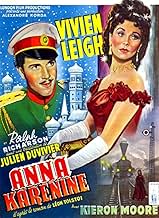
A married woman's affair with a dashing young officer has tragic results.A married woman's affair with a dashing young officer has tragic results.A married woman's affair with a dashing young officer has tragic results.





Niall MacGinnis
- Levin
- (as Niall Macginnis)


6.63.1K
1
2
3
4
5
6
7
8
9
10
Featured reviews
Captures the moods...
While certainly the vanities and indiscretions of upper crust Russia is examined by Tolstoy and it has been some time since I have read the lengthy novel, this version is certainly more memorable and effective than the Garbo version. I do agree with an earlier review in that Garbo herself, perhaps a bit too self-possessed and headstrong, could never represent the character of Anna, a woman carried away on passion, lust and impending tragedy.
Vivien Leigh is stunning in her facial expressions and vulnerable, almost exotic appearance, as we see her in a black gown, contrasted dramatically with other women who blend in the background to obscurity. The gowns and architecture of the era, the stark coldness and added texture of snowflakes, as a bas-relief to the portrait of Anna. Her close-ups particularly as she is in the train station in winter, foreshadowing her eventual fate.
Overall a beautiful film which is well worth viewing. Leigh is beautiful and tragic. 8/10.
Vivien Leigh is stunning in her facial expressions and vulnerable, almost exotic appearance, as we see her in a black gown, contrasted dramatically with other women who blend in the background to obscurity. The gowns and architecture of the era, the stark coldness and added texture of snowflakes, as a bas-relief to the portrait of Anna. Her close-ups particularly as she is in the train station in winter, foreshadowing her eventual fate.
Overall a beautiful film which is well worth viewing. Leigh is beautiful and tragic. 8/10.
A Lack of Discretion
When Vivien Leigh did her version of Anna Karenina for the British cinema she had the advantage of a less stringent censorship in the UK than Greta Garbo had working for MGM in the Thirties. Garbo was hemmed in by restrictions that she had to be a wronged woman, seduced and abandoned by her lover, and committing suicide to also atone for her sins.
Vivien plays a woman who knows precisely what she was doing and yet she chose to flout the male dominated society of 19th Century Russia. Like Garbo she is married to a pill of a husband and when a dashing young cavalry officer shows his attentions to her, she falls madly in love.
It's pointed out to her at least once in the film that her biggest sin is a lack of discretion. But Vivien and Kieron Moore want the whole world to know what's going on with them. Like William Randolph Hearst and Marion Davies.
MGM softened the portrait of Count Vronsky in the Garbo version by making it an eagerness to get back into the military during war that causes the breakup. Here Kieron Moore is far less noble. Not a bad person but a weak one. His mother wants him to make a more advantageous marriage and not to a woman with a bad reputation even though he's the one who gave her the bad reputation.
There's also a cop out scene filmed by MGM where Vronsky played by Fredric March expresses remorse over Anna in the end. No such scene exists in this more realistic version.
Of course Ralph Richardson as the husband Karenin is just as big a pill as Basil Rathbone was back in 1935. A man quite full of himself in his high level job in the Czar's government, he only sees how Anna's betrayal is affecting him. Richardson is almost doing a dress rehearsal for his portrayal of Dr. Sloper in next year's The Heiress.
Vivien Leigh was unfairly compared to Greta Garbo back when this came out, unfairly I think because there's only one Garbo. Vivien was a frail creature in life and that helped in a lot of her work. Anna was a frail creature herself unable to stand up to the hypocrisy and the pressure of the society around her.
In fact Anna Karenina is a story of failure. Two people fall in love, one of them trapped in a loveless marriage, and attempt to flout society and they lose. Tolstoy sees all that and records it well, but offers no solution.
Women's liberation was off the radar in old mother Russia.
Vivien plays a woman who knows precisely what she was doing and yet she chose to flout the male dominated society of 19th Century Russia. Like Garbo she is married to a pill of a husband and when a dashing young cavalry officer shows his attentions to her, she falls madly in love.
It's pointed out to her at least once in the film that her biggest sin is a lack of discretion. But Vivien and Kieron Moore want the whole world to know what's going on with them. Like William Randolph Hearst and Marion Davies.
MGM softened the portrait of Count Vronsky in the Garbo version by making it an eagerness to get back into the military during war that causes the breakup. Here Kieron Moore is far less noble. Not a bad person but a weak one. His mother wants him to make a more advantageous marriage and not to a woman with a bad reputation even though he's the one who gave her the bad reputation.
There's also a cop out scene filmed by MGM where Vronsky played by Fredric March expresses remorse over Anna in the end. No such scene exists in this more realistic version.
Of course Ralph Richardson as the husband Karenin is just as big a pill as Basil Rathbone was back in 1935. A man quite full of himself in his high level job in the Czar's government, he only sees how Anna's betrayal is affecting him. Richardson is almost doing a dress rehearsal for his portrayal of Dr. Sloper in next year's The Heiress.
Vivien Leigh was unfairly compared to Greta Garbo back when this came out, unfairly I think because there's only one Garbo. Vivien was a frail creature in life and that helped in a lot of her work. Anna was a frail creature herself unable to stand up to the hypocrisy and the pressure of the society around her.
In fact Anna Karenina is a story of failure. Two people fall in love, one of them trapped in a loveless marriage, and attempt to flout society and they lose. Tolstoy sees all that and records it well, but offers no solution.
Women's liberation was off the radar in old mother Russia.
Vivien Leigh is a charming Anna- if only Keiron Moore was charming.
I've now watched 6 Anna Kareninas (1935, 1947, 1961, 1985, 1997 and 2012) and this is up there as one of the top ones. Vivien Leigh is perfectly cast as Anna Karenina. There's just something about Leigh that suggests strength but also fragility, primness but also sensuality. She is totally believable as a sensible woman who would go silly over an affair, and believable as a fertile motherly type, frequently surrounded by children.
The object of the affair is the film's weak link- and it's a big one. Keiron Moore as the dashing Count Vronsky seems about as worldly as Anna's little son Sergei. You can sense Vivien Leigh trying to coax him into displaying some sort of dominant passion but Moore is hopelessly lost. His natural accent is Irish I think; his English accent sounds hopelessly strangled.
Ralph Richardson as Anna's bureaucratic husband Karenin is a bit too strong. He has the dominance that Vronsky should have and he displays his love for Anna too clearly. Anna is partly driven to her affair by Karenin's coldness so it makes the affair less credible. Their relationship is too loving- it often seems that there will be a reconciliation, as Leigh clearly has more chemistry with him than Moore.
Onto the supporting actors now. The Kitty/Levin story, although very pared down, is sweet and touching. Yes, they miss out all of Levin's philosophy and farming, but Sally Ann Howes is adorable as Princess Kitty, who gentleman farmer Levin hopelessly loves. It is also neatly tied together with the Anna story when Karenin goes along to their wedding- without Anna.
The film might seem a little dated but I enjoyed the focus on Karenin. There's a comic scene where Karenin goes along to a solicitors to ask about divorce and the solicitor seems a little voyeuristic. Where do I place it in the six AK films? I'm tempted to put it at number 2, just behind the Garbo one.
The object of the affair is the film's weak link- and it's a big one. Keiron Moore as the dashing Count Vronsky seems about as worldly as Anna's little son Sergei. You can sense Vivien Leigh trying to coax him into displaying some sort of dominant passion but Moore is hopelessly lost. His natural accent is Irish I think; his English accent sounds hopelessly strangled.
Ralph Richardson as Anna's bureaucratic husband Karenin is a bit too strong. He has the dominance that Vronsky should have and he displays his love for Anna too clearly. Anna is partly driven to her affair by Karenin's coldness so it makes the affair less credible. Their relationship is too loving- it often seems that there will be a reconciliation, as Leigh clearly has more chemistry with him than Moore.
Onto the supporting actors now. The Kitty/Levin story, although very pared down, is sweet and touching. Yes, they miss out all of Levin's philosophy and farming, but Sally Ann Howes is adorable as Princess Kitty, who gentleman farmer Levin hopelessly loves. It is also neatly tied together with the Anna story when Karenin goes along to their wedding- without Anna.
The film might seem a little dated but I enjoyed the focus on Karenin. There's a comic scene where Karenin goes along to a solicitors to ask about divorce and the solicitor seems a little voyeuristic. Where do I place it in the six AK films? I'm tempted to put it at number 2, just behind the Garbo one.
Best film version of Tolstoy's classic
There is very little to find fault with in this screen update of Tolstoy's classic story. Vivien Leigh is near perfection as the main character. What makes this film work is the way our tragic heroine is shown in relation to the elements that surround her: the scenes of train journeys in winter to and from Russia; and the warm weather and grandeur of a summer spent in Venice.
The supporting players are very effective and match Miss Leigh's talents in the most important scenes. The moment where Anna breaks in to see her son who has been told she died should not be missed. But the single greatest aspect of this film is the inner journey this character takes, as envisioned by Tolstoy. It is a harrowing confrontation of one's fate and delivered bravely as only this classic actress can.
The supporting players are very effective and match Miss Leigh's talents in the most important scenes. The moment where Anna breaks in to see her son who has been told she died should not be missed. But the single greatest aspect of this film is the inner journey this character takes, as envisioned by Tolstoy. It is a harrowing confrontation of one's fate and delivered bravely as only this classic actress can.
Viven Leigh shines
Rumor had it that Vivien Leigh was not anxious to take on the remake of "Anna Karenina" partly because she had just recovered from tuberculosis, and maybe also because the ghost of Greta Garbo was too real. But she had one film left to do for Alexander Korda, and this was it. "Anna Karenina" released in 1948, stars Leigh as the tragic Anna. The story is based on Tolstoy's novel. Anna meets a handsome colonel, Count Vronsky (Kieron Moore) and falls in love with him. The trouble is, she is married to a high-level Russian bureaucrat (Ralph Richardson) and has a son. Anna's husband is a self-absorbed politician type, somewhat cold and aloof, consumed with his image in Russian politics. He sees marriage as a "duty" something he says a few times. Anna runs away with Vronksy, a horrendous scandal at the time and probably still would be today. It all ends tragically. Comparisons between this film and the 1935 one are inevitable. While both films are respectable, I prefer Viven Leigh's performance of Anna. Perhaps it was because Leigh had her own personal demons that she made this part so amazingly real, as she would in "A Streetcar named Desire" three years later. While I admire Garbo, I did not think of her as a great actress. Too aloof in some ways to believe she would fall head over heels for Vronsky. Ralph Richardson plays his part with consummate discipline; he can only see Anna's betrayal in terms of how it effects him. Kieron Moore is harder to judge. In the first part of the movie, he isn't given much to do except show off his good looks. He does, however, get a few good scenes as the movie progresses, and plays Vronksy as a decent man but also a flawed one. If you only know the 1935 version of this film, at least be open-minded enough to give this remake a chance. For me, Viven Leigh was reason enough for me to see it.


Did you know
- TriviaVivien Leigh's costumes were made in Paris by Barbara Karinska to Cecil Beaton's designs. She was in such pain wearing them that she even went to her doctor fearing she had broken her ribs. It was subsequently discovered that the dresser had been putting the corsets on upside down.
- Quotes
Anna Karenina: My dear Korsunsky, you know very well I never dance unless I can help it.
- Crazy creditsClosing credits: "And the light by which she had been reading the book of life, blazed up suddenly, illuminating those pages that had been dark, then flickered, grew dim, and went out forever".
- Alternate versionsU.S. release version runs approximately 112 minutes. This is the version issued by Fox DVD in 2007.
- ConnectionsFeatured in Vivien Leigh: Scarlett and Beyond (1990)
Details
- Release date
- Country of origin
- Official site
- Languages
- Also known as
- Alexander Korda's Production of Tolstoy's Anna Karenina
- Filming locations
- Monterey, California, USA(racetrack and steeplechase scenes)
- Production company
- See more company credits at IMDbPro
Box office
- Budget
- $2,000,000 (estimated)
- Runtime
- 2h 19m(139 min)
- Color
- Aspect ratio
- 1.37 : 1
Contribute to this page
Suggest an edit or add missing content