IMDb RATING
6.3/10
2.5K
YOUR RATING

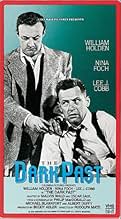
An escaped psychopathic killer who takes the family and neighbors of police psychologist hostage reveals a recurring nightmare to the doctor.An escaped psychopathic killer who takes the family and neighbors of police psychologist hostage reveals a recurring nightmare to the doctor.An escaped psychopathic killer who takes the family and neighbors of police psychologist hostage reveals a recurring nightmare to the doctor.
- Awards
- 2 wins total


Charles Cane
- Sheriff
- (uncredited)
Bill Cartledge
- Arrested Man Leaving Wagon
- (uncredited)
Tom Coleman
- Detective
- (uncredited)

G. Pat Collins
- Al's Father
- (uncredited)

Ellen Corby
- Agnes
- (uncredited)

Lester Dorr
- First Man in Police Line-Up
- (uncredited)

Edward Earle
- McCoy
- (uncredited)
6.32.4K
1
2
3
4
5
6
7
8
9
10
Featured reviews
Killer Personality
The Dark Past may very well have been a turning point in the career of William Holden. As you remember Holden had a dual contract with Columbia and Paramount and I'm sure Billy Wilder at Paramount must have seen The Dark Past before casting Holden in Sunset Boulevard. This B film for Columbia was unlike any of the 'smiling jim' roles that Holden had played up to now.
The Dark Past has only a 75 minute running time and was playing the bottom end of Columbia double bills when it first came out. It's a remake of another Columbia film Dark Past with Chester Morris in Holden's part as the escaped killer. The part of the psychiatrist played by Lee J. Cobb here was played by Ralph Bellamy in the previous production.
Cobb is now a police psychiatrist, but wasn't always; in fact as he relates in flashback he was a professor when he ran into Holden who was escaping from jail with his mob and his moll. They take refuge in Cobb's summer house where Cobb and family are entertaining guests.
Lee is as cool as he would be emerging from a refrigerator. He starts getting under Holden's skin with his training exposing the real cause of his killer personality. Most disarming in every sense of the word.
If it were only that easy. Still the film in its short run does keep one in suspense. A lot like the duel of minds between Humphrey Bogart and Fredric March in The Desperate Hours. Also look for a very good performance by Nina Foch as Holden's moll who unwittingly leads to her man's downfall when she asks Cobb to find out about a recurrent nightmare Holden has.
If a dose of Freud could only cure all bad behavior.
The Dark Past has only a 75 minute running time and was playing the bottom end of Columbia double bills when it first came out. It's a remake of another Columbia film Dark Past with Chester Morris in Holden's part as the escaped killer. The part of the psychiatrist played by Lee J. Cobb here was played by Ralph Bellamy in the previous production.
Cobb is now a police psychiatrist, but wasn't always; in fact as he relates in flashback he was a professor when he ran into Holden who was escaping from jail with his mob and his moll. They take refuge in Cobb's summer house where Cobb and family are entertaining guests.
Lee is as cool as he would be emerging from a refrigerator. He starts getting under Holden's skin with his training exposing the real cause of his killer personality. Most disarming in every sense of the word.
If it were only that easy. Still the film in its short run does keep one in suspense. A lot like the duel of minds between Humphrey Bogart and Fredric March in The Desperate Hours. Also look for a very good performance by Nina Foch as Holden's moll who unwittingly leads to her man's downfall when she asks Cobb to find out about a recurrent nightmare Holden has.
If a dose of Freud could only cure all bad behavior.
Talky hostage drama relies on Freud for Dummies
The return of variously shell-shocked, amnesiac or otherwise afflicted soldiers from the front precipitated a spate of postwar movies purporting to delve into the mysteries of the human psyche. In most cases, psychology was presented either as a sinister black art (to be viewed with the utmost suspicion) or in a laughingly simplistic way. The Dark Past, grindingly earnest, opts for the latter path. Wrong'un William Holden, visibly chafing under the constraints of the script, invades a home and holds its occupants -- family and guests -- hostage. He has the bad luck to find among them psychoanalyist Lee J. Cobb, puffing away at the inevitable pipe, who turns the ordeal into a teaching opportunity. Slowly he breaks down Holden's wall of defenses, until a childhood memory emerges....This Freudian breakthrough, of course, occurs in record time, though for viewers it may seem like a big chunk of eternity. Mercifully, Adele Jergens sashays in and out a few times to lower the picture's tone to tolerable. The Dark Past is a period-piece, of some interest to fans of the noir cycle, but its stagey insights and dated dramaturgy have not aged gracefully.
A very good remake...in fact, a bit better than the original.
"The Dark Past" is a remake of the 1939 picture "Blind Alley" which starred Chester Morris and Ralph Bellamy. In this newer version, William Holden and Lee J. Cobb play these roles.
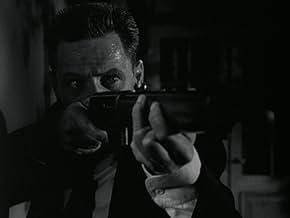
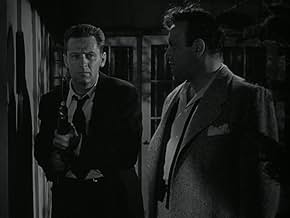
The film begins with a prison break. Al Walker (Holden) is the leader of the band of thugs and he murders the Warden (who they've taken hostage) just for kicks. He decides the gang will NOT hold up in one of the empty vacation homes nearby but one with people in it. This way, he figures, the cops won't suspect where they are hiding. The home happens to be filled with quite a few people, as Dr. Collins and his family are hosting a dinner party. Soon, all of them are prisoners and hoping that the gang doesn't kill them. As for Dr. Collins, he is a psychiatrist and plays a mental game of cat and mouse with Walker.
In many ways, this film is reminiscent of "Suddenly" and "The Desperate Hours"---both films about families being held hostage by killers. All of these are very good films and what sets this film apart is the psychiatrist angle. I enjoyed the film, though as a trained psychotherapist I should point out that Dr. Collins' approach is very Freudian...and rarely used today by therapists. Dream interpretation and mother blaming are rarely discussed in therapy today. And, folks like Walker are NOT cured so quickly and easily!! Ridiculous, sure...but still entertaining.
While I rarely say this, I think this film is actually a bit better than the original. Much of this is due to William Holden's more realistic and less sensationalistic performance.
The film begins with a prison break. Al Walker (Holden) is the leader of the band of thugs and he murders the Warden (who they've taken hostage) just for kicks. He decides the gang will NOT hold up in one of the empty vacation homes nearby but one with people in it. This way, he figures, the cops won't suspect where they are hiding. The home happens to be filled with quite a few people, as Dr. Collins and his family are hosting a dinner party. Soon, all of them are prisoners and hoping that the gang doesn't kill them. As for Dr. Collins, he is a psychiatrist and plays a mental game of cat and mouse with Walker.
In many ways, this film is reminiscent of "Suddenly" and "The Desperate Hours"---both films about families being held hostage by killers. All of these are very good films and what sets this film apart is the psychiatrist angle. I enjoyed the film, though as a trained psychotherapist I should point out that Dr. Collins' approach is very Freudian...and rarely used today by therapists. Dream interpretation and mother blaming are rarely discussed in therapy today. And, folks like Walker are NOT cured so quickly and easily!! Ridiculous, sure...but still entertaining.
While I rarely say this, I think this film is actually a bit better than the original. Much of this is due to William Holden's more realistic and less sensationalistic performance.
Introductory Psychology Gussied Up as a Crime Film
"The Dark Past" is a Psych 101 class disguised as a film noir.
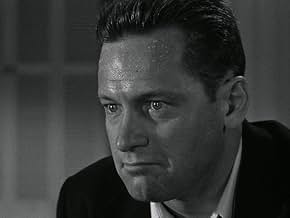
William Holden plays Al Walker, notorious criminal who has escaped from prison and, along with his girlfriend (Nina Foch) and assorted goons, takes a family hostage in their country home while waiting for his getaway. The family patriarch (Lee J. Cobb), however, happens to be a criminal psychologist, and he begins to deconstruct Holden's psyche, eventually rendering him helpless when the ultimate showdown with the police occurs.
This isn't a terribly interesting film, either in style or subject matter. A good portion of the film is spent in Cobb analyzing a recurring nightmare of Holden's, acknowledging it as the key to Holden's anti-social tendencies. But the dream itself is basic Freud, all about anger towards father figures and love for a lost mother. This all might have seemed cutting edge at the time, when psychology as an area of study had become trendy to address in film, but it has a been-there-done-that quality now.
Holden isn't very good in his role, overacting to the hilt, and he's not convincing as a bad guy. But it is nice to see both he and Cobb playing against type for a change. Cobb especially is refreshing, for once playing a character quietly and reservedly rather than as a bellowing lout.
Director Rudolph Mate and his screenwriter could have done all sorts of things to explore the group dynamics of a situation like this, but they don't. For a much better family-taken-hostage story, watch "Key Largo," released the same year as this film.
Grade: B-
William Holden plays Al Walker, notorious criminal who has escaped from prison and, along with his girlfriend (Nina Foch) and assorted goons, takes a family hostage in their country home while waiting for his getaway. The family patriarch (Lee J. Cobb), however, happens to be a criminal psychologist, and he begins to deconstruct Holden's psyche, eventually rendering him helpless when the ultimate showdown with the police occurs.
This isn't a terribly interesting film, either in style or subject matter. A good portion of the film is spent in Cobb analyzing a recurring nightmare of Holden's, acknowledging it as the key to Holden's anti-social tendencies. But the dream itself is basic Freud, all about anger towards father figures and love for a lost mother. This all might have seemed cutting edge at the time, when psychology as an area of study had become trendy to address in film, but it has a been-there-done-that quality now.
Holden isn't very good in his role, overacting to the hilt, and he's not convincing as a bad guy. But it is nice to see both he and Cobb playing against type for a change. Cobb especially is refreshing, for once playing a character quietly and reservedly rather than as a bellowing lout.
Director Rudolph Mate and his screenwriter could have done all sorts of things to explore the group dynamics of a situation like this, but they don't. For a much better family-taken-hostage story, watch "Key Largo," released the same year as this film.
Grade: B-
More post-war psychology...and an odd resemblance
Lee J. Cobb is a psychiatrist who works to discover "The Dark Past" of convict William Holden in this 1948 drama that also stars Nina Foch and Adele Jurgens. Two of Hollywood's favorite subject matters are part of the film plot: The post-war obsession with psychiatry and a hostage situation, of which there have been many in films over the years. Like Bogart in "The Desperate Hours," Holden's an escaped convict with a gang that holes up in someone's home while waiting for a ride that doesn't arrive when it's supposed to. And, like the later "Desperate Hours," the couple has a child that tries to escape. In "The Desperate Hours," you wanted to kill the kid; at least here, he doesn't cause as much trouble.
Psychiatry in America was really just being explored in film, and it was as a result of the trauma soldiers suffered in World War II and the problems they had when they came home. The script is simplistic and dated, but the performances are good. Holden is terrific as the on-the-edge convict tortured by partial hand paralysis and a recurring nightmare from an incident in his childhood; young, pretty Nina Foch is his girlfriend who loves him but is terribly hurt by his actions. When I was growing up, the striking Foch was in her forties and a constant presence in television, usually playing a neurotic mess. She still acts and is a very prominent drama teacher in Los Angeles. It was wonderful to see her in these early days - she made a fine ingénue. Cobb is convincing as a psychiatrist who keeps his cool as he tries to help the young man.
After William Holden's big splash at the age of 21 in "Golden Boy" in 1939, his career settled into a series of light leading man roles that took him nowhere. Superstardom didn't hit until 1950's Sunset Boulevard. One of the comments on IMDb remarked that in "Golden Boy," he looked like Tom Hanks, which stuck in my mind as I was watching "The Dark Past." Well, it's the strangest version of separated at birth that I've ever seen, but there is the oddest resemblance between these two stars. Here, with his hairline exposed, you can really see the similarity in the shape of Holden's face to Hanks', and there's even a similarity in profile and around the eyes. You'd never catch it unless someone mentioned it to you or you've seen "Golden Boy" where Holden is nearly unrecognizable - and then once you pick it up, it's totally distracting.
The other odd thing about this film which says something about our society today is that these people were getting together for a casual evening in a country home and they were all dressed to the nines - even the criminals were wearing suits and ties! Times sure have changed. Despite this and other dated elements of "The Dark Past," William Holden, a tremendous star, is always worth a look.
Psychiatry in America was really just being explored in film, and it was as a result of the trauma soldiers suffered in World War II and the problems they had when they came home. The script is simplistic and dated, but the performances are good. Holden is terrific as the on-the-edge convict tortured by partial hand paralysis and a recurring nightmare from an incident in his childhood; young, pretty Nina Foch is his girlfriend who loves him but is terribly hurt by his actions. When I was growing up, the striking Foch was in her forties and a constant presence in television, usually playing a neurotic mess. She still acts and is a very prominent drama teacher in Los Angeles. It was wonderful to see her in these early days - she made a fine ingénue. Cobb is convincing as a psychiatrist who keeps his cool as he tries to help the young man.
After William Holden's big splash at the age of 21 in "Golden Boy" in 1939, his career settled into a series of light leading man roles that took him nowhere. Superstardom didn't hit until 1950's Sunset Boulevard. One of the comments on IMDb remarked that in "Golden Boy," he looked like Tom Hanks, which stuck in my mind as I was watching "The Dark Past." Well, it's the strangest version of separated at birth that I've ever seen, but there is the oddest resemblance between these two stars. Here, with his hairline exposed, you can really see the similarity in the shape of Holden's face to Hanks', and there's even a similarity in profile and around the eyes. You'd never catch it unless someone mentioned it to you or you've seen "Golden Boy" where Holden is nearly unrecognizable - and then once you pick it up, it's totally distracting.
The other odd thing about this film which says something about our society today is that these people were getting together for a casual evening in a country home and they were all dressed to the nines - even the criminals were wearing suits and ties! Times sure have changed. Despite this and other dated elements of "The Dark Past," William Holden, a tremendous star, is always worth a look.


Did you know
- TriviaThe re-creation of Al's dream uses a few seconds of footage from Blind Alley (1939), the earlier film version of this story; specifically the shot approaching the saloon, panning to see the policemen following the narrator, and panning back to the saloon side entrance.
- GoofsAl takes a book off of Andrew's book shelf and opens it around page 50 or 60, but in the next closeup, the page Al is looking at the start of Chapter 22. It's highly unlikely that a scholarly book about psychology would average under three pages per chapter.
- ConnectionsReferenced in Discovering Film: William Holden (2015)
- How long is The Dark Past?Powered by Alexa
Details
- Runtime
- 1h 13m(73 min)
- Color
- Aspect ratio
- 1.37 : 1
Contribute to this page
Suggest an edit or add missing content